By Alexander Merz · Updated on · Details checked on 14 September 2026
The night sky has captivated humanity for thousands of years with its mysterious depths. For newcomers, stargazing for beginners can feel overwhelming at first, between finding your way around the stars and getting to grips with equipment. The good news: with a handful of simple pointers, anyone can look up and start exploring the heavens tonight.
This guide walks you through the essentials for a strong start: preparing for an observing night, choosing a good site, picking beginner-friendly gear, and learning how to orient yourself. The goal is to make your first steps into the fascinating world of astronomy as smooth as possible.
⚡ The quick answer: To start stargazing, pick a clear night away from light pollution, dress warmly in layers, and begin with the naked eye. A pair of 10×50 binoculars is enough to enjoy the Moon and Jupiter; a beginner telescope (70–100 mm aperture) then opens the door to planets and star clusters. A red flashlight and an astronomy app round out the perfect beginner’s kit.
Preparing for your observing night
Careful preparation makes all the difference to a successful first night under the stars. Because temperatures often drop far more than you’d expect after sunset, the golden rule is to dress in several layers.
Start with moisture-wicking base layers, add an insulating jacket and warm socks, then top it off with a hat and gloves to minimise heat loss. A portable heated blanket noticeably boosts comfort outdoors, while an insulated camping chair or a thermal mat shields you from the cold rising off the ground. The payoff is longer, far more relaxed sessions. It also pays to prepare your gear in advance and let your instruments cool to the outside temperature before you begin.
Finding the perfect observing site
To create the best possible conditions, choosing the right location is decisive. The number-one factor is light pollution: artificial light that brightens the night sky and washes out stars and other celestial objects. The darker the sky, the more you can see. Ideal spots lie far from cities and settlements — rural areas, plateaus or mountains, where the sky is often noticeably darker and clearer.
If you can’t travel far, look for the darkest place near you, such as a park or an open field on the edge of town. Keep an eye on the weather too, since a cloudless sky is essential. Finally, elevated ground like a hill widens your horizon and gives you a better overview of the starry sky. Over time you’ll discover your favourite spots: the darker and more undisturbed the location, the more breathtaking your view into the cosmos.
The right equipment for beginners
Beginners have several equipment options. A pair of binoculars already reveals far more detail and makes a budget-friendly alternative to a telescope: lightweight, easy to carry and simple to use, it’s the ideal companion for your first nights out.
To go further, a beginner telescope with 70–100 mm of aperture is recommended. Aperture directly governs light-gathering ability: the larger it is, the more faint objects become visible and the finer the detail. A stable mount matters just as much, since it reduces vibration and makes precise observation possible.
| Instrument | Best for | What you’ll see |
|---|---|---|
| 10×50 binoculars | First steps, tight budget | Moon, Jupiter’s moons, star clusters |
| 70 mm telescope | Keen beginners | Lunar craters, Saturn’s rings, phases of Venus |
| 100 mm telescope | Stepping up | Planetary detail, bright nebulae |
Ideal starter: Celestron Cometron 7x50 Binoculars
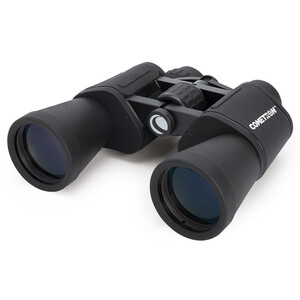
The astronomy classic among affordable binoculars: 7×50 with a large exit pupil for bright handheld views of the Moon and Milky Way – the ideal first step before a telescope.
Price: € 65
Beginner telescope: Omegon Telescope AC 70/700 AZ-2
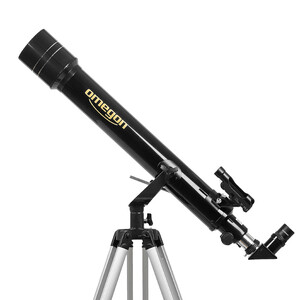
The no-pitfall starter refractor: Moon, Saturn's rings and Jupiter's moons from the very first night. No collimation.
Price: € 119
Best for advanced observers: Skywatcher Dobson Telescope N 200/1200 Skyliner Classic
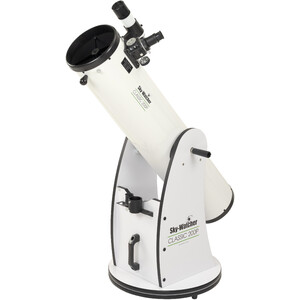
200 mm of aperture — the most sky for your money. Set it on the ground, point by hand: nebulae, clusters and galaxies for years to come.
Price: € 479
* Affiliate link: if you buy through this link we may earn a small commission from Astroshop or High Point Scientific, at no extra cost to you.
What to explore in the sky
The night sky is packed with fascinating targets that are well within reach for beginners. First and foremost is the Moon, whose craters and seas look impressive even through binoculars.
Next come the planets: Jupiter with its distinctive cloud bands, Saturn with its striking rings, and the phases of Venus. Constellations such as Orion, Cassiopeia and the Big Dipper serve as easy signposts for finding your way. Special events — meteor showers, eclipses and unusual planetary alignments — add even more to the experience. For more complex objects like nebulae or galaxies, however, you’ll need a genuinely dark sky and, ideally, a telescope.
Handy tools for finding your way
Several practical tools make orienting yourself under the stars much easier:
- A rotating planisphere (star wheel): especially effective for identifying constellations
- Astronomy apps: they show in real time which objects are visible overhead
- A red flashlight: the indispensable accessory for any night-time session
Unlike bright white light, which desensitises your eyes to faint stars, red lamps or filters preserve your dark adaptation. Thanks to this physiological quirk of the human eye, your night vision stays intact and observing becomes far more comfortable and effective.
Stargazing made easy — an exciting journey through the universe
The magic of astronomy lies in this promise: with simple equipment and focused preparation, you can discover impressive celestial objects from your very first outings. Over time, a deeper understanding of the cosmos takes shape, and every observation adds a little more to our collective knowledge of the universe. From the Moon to distant galaxies, astronomy offers an endless variety of discoveries that thrill beginners and seasoned stargazers alike.
Frequently asked questions
How do I start stargazing as a complete beginner?
Begin with the naked eye from a dark spot to learn the major constellations, then move up to a pair of 10×50 binoculars. It’s the simplest and most affordable way to get started.
Binoculars or a telescope for a beginner?
Binoculars are ideal for starting out: affordable, portable and easy to use. A beginner telescope with 70–100 mm aperture becomes worthwhile once you want to see planets and the Moon in detail.
When is the best time to go stargazing?
A clear, cloudless night without a bright Moon, well away from city lights. New Moon periods are the most favourable for spotting faint objects.
Why use a red flashlight in astronomy?
Red light preserves your night vision: it lets you read a star chart or adjust your gear without “dazzling” the eye, which stays adapted to the dark.
Can I stargaze from the city?
Yes, though light pollution limits what you’ll see. The Moon and bright planets remain perfectly observable; for nebulae and galaxies, it’s better to head out to a darker sky.