By Alexander Merz · Updated on · Details checked on 7 October 2026
On a truly dark night, far from city lights, a faint band of milky light arches across the sky from one horizon to the other. That glow is the Milky Way — our home galaxy, seen edge-on from the inside. It’s nothing less than the disk of the spiral galaxy that cradles our Solar System. Here’s where we sit within it, how big it really is, and which mysteries it still keeps.
⚡ The quick answer: The Milky Way is our home galaxy — a barred spiral roughly 100,000 light-years across that holds several hundred billion stars. Our Sun sits about 26,000 light-years from the center, out on the Orion Arm, and takes roughly 220 million years to orbit once. At the galaxy’s heart lies a supermassive black hole, Sagittarius A*, weighing about 4 million times the mass of the Sun.
Honest answer first: for the Milky Way itself a telescope is the wrong tool – a dark site and your own eyes do more, and 10×50 binoculars are the ideal next step. What to look for is in the astronomy binoculars guide; if it is the galaxies inside it you are after, the telescopes for galaxies guide covers that.


Key takeaways
- The Milky Way is our home galaxy and holds several hundred billion stars.
- It measures roughly 100,000 light-years across.
- A massive core at its center hosts a supermassive black hole.
- It’s estimated to contain at least 100 billion planets.
- The galaxy races through the universe at about 2.1 million km/h.
- Its stars orbit the galactic center once every 200 million years or so.
- It belongs to the Local Group, along with the Andromeda Galaxy.
- Its age is estimated at a minimum of 13 billion years.
- It’s wrapped in a vast dark-matter halo nearly ten times larger than the visible galaxy.
- Studying it helps astronomers understand how galaxies form and evolve.
What is the Milky Way?
The Milky Way, home to our Solar System, is a spiral galaxy with clearly defined arms. We ride along one of them — the “Orion Arm” — about 26,000 light-years from the galactic center. Our neighboring arms go by the names “Sagittarius” and “Perseus.”
Measured against its immediate galactic surroundings, our Solar System is moving at roughly 30 km/s toward the constellation Hercules. The Milky Way is anything but a fixed backdrop: it’s a colossal, slowly spinning disk in which every star takes part in a grand orbital dance.
Where is the Milky Way in the sky?
On a clear, moonless night you can pick out the Milky Way as a broad silvery band stretching across several constellations, including the Summer Triangle marked by Cygnus, Aquila, and Lyra. Sweep it with binoculars or a telescope and it resolves into thousands upon thousands of stars — because you’re looking straight through the disk of our own galaxy.
The center of our galaxy lies in the constellation Sagittarius, yet it stays hidden from us in visible light: clouds of gas and dust block the view. Radio telescopes, however, can pierce that veil and probe the galactic core directly.
When is the best time to see the Milky Way?
Summer, from June through September in the northern hemisphere, is prime time: that’s when the dense, luminous galactic center dominates the evening sky. Get well away from light pollution, let your eyes adapt to the dark for twenty to thirty minutes, and target the nights around the new Moon.
To take in the whole star-strewn band, nothing beats a good pair of binoculars: their wide field reveals clusters, nebulae, and star clouds that a telescope, with its narrow high-magnification view, only chops into pieces.
Best for Milky Way views: Omegon Brightsky 10x50 Binoculars

Bright, high-contrast binoculars: perfect for the Moon, star clusters and Milky Way fields, handheld.
Price: € 289
* Affiliate link: if you buy through this link we may earn a small commission from Astroshop or High Point Scientific, at no extra cost to you.
How big is the Milky Way?
The galaxy currently spans an estimated 100,000 light-years and holds several hundred billion stars. Earth spins once every 24 hours and completes its orbit around the Sun in a year. The Solar System, in turn, makes one full lap around the center of the Milky Way in about 220 million years — a single “galactic year.”
| Property | Estimated value |
|---|---|
| Disk diameter | ≈ 100,000 light-years |
| Number of stars | several hundred billion |
| Sun-to-center distance | ≈ 26,000 light-years |
| Galactic year | ≈ 220 million years |
| Central black hole | Sagittarius A*, ≈ 4 million solar masses |
| Estimated age | ≥ 13 billion years |
The Milky Way seen from above
The Milky Way is built from several spiral arms spread across a disk about 100,000 light-years wide. Because no spacecraft can travel far enough to look back at it, we can’t view it “from above” — we have to infer its shape by studying other galaxies. Those comparisons tell us we live in a spiral galaxy, seated on one of its outer arms.
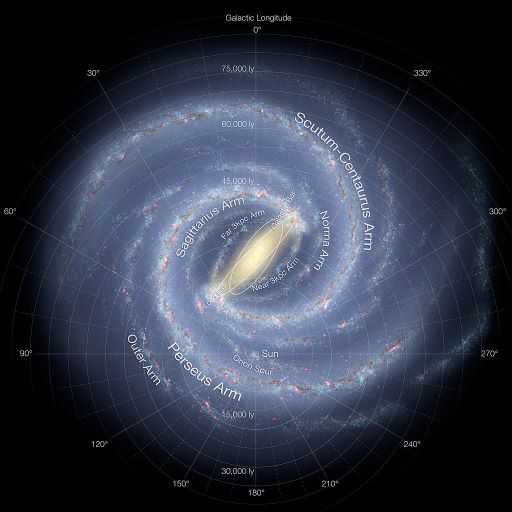
We sit far enough from the center — about 26,000 light-years — to keep a safe distance from the central black hole, which swallows anything that strays too close. The galaxy holds not only stars and planets, but also clouds of gas and dust: stellar nurseries where new stars are born, some of them glowing brightly.
The Milky Way’s neighborhood
Our galaxy is part of a cluster called the Local Group, which brings together roughly 50 galaxies, including the Large and Small Magellanic Clouds.
The Large Magellanic Cloud
The Large Magellanic Cloud lies about 160,000 light-years away and weighs in at roughly 10 billion solar masses. It’s one of the most striking satellite galaxies of the southern sky.
The Small Magellanic Cloud
The Small Magellanic Cloud sits about 200,000 light-years away and totals around 7 billion solar masses. Another notable neighbor, the Triangulum Galaxy, some 2.7 million light-years off, is still faintly visible to the naked eye — but only under very dark skies.
The Andromeda Galaxy
The Andromeda Galaxy is a spiral much like the Milky Way, with a mass of about one trillion suns. It’s the most distant object visible to the unaided eye. In roughly 3 to 4 billion years it will merge with our own galaxy: because stars are so widely spaced, direct collisions will be rare, but the two galaxies’ gravity will reshape both and trigger fresh bursts of star formation.
“Where from” and “where to”? The story of our galaxy
According to the Big Bang theory, every known celestial body traces back to a single founding event. The oldest stars in the Milky Way are estimated at 13 billion years or more. Star formation is an ongoing process: about 4.5 billion years ago, a cluster took shape on the galactic disk, and one of its stars was our Sun.
Yet the Solar System is far from the youngest. The Pleiades cluster formed only about 50 million years ago, and some stars are no more than a million years old. Our galaxy itself evolves under the gravitational influence of the Local Group, which includes the famous Andromeda Galaxy.
An “infinity symbol” at the heart of our galaxy
While studying the galactic center, astronomers uncovered a ring of gas some 300 light-years across, made of dense, cold material. Its shape recalls a sideways figure eight — the mathematical symbol for infinity — and it’s tilted about 40 degrees from the main plane of the Milky Way. Observed with the ESA’s Herschel space telescope, the ring moves as a single unit, at a constant speed at every point.
Rings of similar composition turn up in other galaxies, but never with such a twisted form. Computer models are trying to explain how these central bars and rings arise: gravitational interactions between galaxies — with Andromeda, for instance — may be the cause. Another surprise: the exact center of the structure may not line up perfectly with the constellation Sagittarius, but sits slightly offset.
Is there a black hole at the center of the Milky Way?
Yes. A supermassive black hole named Sagittarius A* occupies the center of our galaxy, with a mass of about 4 million suns. Its existence was confirmed by the unexplained motion of stars and gas near the center, as if tugged by an invisible massive object. X-ray and radio emissions from the region gave it away as well.
The Milky Way itself is best with the naked eye – its star clusters and nebulae are where a telescope comes in.
Six short questions, an honest answer by email – even when binoculars are the better choice.
Frequently asked questions
Can you see the Milky Way with the naked eye?
Yes — under a truly dark, moonless sky it appears as a milky band. From a city, light pollution washes it out entirely, so you need to travel to a dark-sky site.
What is the best time to see the Milky Way?
From June through September in the northern hemisphere, around the new Moon, when the galactic center climbs high in the evening sky.
How wide is the Milky Way’s disk in light-years?
Its disk is about 100,000 light-years across and contains several hundred billion stars.
Where is Earth located in the Milky Way?
On the Orion Arm, about 26,000 light-years from the galactic center — roughly halfway out to the edge of the disk.
What binoculars are best for viewing the Milky Way?
A 10×50 model strikes an ideal balance of magnification, field of view, and light-gathering — perfect for sweeping the Milky Way’s star fields and clusters.
📚 Read next:
This article is also available in German (original), French, and Italian.