By Alexander Merz · Updated on · Details checked on 6 October 2026
The Sun does not just shine — it blows. Out of its million-degree corona streams a never-ending flow of particles that fills the entire solar system: the solar wind. It is so thin that any vacuum laboratory on Earth looks like a fog bank beside it — and yet it is strong enough to align comet tails, ignite auroras, disturb power grids and, over billions of years, strip Mars of its atmosphere.
This guide explains calmly what the solar wind actually is in physical terms, how fast it really travels, where the difference to a solar storm lies, what it does here on Earth — and how you can read its current measurements yourself.
⚡ The quick answer: The solar wind is a constant stream of electrically charged particles — mostly protons and electrons — that the Sun releases into space from its corona. At Earth’s distance it averages around 400 km/s (slow solar wind) and reaches up to 750 km/s (fast solar wind from coronal holes), carries about 5 particles per cubic centimeter and needs 2 to 5 days to travel from the Sun to us. On the ground it is not dangerous: Earth’s magnetic field and the atmosphere keep it away. It does, however, create auroras and can disrupt satellites, radio traffic and power grids.
Through it the Sun loses roughly one million tons of mass per second — over five billion years that still adds up to only about 0.01 % of its total mass.
What is the solar wind? Definition and key facts
The solar wind is a plasma — a gas whose atoms have been broken up into nuclei and electrons, which is why it conducts electricity. The Sun cannot hold on to this plasma: in the corona, the outermost layer of its atmosphere, temperatures run between one and three million kelvin. At those temperatures the particles move so fast that beyond a certain height the Sun’s gravity can no longer bind them. The result is not an explosion but a steady outflow that never stops — day and night, for billions of years.
One point matters for understanding it: the solar wind is not a “wind” in the earthly sense. There is no air, no pressure you could feel on your skin. At Earth’s distance the solar wind plasma is roughly 1014 times thinner than the air you are breathing right now. Its effect comes not from mass but from the fact that it drags a magnetic field along with it and interacts with Earth’s own magnetic field.
What the solar wind is made of
| Component | Share | Significance |
|---|---|---|
| Protons (hydrogen nuclei) | about 95 % of the ions | carry most of the mass |
| Electrons | as many as there are positive charges | keep the plasma electrically neutral |
| Helium nuclei (α particles) | about 4 % of the ions, ~8 % of the mass | share varies with solar activity |
| Heavy ions | traces: C, N, O, Ne, Mg, Si, S, Fe | reveal the temperature of the source region |
| Magnetic field | 5–10 nT on average at Earth | decides whether there are auroras |
The solar wind in numbers (at Earth’s distance)
| Quantity | Typical value | Context |
|---|---|---|
| Speed | 300–800 km/s (average ~400 km/s) | 1.1–2.9 million km/h |
| Particle density | ~5 particles/cm³ (1–100) | equals 5 million particles per m³ |
| Temperature (protons) | ~100,000 to 1.6 million K | fast wind is cooler than slow wind |
| Magnetic field strength | ~5 nT (Bt), extremes above 50 nT | Earth’s field at ground level: ~50,000 nT |
| Travel time Sun → Earth | 2–5 days | light needs 8 minutes 20 seconds |
| Mass loss of the Sun | ~1 million tons per second | ~32 trillion tons per year |
| Reach | to ~120 AU (heliopause) | 18 billion kilometers |
Central star? The term turns up constantly in older texts about the solar wind and simply means the star a planetary system orbits — for us, then, the Sun. “Earth’s central star” is therefore just another way of saying the Sun. For other stars one speaks in the same way of their stellar wind.
How does the solar wind form?
The solar wind is born in a chain of four steps: energy is generated in the core, works its way outward, heats the corona in some still-puzzling way to far above the temperature of the Sun’s surface — and this overheated plasma finally escapes gravity.
Step 1: Energy transport inside the Sun
In the Sun’s core, hydrogen fuses into helium at around 15 million kelvin. The energy released there, however, is in no hurry. First it has to cross the radiative zone, where photons are absorbed again and again and re-emitted in random directions. Depending on the model, this random walk takes between tens of thousands and several hundred thousand years. Only in the outer 30 % or so of the solar radius does the convection zone take over: there hot gas rises in enormous cells, cools at the surface and sinks back down — visible as the granulation of the photosphere.
Only after this long journey does the energy leave the Sun as light. From there it needs just 8 minutes and 20 seconds to reach Earth. The solar wind, by contrast, is a thousand times slower — it is matter, not radiation.
Step 2: The overheated corona — the coronal heating problem
This is where it gets strange. The photosphere, the visible “surface” of the Sun, is about 5,500 °C hot. Further out the temperature first drops in the chromosphere to roughly 4,000 °C — and then shoots up in the corona to one to three million kelvin. So it does not get colder outward, it gets dramatically hotter. That contradicts everyday experience at any campfire, and it has kept solar physicists busy since the 1940s.
Two processes are considered the main heating mechanisms today, and they probably work together: nanoflares — countless tiny reconnection events in twisted magnetic loops — and Alfvén waves, magnetic oscillations that carry energy up from the convection zone and deposit it higher up. In 2021 the Parker Solar Probe showed that the magnetic structures needed for this really do originate in so-called magnetic funnels between the supergranulation cells.
Step 3: The escape from gravity
Because the corona is so hot, its outward gas pressure is greater than the Sun’s gravity can compensate for. That is exactly what Eugene Parker calculated in 1958: a static, resting corona is physically impossible — it has to flow outward and even accelerate to supersonic speed. His paper was rejected by the referees at the time and was published only because the editor, Subrahmanyan Chandrasekhar, stepped in. Four years later the space probe Mariner 2 confirmed the effect.
Step 4: The Alfvén surface — where the Sun’s atmosphere ends
There is a sharp physical boundary between “solar atmosphere” and “solar wind”: the Alfvén surface. Below it the magnetic field is strong enough to steer the plasma; disturbances can still travel back to the Sun. Above it the plasma flows faster than magnetic waves can run back — the connection is severed. On 28 April 2021 the Parker Solar Probe crossed this boundary for the first time, at 18.8 solar radii (about 13 million kilometers from the center of the Sun). Since then it can be said that humankind has “touched” the Sun.
How fast is the solar wind? Slow and fast streams compared
The solar wind comes in two clearly distinguishable varieties, and they originate in different regions of the Sun. That is more than a technicality: only once you know both do you understand why aurora forecasts sometimes work to the day and sometimes not at all.
| Feature | Slow solar wind | Fast solar wind |
|---|---|---|
| Speed at Earth | 300–500 km/s | 600–800 km/s |
| Source region | streamer belt, edges of active regions | coronal holes (open field lines) |
| Temperature | 1.4–1.6 million K | about 800,000 K |
| Density | higher (~5–10 /cm³) | lower (~2–4 /cm³) |
| Composition | variable, more heavy ions | stable, “fresh” coronal mix |
| Behavior | irregular, gusty | steady streams, often recurring every 27 days |
| Travel time to Earth | 3.5–5.8 days | 2.2–2.9 days |
Coronal holes: the nozzles of the fast solar wind
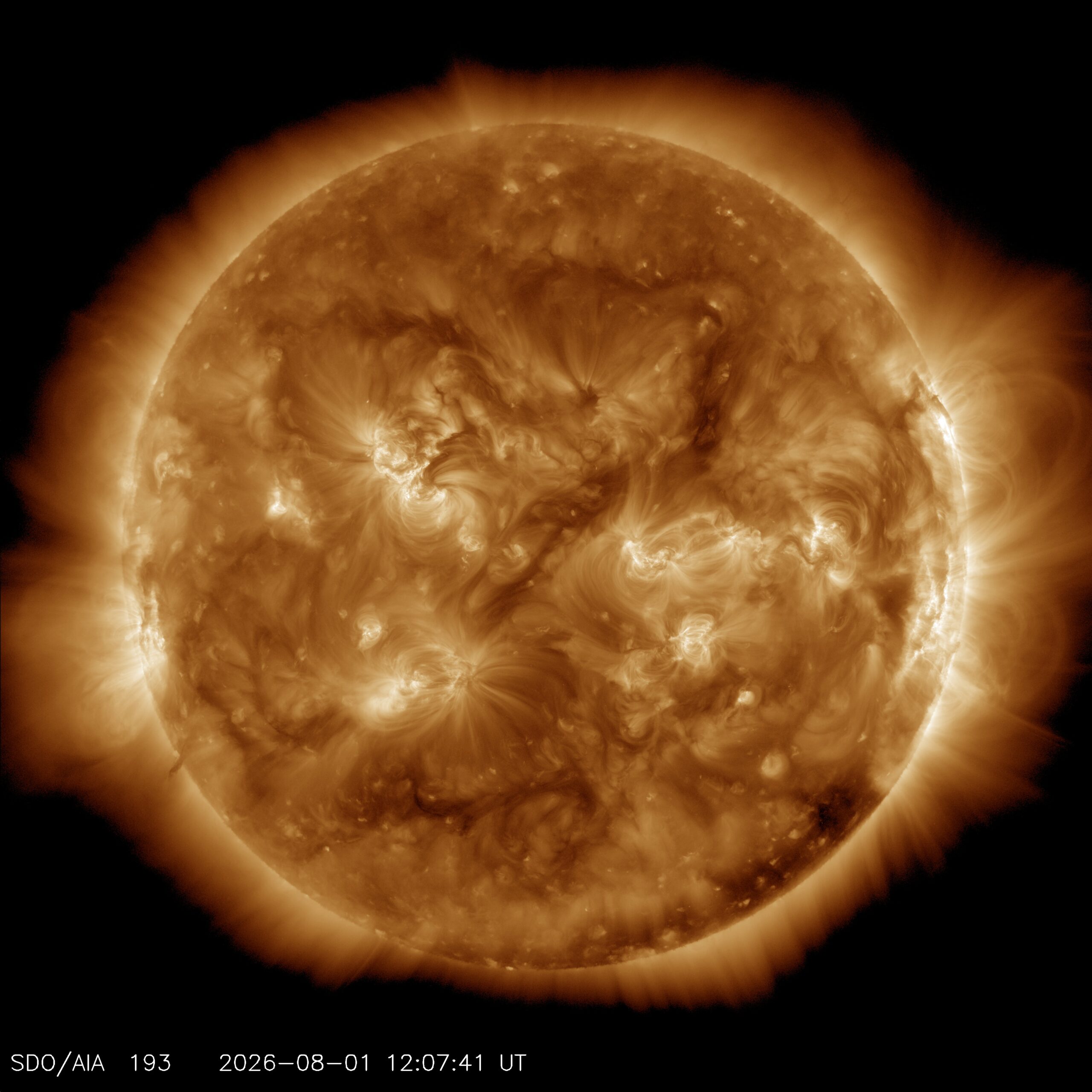
A coronal hole is not a real opening but a region in which the Sun’s magnetic field lines do not return to the surface but reach out openly into space. Plasma can stream outward there unhindered. In ultraviolet light these regions appear dark because less hot material is trapped in them — exactly the black zones in the picture above.
Because the Sun turns once in about 27 days (as seen from Earth), the beam from a long-lived coronal hole sweeps across Earth’s orbit like the finger of a lighthouse. Such recurrent high-speed streams are therefore unusually easy to forecast: whatever triggered an aurora 27 days ago may well do so again. When fast wind runs into slower wind still ahead of it, a compression zone builds up — a corotating interaction region — which can set off geomagnetic storms entirely without a solar eruption.
How long does the solar wind take to reach Earth?
The arithmetic is simple: 149.6 million kilometers divided by the speed. For typical values that gives:
| Speed | Type | Travel time Sun → Earth |
|---|---|---|
| 300 km/s | very slow wind | 5 days 18 hours |
| 400 km/s | average value | 4 days 8 hours |
| 500 km/s | faster stream | 3 days 11 hours |
| 700 km/s | coronal hole | 2 days 11 hours |
| 1,000 km/s | strong CME | 1 day 18 hours |
| 2,000 km/s | very strong CME | 20.8 hours |
| 3,000 km/s | extreme event | 13.9 hours |
| 299,792 km/s | light (for comparison) | 8 minutes 20 seconds |
In practice the advance warning comes even later: the solar wind is only measured at the Lagrange point L1, some 1.5 million kilometers ahead of Earth. Between the measurement there and its arrival here lie — depending on the speed — no more than 30 to 60 minutes. For the severe cases there is no more warning time than that.
Solar wind, solar storm, flare, CME — what is the difference?
These four terms get cheerfully mixed up in news reports. Yet they describe completely different things that differ markedly in speed, warning time and effect.
| Phenomenon | What it is | Speed | Time to Earth | Effect |
|---|---|---|---|---|
| Solar wind | permanent state: constant particle stream from the corona | 300–800 km/s | 2–5 days | background hum, shapes the heliosphere |
| Flare (solar eruption) | burst of radiation above an active region | speed of light | 8 minutes | shortwave radio blackout on the day side |
| CME (coronal mass ejection) | ejected plasma cloud with its own magnetic field | 300–3,000 km/s | 14 hours – 4 days | geomagnetic storm, auroras, grid disturbances |
| Solar storm | everyday term for the terrestrial effect of a CME or high-speed stream | — | — | collective label, not a physical term in its own right |
In short: the solar wind is always there. A flare is a flash, a CME is a projectile. And solar storm is what journalists write when a CME or a fast stream catches Earth’s magnetic field. Flares and CMEs almost always originate above large sunspots, where magnetic energy builds up and discharges all at once.
The Parker spiral explained: why the solar wind coils up
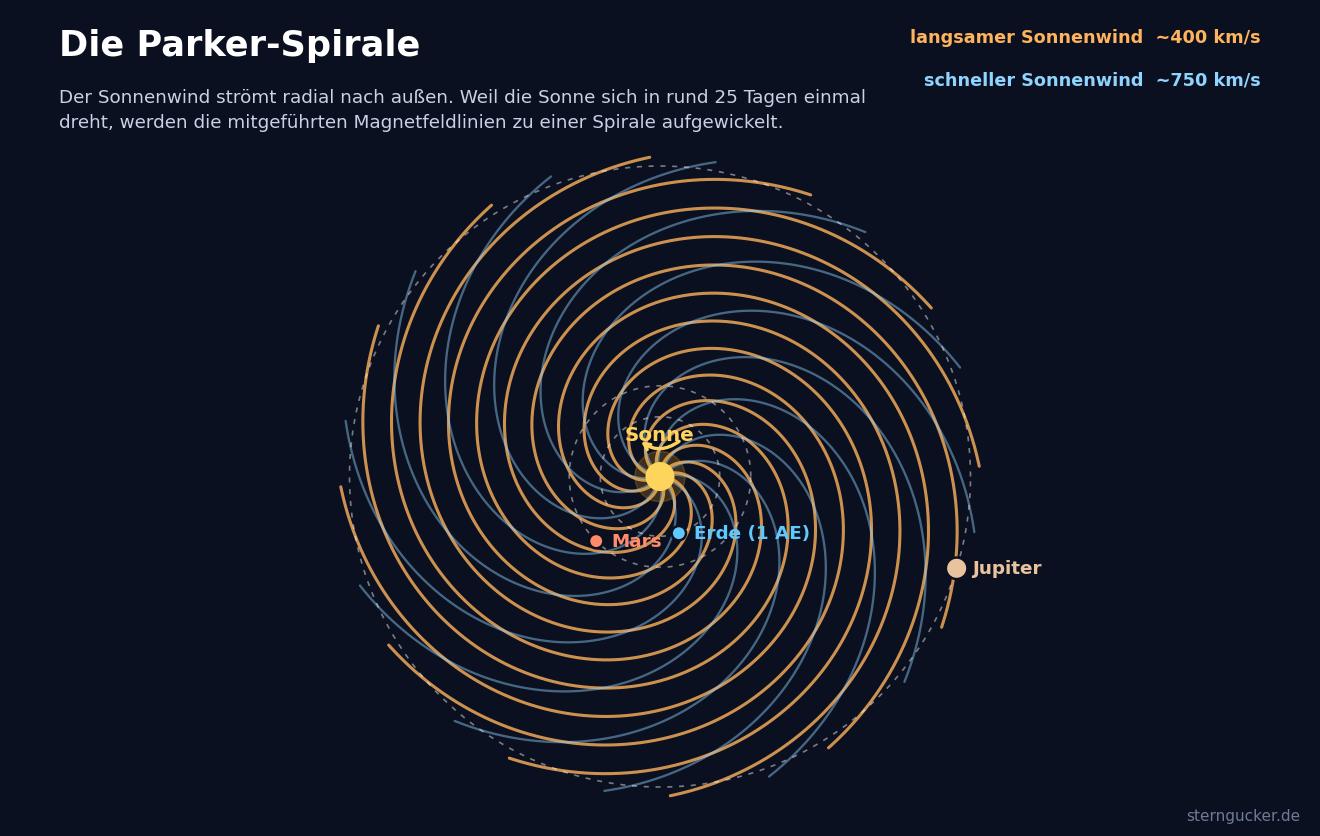
The solar wind streams radially outward — straight ahead, away from the Sun. The magnetic field it carries along, however, stays anchored with its footpoint on the Sun. And the Sun rotates: once in about 25 days at the equator. The result is the same as with a rotating lawn sprinkler — every drop of water flies straight ahead, and yet the visible jet forms a spiral.
This Parker spiral is the reason why the interplanetary magnetic field at Earth does not point away from the Sun but sits at an angle of roughly 45 degrees to the Sun–Earth line. At Jupiter the spiral is already wound up almost perpendicular to it. The practical consequence: charged particles travel along the field lines. An eruption connects magnetically to Earth particularly well when it happens in the western part of the solar disk — that is where the spiral begins that reaches us.
The solar wind hits Earth: magnetosphere, bow shock, magnetotail
When the solar wind reaches Earth, it does not run into the atmosphere but into Earth’s magnetic field. Because the plasma conducts electricity, it cannot penetrate the field lines — it piles up in front of them and is deflected around the planet. That is how a protective bubble arises: the magnetosphere.
| Structure | Typical position | Function |
|---|---|---|
| Bow shock | ~90,000 km sunward | Here the solar wind is abruptly slowed down and heated |
| Magnetopause | ~65,000 km sunward (10 Earth radii) | Outer boundary of Earth’s magnetic field; pushed in to under 6 Earth radii during storms |
| Magnetotail | over 6 million km nightward | Drawn out by the solar wind like a flag |
| Van Allen belts | 1,000–60,000 km | Trapped charged particles — a radiation risk for satellites |
| Auroral oval | ~100–400 km altitude | Here particles enter the atmosphere along the field lines |
The magnetosphere is therefore anything but spherical: on the day side it is squashed flat, on the night side it draws out into a tail that reaches further than the Moon’s orbit. Whether a solar wind event really has an effect depends less on its speed than on the direction of its magnetic field: if the north–south component Bz points south — that is, opposite to Earth’s field — the fields couple together and energy pours into the magnetosphere. A fast wind with a positive Bz, by contrast, can sweep past almost without effect.
Auroras: solar wind you can actually see
The particles that plunge along the field lines into the polar regions strike oxygen and nitrogen atoms at altitudes of 100 to 400 kilometers and excite them into glowing. Green comes from atomic oxygen at roughly 100–200 km, the rare deep red from oxygen above 200 km, violet and blue from nitrogen.
How far south the auroral oval migrates is described by the Kp index, running from 0 to 9. In Germany things start to get interesting from about Kp 6 to 7. Everything practical about it — forecast apps, the best times, choosing a site — is covered in detail in the guide Northern lights in Germany; if you want to photograph them, Photographing auroras: settings for phone & camera will help.
What the solar wind does to our technology
At ground level the solar wind is harmless to people — the atmosphere alone weighs ten tons per square meter above us. For technology the balance sheet looks different:
- Power grids: Rapid changes in Earth’s magnetic field induce geomagnetically induced currents (GIC) in long lines. These saturate transformer cores, which then overheat.
- Satellites: The heated upper atmosphere expands, so drag increases in low orbits. Starlink satellites are affected too, as is the ISS space station, whose orbit then has to be raised more often.
- Navigation: A disturbed ionosphere delays GPS signals irregularly — positioning errors of several meters are possible, a problem for precision agriculture and surveying.
- Radio: Shortwave on the day side can fail completely for minutes or hours (a radio blackout), which particularly affects polar flight routes.
- Pipelines: Induced currents flow in long pipelines as well and accelerate corrosion.
How serious this can get is clear from a look at the historical record:
| Date | Event | What happened |
|---|---|---|
| 1–2 September 1859 | Carrington event | Strongest storm on record; CME at Earth in ~17.6 hours; telegraph lines threw sparks, auroras as far south as the Caribbean |
| 13 March 1989 | Québec blackout | The Hydro-Québec grid collapsed in 90 seconds, leaving 6 million people without power for 9 hours |
| 29 October 2003 | Halloween storms | Power cut in Malmö, satellite failures, polar flights rerouted, auroras as far south as central Italy |
| 3 February 2022 | Starlink loss | 38 of 49 newly launched satellites burned up because a storm had made the atmosphere expand |
| 10–11 May 2024 | Gannon storm | Strongest storm since 2003 (G5); auroras all across Germany, GPS outages on farm machinery in the USA |
The solar wind without a shield: what it does to Mars and comets
What happens when a planet has no global magnetic field is shown by Mars. Its dynamo died out some four billion years ago. Since then the solar wind has struck the upper atmosphere directly and torn it away particle by particle. NASA’s MAVEN probe has been measuring this loss since 2014: to this day Mars loses on the order of 100 grams of atmosphere per second, and many times that during solar storms. Summed over billions of years, that accounts for what was once a dense envelope of air with liquid water — today the air pressure is below one percent of Earth’s.
Comets make the solar wind visible too. An active comet shows two tails: the yellowish-white dust tail follows the orbit in a curve, because the radiation pressure of light only nudges it gently. The bluish ion or plasma tail, on the other hand, points always exactly away from the Sun, because the solar wind drags the ionized gases along directly. It was precisely this observation that put Ludwig Biermann on the trail in 1951: the radiation pressure of light alone could not explain the acceleration observed — there had to be a stream of particles. Seven years before Parker’s theory and eleven years before the first measurement.
Solar wind right now: readings from 1 August 2026
Current solar wind data are public and updated by the minute — measured by the DSCOVR and ACE probes at Lagrange point L1. One snapshot as an example:
| Measurement | As of 1 August 2026, 12:09 UTC | Context |
|---|---|---|
| Speed | 277 km/s | quiet (average ~400 km/s) |
| Total magnetic field (Bt) | 4 nT | low |
| Bz component | −2 nT | slightly southward — still harmless |
| Kp index | 0 | no geomagnetic activity |
| Solar radio flux F10.7 | 147 sfu | solar activity still elevated |
To put that in context: Solar Cycle 25 passed its maximum in October 2024 but remains clearly more active than the weak cycle before it. An F10.7 value of 147 sfu means plenty of active regions on the Sun — a quiet solar wind on a single day says little about that. The coming years, out to about 2030, are heading toward the next minimum.
How to read the live data yourself
Three numbers are enough to judge the chance of an aurora:
1. Speed: below 400 km/s is quiet, 400–600 km/s is elevated, above 600 km/s is exciting.
2. Bz: the most important number. Only a clearly negative Bz (−10 nT and below) opens up the magnetosphere. A positive Bz means little will happen, no matter how fast the wind is.
3. Density: above 10–20 particles/cm³ the effect is amplified. The official data come from NOAA’s Space Weather Prediction Center; the common aurora apps display exactly these three values.
The heliosphere: where the solar wind ends
The solar wind does not stop beyond Earth. It blows a gigantic bubble into the interstellar medium — the heliosphere. Its boundary lies where the pressure of the solar wind and the pressure of the gas between the stars balance each other. Inside this bubble the solar wind has pushed the interstellar gas aside. Outside it, the Milky Way in the narrower sense begins.
| Location | Distance | In kilometers | State of the solar wind |
|---|---|---|---|
| Earth’s orbit | 1 AU | 150 million km | solar wind ~400 km/s |
| Neptune’s orbit | 30 AU | 4.5 billion km | wind still clearly detectable |
| Termination shock | 84–94 AU | 12.6–14 billion km | wind brakes abruptly from ~350 to ~130 km/s |
| Heliopause | ~119–122 AU | ~18 billion km | end of the solar wind’s influence |
| Oort cloud | 2,000–100,000 AU | up to 1.5 light-years | far outside the heliosphere |
This boundary has been surveyed by exactly two objects. Voyager 1 passed through the termination shock in December 2004 at 94 AU and crossed the heliopause on 25 August 2012 at 121.6 AU. Voyager 2 followed on 5 November 2018 at about 119 AU — on a completely different trajectory and in a different phase of the solar cycle, and yet at almost the same distance. Why the bubble is so symmetrical has still not been conclusively explained.
To get a sense of the scales: even 122 AU is nothing in cosmic terms. The Oort cloud — the home of the long-period comets — only begins about twenty times further out. The solar wind therefore ends long before the actual edge of the solar system.
Exploring the solar wind: from comet tails to touching the Sun
| Year | Who / what | Contribution |
|---|---|---|
| 1859 | Richard Carrington | Observes a flare and the storm 17 hours later — the first hint of a connection |
| 1951 | Ludwig Biermann | Infers a constant particle stream from the ion tails of comets |
| 1958 | Eugene Parker | Theory of the supersonic outflow; coins the term “solar wind” |
| 1959 | Luna 1 / Luna 2 | First direct measurements of the particle stream in interplanetary space |
| 1962 | Mariner 2 | Confirms the solar wind beyond doubt on its way to Venus |
| 1990–2009 | Ulysses | The only probe to fly over the Sun’s poles, mapping fast and slow wind |
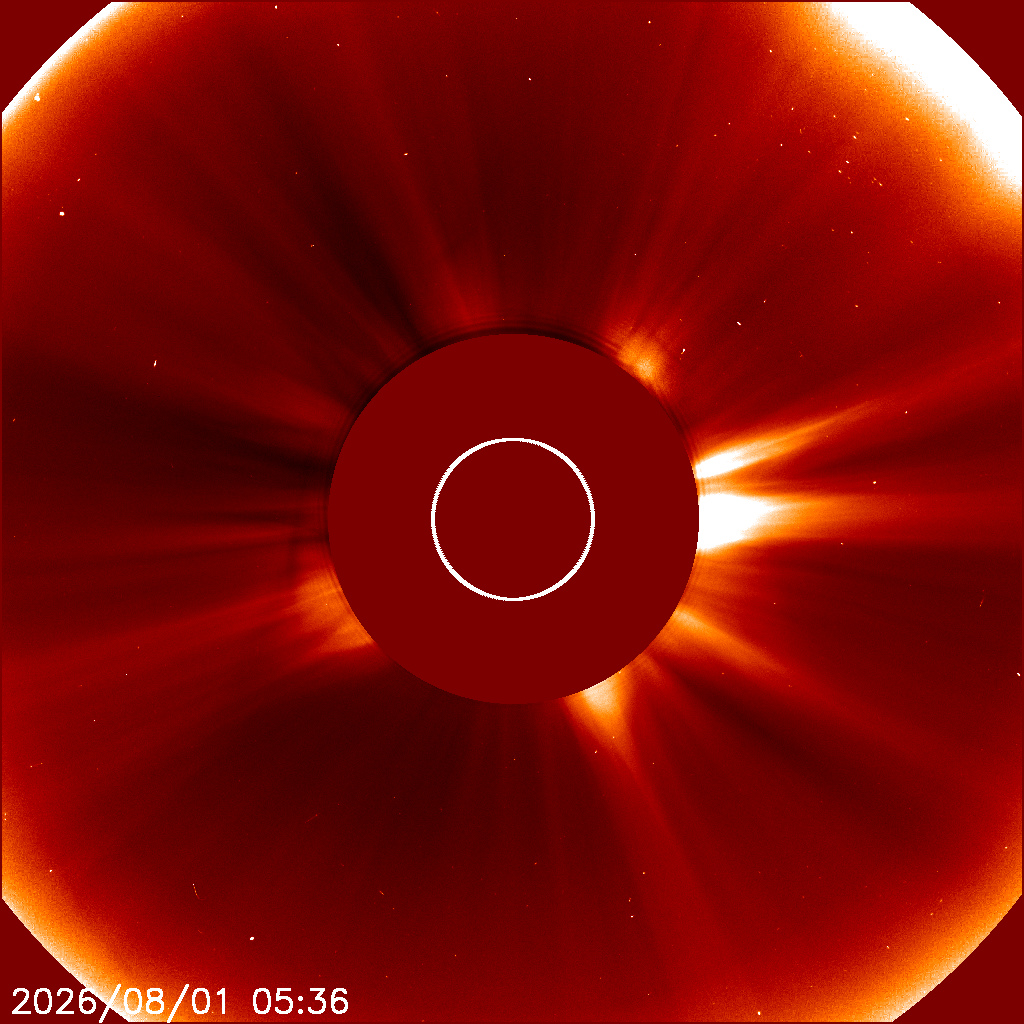
| since 1995 | SOHO | The LASCO coronagraph still delivers the images of coronal mass ejections today |
| since 1997/2015 | ACE and DSCOVR | Permanent sentinels at point L1 — the basis of every space weather warning |
| since 2018 | Parker Solar Probe | Flies into the corona; in 2021 inside the Alfvén surface for the first time |
| since 2020 | Solar Orbiter | ESA probe with a view of the Sun’s poles, combining remote sensing and in-situ measurement |
The most extreme record so far is held by the Parker Solar Probe: on 24 December 2024 it passed the Sun at a distance of just 6.1 million kilometers from the surface — at 692,000 km/h, the fastest object ever built. Its heat shield reached about 980 °C in the process, while the instruments behind it carried on working at room temperature.
Can you observe the solar wind?
You cannot see the solar wind directly — it is too thin and does not glow. Only its effects and its sources are visible. Three of them you can observe yourself:
- Auroras — the most spectacular effect. During strong storms they are visible as far south as southern Germany; everything else is in the aurora guide.
- Sunspots — the source regions of the eruptions. Clearly visible even in a small telescope with a safe solar filter (sunspot guide).
- Comet tails — the ion tail shows the direction of the solar wind directly. Binoculars are enough when a bright comet is in the sky.
⚠️ Never look at the Sun unprotected. Not with the naked eye, and not with binoculars or a telescope. Sunlight at the focus of a telescope destroys the retina in a fraction of a second — and painlessly, because the retina has no pain receptors. Emergency blankets, sunglasses, sooted glass or CDs are not sun protection. The only safe options are certified solar filters in front of the telescope’s aperture (objective filters) or the projection method.
For safe observation of the Sun — and thus of the regions from which flares and CMEs originate — a filter film is the cheapest reliable solution:
The standard for safe solar observing: Baader AstroSolar Safety Film OD 5.0
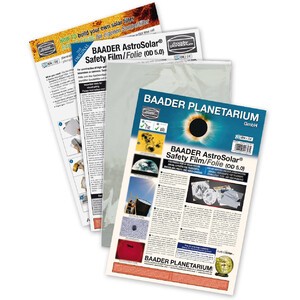
The standard film for safe solar observing: OD 5.0 passes just 1/100,000 of the light. Cut it, mount it – and sunspots snap into razor-sharp view.
Price: € 29
You will find more on filters and accessories in the overview Filters for the telescope. If you do not own an instrument yet, the guide Buying a telescope will help. And on 12 August 2026 the total solar eclipse is the best possible reason to get to grips with safe solar observing anyway.
Frequently asked questions about the solar wind
Is the solar wind dangerous to humans?
Not at ground level. Earth’s magnetic field deflects the solar wind, and the atmosphere slows down the few particles that get through. Even during the Carrington event of 1859 nobody was harmed by radiation. Outside this protection the picture is different: astronauts on a lunar mission or on the way to Mars would be seriously at risk during a strong particle event — which is why radiation shelters are a central topic in every crewed Mars plan. Indirectly, an extreme storm can become dangerous on Earth as well, but through failed infrastructure rather than through radiation.
What is the difference between solar wind and a solar storm?
The solar wind is the permanent state: it always blows, at 300 to 800 km/s. A solar storm is an event — usually a coronal mass ejection that crashes into Earth’s magnetic field as a dense, fast cloud of plasma and sets off a geomagnetic storm there. To put it in an image: the solar wind is the river, the solar storm is the flood wave.
What is the solar wind — explained for children?
The Sun is so hot that tiny particles are constantly flying away from it, far too small to see. They race through the whole solar system, past Earth as well. But Earth has an invisible shield — its magnetic field. It steers the particles around us, the way a bridge pier splits the water of a river. Only at the North Pole and the South Pole do a few particles slip in. There they bump into the air, and the air starts to glow: those are the auroras.
Do solar winds cool the Sun’s core?
No — this is a widespread misconception that often turns up as a quiz question. The solar wind arises in the corona, right on the outside, and has nothing to do with the core. Energetically it barely registers: its kinetic energy amounts to only about one ten-millionth of the Sun’s radiated power. And the core is so well insulated thermally by the radiative zone that energy needs tens of thousands of years to get from there to the surface. Nothing cools the core — it regulates itself through the balance between gravity and fusion rate.
Exactly how fast is the solar wind?
At Earth’s distance typically 300 to 500 km/s (slow solar wind) and 600 to 800 km/s (fast solar wind from coronal holes). The average is around 400 km/s, that is about 1.4 million km/h. During extreme coronal mass ejections more than 3,000 km/s has been measured. For comparison: a passenger jet manages 0.25 km/s.
Why is the corona hotter than the Sun’s surface?
That is the so-called coronal heating problem, and it has not been fully solved. The main mechanisms are thought to be nanoflares — myriads of tiny magnetic short circuits — together with Alfvén waves, which transport energy upward out of the convection zone. One point matters: the corona may be millions of degrees hot, but it is extremely thin. It holds almost no heat energy — a particle up there is very fast, but there are hardly any of them.
How many days does the solar wind spend on its way to Earth?
At 400 km/s about 4 days and 8 hours, and with fast wind at 700 km/s roughly 2.5 days. A very fast coronal mass ejection can cover the distance in 14 to 20 hours. The light from the same eruption, by contrast, is already here after 8 minutes 20 seconds — which is why you always see the flare long before the storm.
Does the Sun lose much mass through the solar wind?
About one million tons per second, so roughly 32 trillion tons a year. That sounds enormous, but measured against a solar mass of 2 · 1030 kilograms it is vanishingly small: over five billion years only about 0.01 percent is lost this way. The Sun loses considerably more mass through nuclear fusion itself — there, around four million tons of matter are converted into energy every second.
What is the heliosphere and how far does it reach?
The heliosphere is the bubble the solar wind has blown clear in the interstellar gas. According to the measurements of the two Voyager probes, its boundary, the heliopause, lies at about 119 to 122 astronomical units — roughly 18 billion kilometers. Inside this bubble the solar wind dominates, outside it the medium between the stars.
Can I see the solar wind with a telescope?
Not the solar wind itself — it is invisible. Only its sources and effects can be seen: sunspots and prominences with a safe filter, coronal structures during a total solar eclipse, the ion tail of a comet and, of course, auroras. The numbers themselves are supplied by satellites at point L1, whose data anyone can access freely.
How do we know that the solar wind exists?
The first hint came in 1951 from Ludwig Biermann and his observations of comet tails: the ion tail always points exactly away from the Sun and reacts too quickly for light pressure alone to explain it. Eugene Parker supplied the theory in 1958, the Soviet Luna probes the first measurements in 1959, and Mariner 2 the definitive proof in 1962. Today ACE and DSCOVR measure the solar wind continuously, around the clock.
Read more on Sterngucker.de
- Observing the Sun safely: filters, technique and what never to do
- Northern lights in Germany — when and where to see them
- Sunspots: how they form, Cycle 25 and safe observation
- Solar activity: cycles and their consequences
- How big is the Sun? A size comparison
- How long does sunlight take to reach Earth?
- The Oort cloud: the icy shell at the edge of the solar system
- Solar eclipse on 12 August 2026