By Alexander Merz · Updated on · Details checked on 6 October 2026
Beyond Neptune’s orbit lies a region astronomers have only truly known since the 1990s: the Kuiper Belt – a vast ring of icy, primordial rubble where Pluto traces its orbit. Out here the Sun is little more than a bright star, temperatures hover around −230 °C – and that is exactly why the raw building material of the solar system has survived almost unchanged for 4.6 billion years.
More in our overview: Comets.
⚡ The quick answer: The Kuiper Belt is a ring-shaped region beyond Neptune’s orbit, roughly 30 to 50 astronomical units from the Sun (about 2.8–4.6 billion miles). It holds hundreds of thousands of icy objects – leftovers from the birth of the solar system. The best known are the dwarf planets Pluto, Eris, Makemake, and Haumea. It’s named after the astronomer Gerard Kuiper.
What Is the Kuiper Belt? A Simple Explanation
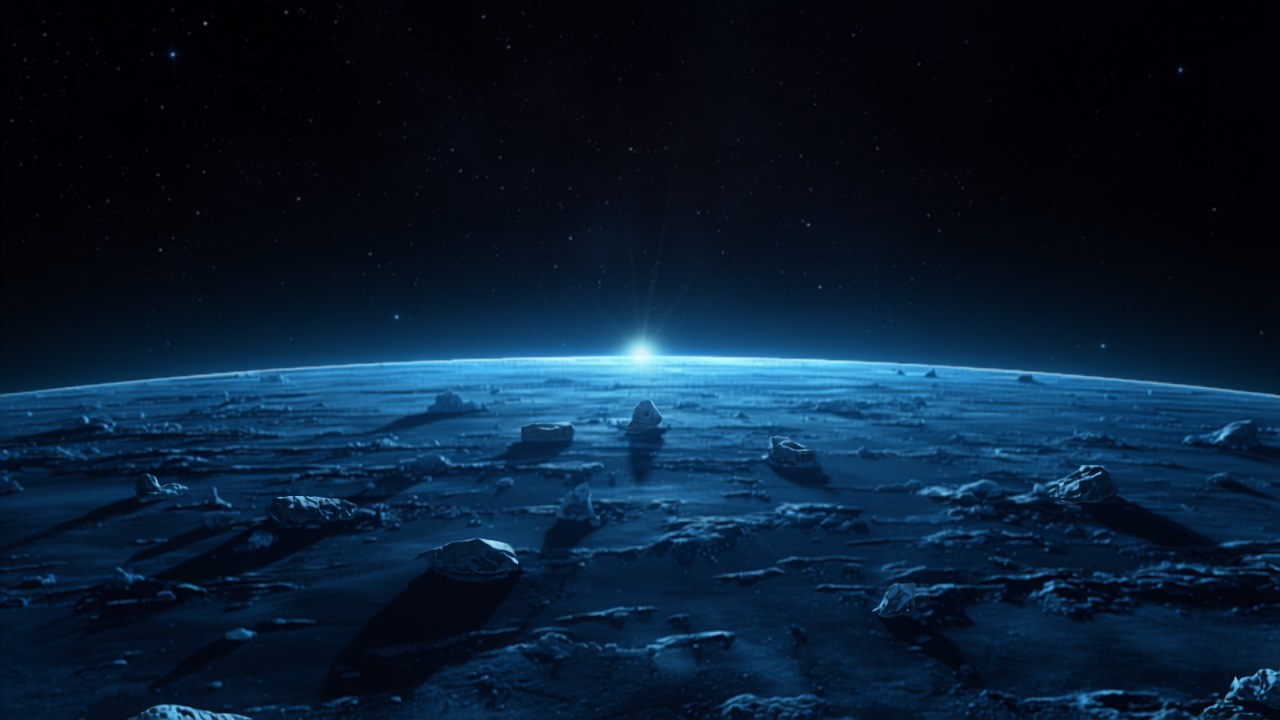
The Kuiper Belt is the icy counterpart to the asteroid belt: a flat, donut-shaped zone full of small bodies orbiting the Sun beyond the outermost planet, Neptune. Where rock and metal rule the asteroid belt, the objects out here are made mostly of frozen water, methane, and ammonia – at −230 °C, even gas is rock-hard.
Put simply: when the solar system formed, plenty of icy “building blocks” were left over at its edge, never coming together into a planet – Neptune’s gravity stirred and scattered them. Those leftovers still circle out there today, essentially deep-frozen and preserved. That’s why the Kuiper Belt is considered an archive of the solar system’s earliest days.
The Kuiper Belt at a Glance
| Feature | Value |
|---|---|
| Location | beyond Neptune’s orbit |
| Distance from the Sun | approx. 30–50 AU (2.8–4.6 billion miles) |
| Shape | flat, donut-shaped ring (torus) |
| Objects > 60 miles | estimated over 100,000 |
| Known objects (KBOs) | several thousand catalogued |
| Mass | roughly 20–200× the asteroid belt, but under 10% of Earth’s mass |
| Composition | ice (water, methane, ammonia) + rock |
| Best-known objects | Pluto, Eris, Makemake, Haumea, Arrokoth |
| Named after | Gerard Kuiper (theory, 1951) |
| First KBO discovered (after Pluto) | 1992 QB1 “Albion” (1992) |
How Far Away Is the Kuiper Belt?
The main zone stretches from about 30 to 50 astronomical units – that’s 30 to 50 times the Earth-Sun distance, or roughly 2.8 to 4.6 billion miles. For comparison: even light takes more than 4 hours to travel there from the Sun. The New Horizons probe – the fastest spacecraft ever launched – flew for over 9 years before reaching Pluto in 2015.
Who Is the Kuiper Belt Named After?
It’s named for the Dutch-American astronomer Gerard Kuiper, who theorized in 1951 about a zone of small bodies beyond Neptune – with the historical irony that he himself believed it must be swept clean by now. As early as 1943, the Irishman Kenneth Edgeworth had published a very similar idea, which is why it’s often called the Edgeworth-Kuiper Belt, especially in English. The proof came only from David Jewitt and Jane Luu: after a five-year search, they discovered the first classical Kuiper Belt object in 1992 – 1992 QB1 (now “Albion”) – opening the door to an entirely new region of the solar system.
The Largest Objects in the Kuiper Belt
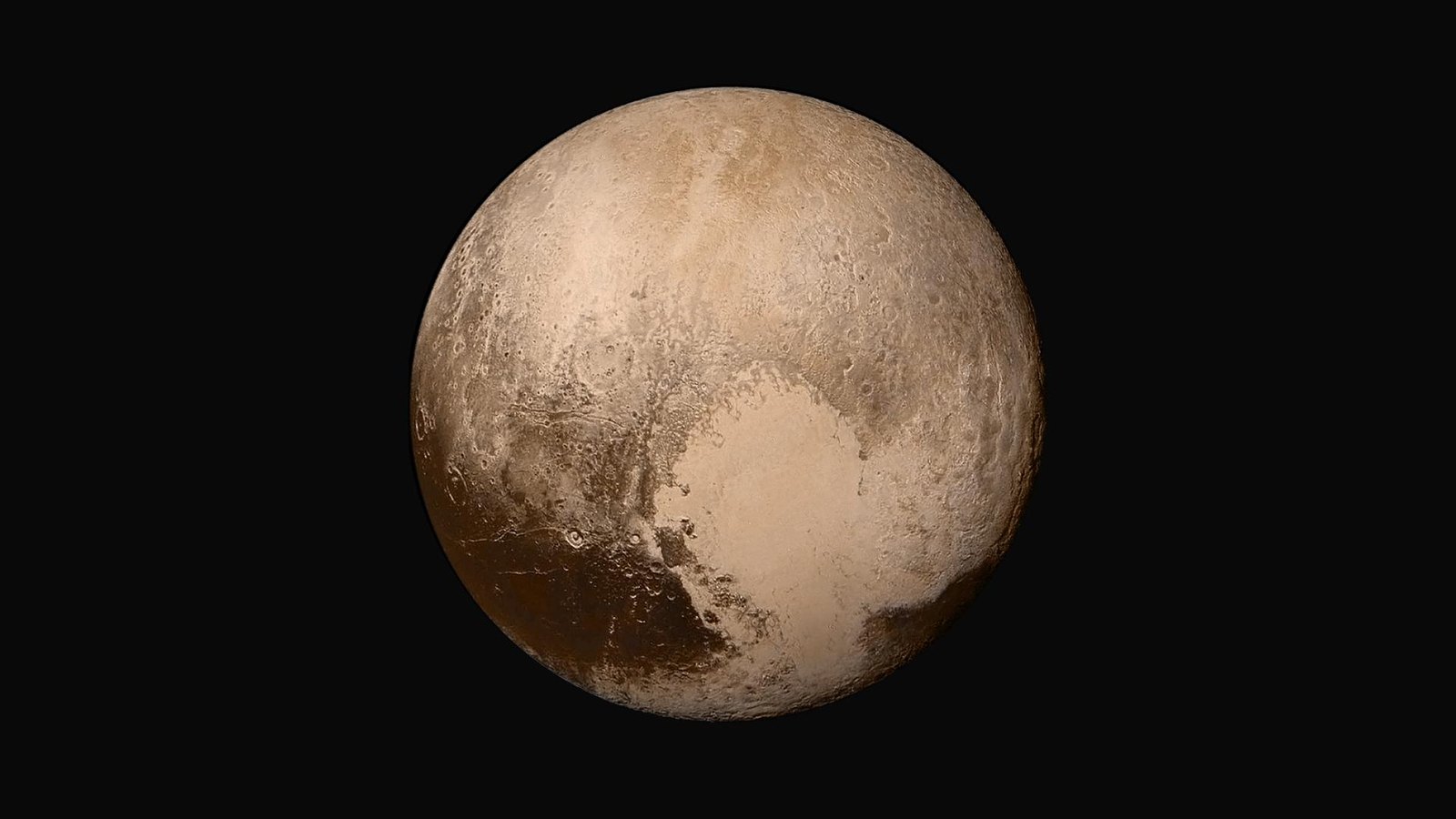
Several thousand Kuiper Belt objects (“KBOs”) have now been catalogued. The heavyweights are all dwarf planets:
| Object | Diameter | Claim to fame |
|---|---|---|
| Pluto | approx. 1,477 mi (2,377 km) | largest KBO, 5 moons, heart-shaped Tombaugh Regio |
| Eris | approx. 1,445 mi (2,326 km) | more massive than Pluto – triggered its 2006 “demotion” |
| Haumea | approx. 995 mi (1,600 km, elongated) | spins in 4 h, egg-shaped, has rings |
| Makemake | approx. 889 mi (1,430 km) | reddish surface of frozen methane |
| Quaoar | approx. 685 mi (1,100 km) | has a ring that breaks all the rules |
| Arrokoth | approx. 22 mi (36 km) | most distant object ever visited (New Horizons, 2019) |
Fun fact: The discovery of Eris in 2005 put astronomy on the spot – it’s heavier than Pluto. Rather than crown a 10th planet, the IAU redefined the word “planet” in 2006. You know how that turned out: Pluto became a dwarf planet – in a sense, the Kuiper Belt cost it its planet status.
Plutinos, Cubewanos & Co.: Order in the Ice
Neptune is the secret conductor of the Kuiper Belt. Its gravity locks many objects into fixed rhythmic ratios:
Plutinos orbit the Sun exactly twice for every three Neptune orbits (a 2:3 resonance) – just like Pluto itself, hence the name. Cubewanos (named after “QB1”) are the classical KBOs on calm, near-circular orbits between the resonances. And the objects of the scattered disk were flung by Neptune onto highly stretched, tilted orbits – Eris is among them, retreating to nearly 100 AU from the Sun.
The Kuiper Belt: Home of the Comets
When an icy chunk is nudged into the inner solar system by collisions or Neptune’s tugs, its second life begins: solar heat vaporizes the ice, a coma and tail form – and a comet is born. The short-period comets (orbital periods under 200 years) come from the Kuiper Belt and the scattered disk. The famous long-haul visitors on millennia-long orbits, by contrast, hail from a far more distant region – more on that shortly.
New Horizons: A Visit to the Edge of the Solar System
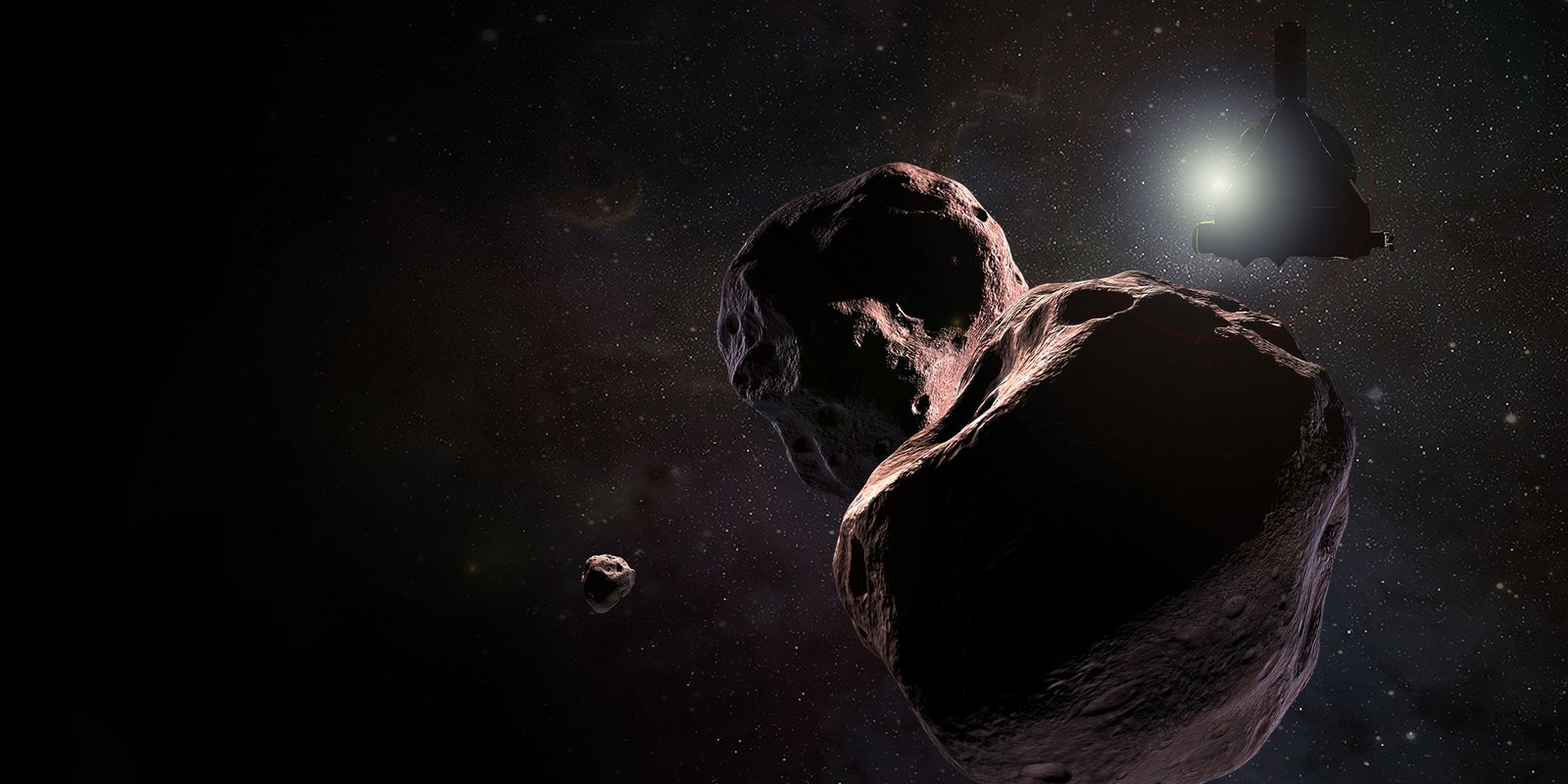
NASA’s New Horizons probe is so far the only mission to the Kuiper Belt – and it delivered two landmark moments: on July 14, 2015, it raced past Pluto and revealed a surprisingly active world with nitrogen glaciers and a blue haze. On January 1, 2019, Arrokoth followed – the most distant object ever studied up close. The 22-mile chunk looks like a glued-together snowman made of two primordial bodies, confirming just how gently the solar system’s building blocks once came together.
Kuiper Belt vs. Oort Cloud: The Difference
| Kuiper Belt | Oort Cloud | |
|---|---|---|
| Distance | approx. 30–50 AU | approx. 2,000 to over 100,000 AU |
| Shape | flat ring near the planetary plane | spherical shell around the entire solar system |
| Status | directly observed and explored | theoretical – no object observed on site |
| Source of | short-period comets (< 200 years) | long-period comets (millennia) |
| Example objects | Pluto, Eris, Arrokoth | likely billions of comet nuclei |
The Oort Cloud begins far beyond the Kuiper Belt and probably reaches out to 1.6 light-years – nearly halfway to the nearest star. It remains pure theory for now: no telescope has ever observed an object directly out there, but the orbits of long-period comets betray its existence. Everything about its structure, distance, and the comets it sends our way is in our in-depth guide, the Oort Cloud.
Can I See Kuiper Belt Objects Myself?
The honest answer: it’s an expert-level challenge – but doable. Pluto only reaches about magnitude 14.5. To spot it as a faint dot, you’ll need a dark rural sky, a finder chart, and a telescope with at least 8 inches (200 mm) of aperture. The trick is the same one the pros used in 1930: sketch the field on two nights – the “star” that moved is Pluto. Pull it off and you’ve seen the most distant large object in the solar system reachable with amateur gear!
Best value: Skywatcher Dobson Telescope N 200/1200 Skyliner Classic
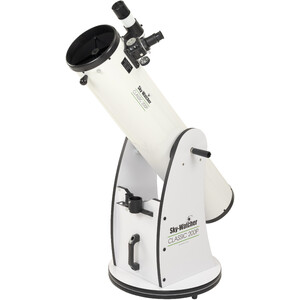
200 mm of aperture — the most sky for your money. Set it on the ground, point by hand: nebulae, clusters and galaxies for years to come.
Price: € 479
* Affiliate link: if you buy through this link we may earn a small commission from Astroshop or High Point Scientific, at no extra cost to you.
Frequently Asked Questions About the Kuiper Belt
What is the Kuiper Belt in simple terms?
A vast ring of icy small bodies beyond Neptune – leftover building material from the formation of the solar system, deep-frozen at −230 °C.
How far is the Kuiper Belt from Earth?
Its main zone lies about 30–50 AU from the Sun, or 2.8–4.6 billion miles. Light takes more than 4 hours to get there.
Which planets are in the Kuiper Belt?
No true planets – but several dwarf planets: Pluto, Eris, Makemake, and Haumea. It was precisely these many Pluto-siblings that cost Pluto its planet status in 2006.
Why is it also called the Edgeworth-Kuiper Belt?
After the astronomer Gerard Kuiper (1951 theory). Because of the nearly simultaneous idea from Kenneth Edgeworth (1943), it’s often called the “Edgeworth-Kuiper Belt.”
How much mass does the Kuiper Belt have?
Considerably more than the asteroid belt (roughly 20–200 times), but in total likely less than a tenth of Earth’s mass – the region is enormous, yet extremely sparsely populated.
Is there anything beyond the Kuiper Belt?
Yes: first the “scattered disk” with objects like Eris, then – according to current theory – the Oort Cloud, reaching out to 1.6 light-years. Some astronomers even suspect an undiscovered “Planet Nine” out there, because the orbits of a few extremely distant objects cluster suspiciously – though it hasn’t been proven yet.