By Alexander Merz · Updated on · Details checked on 6 October 2026
Deep inside the Sun, colossal energy conversions are constantly at work. These mechanisms don’t just shape our home star — they drive the weather of the entire solar system. Understanding solar activity helps explain why Earth is a living world rather than a lifeless rock, and why the occasional flare still makes headlines.
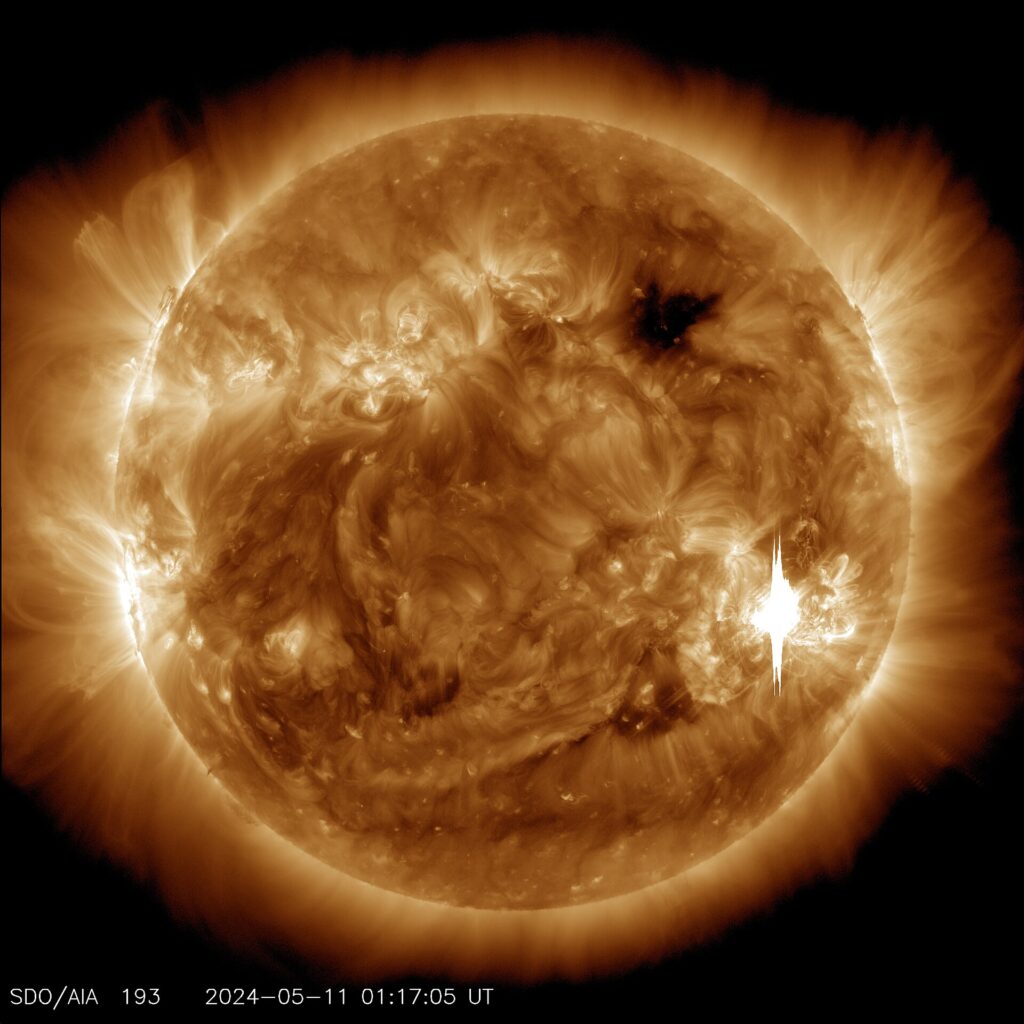
⚡ The quick answer: Solar activity is the collective term for the Sun’s energetic phenomena — sunspots, flares, and coronal mass ejections — all driven by its magnetic field. It follows a roughly 11-year cycle that swings between quiet minimums and turbulent maximums. Strong outbursts can reach Earth, sparking auroras and disrupting technology.
Space weather brings more than spectacular light shows to every irradiated body in the solar system — it also brings real challenges. In 2012, a burst of heightened solar activity drew intense media coverage and even alarmed less-informed observers. Getting to know the “hot onion” at the center of our solar system lets us explain some genuinely puzzling solar behavior in a logical way.
The Sun’s Actual Surface
Although the Sun is a star and not a planet, it too has a core. That core isn’t made of “mere” magma, though — it’s a gigantic nuclear-fusion furnace, the source of all solar activity.
Before the photons generated in the core can escape into space, they must fight their way through many layers of our home star. At the edge of the convection zone, the scattering and binding forces finally taper off. From there, the Sun’s life-giving — and occasionally worrying — energy reaches Earth.
The Sun’s “shells” aren’t as sharply separated as Earth’s interior layers, yet they are defined by very strong differences in density, energy output, and, of course, temperature.
The photosphere counts as the surface of our star because the density of the convection zone drops off abruptly there. This “outer skin” still glows at roughly 5,800 kelvin. A small share of the energy released here is absorbed by the layer above it.
Crossing Into the “Solar Atmosphere”
The radiation from the 300-to-400-kilometer-thick photosphere passes almost unhindered into the Sun’s next layer, the chromosphere. There, a wafer-thin film of hydrogen and helium produces a reddish, jagged “color mantle.”
Without a special solar filter (an H-alpha filter), you can see this “wreath” from Earth only as a faint shimmer during a total solar eclipse. The gas density drops off sharply again here, while solar activity heats this region to between 6,000 and 10,000 K — considerably hotter than the surface below it.
Back when astronomers had neither powerful telescopes nor effective glare protection, the Sun remained an unpredictable mystery. The invention of the telescope and the steady improvement of solar filters allowed many questions to be answered and the Sun’s energy output to be studied cycle by cycle.
As so often in astronomy, though, every answer breeds new riddles. The current surge in solar phenomena — most famously sunspots — fuels public uncertainty about the possible effects on Earth, along with close attention from astronomers and the media.
The Sunspot Cycle and Its Causes
The most reliable yardstick for telling whether a solar cycle is calm or unpredictably active is the sunspot. Records have been kept in writing since 1749. If our calendar ran on solar activity, we would now be in the 25th cycle — meaning the Sun has “simmered” quietly and then hurled radiation and material into surrounding space, Earth included, that many times over.
Sunspots are the product of the Sun’s various magnetic fields. Where these dark patches appear in the photosphere, the surface temperature drops by up to 2,000 K below the star’s usual value. Depending on the phase of the cycle, magnetic fields of opposite polarity reconnect very often (during high activity) or only rarely (in the aftermath of a maximum). The energy released in this process fires part of the Sun’s material into space as a “flare.” During especially violent flares, the material from these solar storms sometimes reaches Earth.
What Can You See, and How Often?
The table below sums up the main solar-activity phenomena, what they are, and how to spot them safely.
| Phenomenon | What it is | What you observe (safely) |
|---|---|---|
| Sunspots | Cooler regions of the photosphere (up to 2,000 K cooler) | Dark spots, visible through a certified solar filter |
| Solar flares | Sudden releases of magnetic energy | Bright flashes in H-alpha light |
| Coronal mass ejections | Clouds of plasma hurled into space | Tracked via space-weather bulletins |
| Auroras | Solar particles exciting Earth’s atmosphere | Colorful curtains in high-latitude night skies |
| Solar cycle | Roughly 11-year rise and fall in activity | Sunspot counts that vary year to year |
⚠️ Safety first: Never look directly at the Sun — not with the naked eye, and never through binoculars or a telescope that isn’t properly equipped. Solar observing absolutely requires a certified special solar filter (a full-aperture glass or film filter, or a dedicated H-alpha instrument) mounted in front of the objective. Screw-on eyepiece “sun filters” are dangerous and must never be used. When in doubt, project the Sun’s image onto a white screen instead.
What actually shows the spots
Of everything in that table, an amateur telescope shows exactly one thing: the spots. Flares and prominences need a dedicated H-alpha instrument, and those start in the four-figure range. A reasonably large spot group, though, is sharp even in a small refractor — as long as a certified filter sits in front of the aperture.
The cheapest route is filter film you mount yourself: the Baader Planetarium Visual AstroSolar Safety Film - ECO-Size - 5.5" x 6.1" SheetBaader AstroSolar ECO-size Safety Film OD 5.0 (14x15.5 cm) costs $22.00€ 16 and is enough for one telescope filter up to roughly 130 mm of aperture, or for two binocular filters. If you would rather not build anything, take the ready-made ZWO Silver Black Polymer Solar Filter for Seestar 50Omegon 50 mm solar filter (Seestar S50 & binoculars) at $25.00€ 34.90. Either way the filter belongs in front of the objective, never on the eyepiece.
What does not do the job is a pair of eclipse glasses: they are safe, but they do not magnify, and without magnification sunspots stay invisible apart from very rare giant groups. Which filters are worth it, how to mount the film and which mistakes are dangerous is covered in the guide Observing the Sun safely.
* Affiliate link: if you buy through this link we may earn a small commission from Astroshop or High Point Scientific, at no extra cost to you.
Reconstructing the Historical Effects on Earth
On one hand, it’s well documented that when sunspot counts are low, Earth tends to be cooler, too. From the mid-17th to the early 18th century, astronomers identified the first “Maunder Minimum” — a stretch almost free of sunspots, during which the Sun shone noticeably less and a “Little Ice Age” set in. That climate shifts can accompany cycles of reduced solar radiation is now widely accepted. A direct cause-and-effect link between solar activity and Earth’s climate, however, has not yet been fully proven.
On the other hand, highly active episodes leave their mark as well. The Carrington Event of 1859 remains the most intense solar storm ever recorded: it triggered auroras as far south as the tropics and knocked out telegraph lines. An event of that scale today would affect satellites, power grids, and communications — which is exactly why space weather is monitored around the clock.
Frequently Asked Questions About Solar Activity
What is the 11-year solar cycle?
It’s the average period over which solar activity climbs from a minimum (few sunspots) to a maximum (many sunspots and flares) and then declines again. We’re currently in the 25th cycle since record-keeping began in 1749.
Is solar activity dangerous to Earth?
Our atmosphere and magnetic field shield us from the radiation. Intense solar storms can still disrupt satellites, GPS, radio communications, and power grids, but they don’t directly threaten human life on the ground.
How can I observe sunspots safely?
Only with a certified solar filter mounted in front of the objective of a telescope, or with a dedicated H-alpha instrument. Never look at the Sun directly. Projecting the image onto a white screen is a safe, no-cost alternative.
Why do sunspots look darker?
Because they’re cooler than the surrounding photosphere — by up to 2,000 K. They appear dark only by contrast; on their own, they would still shine brightly.
Does solar activity affect Earth’s climate?
Cycles of low radiation, like the Maunder Minimum, have coincided with cooling. A full, direct link between solar activity and today’s climate has not yet been conclusively established.
Read next:
- Observing the Sun safely: filters, technique and what never to do
- Sunspots: origin, cycle, and how to observe them
- Solar eclipse: how to watch it safely
- The best beginner telescopes
Also available in other languages: Deutsch · Français · Italiano