By Alexander Merz · Updated on · Details checked on 13 October 2026
Our solar system is home to eight planets orbiting the Sun, our central star. Earth is just one of them: four rocky worlds sit alongside four gas and ice giants, and since the 1990s we have known that countless planets circle other stars as well. This guide walks you through the planets of our solar system, how they formed, what you can actually see through a telescope, and the distant worlds we call exoplanets.
⚡ The quick answer: The solar system has eight recognised planets. In order from the Sun: Mercury, Venus, Earth and Mars (the rocky planets), then Jupiter, Saturn, Uranus and Neptune (the gas and ice giants). Pluto, demoted in 2006, is now classified as a dwarf planet. Even a small beginner telescope already reveals Saturn’s rings and Jupiter’s moons.

What is a planet?
A planet is a celestial body that does not shine by its own light and that follows an orbit around its star. Since 2006, the International Astronomical Union (IAU) has defined three strict criteria for a body to count as a planet:
- it orbits the Sun (rather than another planet);
- it has enough mass for its own gravity to pull it into a nearly spherical shape, unlike asteroids;
- it has cleared its orbit of other bodies of comparable size (orbital dominance).
It is this last criterion that Pluto fails to meet, which is why it was reclassified as a dwarf planet.
How do planets form?
Historically important theories of planet formation go back to Pierre-Simon Laplace and James Jeans. The modern model shares its foundations with the Kant-Laplace hypothesis: planets are born from the collapse of a cloud of gas and dust known as a protoplanetary disc.
As a star forms, angular momentum sets the surrounding material spinning into an accretion disc. Once stellar fusion ignites, seed grains appear from which proto-planets grow. These proto-planets gather mass, merge with one another, or are flung out of their orbits by the gravity of larger bodies. What remains at the end is a stable planetary system.
The exact sequence of planet formation is still not fully understood. Several variants of the modern theory coexist today, each with its own supporters.
The planets of the solar system
Until 2006 our solar system had nine planets. In August 2006 the IAU stripped Pluto of its planetary status because it does not dominate its orbit. The much-debated decision remains controversial to this day. Until the early 17th century, the “geocentric model” placed Earth at the centre of the world; only Mercury, Venus, Earth, Mars, Jupiter and Saturn were known back then. The shift to the heliocentric model overturned that view.
Inner and outer planets
The eight recognised planets are grouped by their structure. Mercury, Venus, Earth and Mars are the “terrestrial” (rocky) or inner planets: their geology resembles Earth’s, with a core, mantle, crust and atmosphere. Jupiter, Saturn, Uranus and Neptune are the “Jovian” or outer planets: these gas and ice giants are made mostly of light elements, have only a solid core at their centre, and are accompanied by ring systems and many natural satellites.
Mercury
The rocky planet closest to the Sun, Mercury spins so slowly that one Mercurian day almost equals one Mercurian year. It can be observed as it transits across the face of the Sun.
Venus
Nearly Earth’s twin in size, Venus has an extremely dense atmosphere that drives a runaway greenhouse effect, pushing surface temperatures to several hundred degrees Celsius. Like Mercury, it has no moon.
Earth
The third rocky planet, Earth orbits within the Sun’s habitable zone. It has one moon, pronounced seasons and, so far, the only known life in the universe.
Mars
The last rocky planet, Mars is about half the size of Earth and has two small, potato-shaped moons, Phobos and Deimos. It sits just outside the habitable zone. The red planet fascinates researchers because it may once have resembled Earth, and evidence of liquid water in its past has caused a stir.
Jupiter
The largest planet in the solar system, Jupiter could have become a star under different conditions. Among its many moons, Europa draws particular attention: a liquid-water ocean is suspected beneath its icy shell. With its powerful gravity, Jupiter stabilises the asteroid belt and shields Earth from many impacts.
Saturn
The second-largest planet, Saturn owes its fame to its spectacular ring system. It too has many moons, including Titan, which has its own atmosphere, and Enceladus, which is streaked with active geysers.
Uranus
Uranus has a distinctive blue-green colour. Like all the giants it has several, still poorly explored moons. Its oddity: a rotation axis tilted more than 90° to its orbital plane, so the planet appears to “roll” along its path.
Neptune
Neptune is the outermost planet of the solar system. It too has many moons, the largest of which is Triton. Its mass dominates the trans-Neptunian objects and forces Pluto into a 3:2 orbital resonance.
Which telescope is best for observing the planets?
Planets offer the observer two advantages: they are bright and, on an astronomical scale, relatively close. A good planetary instrument should therefore deliver a sharp, high-contrast image, allow a fairly high magnification and stay comfortable at the eyepiece. Because planets are luminous, you can favour optical quality over sheer aperture.
For beginners, a compact achromatic refractor is ideal: it already shows the phases of Venus, Saturn’s rings and Jupiter’s main moons, without a big budget or complicated setup.
Ideal for beginners: Omegon Telescope AC 70/700 AZ-2
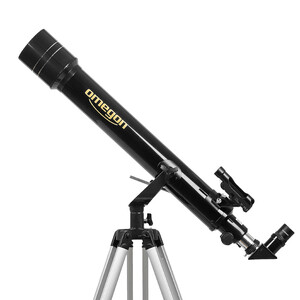
The no-pitfall starter refractor: Moon, Saturn's rings and Jupiter's moons from the very first night. No collimation.
Price: € 129
Best for advanced observers: Skywatcher Dobson Telescope N 200/1200 Skyliner Classic
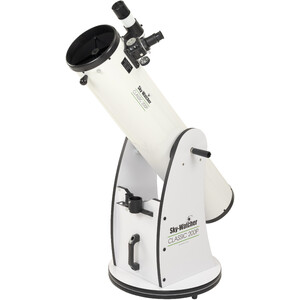
200 mm of aperture — the most sky for your money. Set it on the ground, point by hand: nebulae, clusters and galaxies for years to come.
Price: € 479
* Affiliate link: if you buy through this link we may earn a small commission from Astroshop or High Point Scientific, at no extra cost to you.
What can you see of each planet through a small telescope?
| Planet | What a small scope (60–90 mm) reveals |
|---|---|
| Mercury | Tiny disc, faint phases; tricky to catch, always low on the horizon |
| Venus | Clear phases (crescent, quarter); dazzlingly bright, no surface detail |
| Mars | Small orange disc, polar cap and dark markings around opposition |
| Jupiter | Disc with two cloud belts plus the four Galilean moons, shifting nightly |
| Saturn | The rings, clearly separated from the globe, and Titan, its largest moon |
| Uranus | Greenish point, barely resolved into a tiny disc at high magnification |
| Neptune | Bluish, star-like point, hard to tell apart from a faint star |
What is an exoplanet?
An exoplanet (extrasolar planet) is a planet that lies outside the gravitational field of our Sun but is bound to another star. The first such distant world was detected in the early 1990s, and we have been finding more of them every year since.
How are they detected?
Several methods complement each other. Direct imaging with a telescope, across different wavelengths, is complex and error-prone, so only a small fraction of known exoplanets have been found this way. The transit method detects the slight dip in a star’s brightness as a planet passes in front of it. The radial-velocity method measures the tiny wobble of a star around the common centre of mass it shares with its planet.
As in our own solar system, exoplanets fall into rocky planets and gas giants. As instruments grow more precise, ever smaller worlds are found: at first mostly Jupiter-like giants, then “super-Earths” (up to 14 times Earth’s mass), and increasingly planets close to Earth in size.
Are there inhabited planets?
Apart from Earth, no inhabited planet is known to date. Research focuses on bodies that may hold liquid water, considered a central prerequisite for life by current models. Within our solar system three candidates stand out: Mars, which once resembled Earth; the moons Europa (Jupiter) and Enceladus (Saturn), thought to hide an ocean beneath their ice; and, further afield, exoplanets in their star’s habitable zone, whose atmospheres are being searched for biomarkers.
What is a planemo?
The term planemo (short for planetary mass object) describes planet-like bodies that belong to no star and orbit none: they roam freely through space. Detecting them is extremely difficult because they emit no light, yet infrared astronomy has revealed several of them in our galaxy.
Jupiter’s moons and Saturn’s rings need only a small telescope – but not every small telescope delivers.
Six short questions, an honest answer by email – even when binoculars are the better choice.
FAQ – The planets of the solar system
What is the largest planet?
The largest planet is Jupiter. Its diameter is about 11 times that of Earth, and its mass is roughly 2.5 times that of all the other planets combined.
What is the smallest planet?
The smallest planet is Mercury. At 4,880 km across it is only about half the size of Earth and just 1.4 times the size of our Moon. It is even smaller than the moons Ganymede (Jupiter) and Titan (Saturn).
Which planet has the most moons?
Saturn now tops the list with more than 140 confirmed moons, ahead of Jupiter and its roughly 95 satellites. These figures keep changing as new moons are discovered.
Which planet has the largest moon?
Ganymede, a moon of Jupiter, is the largest moon in the solar system. With a diameter of 5,262 km it is nearly half the size of Earth.
Can you see the planets with the naked eye?
Yes: Mercury, Venus, Mars, Jupiter and Saturn are all visible to the naked eye and often outshine the stars. A small telescope additionally reveals Saturn’s rings and Jupiter’s four main moons.
How many exoplanets have been discovered so far?
More than 6,400 exoplanets have now been confirmed (NASA Exoplanet Archive, as of October 2026), spread across several thousand planetary systems. With the James Webb Space Telescope, researchers hope to characterise the atmospheres of these worlds in unprecedented detail.
📚 Read next:
🌍 Other languages: Deutsch (original) · Français · Italiano