By Alexander Merz · Updated on · Details checked on 9 October 2026
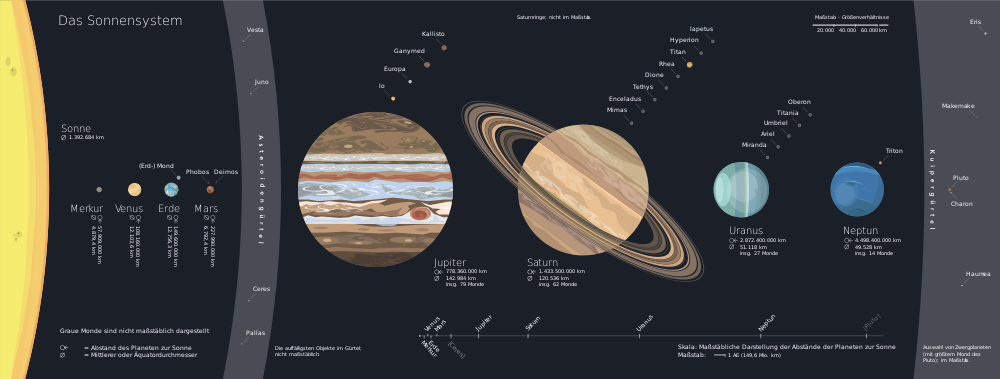
Once, we humans believed our Earth was the center of the world. The position that science may grant us in perhaps a thousand years remains hidden. One theory has long been proven: Earth, the Sun and all planets orbit within a shared space around the Sun – in the Solar System.
The Solar System – Definition and Structure
All systems in which a central star forces several “satellites” onto fixed orbits through its gravitational forces resemble one another in their interactions. To distinguish it from other orbital structures, our Solar System is catalogued as a “planetary system” or a “single-star system”.

The easiest way to memorize the order of the planets is with one of the well-known planet mnemonics.
Orbiting the Sun in increasing distance and size are the 8 recognized planets: Mercury, Venus, Earth, Mars, Jupiter, Saturn, Uranus and Neptune.
Dwarf planets, asteroids, comets and a large number of small moons are also forced by the Sun’s gravity into a perpetual orbit within the Solar System.
For scientific purposes, the Solar System is divided into zones. The inner zone consists of the group of “rocky (Earth-like)” planets. Beyond the “Kuiper Belt” move the “gas planets (or gas giants)”.
Theories on the Formation of Our Solar System
There is no shortage of speculation about how the formation of a system as complex as our Solar System was even possible. Currently, the prevailing hypotheses are those of Kant and Laplace.
In his version, Kant considers only the processes of attraction and repulsion to explain the formation of the planets and the orbits of our Solar System. He assumes that the sum of all interacting forces settled into an equilibrium.
Laplace believed that the Sun had already been heated to its present stellar state long before the system formed. Over the course of its rotations, clouds of gas detached from this star and gradually condensed into the planets known today, taking up stable orbital positions in the Solar System.
The study of our Solar System has made great progress in the course of modern astronomy. In recent times, scientists have also gained many sensational insights through the simultaneous study of neighboring or newly discovered star systems.
The Development of Our Solar System (Kant–Laplace)
In 1755, Immanuel Kant published a spectacular work on the development of the Solar System titled “Universal Natural History and Theory of the Heavens”.
His theory sparked numerous controversies among scientists. New ideas attempted to refute his hypothesis of the primordial state. The technical advances of recent decades show what genius he demonstrated in his reasoning.
Even today, most astronomers regard his published hypotheses as the most probable.
Kant’s Idea of Development in the Solar System
Kant proceeded systematically in his reasoning. All matter is indeed in constant motion, change and transformation. Yet in order to enter into these processes, a primordial state is necessary.
According to Kant’s theory, all matter was originally scattered loosely throughout the universe. The physical forces of attraction and repulsion acted during the development of the Solar System until the currently known balance of equilibrium among matter was established.
Kant further imagined that all fixed-star systems – that is, the Milky Way and other galaxies – show, on a vastly enlarged scale, the development of the Solar System. This meant that planetary systems and stars are born from a primordial nebula at regular intervals and destroyed again.
For Kant’s time, this was a bold and, back then, completely unproven hypothesis. Today’s research shows how close the scientist came to all currently known facts about the workings of the universe. In cosmogony, his work is still used today for simulations, test series and calculations.
The Nebular Hypothesis according to Laplace
“Exposition du système du monde” (Description of the World System) is a five-volume treatise by the French mathematician and astronomer Pierre-Simon Laplace, published in 1796.
According to his assumptions, a star existed long before the development of the Solar System, one that heated up more and more. Eventually, clouds of gas detached from the surface of the star, condensed into planets and began to orbit the Sun according to Kant’s principle of equilibrium.
Both theories served later astronomers in their research. Both developed hypotheses contain provable approaches, yet also differences from present-day observations. Nevertheless, the cosmogony of our day combines the theories of both contemporaries as the “Kant–Laplace theory”.
Seeing the Solar System for Yourself
Almost everything on this page can be checked from your own garden. Five planets are visible to the naked eye – Mercury, Venus, Mars, Jupiter and Saturn – and they give themselves away by shining steadily while the stars twinkle.
Which instrument is enough for what is surprisingly clearly graded. The most common disappointment comes from the probe images in books and on this page: in the eyepiece, planets are small, pale and low in colour. Knowing that, you will still be lost for words at your first Saturn ring.
| With what | What you get to see |
|---|---|
| naked eye | Venus as the “evening star”, Jupiter as the brightest point of the night, Mars by its colour, Saturn as a calm yellowish star. Mercury is the hardest – it always sits close to the horizon, in the twilight. |
| 10×50 binoculars | Jupiter’s four large moons as dots in a line – the same ones Galileo saw in 1610, and they shift visibly from night to night. On the Moon, the craters along the terminator. Binoculars do not show Saturn’s rings. |
| telescope from about 100–130 mm | Saturn’s ring as a ring, Jupiter’s two dark cloud belts, the phases of Venus and, around opposition, the white Martian polar cap. |
| Uranus and Neptune | Stay point-like to barely disc-shaped even in a larger telescope, Neptune a pale blue. The appeal lies in finding them at all – there are no details to see here. |
Sensibly, the start is not the instrument but the date: which planets are visible tonight is in the continuously updated overview. A planet that currently stands close to the Sun cannot be seen even with the best optics.
Anyone looking for a first telescope after that will find the breakdown by design, aperture and budget in the beginner’s guide; what a particular instrument can do on paper is shown by the telescope calculator. As a starting point, the one that makes the third row of the table work:
Enough for Saturn's ring, Jupiter's belts and lunar craters: Skywatcher Dobson Telescope N 130/650 Heritage FlexTube
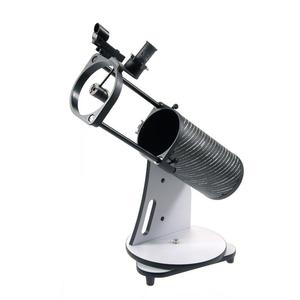
A compact tabletop Dobson with a true parabolic mirror. Folds down, fits in a bag: the Moon, planets and the bright deep-sky classics.
Price: € 265
* Affiliate link: if you buy through this link we may earn a small commission from Astroshop or High Point Scientific, at no extra cost to you.
Open Questions about Our Solar System
Ever since the first human wrote down and evaluated their observations of the sky, every subsequent researcher has tried to verify the results, to explain contradictions through newer analyses, or to prove a computational error on the part of the first discoverer.
Yet astronomy seems to fare much like the universe itself: every new insight raises 10 new questions. Just as a problem appears explained, a discovery that supposedly cannot exist refutes the plausibility. Even today, our own Solar System continues to pose unsolved riddles.
In addition, popular questions such as “How many times does Earth fit into the Sun?” can often be explained quite vividly.
The Mystery of How Our Planets Formed
The formation of the planets does indeed appear to have taken place as astronomical models illustrate. The word “appear” could not yet be replaced by a definite “is”. For according to our theory of the formation of the Solar System, some newly discovered exoplanets should not exist – neither in their shape nor in their stellar orbit.
Astronomers still wonder why the Sun holds almost all of the mass of the Solar System, yet only about 0.5% of the angular momentum. Why is this momentum distributed among the planets as orbital angular momentum?
This question may possibly be answered in the near future. Similar single-star systems have been discovered a few light-years away. There, however, the discovery of important, namely terrestrial, planets is still pending. Due to the distance, only the discovered gas giants and the presumed orbits of smaller stellar companions can be evaluated so far.
Also, the Sun’s equatorial plane “must not” be inclined by about 7° relative to the mean orbital planes of the planets, because – according to our current knowledge – it is far too heavy for that. Once again, previous attempts at explanation are merely hypotheses.
Thus, in the Sun’s early years, a dwarf star may have accompanied and thereby influenced the central star in our Solar System. Or a neighboring star from the original star cluster “visited” and, in doing so, tilted not the Sun but the protoplanetary disk by the aforementioned 7°.
Fascinating Moons in the Solar System
Besides the planets of our Solar System, there is a multitude of fascinating moons orbiting their respective planets. Some of these moons are known for their unique properties and discoveries:
- Ganymede: The largest moon in the Solar System belongs to the planet Jupiter and is even larger than the planet Mercury. Ganymede has a thin atmosphere and an icy surface beneath which an ocean of liquid water may exist.
- Titan: The largest moon of Saturn is Titan. It has a dense atmosphere and is the only known moon with standing liquids on its surface. It is thought that Titan has lakes and rivers of liquid methane and ethane.
- Enceladus: Another moon of Saturn, Enceladus, has surprised researchers with its ice fountains that are hurled from its interior into space. This discovery suggests that Enceladus has a subsurface ocean that could possibly harbor life forms.
- Europa: A moon of Jupiter, Europa is also known for its ice. Beneath the ice crust, another ocean of liquid water is suspected, considered a possible habitat for extraterrestrial organisms.
Life in the Solar System – The Search for Extraterrestrial Life
One of the most fascinating questions in science is that of extraterrestrial life in the Solar System. Astronomers search for signs of life or conditions that could make life possible. Possible candidates for life in the Solar System are:
- Mars: The Red Planet has captured the interest of scientists for decades. There are indications of formerly flowing water on the surface and frozen water underground, suggesting that Mars may once have been more hospitable to life.
- Europa: The aforementioned Jupiter moon Europa may hold an ocean of liquid water beneath its icy surface, offering a potential environment for life.
- Enceladus: Saturn’s moon Enceladus, too, with its subsurface oceans and ice fountains, could harbor life forms.
- Titan: Despite the extreme cold and the unusual chemistry on Titan, Saturn’s largest moon, alternative life forms based on methane and ethane could exist there.
Space Probes and Missions Exploring the Solar System
The exploration of the Solar System has been made possible by numerous space probes and missions that gather valuable data and images of planets, moons and other celestial bodies. Some notable missions are:
- Voyager probes: Voyager 1 and 2 were launched in 1977 and are the most distant human-made objects in space.
- Cassini–Huygens: The Cassini–Huygens mission was launched in 1997 and studied the planet Saturn and its moons, in particular Titan and Enceladus. The mission ended in 2017, when the Cassini spacecraft was deliberately steered into Saturn’s atmosphere.
- Mars rovers: Since 1997, several rovers have been sent to the Martian surface, including Sojourner, Spirit, Opportunity, Curiosity and Perseverance. These rovers have gathered important information about the geology, atmosphere and possible living conditions on Mars.
- Juno: The Juno mission was launched in 2011 and reached Jupiter in 2016. Juno studies the atmosphere, magnetosphere and interior of the gas giant to learn more about its formation and development.
- New Horizons: The New Horizons mission was launched in 2006 and flew past the dwarf planet Pluto in 2015, delivering breathtaking images and data about its surface and atmosphere. Later, the probe flew past the Kuiper Belt object Arrokoth and studied its geology and composition.
The Future of Solar System Exploration
The exploration of our Solar System is far from complete. Future missions will further expand our knowledge of planets, moons and other celestial bodies. Some planned and proposed missions are:
- Europa Clipper: A planned NASA mission to study the Jupiter moon Europa. The mission will aim to learn more about the suspected subsurface ocean and the moon’s suitability for life.
- Dragonfly: A planned NASA mission that will send a drone to Saturn’s moon Titan to investigate its surface, atmosphere and possible living conditions.
- Mars Sample Return: A joint NASA and ESA mission that aims to bring samples from the Martian surface back to Earth for more detailed analysis.
- BepiColombo: A current ESA and JAXA mission exploring the planet Mercury. The BepiColombo spacecraft was launched in 2018 and, after several flybys, is set to enter orbit around the planet to study its geology, magnetic field and atmosphere.
- Artemis Program: A crewed spaceflight program by NASA that aims to return astronauts to the lunar surface and enable long-term crewed missions on the Moon.
All of these missions and future discoveries will further deepen our understanding of the Solar System and may raise new questions and mysteries. The exploration of our Solar System remains an exciting and inspiring endeavor for scientists and space enthusiasts alike.
Placing Our Solar System in Context with Discovered Exoplanet Systems
Since the discovery of the first exoplanet orbiting a Sun-like star in 1995, astronomers have identified thousands of exoplanets in various star systems. These discoveries have broadened our understanding of planetary systems and allow a comparison between our Solar System and the discovered exoplanet systems.
- Differences in planetary composition: Unlike our Solar System, which consists of four terrestrial planets (Mercury, Venus, Earth and Mars) and four gas giants (Jupiter, Saturn, Uranus and Neptune), many exoplanet systems contain so-called “super-Earths” and “mini-Neptunes”. These planets are larger than Earth but smaller than the gas giants in our Solar System. Their composition and structure may differ from the planets we know.
- Differences in planetary arrangement: While in our Solar System the terrestrial planets lie closer to the Sun and the gas giants farther away, many exoplanet systems show no such clear separation. In some systems, gas giants have been discovered close to their central star, referred to as “hot Jupiters”. These unusual arrangements raise questions about the formation and development of planetary systems.
- Differences in orbit: The orbits of the planets in our Solar System are relatively circular and arranged in a common plane. In some exoplanet systems, however, highly elliptical orbits and differing orbital planes have been observed, suggesting that the dynamics of these systems may be more complex than those in our Solar System.
- Differences in stellar evolution: Our Solar System is dominated by a single G-type main-sequence star, the Sun. Many of the discovered exoplanets, however, orbit other types of stars, such as red dwarfs or Sun-like stars at various stages of development. The differing properties of these stars affect the living conditions on the orbiting planets and could influence the presence of life.
The exploration of exoplanet systems expands our knowledge of the diversity and complexity of planetary systems in the universe. The differences between our Solar System and the discovered exoplanet systems give astronomers valuable insights into the formation and development of planets and allow us to deepen our understanding of our place in the cosmos.
Currently Popular
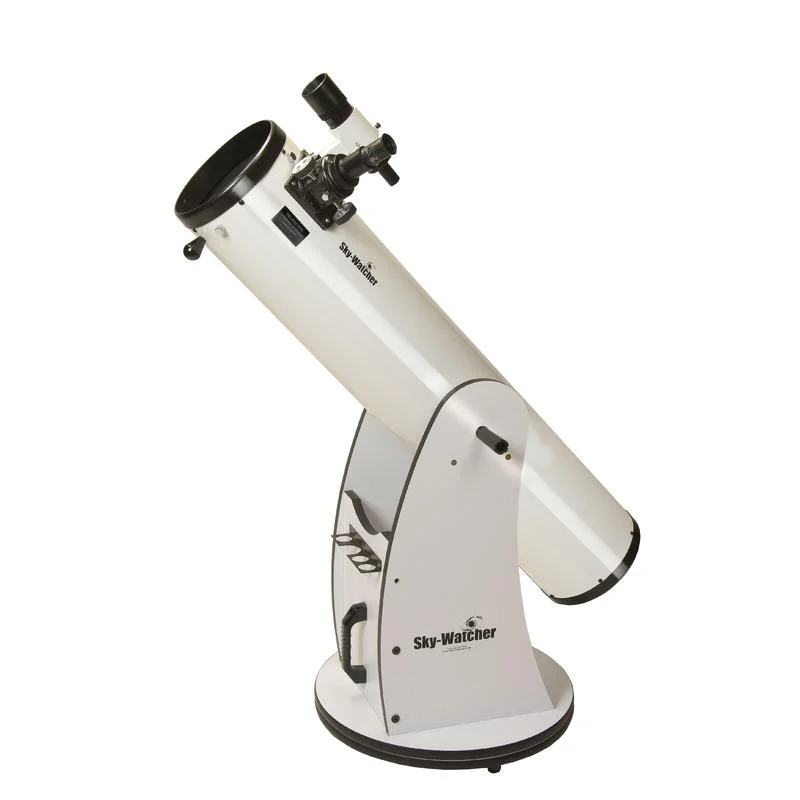
Skywatcher Dobson 8″
Our recommendation for getting started: large aperture, easy operation, fair price.