By Alexander Merz · Updated on · Details checked on 11 October 2026
More in our overview: Telescope Accessories.
Filter Recommendations
- Apertura 1.25″ Moon FilterOmegon Premium Moon Filter 1.25″ ($14.95€ 19.90) – dims the dazzlingly bright Moon and brings out crater detail
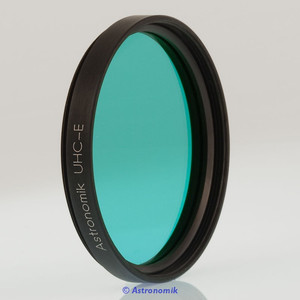
- Apertura Ultra High Contrast (UHC) Filter 1.25″Omegon Pro Ultra High Contrast (UHC) Filter 1.25″ ($55.00€ 59) – noticeably boosts the contrast of the Orion Nebula, the Ring Nebula & co., even under light pollution
- Celestron 1.25″ Lunar & Planetary Color Filter Set (4-piece)Omegon 1.25″ Color Filter Set (6-piece) ($54.95€ 59) – each color filter emphasizes different details on Jupiter, Mars & Saturn
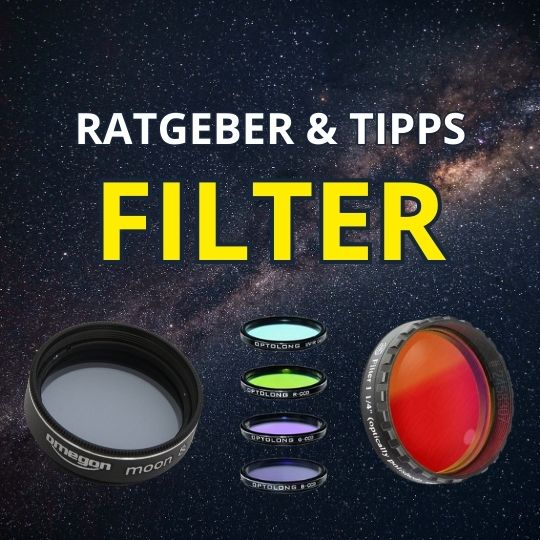
All the achievements of the telescope centuries would have been only half exploited without all the telescope accessories of modern astronomy. »Hubble«, for example, the space telescope, could not send us anywhere near such breathtaking photographs from the depths of space without dozens of special shutters and filters, eyepieces and highly complex lens systems.
But amateur astronomy, too, benefits from the ingenious systems of astrophysics. Today we can capture galaxies and hazy shapes and all the diverse deep-sky objects not just as diffuse images, but magnify and enhance them, photograph and analyze them right down to genuinely fine detail using a wide variety of filters.
Filters as an Aid to Sky Observation
In modern astronomy, the surface characteristics of nearby planets, the fine details (for example the spiral arms of the Milky Way) of far-off deep-sky objects, or previously undiscovered celestial phenomena are made visible – or their appearance enhanced – with the help of special telescope attachments.
Color filters block out the light of other parts of the spectrum and concentrate the perception of detail on a few suitable wavelength ranges. The image the observer sees in the telescope appears somewhat darkened. But it is precisely those faint spectra of distant celestial objects that then reach the eye with particular clarity.
For the deep-sky »hunters« in light-polluted residential areas, astronomy has come up with something ingenious – nebula filters. In the spectral range of street lighting, between 530 and roughly 630 nm, it would be difficult without filtering even to find distant deep-sky objects, let alone make out anything better than a smudge in the telescope.
The transmission curve of nebula filters is most effective above the aforementioned 630 nm, because from here on the street-lamp light is blocked and contrast observations are possible with far greater precision, even in the fainter range.
Moon Filters
Moon filters – indispensable for observing the Moon
Observatories are happy to show interested visitors the Moon through a large telescope – but without a filter. When the observer looks back into the room, a partial image of the surface has all but burned itself into the retina. Only long after the visit is a normal, »Moon-free« view possible again.
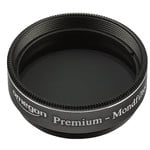
That is precisely why numerous astro shops offer moon filters – also called neutral or grey filters – for amateur astronomy. The bright moonlight is dampened and the contrast of the interesting surface structures is increased. The larger the telescope, the less light-transmitting the filter should be.
To a limited extent you can also observe bright deep-sky objects with these. But for that there are dedicated filters that work in a different way.
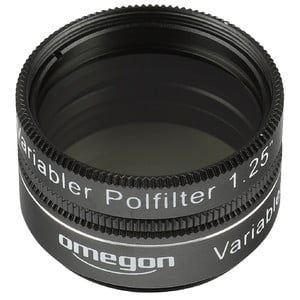
More versatile than a fixed moon filter is a variable polarizing filter. By rotating two filters against each other, the transmission can be adjusted continuously and thus adapted very easily to the particular need.
Moon filters can be fitted to almost any telescope. They are not comparable to special color filters; instead they »grey out« the object and its surroundings.
For plain observation of the Moon or a closer look at double stars of differing brightness, the grey attenuation of such filters is enough to improve the contrast.
Polarizing Filters
Uses of polarizing filters
The closer a celestial body stands before the observer’s eye, the more important – alongside a high-contrast image – eye protection at the telescope becomes.
Sunlight causes permanent damage to vision, even when you are not looking directly at the Sun. Polarizing filters are the flexible solution for observing planets or the Moon safely despite areas of differing brightness.
On all telescopes, variable polarizing filters darken the observed area to differing degrees depending on the brightness of the object. These filters consist of two discs that are joined together and can be adjusted against each other.
This produces either a weak dimming, in which 40% of the light still reaches the eye, or stronger settings in which only 1% of the light passes through the telescope.
Stray-Light Filters
Anyone who sets up their telescope in sparsely populated areas will probably find deep-sky objects with good success. In urban areas, however, distant galaxies or little star clusters blur behind the nightly flood of light that the modern world calls »light pollution« (and in part disputes). Nebula filters provide a remedy. Laypeople mistakenly assume the term simply means dimming or shutting out light.
Telescopes don’t really »catch« stars or galaxies. They channel incoming light waves, whether strong or weak, in various ways onto a single point of the image. If you break a deep-sky object down into its individual wavelengths, a »color band« – the »spectrum« – becomes visible.
This varies depending on which wavelength components dominate in the received beam of light. Under observing conditions in light-polluted areas, the few light waves that arrive here from distant galaxies usually »drown«. With nebula filters it becomes possible to bring out even fine detail against the background of stray light.
Bandwidths according to intended use
Just as varied as telescopes and their image qualities are the filter qualities in the sensitive field of deep-sky observing. According to their spectral width, nebula filters fall into 3 filter classes of differing strength.
As an attachment on the telescope, line filters practically darken the entire starry sky and specifically receive the light of emission nebulae at particular wavelengths.
Narrowband UHC filters (»Ultra High Contrast«) let in a bit more, above all blue-green wavelengths. Most planetary, emission and other nebulae are rendered in very good quality here. A special form are dedicated »comet filters«, which also let carbon lines pass (good rendering of comet tails). The most common – and therefore offered in the widest variety of variations – are broadband filters.
They do help against light pollution, but are better suited to astrophotography than to direct deep-sky observation. For observing star fields, star clusters or galaxies, these nebula filters are better suited to rural / low-stray-light observing sites.
Stray-light filters for deep-sky observation and astrophotography
Brand-name filters from Astronomik, ICS or Lumicon are usually expensive. Are they worth their price, or do cheaper filters deliver the hoped-for experience just as well when used on faint nebula structures? One dealer had so far stocked only the expensive brand-name filters. He now wanted to add the cheaper ones as well. He had the filters from the first delivery measured – with a sadly devastating result.
The test objects were 5 UHC and 5 OIII filters each from one of the well-known Chinese suppliers. According to the accompanying leaflet, the transmission curve of the UHC filter looks nicely steep-flanked and reaches a transmission of over 85%, and the pass band of the curve is also in the right place.
The measurement result of these 5 filters unfortunately shows a completely different picture. The transmission is in some cases over 95%, but the pass band lies clearly off the desired lines. The worst filter lets through just 6% of the light for the H-beta line, another manages only 19%. For the OIII characteristic lines, too, the transmission is in some cases only just around 80%.
Not a single one of the 5 measured filters may be called usable, because either the H-beta line or the OIII lines show far too low a transmission. The UHC brand-name filters from ICS or Astronomik deliver at least 90% here, with an average transmission of 96%.
For the OIII filters that were likewise measured, the accompanying leaflet also shows a nice narrow pass characteristic with almost 90% transmission. The measurement result of these filters is equally devastating. The actual measured values lie between 24% and 88%.
One of the 5 measured filters can, with a lot of goodwill, still be rated usable, although 84% and 88% respectively are still a poor transmission value.
The ICS OIII brand-name filters or the filters from Astronomik have a transmission of at least 91% and on average 94%.
On the website of G. Neumann you can find a comparative curve of a “cheap” filter from China alongside an Astronomik filter.
Spectral measurement of your filters (Gerd Neumann)
Addendum: In an astronomy forum, a user posted the measurements of his filters – premium-label filters from one of the well-known suppliers.
Here too, once again the same sad result: the filters are as good as useless. The only exception here is the UHC filter (image UHC Premium), although it too comes with a drawback. Its pass curve does fit as far as the necessary spectral lines are concerned, but it is very broad (460-520 nm) and thus lets through too much unnecessary light outside the desired range (Astronomik approx. 475-505 nm).
The measured OIII filter has only 67.2% transmission at 496 nm and a paltry 26.5% at 501 nm, and is therefore absolutely useless. Equally useless is the measured H-beta filter. Its pass band should be at 486 nm – here the measured filter shows a transmission of only 30.9%.
User Matthias from the astronomy forum has since acquired filters from Astronomik and measured these as well. Values for the OIII filter: transmission for the two lines is 95.8% and 99.1%, the half-width around 15 nm. Values for the H-beta filter: transmission on the line 89.7% and a half-width of around 10 nm.
Astronomik filtersAstronomik filters
More recently, Explore Scientific has also been offering UHC, OIII and H-beta filters relatively cheaply. These come with serial numbers and a certificate and are advertised, with corresponding wording, as very good.
An astronomy friend obtained an H-beta filter that, according to the supplier, was “hand-selected”, tested it visually on the sky and measured it with a home-built spectrometer. The result is unfortunately sobering again – the pass bandwidth is considerably broader and also does not hit the line correctly.
Result of the measurement: the money apparently saved when buying a cheap UHC or OIII filter made in China is a pure lottery – and in this lottery usually only the manufacturer/dealer wins.
The customer and user, on the other hand, throws his money out the window – and amateurs without a direct means of comparison cannot even determine that their cheaply acquired filter is worthless – and so, sadly, miss out on the real aha moment.
Reiner Vogel has also built a very good site with a lot of information. He, too, has the ability to determine the transmission curves of filters himself.
Solar Filters
Anyone who wants to observe the Sun with their own telescope absolutely needs a solar filter. The unfiltered rays of the Sun would, through the magnifying and concentrating effect of the objective and eyepiece, lead to instant blindness.
Baader AstroSolar Visual Film at High Point ScientificBaader AstroSolar Safety Film OD 5.0 at Astroshop ($22.00€ 29)
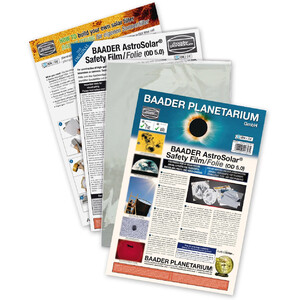
The solar filter is mounted in front of the objective, i.e. on the telescope aperture, and reduces the incoming radiation to 0.001-0.0001%. The diameter of the solar filter must be chosen to match the aperture of the telescope. With a high-quality, certified solar filter, the Sun can be observed without danger.
Solar filters through the ages
The beginnings of solar research were limited to the study of prominences during a solar eclipse. It was not until 1930 that the French astronomer Bernard Lyot invented the coronagraph, which artificially produced a solar eclipse. In 1933, a first filter was developed and named after him: the »Lyot filter«.
Suddenly scientists were able to carry out continuous daytime research. The image quality of such additions to telescopes was, by today’s standards, poor. Through the solar filter, however, one at least saw our central star more clearly than ever before.
In the »Lyot filter« (or polarization interference filter), crossed polarizers, birefringent plates and quartz or calcite rods were combined in up to 9 precisely measured layers. For use on telescopes in amateur astronomy, the price of these solar filters was out of the question. Only 2 manufacturers, the »Halle« company (Berlin) and the »Zeiss« company (Oberkochen), supplied professional observatories and well-funded astronomical institutes for several hundred marks apiece.
The »Lyot filter« was further developed in a wide variety of forms. Special glass for telescopes likewise possesses polarizing, refracting and protective properties. For amateur astronomy, solar filters in the form of films are, firstly, more affordable and, secondly, perfect, since they can be fitted to any home-built telescope as desired.
Solar observation at rock-bottom price – solar filters as glasses or accessory
Perfect solar protection for astronomical purposes on any telescope or binoculars is CE-tested solar filter film. The filter factor of 100,000 protects the eyes when looking at the Sun. Both of these criteria must be marked on every product. Unsuitable film quality is often touted as adequate – with »black sheep« even claiming you »…could just fold the film double…«.
Urgent note to beginners: never rely on such a nonsensical statement – your eyesight depends on it!
Anyone who does not want to build a telescope themselves or fit solar filter film to it can use an eclipse-viewing pair of glasses of the quality described. For the first steps in daytime observation, this minimal starter kit is sufficient.