By Alexander Merz · Updated on · Details checked on 14 October 2026
The rings of Saturn are the most iconic sight in the entire night sky. This vast halo of ice and rock circling the giant planet has captivated stargazers for four centuries. The best part? You don’t need a professional observatory to enjoy it. A simple pair of binoculars already hints at the rings, and an affordable beginner telescope shows them off in all their glory.
More in our overview: Saturn Through a Telescope.
⚡ The quick answer: Saturn’s rings are a flat disk of billions of ice and rock particles, ranging from dust grains to boulders several meters wide. They span nearly a million kilometers across but are only 10 to 100 meters thick. Astronomers divide them into rings A through G, separated by gaps such as the famous Cassini Division. You can spot them with even a small beginner telescope.
How Were Saturn’s Rings Discovered?
Right after the first telescopes were invented, the study of the planets in our solar system took off at an astonishing pace. In 1610, Galileo Galilei became the first person to observe Saturn through a telescope. His still-crude optics led him to believe the planet had two “handles” on either side, though he never grasped what they really were.
It wasn’t until 1655 that the Dutch astronomer Christiaan Huygens proved these “handles” were actually a tilted ring encircling the planet. About 20 years later, Giovanni Domenico Cassini spotted a striking gap dividing the rings — the famous Cassini Division. That discovery supported his hunch that the entire system wasn’t solid at all, but made up of countless separate particles.
What Exactly Are Saturn’s Rings?
Saturn’s rings are a broad, flat disk of material spread across the planet’s equatorial plane. The reason they’re so famous is simple: they can be seen from Earth at low magnification, unlike the far fainter rings around other planets.
From Earth, you can make out the A, B, and C rings, plus the faint D ring. Thanks to space probes, astronomers have also identified more distant, diffuse rings labeled E, F, and G.
The rings are separated from one another by gaps that are sometimes strikingly obvious. The well-known Cassini Division lies between the A and B rings, while the narrower Encke Gap sits within the A ring itself. Space probes have revealed many more divisions, several of them carved out by the gravitational pull of Saturn’s moons.
What Are Saturn’s Rings Made Of?
The rings are made up of countless small and medium-sized particles of ice and rock arranged in Saturn’s equatorial plane. These particles range from tiny dust grains to boulders several meters across.
Despite their impressive size, the rings account for only about one-millionth of Saturn’s total mass. And Saturn isn’t the only planet with rings: Jupiter and Neptune have them too. Theirs, however, are far fainter and stay invisible to backyard observers, while Saturn’s put on a show even at low magnification.
How Old Are Saturn’s Rings?
The rings likely date back to the birth of the planet itself, meaning parts of the system could be roughly 4.5 billion years old. Yet data from NASA’s Cassini spacecraft suggests other portions are far younger — and may even vanish in the relatively near astronomical future.
Over its long history, Saturn has also captured many rocky bodies that never became planets. Its gravity ground them down, and their material was folded into the ring system. This process is still going on today.
How Big Are Saturn’s Rings?
The rings lie in Saturn’s equatorial plane and stretch nearly a million kilometers across. What’s truly astonishing is how thin they are: just 10 to 100 meters from top to bottom. Compared with their enormous width, the rings are proportionally thinner than a sheet of paper.
| Ring | Visibility | Key Feature |
|---|---|---|
| C Ring | Telescope | Dark, semi-transparent inner ring |
| B Ring | Small telescope | Brightest and densest ring |
| Cassini Division | Quality telescope | Gap between the A and B rings |
| A Ring | Small telescope | Home to the narrow Encke Gap |
| D, E, F, G Rings | Space probes | Faint, invisible from Earth |
How Can I Observe Saturn’s Rings?
Observing Saturn’s rings is one of the most breathtaking sights in amateur astronomy. The great thing is that even very simple equipment is enough to make out the rings. With a beginner telescope, even more detail comes into view: the oval shape of the system, and on a steady night, sometimes the Cassini Division itself.
The rings can be observed almost year-round. The one exception is when the planet’s equatorial plane lines up exactly with our line of sight. We then look straight at the edge of the system — just 10 to 100 meters thick — and the rings nearly disappear. This so-called ring plane crossing happens about every 14.8 years.
What each aperture actually shows – from a 60 mm refractor to a 200 mm Dobsonian, with an honest simulation instead of a Hubble image – is covered in our guide Saturn through a telescope.
Best for beginners: Omegon Telescope AC 70/700 AZ-2
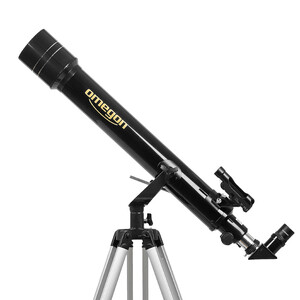
The no-pitfall starter refractor: Moon, Saturn's rings and Jupiter's moons from the very first night. No collimation.
Price: € 129
Best for advanced observers: Skywatcher Dobson Telescope N 200/1200 Skyliner Classic
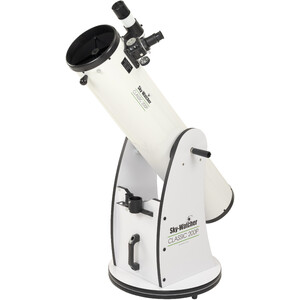
200 mm of aperture — the most sky for your money. Set it on the ground, point by hand: nebulae, clusters and galaxies for years to come.
Price: € 479
* Affiliate link: if you buy through this link we may earn a small commission from Astroshop or High Point Scientific, at no extra cost to you.
How far open are the rings right now?
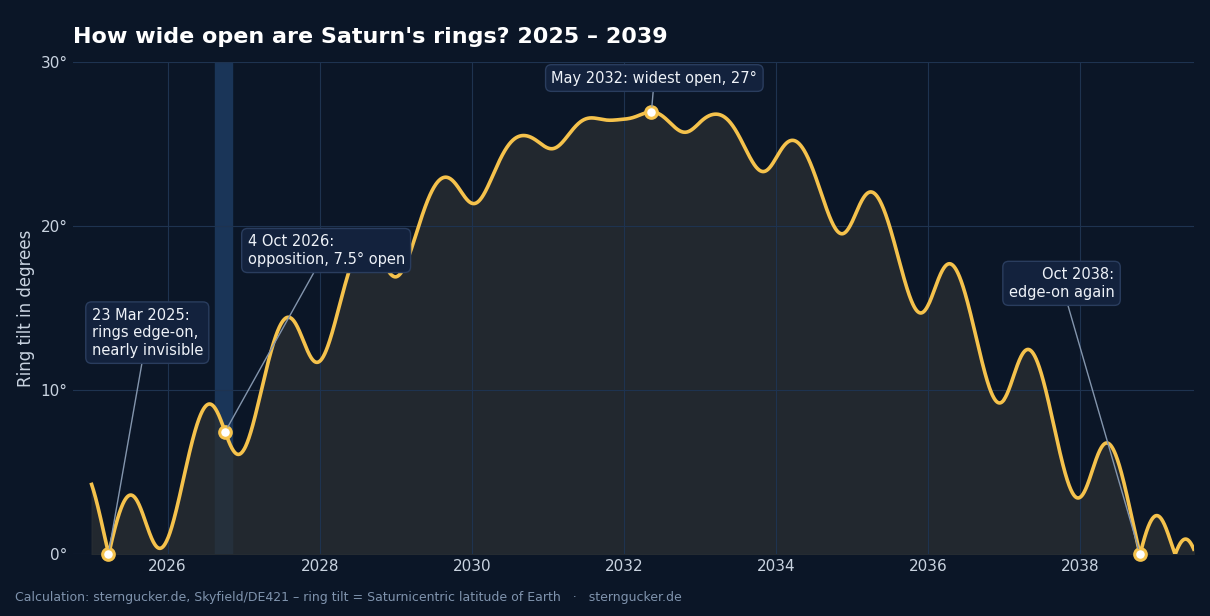
After the edge-on crossing of 23 March 2025 the rings have been tilting back open. Values straight from the JPL Horizons ephemerides: 1.8° in January 2026, 9.1° in mid-July 2026, 7.5° at the Saturn opposition on 4 October 2026 and 6.6° by the end of October. We are currently looking at the southern face of the ring system.
| Opposition | Ring opening | Brightness |
|---|---|---|
| October 4, 2026 | 7.5° | 0.33 mag |
| October 18, 2027 | 12.9° | 0.09 mag |
| October 31, 2028 | 17.9° | −0.13 mag |
| November 14, 2029 | 22.0° | −0.32 mag |
| November 28, 2030 | 25.0° | −0.45 mag |
| December 12, 2031 | 26.5° | −0.54 mag |
🪐 Best window in 2026
Around the opposition on 4 October 2026 Saturn is closest to Earth, brightest (0.33 mag) and largest in the eyepiece (19.7″). It culminates about 01:18 local time at some 41° above the horizon. Full details in our Saturn guide.
From there the tilt keeps climbing to a maximum of roughly 27° in May 2032. The next edge-on crossing – when the rings all but vanish again – does not follow until October 2038. In other words: every year from now on shows you a slightly more open ring system, so there is no reason to wait.
The rings are visible in any decent small telescope; the Cassini Division needs a bit more aperture.
Six short questions, an honest answer by email – even when binoculars are the better choice.
Frequently Asked Questions About Saturn’s Rings
Can you see Saturn’s rings with binoculars?
Yes, but only barely. A good pair of binoculars (such as 10×50) will show that Saturn isn’t perfectly round and hint at an elongated shape. To truly separate the rings from the planet’s globe, though, you’ll need a small telescope.
What magnification do you need to see Saturn’s rings?
A magnification of about 30 to 50x is already enough to see the rings clearly. To try for the Cassini Division, aim for 100 to 150x on a night with steady air and a telescope that has cooled to the outside temperature.
Why do Saturn’s rings sometimes disappear?
About every 14.8 years, Earth passes through the plane of the rings. Because they are so incredibly thin, we then see them edge-on and they seem to vanish almost completely. The last such crossing was on 23 March 2025; the next one comes in October 2038.
Is Saturn the only planet with rings?
No. Jupiter, Uranus, and Neptune all have rings too. But they are far fainter than Saturn’s and remain out of reach for amateur equipment.