By Alexander Merz · Updated on · Details checked on 13 October 2026
Beyond the asteroid belt, where the Solar System leaves its rocky worlds behind and enters the realm of the gas giants, reigns Jupiter, the largest planet orbiting our Sun. As the second-brightest object in the night sky after Venus, Jupiter is one of the most rewarding targets for beginners: its cloud belts and four Galilean moons reveal themselves even with modest equipment. The real question for stargazers is simple — which telescope do you need to see Jupiter and its details?
More in our overview: Planets of Our Solar System.
⚡ The quick answer: A simple pair of 10×50 binoculars is enough to spot Jupiter’s four large moons, lined up as tiny points of light. The two main cloud belts already show in a 60–70 mm telescope at around 50–70x; for the Great Red Spot you’ll want about 90–100 mm of aperture and steady air. The larger the aperture, the more atmospheric detail you’ll see.

Jupiter fact sheet
- Gas giant, the largest planet
- Diameter: 142,984 km
- Orbital period: 11.86 years
- Length of day: 9 h 56 min
- Distance from the Sun: 778 million km
- Temperature: −110 °C
When you can see Jupiter: After Venus, Jupiter is the brightest point in the night sky, and you can pick it out with the naked eye as soon as it clears the horizon. The next highlight is opposition on 11 February 2027 – that night it stays bright from dusk until dawn. To check whether it is up tonight and when it rises: Which planets are visible tonight? And if you want to be ready by then: which telescope to start with or, specifically for planets, which telescope for planets?
Where the name Jupiter comes from
Jupiter captivated humanity long before the telescope was invented. The ancient Egyptians knew it as “Hor-wepesch-taui,” the Babylonians called it their “royal star,” and the Mesopotamians named it “Sag-me-gar.” The planet owes this early fame to its brightness and size: among the objects visible to the naked eye, few can rival it.
In the original Indo-European language, the word “dyeu ph2ter” — from which Jupiter derives — means “Sky-Father” or “God the Father.” Because of its brilliant glow, the ancients associated the planet with the element of fire, viewing it at times as a blessing and at times as an omen falling from the heavens.
Jupiter’s key facts at a glance
With a diameter of about 143,000 kilometres at the equator, Jupiter is by far the most massive planet in the Solar System — it alone weighs 318 times as much as Earth. It takes almost 12 Earth years (11 years and 315 days) to complete a nearly circular orbit 778 million kilometres from the Sun. Remarkably for such a colossus, it spins on its axis in under 10 hours, the fastest rotation of any planet.
| Property | Value |
|---|---|
| Type | Gas giant, largest planet |
| Equatorial diameter | 142,984 km |
| Mass | 318 Earth masses |
| Mean distance from the Sun | ≈ 778 million km |
| Orbital period | 11 years, 315 days |
| Day length (rotation) | 9 h 56 min |
| Mean cloud-top temperature | ≈ -100 °C |
| Known moons | More than 110 (NASA, as of August 2026; 4 Galilean) |
Jupiter, guardian of the Earth
Jupiter is not just imposing — it plays a balancing role within the Solar System. With its enormous gravity, it keeps the asteroid belt in its orbit and deflects countless wandering bodies. Without this gravitational shield, statistical estimates suggest a major asteroid would strike Earth roughly every 100,000 years. Life as we know it would have struggled to emerge, or might have been destroyed in its earliest stages.
A raging atmosphere
Unlike rocky planets, which have a thin atmosphere over solid ground, gas giants are made up entirely of light elements. Jupiter consists mainly of hydrogen and helium, with small amounts of methane and ammonia. Its low average density explains how such a colossal planet can spin so quickly on its axis.
On Jupiter, atmosphere is practically everything. Only the immense pressure deep inside compresses the gases into a liquid — and, in the innermost regions, a metallic state. Astronomers suspect organic compounds in the warmer lower layers and do not rule out a rock-and-ice core hidden beneath the impenetrable clouds.
The Great Red Spot: the Solar System’s most famous storm
Jupiter’s “Great Red Spot” is the largest known storm in the Solar System, with a characteristic orange hue. Robert Hooke (1664) and Giovanni Domenico Cassini (1665) already described a spot on Jupiter. Whether the spot seen in the 17th century was the same storm is uncertain; a 2024 study suggests it was a different one. In a telescope you’ll find it on the southern edge of the South Equatorial Belt (SEB), sitting in a bright notch at about 22° south latitude. Today it is roughly the size of Earth: the British Astronomical Association (BAA) measured about 11.5° of longitude in 2025, around 13,400 kilometres. In the 1970s it was considerably larger.
Smaller storms keep forming on Jupiter as well, often first as white spots. Some merge and, like the Great Red Spot, take on a reddish colour.
Jupiter’s rings
It is often forgotten, but Jupiter has a ring system too. Suspected as early as 1974 during the Pioneer 11 mission, it was confirmed in 1979 by Voyager 1’s photographs, which captured these faint structures backlit in the planet’s shadow. Made of fine dust with a very low albedo (5%), the rings remain invisible from Earth.
The Galileo mission (1995–2003) solved the mystery of their origin: Jupiter’s moons, struck by meteorites, eject debris that — lacking enough gravity to hold it — feeds the rings. Each ring has since been traced back to the moon from which its dust originates.
Jupiter’s court: more than 110 moons
In 1610, Galileo in Italy and Simon Marius in Germany independently discovered Jupiter’s four largest moons: Io, Europa, Ganymede and Callisto, known as the Galilean moons. The American astronomer Edward Emerson Barnard added Amalthea in 1892. Since then the catalogue has kept growing, and as of August 2026 NASA lists more than 110 moons — many of them bodies captured by the giant’s gravity rather than born alongside it.
The four large moons are very different: Io is a rocky moon, Europa has an icy crust over an ocean, and Ganymede and Callisto consist largely of ice. Their study has fuelled bold hypotheses about possible conditions for life: on Callisto, for instance, ice has been detected on the surface, liquid water deep inside, and traces of carbon and nitrogen compounds. Europa, with its subsurface ocean, is a leading candidate.
Space missions to Jupiter
From Pioneer to Voyager, from Galileo to Juno, Jupiter has been one of the most visited planets. Europe’s JUICE mission, launched in April 2023, is on its way to explore Jupiter and its icy moons — including Ganymede — to better understand the conditions for habitability around a gas giant. It is due to arrive at Jupiter in 2031.
Which telescope should you use to observe Jupiter?
Jupiter is a rewarding target for any instrument. A simple pair of binoculars (7×50 or 10×50) already reveals the four Galilean moons as points of light whose positions shift from night to night. To go further and make out the cloud belts, you’ll need a telescope: from an aperture of 70–100 mm and around 100x magnification, the detail appears. The two main cloud belts already show at around 50–70x. The Great Red Spot tends to appear from about 80–120x in steady air, when it is on the side facing us.
For a first, budget-friendly instrument, a compact achromatic refractor is an excellent starting point: easy to use, it delivers crisp views of the Moon and bright planets like Jupiter.
Best for beginners: Omegon Telescope AC 70/700 AZ-2
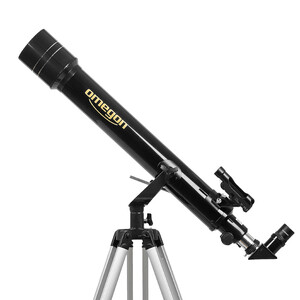
The no-pitfall starter refractor: Moon, Saturn's rings and Jupiter's moons from the very first night. No collimation.
Price: € 129
Ready to go further? A 200 mm Dobsonian gathers far more light and resolves Jupiter’s cloud belts, the Great Red Spot and the dance of its moons in much finer detail – our best-selling telescope for advancing observers:
Best for advanced observers: Skywatcher Dobson Telescope N 200/1200 Skyliner Classic
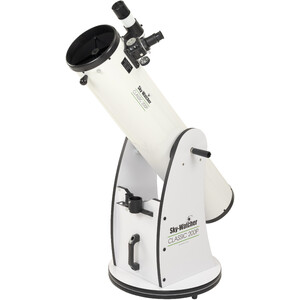
200 mm of aperture — the most sky for your money. Set it on the ground, point by hand: nebulae, clusters and galaxies for years to come.
Price: € 479
* Affiliate link: if you buy through this link we may earn a small commission from Astroshop or High Point Scientific, at no extra cost to you.
Jupiter’s cloud bands and four moons are visible in almost any telescope – the Great Red Spot needs a little more.
Six short questions, an honest answer by email – even when binoculars are the better choice.
Frequently asked questions about observing Jupiter
Can you see Jupiter’s moons with binoculars?
Yes. A simple pair of 7×50 or 10×50 binoculars shows the four Galilean moons as small points of light next to the bright planet.
Which telescope do you need to see Jupiter’s bands?
A refractor or telescope with at least 70–100 mm of aperture, used at around 100x magnification, is enough to reveal the main cloud belts. The larger the aperture, the sharper the detail.
How often is Jupiter at opposition?
About every 13 months. The planet then sits directly opposite the Sun, visible all night long and especially large and bright.
What is the Great Red Spot?
A gigantic storm, roughly the size of Earth, that has been raging for at least 150 years. In a telescope it usually shows from about 80–120x magnification, in steady air and when it is on the side facing us.
How long does Jupiter take to orbit the Sun?
Almost 12 years. That’s why the planet moves roughly one zodiac constellation further each year.
📚 Read next:
- Best beginner telescopes: buyer’s guide
- Saturn and its rings: an observing guide
- All the planets of the Solar System
This article is also available in German, French and Italian.