By Alexander Merz · Updated on · Details checked on 13 October 2026
The eyepiece is the part of a telescope you look through, and it is what sets the magnification of your instrument. Choosing the right telescope eyepieces transforms your view: the same scope can reveal razor-sharp lunar craters or sweep across a wide star field in a single glance. This guide shows you how to calculate magnification, understand eyepiece designs, and build a genuinely useful set of three to four focal lengths.
More in our overview: Telescope Accessories.
⚡ The quick answer: Magnification equals the telescope’s focal length divided by the eyepiece’s focal length. To get the most from any scope, keep three to four quality eyepieces on hand: a long focal length for wide fields (~25-40x), a medium one for the Moon and galaxies (~60-120x), and a short one for planets and fine detail (150-300x). The objective’s aperture always matters more than the highest magnification printed on the box.

Eyepiece finder for your telescope
Which eyepieces suit a telescope comes down to just two numbers: its aperture and its focal length. Find your instrument in the list – underneath you get three eyepieces that together cover what it can show, each with the magnification that results. If your telescope is not there, you can enter aperture and focal length yourself; both numbers are printed on the tube.
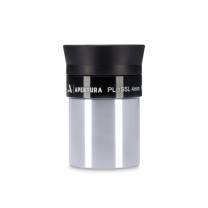
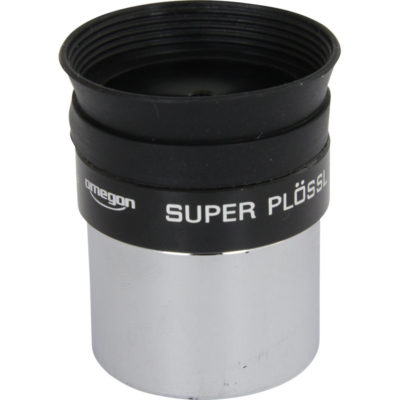
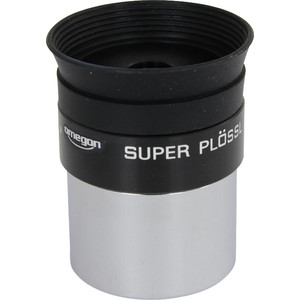
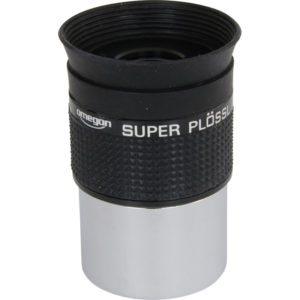
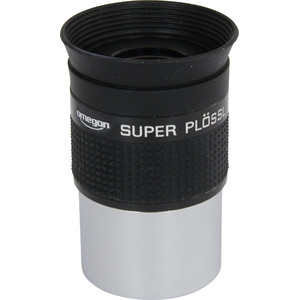
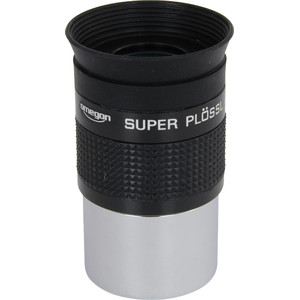
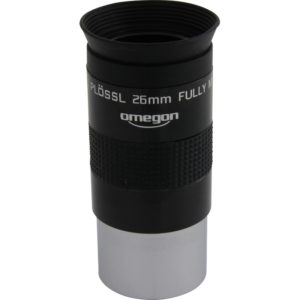
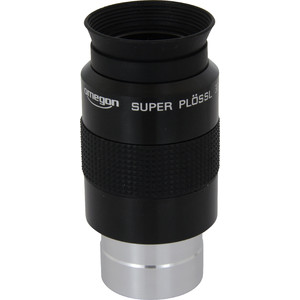
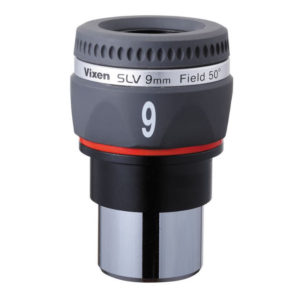
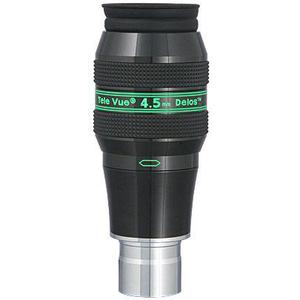
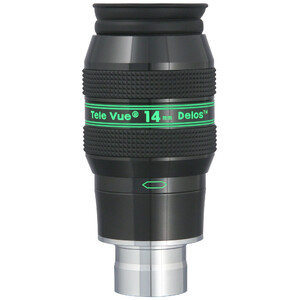
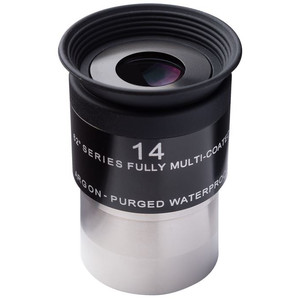
Only eyepieces with a 1.25-inch barrel are suggested, because those fit every telescope. If your focuser takes 2 inches, the wide-view eyepiece will give you noticeably more sky in the field – what the larger barrel buys you and when it is worth it is explained further down in the section on eyepiece barrel sizes.
What is a telescope eyepiece?
The eyepiece is the part of an optical system on the eye side. Opposite it, facing the object being viewed, sits the objective. What most people picture as “the telescope” is actually the objective: it forms a small image of a distant object, which the eyepiece then magnifies like a loupe until a sharp image lands on our retina.
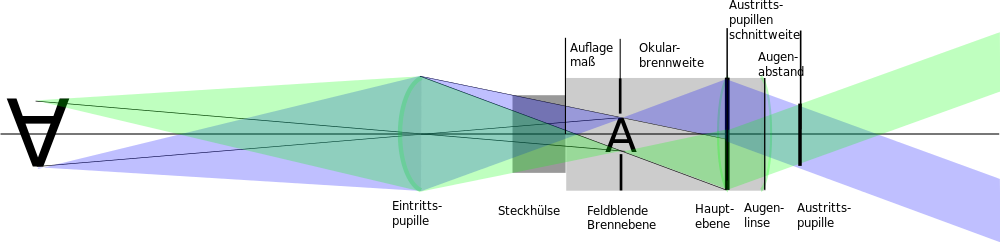
Depending on its design, an eyepiece delivers a wider or narrower apparent field of view. Below 40° you feel as if you are peering down a tunnel. Above 65°, the eye can no longer take in the whole field at once: these are wide-angle eyepieces, and they produce a striking “spacewalk” effect.
Most eyepieces hold their value well because they fit almost every type of telescope. Investing in quality eyepieces therefore pays off: they remain usable if you upgrade your telescope or add a different type to your kit.
Parfocal eyepieces
Parfocal (homofocal) eyepieces form sets you can swap one after another without re-touching the focuser. The big advantage: at high magnifications you avoid the vibrations caused by refocusing, since no focus change is needed.
Long-View (LV) eyepieces
Eye relief describes how close your eye must sit to the eyepiece to see the image. On short-focal-length eyepieces, which deliver high magnifications, this can become very uncomfortable — an even bigger problem for spectacle wearers.
To fix this, LV eyepieces build in a diverging (Barlow-type) lens that lengthens the focal length and allows far more generous eye relief. They are an excellent alternative, especially for very short focal lengths.
The parts of an eyepiece
An eyepiece combines several technical components that, working together, magnify the image formed by the objective like a magnifying glass.
The main components:
- at least two lenses (the eyepiece type depends on how they are arranged);
- a standardised barrel of 1.25″ (31.8 mm) or 2″ (50.8 mm);
- a field stop that defines the size of the visible image;
- an eyecup that shields against stray light.

Barrel diameter: 2″ vs. 1.25″
Eyepieces with a 2″ barrel only fit focusers built for that diameter. A 1.25″ eyepiece, on the other hand, can be mounted on a 2″ focuser using an adapter.
The advantage of 2″ is the large field of view, which shines at medium-to-long focal lengths and on large-aperture scopes. The drawback: a good 2″ eyepiece costs noticeably more.
Field of view
The human eye takes in about 65° without moving. An eyepiece’s field of view, by contrast, depends on its focal length and field stop.
The appeal of wide-field (wide-angle) eyepieces is a spectacular visual experience: the edges of the field slip out of perception and you feel as though your gaze is diving into space. The effect is strongest on fast, light-hungry telescopes and with a binoviewer. Viewing large deep-sky objects becomes especially immersive.
Eyepiece designs
The various construction types differ mainly in the nature and number of lenses used.
| Type | Lenses | Apparent field | Description |
| Huygens | 2 | 40° | Budget eyepiece bundled with entry-level scopes. |
| Kellner | 3 | 40° | The eye-side lens pair is cemented, reducing chromatic aberration. A common basic eyepiece. |
| Orthoscopic | 4 | 40° | Three cemented lenses further reduce aberrations, making the image “true-seeing” (orthoscopic). |
| Plössl | 4 | 50° | Two cemented doublets virtually eliminate chromatic aberration. The astronomy standard. |
| Super-Plössl (Erfle) | 5 | 60°-70° | An added converging lens between two doublets widens the apparent field (wide-angle). |
| Nagler | 8 | 87° | Multiple doublets and converging lenses create a huge apparent field. Worthwhile only on fast scopes. |
| Zoom | 6-8 | 42°-62° | A rotating mechanism varies focal length and thus magnification. Image quality dips slightly, as correcting lenses are optimal only at certain settings. |
Calculating eyepiece magnification
A telescope’s magnification follows from the focal length of the objective and that of the eyepiece:
theoretical magnification = telescope focal length / eyepiece focal length
Beside maximum magnification, the often-overlooked minimum useful magnification matters too. It depends on the aperture and the maximum pupil diameter (about 7 mm, which shrinks with age):
minimum useful magnification = aperture / 7 mm
It bears repeating: the objective’s aperture is far more decisive than theoretical magnification, because aperture sets the maximum magnification you can actually use.
maximum useful magnification = 2 × aperture
The optimal (resolving) magnification is the one that best exploits the objective’s resolving power. Go higher and the object merely looks bigger, with no extra detail.
optimal magnification = aperture / 0.7
Another selection criterion is the exit pupil (EP), which describes the size of the light beam delivered to the eye:
EP = telescope aperture / magnification
Which eyepiece focal lengths make sense?
To unlock the full potential of a beginner telescope, you need three to four quality eyepieces. Each sets a magnification suited to certain objects:
- Minimum magnification: ideal for locating an object or viewing extended targets. Too long a focal length drops below the useful minimum, pushes the exit pupil past 7 mm and wastes light.
- Optimal magnification: exploits the scope best, giving the most detail-rich image.
- Medium magnification: an intermediate focal length between minimum and optimal — very versatile.
- Maximum magnification: about twice the aperture, reserved for the rare nights of perfectly steady air (good seeing).
A worked example
Take a Dobsonian 200/1200 Classic, healthy eyes and a pupil that dilates to 7 mm. The objective has a 200 mm aperture and a 1200 mm focal length. Let’s pick our focal lengths:
The minimum magnification is 200 / 7 = 28.6x. Using “magnification = telescope focal length / eyepiece focal length”, we solve 28.6 = 1200 / focal length, giving a 41.9 mm eyepiece as our first.
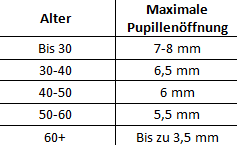
The optimal magnification is 200 / 0.7 = 285.7x, which corresponds to a 4.2 mm eyepiece. Continuing, the maximum magnification needs roughly a 3 mm eyepiece, and a medium magnification lands between the two — say 18 mm.
You buy an eyepiece for a telescope. If you do not have one yet:
Six short questions, an honest answer by e-mail – and honest sometimes means “later”.
Which eyepiece for which purpose?
| Focal length (on 1200 mm) | Use | Magnification | Eyepiece type |
| ~40 mm | Locating, extended nebulae, spacewalk | ~25x | Super-Plössl (Nagler) |
| ~15-18 mm | Moon, Sun, galaxies, planetary nebulae | ~60-100x | Super-Plössl |
| ~8-9 mm | Planets, lunar detail | ~130-150x | Super-Plössl, orthoscopic |
| ~4-6 mm | Planetary detail, double stars | ~200-300x | Orthoscopic |
As a beginner you don’t have to hunt down these eyepiece types one by one: a starter kit covers the magnifications that matter in one go, from wide-field views to lunar and planetary detail. That is exactly what this set does:
Our recommendation: Omegon Eyepiece Starter Kit
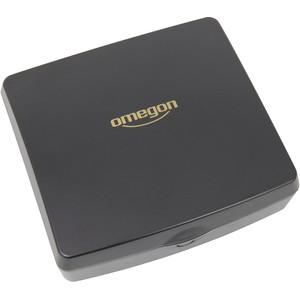
Eyepieces, filters and a Barlow in one case: everything to round out your telescope at once, cheaply.
Price: € 89
No telescope yet to put these eyepieces in? The guide best beginner telescopes helps you find the right instrument – and the most important eyepieces usually come in the box.
How the focal ratio affects your eyepieces
The focal ratio is written as f/N, where N is the f-number. An f/4 ratio is “faster” than f/10 (N sits in the denominator). It is calculated as focal length divided by aperture:
Telescope with 200 mm aperture and 1000 mm focal length = 200 / 1000 = 1/5 = f/5
On fast focal ratios (faster than f/5), the light converges at a steeper angle. This creates larger angles of incidence in both objective and eyepiece, and therefore more aberration and reflection to correct.
That correction gets technically harder: aspherical surfaces or extra lenses are required, and every new surface must be flawlessly coated. Eyepieces from TeleVue offer benchmark solutions here. Fast reflectors such as Newtonian and Dobsonian telescopes are most affected.
The zoom eyepiece
Zoom eyepieces let you vary the focal length continuously, which makes them highly versatile. The catch: their correcting lenses only correct perfectly at one focal length. Correction therefore shifts as you zoom, degrading the image slightly compared with a fixed-focal-length eyepiece, sometimes with a narrower field at the extremes.
Only high-end zooms keep this flaw to a minimum, so it is unwise to be tempted by the cheapest model.
| Model | Focal length | Ideal for | Price |
|---|---|---|---|
| Celestron 8-24 mm 40-60° 1.25" Zoom EyepieceOmegon Magnum Zoom Eyepiece 8–24 mm | 8–24 mm | The affordable way into zooming – to find out whether the design suits you | $107.95€ 49.90 |
| Celestron 8-24 mm 40-60° 1.25" Zoom EyepieceOmegon Premium Zoom Eyepiece 7.5–22.5 mm | 7.5–22.5 mm | ⭐ Best value for moneyClearly better than entry-level zooms, without the premium surcharge | $107.95€ 269 |
| Pentax SMC XF Zoom Eyepiece 6.5–19.5 mm | 6.5–19.5 mm | Optically close to fixed eyepieces – if the zoom is to become your main eyepiece | about $349€ 349 |
| Baader Hyperion Mark IV 8-24 mm 50° Zoom Eyepiece with Free CaseBaader Hyperion Universal Zoom Mark IV + Barlow | 8–24 mm | Zoom plus matching Barlow as a set – replaces a whole eyepiece case | $396.00€ 365 |
*Affiliate link: if you buy through it we earn a small commission – the price stays the same for you.
Eyepiece prices
In astronomy, a higher price usually means a better eyepiece: precision polishing, glass quality and anti-reflection coatings explain huge price gaps between otherwise similar models. You are almost always better off with the finer eyepiece. Remember, though: even a superb eyepiece can never compensate for a flawed objective.
Our eyepiece recommendation
To start out without missteps, the smartest choice is a complete kit: a few well-chosen focal lengths, a Barlow and some filters cover most observing situations and unlock the potential of any scope with a 1.25″ fitting.
🔭 Concrete eyepiece recommendations to buy
Celestron AstroMaster Accessory KitOmegon Eyepiece Starter Kit ($89.95€ 89) – a complete starter set: extra focal lengths, a Barlow and a moon filter in one case. The most sensible upgrade for any beginner telescope with a 1.25″ fitting.
Check availability →
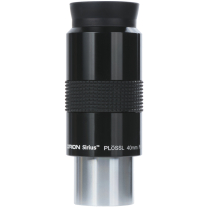
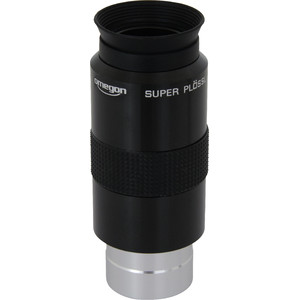
Orion 40 mm Sirius Plossl 1.25" EyepieceOmegon Super Plössl 40 mm Eyepiece ($39.95€ 39.90) – the wide-field eyepiece for star fields, the Milky Way and large nebulae; on a 1.25″ fitting it shows the maximum field this design allows.
Check availability →
Celestron 8-24 mm 40-60° 1.25" Zoom EyepieceOmegon Magnum Zoom Eyepiece 8–24 mm ($107.95€ 49.90) – one eyepiece, every magnification: ideal for homing in on the focal length you are actually missing.
Check availability →
Baader Hyperion Mark IV 8-24 mm 50° Zoom Eyepiece with Free CaseBaader Hyperion Universal Zoom Mark IV + Barlow ($396.00€ 365) – the premium solution that replaces a whole eyepiece case.
Check availability →
* Affiliate link: if you buy through this link we may earn a small commission from Astroshop or High Point Scientific, at no extra cost to you.
Super-Plössls
To expand a starter set, beginners can’t go wrong with (Super-)Plössls. They strike a good balance of sharpness, field, colour fidelity and viewing comfort at a reasonable price. As the price rises, so does their optical quality.
| Model | Focal length | Ideal for | Price |
|---|---|---|---|
| Apertura Plossl 4 mm 52° 1.25" EyepieceOmegon Super Plössl 4 mm Eyepiece | 4 mm | Lunar and planetary detail when the air is steady – on telescopes from about 700 mm focal length | $29.95€ 39.90 |
| Orion 15 mm Sirius Plossl 1.25" EyepieceOmegon Super Plössl 15 mm Eyepiece | 15 mm | ⭐ If you only buy oneThe all-rounder: enough magnification for detail, enough field to find things | $29.95€ 39.90 |
| Meade 1.25 Series 4000 - 26 mm Super Plossl EyepieceOmegon Super Plössl 26 mm Eyepiece | 26 mm | Star clusters and large nebulae – the focal length for searching | $19.95€ 39.90 |
| Orion 40 mm Sirius Plossl 1.25" EyepieceOmegon Super Plössl 40 mm Eyepiece | 40 mm | Maximum field on a 1.25″ fitting, relaxed viewing | $39.95€ 39.90 |
*Affiliate link: if you buy through it we earn a small commission – the price stays the same for you.
High-end eyepieces
The high-end classics from TeleVue are a lifetime investment. Their exceptional image quality and superb build make them outstanding eyepieces that hold excellent resale value.
| Model | Focal length | Ideal for | Price |
|---|---|---|---|
| Tele Vue 4.5 mm Delos 1.25" Eyepiece with Free CaseTeleVue Delos Eyepiece 4.5 mm 1.25" | 4.5 mm | Highest magnification on planets, 20 mm eye relief | $438.00€ 599 |
| Tele Vue 14 mm Delos 1.25" EyepieceTeleVue Delos Eyepiece 14 mm 1.25" | 14 mm | ⭐ The most sensible investmentThe everyday classic of the series: sharp to the edge, relaxed viewing | $438.00€ 569 |
| Tele Vue 22 mm Nagler Type 4 EyepieceTeleVue Nagler Eyepiece 22 mm Type 4 2" | 22 mm | Wide field on a 2″ fitting – the view TeleVue is famous for | $551.00€ 699 |
| Tele Vue 35 mm Panoptic 2" EyepieceTeleVue Panoptic Eyepiece 35 mm 2" | 35 mm | Maximum overview on a 2″ fitting for large nebulae | $485.00€ 650 |
*Affiliate link: if you buy through it we earn a small commission – the price stays the same for you.
The planetary eyepiece
Planetary eyepieces are often orthoscopics. They deliver a highly detailed image at short focal lengths (high magnifications) and are used to scrutinise planets or the Moon. In a Long-View version they offer very comfortable eye relief; the narrow field is irrelevant for detail work.
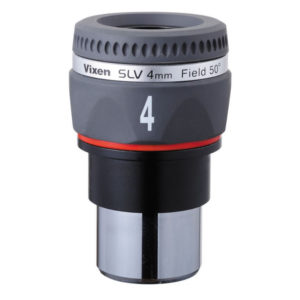
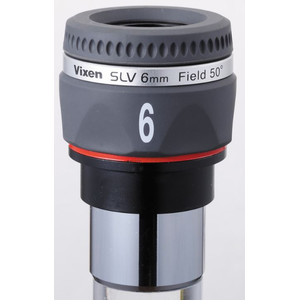
All three offer 20 mm of eye relief – you don’t have to press your eye against the glass and can keep your glasses on.
| Model | Focal length | Ideal for | Price |
|---|---|---|---|
| Vixen SLV 4 mm Eyepiece | 4 mm | The detail view of Moon and planets when the air really is steady | about $142€ 142 |
| Vixen SLV 6 mm Eyepiece | 6 mm | ⭐ The best compromiseOn most nights the highest magnification that still stays sharp | about $142€ 142 |
| Vixen SLV 9 mm Eyepiece | 9 mm | Less magnification, but the better image on average nights | about $142€ 142 |
*Affiliate link: if you buy through it we earn a small commission – the price stays the same for you.
Not sure yet which focal lengths you are missing? A Barlow lens doubles the magnification of every eyepiece you already own and is often the cheaper route to a second focal length. Which telescope suits which eyepiece is covered in the beginner’s guide.
FAQ
Which objects are 2″ eyepieces good for?
2″ eyepieces offer a very wide overview. They excel on extended objects such as nebulae and open clusters, at low magnifications and on fast telescopes. Their larger lenses make them pricier than 1.25″ eyepieces.
What are the advantages of an eyepiece?
Without an eyepiece, the image formed by the telescope would remain invisible to the eye. The eyepiece lets you set the magnification, and its internal thread accepts filters.
How much does a good eyepiece cost?
A high-end eyepiece can quickly exceed $200€200: special glass, blackened edges and anti-reflection coatings push the price up. In return, these eyepieces hold their value and sell well second-hand.
How do I calculate my eyepiece’s magnification?
Divide your telescope’s focal length by the eyepiece’s focal length. A 10 mm eyepiece on a 1000 mm scope yields 100x.
Is a zoom eyepiece as good as a set of fixed eyepieces?
A good zoom adds real convenience, with no eyepiece swapping. But only quality models rival fixed focal lengths optically, and their price can exceed that of three classic eyepieces.
Read next:
- Best beginner telescopes: how to choose
- How to buy a telescope: the complete guide
- Observing the planets with a telescope
This article is also available in other languages: Deutsch (original) · Français · Italiano
Sources
- Alturand, Strahlengang im Teleskop mit Okular, CC BY-SA 4.0, retrieved 05 Jan 2020
- Kapege.de, Okulare, CC BY-SA 3.0, retrieved 05 Jan 2020