By Alexander Merz · Updated on · Details checked on 14 October 2026
Venus is the second planet from the Sun: at 12,104 km across it is almost as large as Earth, and at 464 °C it is the hottest of the eight planets. After the Sun and the Moon, it is the brightest object in the sky.

Venus fact sheet
- Rocky planet, 2nd from the Sun
- No moons, no rings
- Diameter: 12,104 km
- Orbital period: 224.7 days
- Length of day: 243 days (retrograde)
- Distance from the Sun: 108.2 million km
- Temperature: 464 °C
- Atmosphere: 96.5 % CO₂
📋 The key facts
Venus is the second planet from the Sun, a rocky planet 12,104 km in diameter (95 % of Earth’s) and without any moons. It orbits the Sun in 224.7 days at a mean distance of 108.2 million kilometres. Its atmosphere is 96.5 % carbon dioxide and drives a greenhouse effect that heats the surface to around 464 °C – hotter than on Mercury, which is closer to the Sun.
Venus spins backwards, and so slowly that one rotation takes 243 Earth days. A day on Venus is therefore longer than a Venus year.
Observing in 2026/27 (calculated for central Europe): After inferior conjunction on 24 October 2026, Venus becomes a morning star from early November 2026. On 25 November it reaches its greatest brilliancy at −4.9 mag, and on 9 December its greatest altitude of almost 25 degrees.
The evening sky in 2026, on the other hand, is a write-off. Venus will not be an evening star again until late November 2027, with a peak in spring 2028.
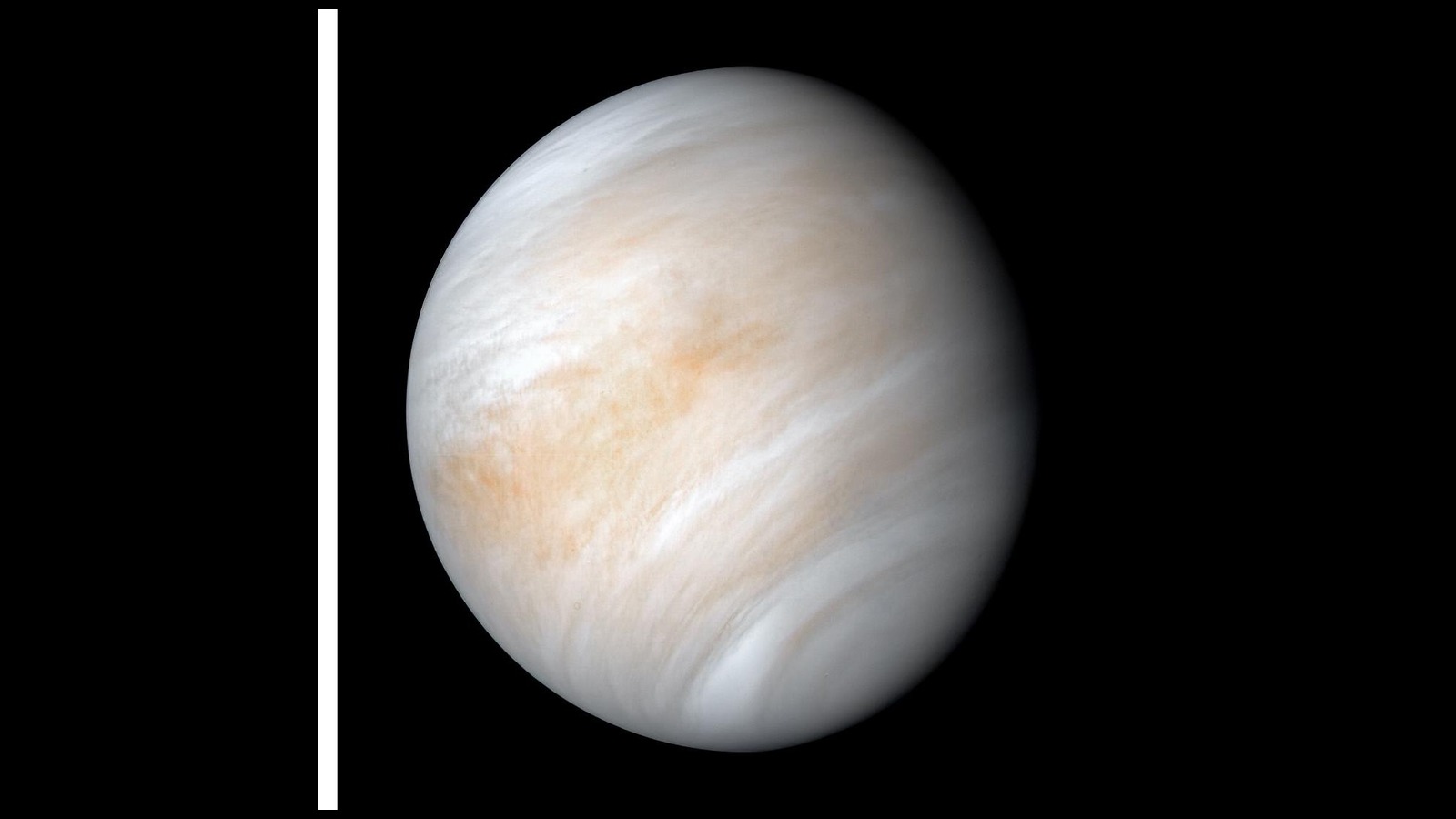
Venus fact sheet: all the planet’s key data at a glance
The following values come from NASA and ESA reference data. Two figures deliberately differ from what many fact sheets online state: the mean distance from the Sun is 108.2, not 110 million kilometres, and the often-quoted “116-day length of day” is not the rotation period but the solar day – more on that further down.
| Property | Value |
|---|---|
| Position in the Solar System | 2nd planet from the Sun |
| Type of planet | Rocky planet (terrestrial planet) |
| Diameter (equator) | 12,104 km (0.95 Earth diameters) |
| Circumference | 38,025 km |
| Mass | 4.867 · 1024 kg (0.815 Earth masses) |
| Mean density | 5,243 kg/m³ |
| Surface gravity | 8.87 m/s² (90 % of Earth’s) |
| Escape velocity | 10.36 km/s |
| Mean distance from the Sun | 108.21 million km (0.723 AU) |
| Closest / farthest point from the Sun | 107.48 / 108.94 million km |
| Orbital period around the Sun (Venus year) | 224.7 days |
| Orbital speed | 35.02 km/s |
| Orbital inclination / eccentricity | 3.39° / 0.0068 |
| Rotation period (sidereal) | 243.0 days – retrograde |
| Solar day (day–night cycle) | 116.75 days |
| Axial tilt | 177.4° |
| Mean surface temperature | 464 °C (737 K) |
| Surface pressure | 92 bar (92 times Earth’s) |
| Atmosphere | 96.5 % CO₂, 3.5 % nitrogen |
| Cloud cover | Sulphuric acid, 45–70 km altitude |
| Albedo (reflectivity) | 0.77 (Bond albedo) – highest of all planets |
| Number of moons | 0 |
| Ring system | no |
| Magnetic field | no global magnetic field |
| Apparent magnitude | −3.8 to −4.9 mag |
| Synodic period | 583.9 days |
| Closest / farthest distance from Earth | 38.2 / 261 million km |
| Apparent diameter | 9.7″ to 66″ (arcseconds) |
| Age | approx. 4.5 billion years |
| Age of the surface | 500–700 million years |
| Named after | Venus, Roman goddess of love |
For comparison: Mercury is considerably smaller, and Mars is only just over half the diameter of Venus. You’ll find an overview of all eight planets and their key figures on our planets page.
How big is Venus compared to Earth?
Venus is only 5 percent smaller than Earth and weighs in at 82 percent of its mass. If you stood on it, you would feel 90 percent of your weight on Earth. That, however, is where the similarity ends.
| Property | Venus | Earth |
|---|---|---|
| Diameter (equator) | 12,104 km | 12,756 km |
| Mass | 0.815 Earth masses | 1 (5.97 · 1024 kg) |
| Mean density | 5,243 kg/m³ | 5,514 kg/m³ |
| Gravity | 8.87 m/s² | 9.81 m/s² |
| Mean temperature | 464 °C | 15 °C |
| Air pressure at the surface | 92 bar | 1 bar |
| One rotation | 243 days, backwards | 23 h 56 min |
| One year | 224.7 days | 365.25 days |
| Moons | 0 | 1 |
What makes Venus special: seven things that make it unique
On paper, Venus is Earth’s twin; in practice, it is a planet of records. It has several properties that no other planet shares – here are the most important ones at a glance.
| Special feature | What’s behind it |
|---|---|
| Longest day | One rotation takes 243 days – longer than its year of 224.7 days. |
| Spins backwards | Apart from Uranus, the only planet with retrograde rotation: the Sun rises in the west there. |
| Hottest planet | 464 °C, even though Mercury is almost twice as close to the Sun. |
| Brightest planet | Up to −4.9 mag, because its clouds reflect 77 percent of the sunlight. |
| Roundest orbit | With an eccentricity of 0.0068, it travels on an almost perfect circle. |
| No moon, no magnetic field | Like Mercury it has no moon – and no global magnetic field either. |
| Female name | The only planet named after a goddess. |
On top of that, its surface is only 500 to 700 million years old, which makes it geologically young. You’ll find out why in the section Surface of Venus.
Venus as a morning star in 2026/27: the best apparition in years
On 24 October 2026, Venus passes between Earth and the Sun – this is inferior conjunction. A few days later it reappears in the morning sky, and one of its best apparitions of this decade begins.
We calculated the altitude and brightness ourselves for 51° north latitude (central Germany, i.e. central Europe), in each case at the start of civil twilight.
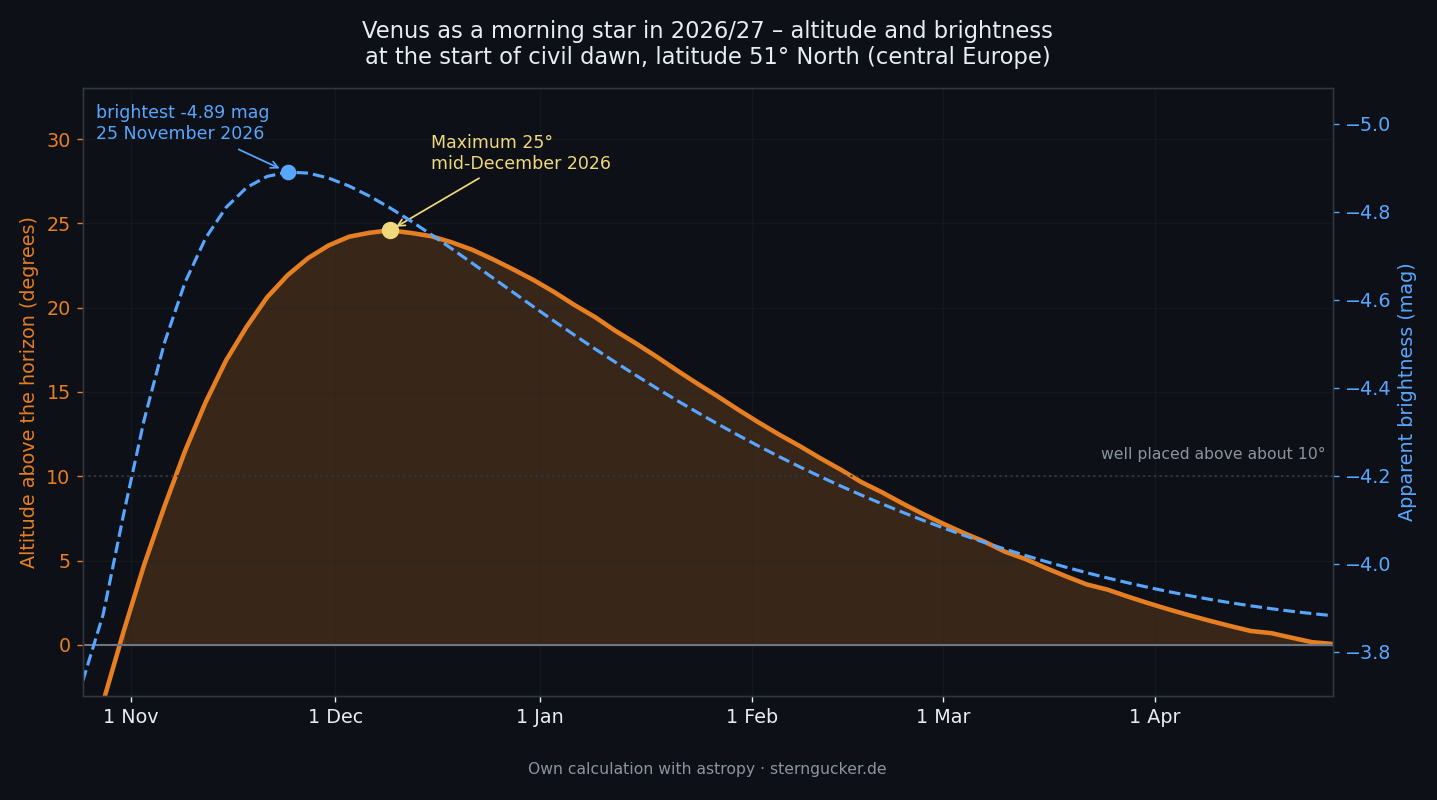
When does Venus become a morning star in 2026?
At the end of September 2026, Venus is still east of the Sun and therefore, formally, an evening star. You can’t actually see it at the moment, though: it sets while the twilight is still bright and is moving towards the Sun.
From 1 November 2026, Venus is above the horizon in the morning again, at first only just over 2 degrees high – you’ll need a completely unobstructed view to the east-southeast. After that, things move quickly: by mid-November it is already almost 17 degrees, by early December 24 degrees.
The peak comes on 9 December 2026 at around 24.6 degrees. Until early February 2027 it stays above 13 degrees and is therefore easy to observe; from March it gets lower, and in mid-April it disappears into the twilight.
You can watch the show with the naked eye – but it gets more exciting with optics: in a telescope, Venus shows its phases like a little Moon. Which instruments can do this is covered in our buying guide Telescope for planets; how to go about it is explained in the section Observing Venus through a telescope.
| Date | Altitude in twilight | Brightness | What’s special |
|---|---|---|---|
| 1 Nov 2026 | 2° | −4.86 mag | first reappearance, very low |
| 7 Nov 2026 | 8° | −4.88 mag | thin crescent Moon just over 2° from Venus |
| 9 Nov 2026 | 10° | −4.88 mag | close encounter with Spica (1.2°) |
| 25 Nov 2026 | 22° | −4.89 mag | greatest brilliancy of the apparition |
| 1 Dec 2026 | 24° | −4.87 mag | crescent easy to see in binoculars |
| 9 Dec 2026 | 25° | −4.83 mag | highest position |
| 3 Jan 2027 | 21° | −4.54 mag | greatest western elongation (47°), half-lit Venus |
| 1 Feb 2027 | 13° | −4.26 mag | almost two-thirds lit, disc 19″ |
| 1 Mar 2027 | 7° | −4.07 mag | farewell to the morning sky |
The best dates: Moon, Spica and peak brightness
There are three dates worth noting down. On 7 November 2026, the thin waning crescent Moon stands only about two and a half degrees from Venus in the morning twilight – just under five full-Moon widths, and a rewarding photo subject even with a smartphone.
On 9 November, Venus passes 1.2 degrees from Spica, the brightest star in Virgo. And on 25 November it reaches its peak brightness of −4.89 mag: in clear air at a dark site, it then casts a visible shadow.
Constellation and direction: where to find Venus
Look southeast in the morning twilight. In early November, Venus is low in the east-southeast; by Christmas it moves round to the south-southeast.
| Period | Constellation | Direction in twilight |
|---|---|---|
| 1 Nov – 14 Dec 2026 | Virgo | east-southeast to southeast |
| 15 Dec 2026 – 9 Jan 2027 | Libra | south-southeast |
| 10 – 31 Jan 2027 | briefly Scorpius, then Ophiuchus | south-southeast |
| February 2027 | Sagittarius | south-southeast to southeast |
| March 2027 | Capricornus, from 25 March Aquarius | southeast to east-southeast, very low |
The constellation hardly matters when you’re looking for it: Venus is brighter than any star and outshines its surroundings in the twilight anyway. The data are our own calculations with Skyfield for 51° North (central Europe).
Why the 2026 evening apparition is practically a write-off
On paper, Venus is an evening star in August and September 2026, reaching its greatest eastern elongation of 45.9 degrees on 15 August. From central Europe, however, that doesn’t help much: in late summer, the ecliptic lies very flat above the western horizon in the evening.
Our calculation gives an altitude of only 4.8 degrees at the end of civil twilight on 15 August, 2.3 degrees on 1 September, and from mid-September it is already below the horizon. If you really want to see Venus in 2026, wait for November.
When will Venus be an evening star again?
After superior conjunction on 11 August 2027 – Venus is then behind the Sun – it moves over to the evening sky. From late November 2027 it stands more than 5 degrees high in the southwest at the end of civil twilight.
The evening apparition in spring 2028 will be excellent. On 22 March 2028, Venus reaches its greatest eastern elongation and stands a good 35 degrees high in the evening twilight – much higher than during the 2026/27 morning apparition. Peak brightness follows at the end of April, and at the end of May it disappears again.
| Date | Altitude in twilight | Brightness | What’s special |
|---|---|---|---|
| 11 Aug 2027 | – | – | superior conjunction, invisible |
| 1 Dec 2027 | 6° | −3.91 mag | back in the evening sky, southwest |
| 1 Feb 2028 | 26° | −4.12 mag | comfortably high in the west-southwest |
| 22 Mar 2028 | 36° | −4.46 mag | greatest eastern elongation (46°), half-lit Venus |
| 30 Apr 2028 | 26° | −4.75 mag | greatest brilliancy, crescent in binoculars |
| 1 Jun 2028 | – | – | inferior conjunction |
Morning star and evening star: why Venus has two names
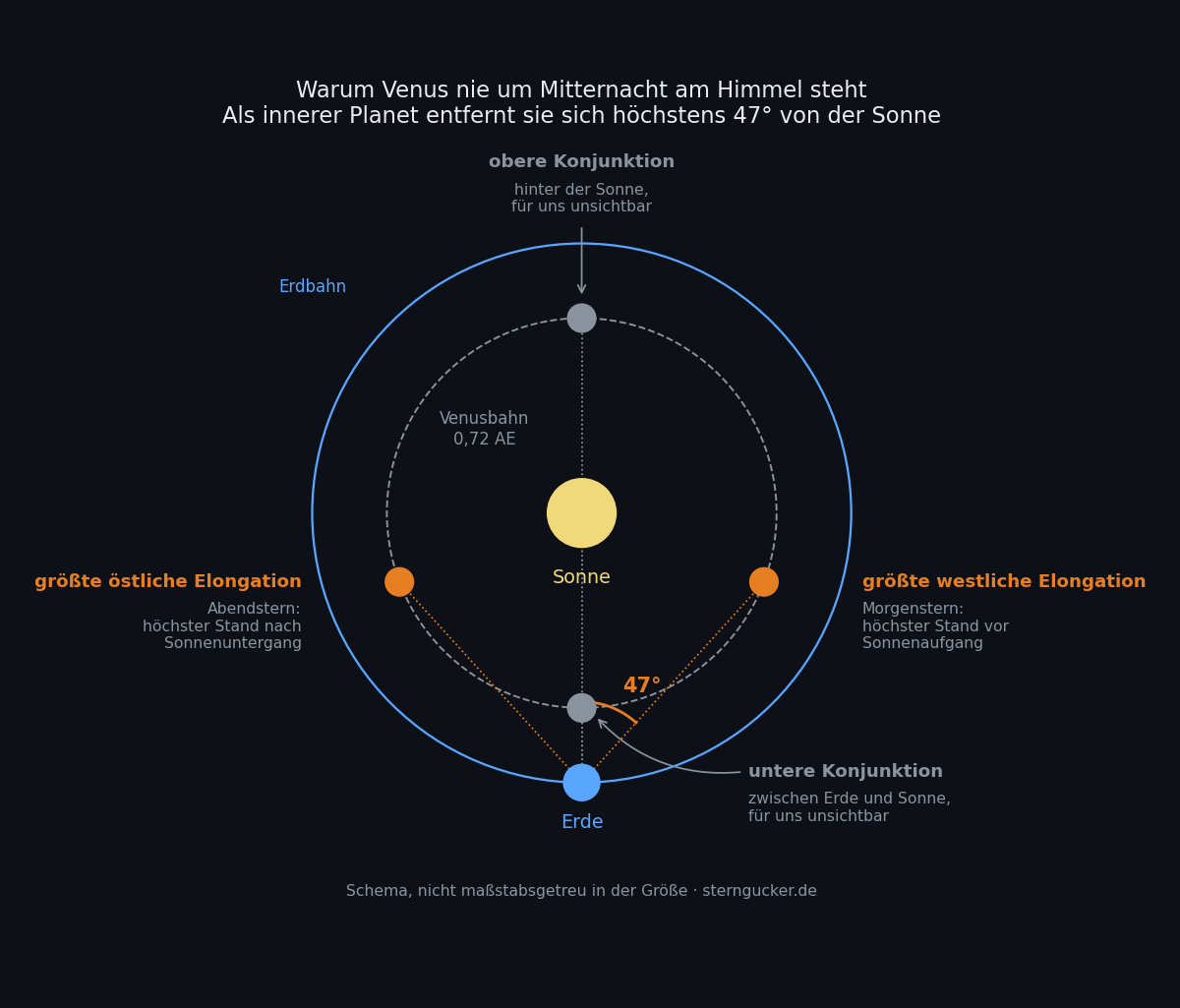
Venus is an inferior planet: its orbit lies inside Earth’s orbit. As seen from Earth, it can therefore never move far from the Sun – at most about 47 degrees.
It always rises shortly before the Sun or sets shortly after it, and is therefore only visible in the morning or evening twilight. Venus is never in the sky at midnight.
What other names does Venus have?
It is known as the morning star, the evening star and, in folk tradition, also as the shepherd’s star. For a long time the Greeks thought the two appearances were two different objects and called them Phosphoros (light-bringer) and Hesperos (of the evening); the Romans turned these into Lucifer and Vesper.
Its present name comes from the Roman goddess of love and beauty – it is the only planet with a female name. In China it is called the “metal star”; in Norse tradition it was linked with Freyja, and in Mesopotamia with Ishtar.
Elongation, conjunction and the 584-day rhythm
The switch between evening and morning star follows a fixed beat. After superior conjunction (Venus behind the Sun) it appears in the evening sky, moves out to its greatest eastern elongation and then swings rapidly back to inferior conjunction (Venus between Earth and Sun). After that, it is a morning star.
A complete cycle takes 583.92 days – the synodic period. The Babylonians already knew this rhythm: the Venus tablet of King Ammi-şaduqa records exactly this 584-day interval from around 1645 BC.
Orbital period of Venus: a Venus year lasts 225 days
Venus circles the Sun in 224.7 days, travelling at around 35 kilometres per second – noticeably faster than Earth at 29.8 km/s. That’s no coincidence but celestial mechanics: the closer a planet is to the Sun, the harder the Sun pulls on it and the faster it has to move so as not to fall in. With an eccentricity of 0.0068, its orbit is the most circular of all planetary orbits in the Solar System.
A day on Venus is longer than a Venus year
This is perhaps the planet’s strangest property. Venus needs 243.0 Earth days for a single turn on its own axis – longer than for a complete orbit of the Sun. So a “day” there lasts longer than a “year”.
That makes it the slowest rotator in the Solar System: a point on the Venusian equator moves at a leisurely 6.5 kilometres per hour – a pedestrian could almost keep up. On Earth’s equator it is 1,670 km/h.
116 days: the truth behind the “length of day”
Almost every fact sheet online gives Venus a day length of 116 days and mixes it up with the rotation. Both figures are correct – they are just two different things. The sidereal rotation (one turn relative to the stars) takes 243.0 days.
But because Venus is orbiting the Sun at the same time and, on top of that, spinning backwards, only 116.75 days pass between two sunrises. That is the solar day, and it follows exactly from 1 ÷ (1/243.0 + 1/224.7). So a Venus year contains just under two Venus solar days.
Why does Venus spin backwards?
Its axis is tilted by 177.4 degrees – it is practically upside down. For an observer on the surface, the Sun would rise in the west and set in the east.
Two explanations compete: a huge impact early in its history that knocked the planet over – or tidal forces from the Sun which, together with the dense atmosphere, first slowed the rotation over billions of years and then reversed it. The second explanation is now considered more likely.
Structure of Venus: what the planet is made of
Venus is a rocky planet and – like Earth – consists of an iron-nickel core, a mantle of silicate rock and a thin crust. The core has a radius of about 3,200 kilometres, the mantle is around 2,800 kilometres thick, and the crust just 20 to 50 kilometres. At 5,243 kg/m³, its mean density is almost as high as Earth’s – so Venus is made of the same material in similar proportions.
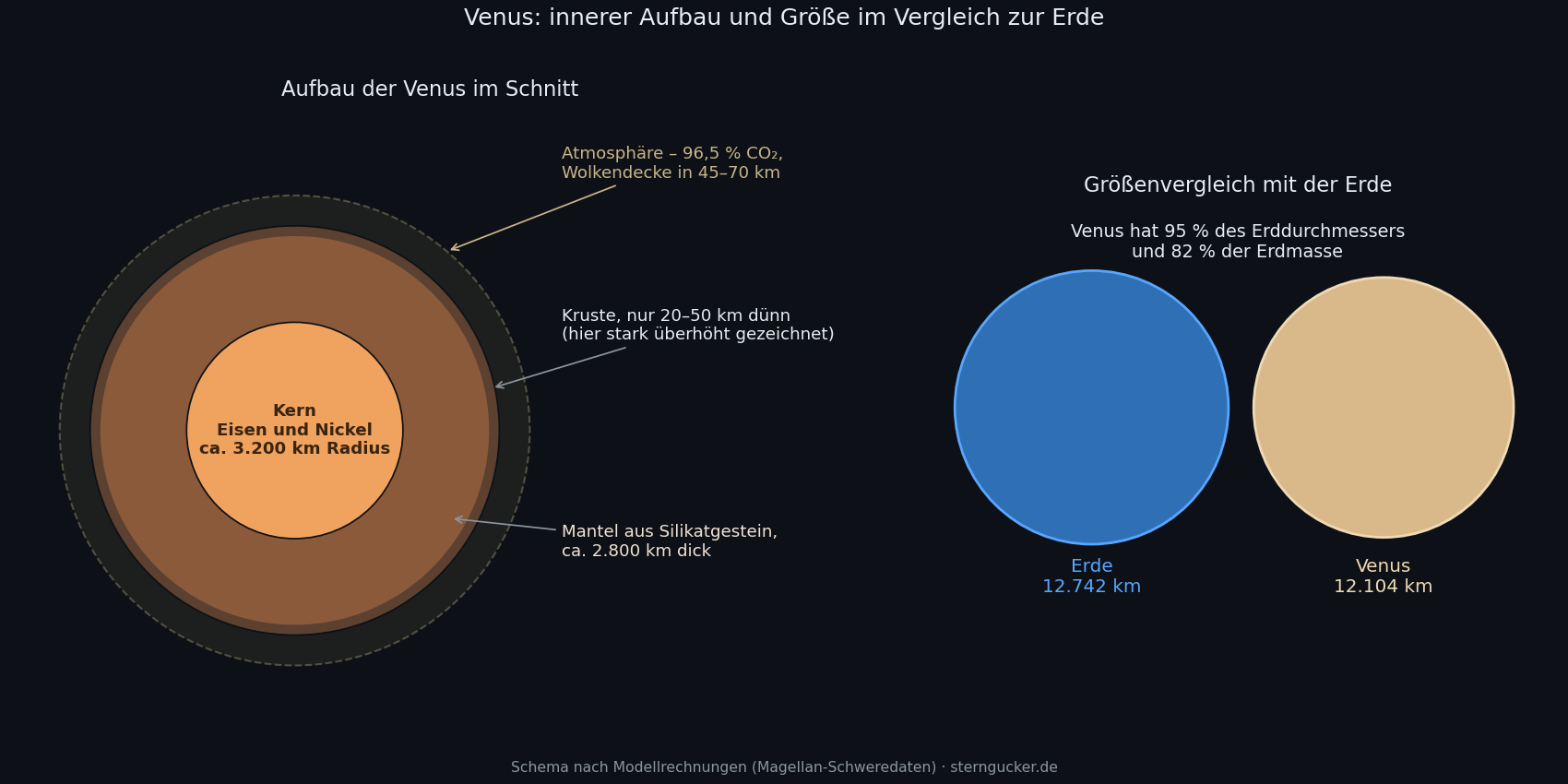
| Layer | Extent | What it is made of |
|---|---|---|
| Core | radius about 3,200 km | iron and nickel, probably partly liquid |
| Mantle | about 2,800 km thick | silicate rock |
| Crust | 20–50 km thick | volcanic rock (basalt) |
| Atmosphere | 92 bar at the surface | 96.5 % carbon dioxide, 3.5 % nitrogen |
| Cloud cover | 45–70 km altitude | droplets of sulphuric acid |
There is still one crucial difference inside: Venus has no global magnetic field. Mariner 2 established this as early as 1962. The reason is probably its extremely slow rotation – a dynamo in the liquid core needs spin to build up a field.
Without a magnetic field, there is no shield against the solar wind, which for billions of years has been carrying light atoms away from the upper atmosphere. That explains why Venus has lost practically all its water.
Plate tectonics: Venus does it differently
Earth releases its internal heat via drifting continental plates. On Venus there is no plate tectonics in the Earthly sense – the crust is a single rigid lid.
The usual explanation: heat builds up beneath the crust until it is released in global volcanic outbreaks that repave the surface over large areas. That fits neatly with the strikingly young surface age of 500 to 700 million years.
Atmosphere and temperature: 464 degrees beneath sulphuric acid clouds
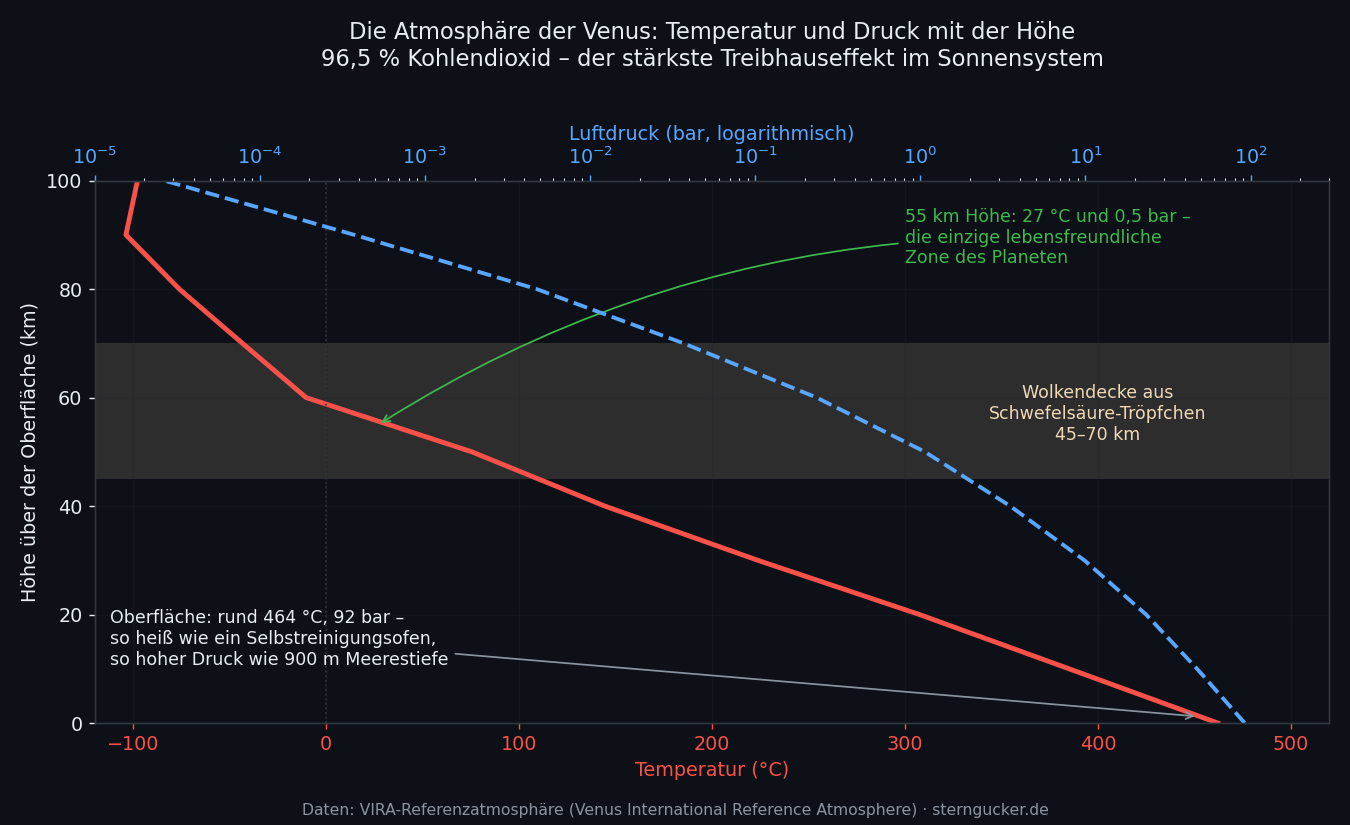
The Venusian atmosphere is 96.5 percent carbon dioxide and 3.5 percent nitrogen, plus traces of sulphur dioxide, argon, water vapour and carbon monoxide. It is so massive that the pressure at the surface is 92 bar – as much as 900 metres down in the ocean.
The cloud deck of sulphuric acid droplets lies between 45 and 70 kilometres up and is completely closed. From the ground, the Sun would therefore never be visible as a disc.
Venus temperature: day, night, poles and peaks
On Venus it is practically just as hot by day as by night: around 464 °C. The dense atmosphere distributes the heat so well that neither the poles nor the months-long night side cool down noticeably. It only gets cooler with altitude.
| Location | Temperature | Pressure |
|---|---|---|
| Surface, average | 464 °C | 92 bar |
| Night side and poles | only a few degrees cooler | 92 bar |
| Summit of Maxwell Montes (11 km) | around 380 °C | around 45 bar |
| Cloud layer at 55 km altitude | around 27 °C | around 0.5 bar |
| Cloud tops at 70 km altitude | around −45 °C | around 0.04 bar |
| For comparison: Mercury | 430 °C by day, −180 °C at night | practically zero |
| For comparison: Earth | 15 °C on average | 1 bar |
Hottest planet: why Venus is hotter than Mercury
Venus is the hottest planet in the Solar System, even though Mercury is almost twice as close to the Sun. Mercury’s day side, however, “only” reaches about 430 degrees – and it cools to −180 degrees at night. Venus, by contrast, holds a constant 464 degrees or so, day and night, at the equator and at the poles.
The reason is the greenhouse effect: visible sunlight gets through to the surface, but the heat radiated back is trapped by the carbon dioxide.
Without the greenhouse effect, the temperature would be around −40 degrees. So around 500 degrees of heating are down to CO₂ alone – Venus is the most dramatic example of a runaway greenhouse effect known to science.
Super-rotation: clouds faster than the planet
While the body of the planet turns once in 243 days, the upper cloud layer races around Venus in just four days – at about 360 km/h. This super-rotation is still not fully explained; the Japanese probe Akatsuki identified thermal tides in the atmosphere as a driving force. At the surface, by contrast, there is hardly any wind, only a few kilometres per hour – but in a gas about 50 times denser than our air.
Why is Venus so bright?
Two reasons come together. Firstly, Venus is close – only about 40 million kilometres away at inferior conjunction; no other planet comes closer to us.
Secondly, its closed cloud deck reflects 70 to 80 percent of the sunlight. This albedo is the highest of all the planets; Earth manages 0.3, Mars only 0.25. At up to −4.9 mag, Venus is therefore a good 20 times brighter than Sirius, the brightest star.
It is so bright that it regularly gets reported as a UFO. When it is low above the horizon, the turbulent air makes even its steady light flicker and change colour.
What Venus looks like: the planet’s real colour
From the outside, Venus is a creamy white to slightly yellowish ball with no visible detail. What you see in the sky and through a telescope is always the top of the closed cloud deck, never the ground.
| View | What you see | Colour |
|---|---|---|
| Naked eye | very bright, steadily shining point | white to yellowish white |
| Binoculars and telescope | small disc or crescent without detail | creamy white |
| Telescope with UV filter | dark, changing cloud bands | shades of grey |
| Radar (Magellan) | volcanoes, highlands, lava plains | orange is false colour |
| On the ground (Venera 13 and 14) | sharp-edged slabs of basalt | yellowish-orange light, dark rock |
The familiar orange images of Venus are false-colour radar data. NASA based the hues on the photos from the Venera landers; a camera sees nothing through the clouds.
On the surface itself, the sky is permanently a murky yellowish orange, because the dense atmosphere filters out the blue part of the sunlight. In this light, the dark basalt rock looks reddish brown.
In visible light the clouds are featureless, but in ultraviolet they show clear patterns: a substance that has still not been identified with certainty absorbs UV light and draws dark bands. With a UV pass filter and a planetary camera, amateurs can photograph these structures too – how to do it is explained in our guide to planetary photography.
Surface of Venus: volcanoes, highlands and hardly any craters
Because the clouds block every view, we only know the surface of Venus from radar measurements – most precisely from NASA’s Magellan spacecraft, which mapped almost the entire planet between 1990 and 1994. The result is a landscape of vast volcanic plains, two larger highland regions (Ishtar Terra in the north, Aphrodite Terra at the equator) and more than 1,600 large volcanoes. The highest mountain, Maxwell Montes, rises eleven kilometres – two kilometres higher than Mount Everest.
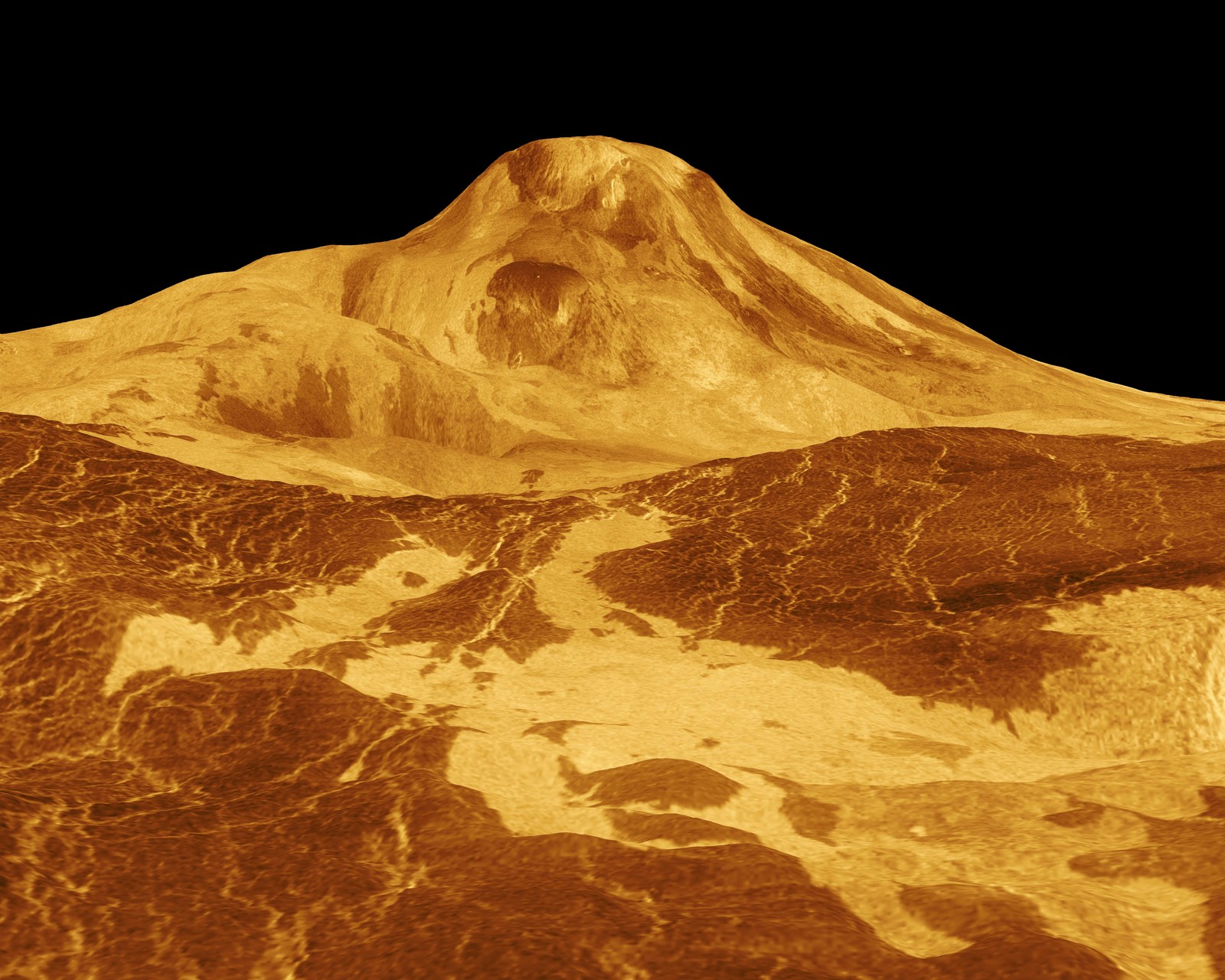
What’s striking is what’s missing: impact craters. Venus has only around 1,000 of them, evenly spread across the planet – a sign that the entire surface was renewed 500 to 700 million years ago within a geologically short time.
Small meteorites never reach the ground anyway: they burn up in the dense atmosphere. That’s why there isn’t a single crater on Venus smaller than about three kilometres across.
Is Venus still volcanically active today?
There’s a lot to suggest it is. In 2023, researchers found a vent on the volcano Maat Mons in old Magellan radar data that had visibly changed between two passes in 1991 – the first direct image of an active eruption.
On top of that there are fluctuating sulphur dioxide levels in the atmosphere and strikingly fresh lava flows. The upcoming VERITAS and EnVision missions are meant to settle exactly this question.
Formation of Venus: how Earth’s twin turned into a hell
Venus and Earth formed around 4.5 billion years ago in the same region of the protoplanetary disc, from the same material and with almost the same mass. Model calculations suggest that the young Venus had liquid water – perhaps even an ocean that lasted for a few hundred million years.
Then the system tipped over. The Sun slowly grew brighter, water evaporated, and water vapour is itself a powerful greenhouse gas: it got warmer, more water evaporated, it got warmer still. In the upper atmosphere, UV radiation split the water molecules and the light hydrogen escaped into space.
Without water, carbon dioxide could no longer be locked away in carbonate rock – all the CO₂ stayed in the air. On Earth, a comparable amount of carbon is stored in the limestone of the seabed. In the end, the difference between Earth and Venus comes down to just this: around 41 million kilometres more distance from the Sun.
Neighbouring planets: where Venus sits in the Solar System
Venus is the second planet from the Sun. Its neighbours are Mercury on the inside and Earth on the outside.
That makes it one of the four inner rocky planets: Mercury, Venus, Earth and Mars. If you want to memorise their order, you’ll find a few handy mnemonics on our page about the planet mnemonic.
Does Venus have any moons?
No. Venus and Mercury are the only planets in the Solar System with no moon at all.
The reason probably lies in its closeness to the Sun: the Sun’s tidal forces make stable orbits around such a nearby planet difficult, and a captured body would, over long periods, either crash or drift away. In the 17th and 18th centuries, several astronomers reported a moon of Venus called “Neith” – it turned out to be reflections in the telescope.
Observing Venus through a telescope: phases instead of surface
Venus is the most rewarding and at the same time the most disappointing telescope target in the sky. Rewarding, because it is so bright that any instrument shows it, and you can even find it in the daytime sky.
Disappointing, because you see nothing on it: no cloud belts as on Jupiter, no polar cap as on Mars, just a featureless white surface. What makes Venus interesting is its shape.
Can you see the phases of Venus?
Yes – even in a pair of 10x binoculars mounted steadily, once the crescent is large enough. In a telescope, the change of phase is unmistakable at 30 to 50 times magnification.
Venus goes through the same phases as the Moon, but with one special twist: the thinner the crescent, the larger it appears, because that’s when it is closest to us. Its disc varies between 9.7 and 66 arcseconds – almost a factor of seven.
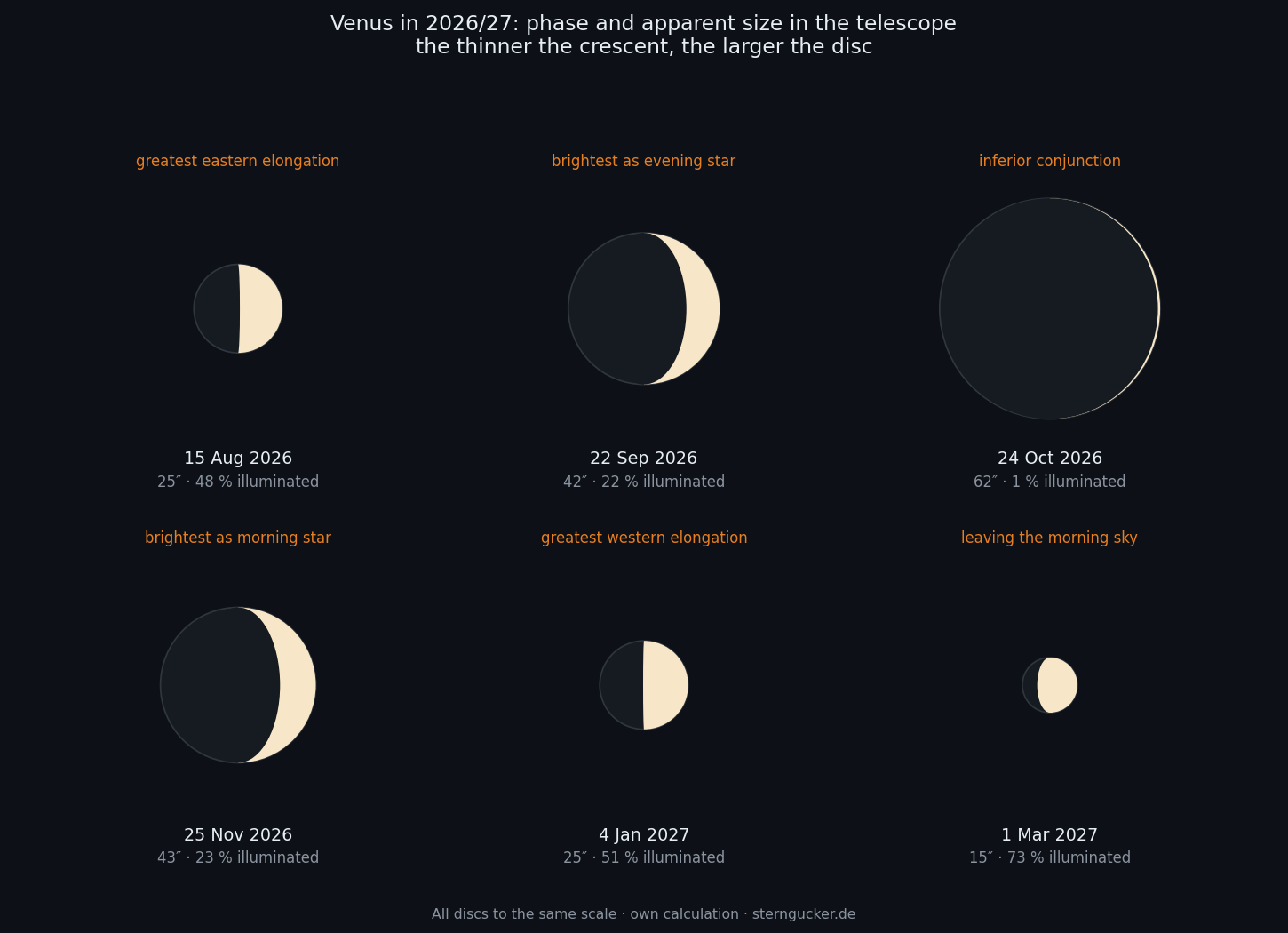
It was exactly these phases that in 1610 provided the decisive proof against the Ptolemaic world view – more on that below in the section on the history of research.
Which telescope is worth it for Venus?
Venus itself doesn’t need much: just 60 millimetres of aperture – the diameter of the front lens or primary mirror – will show its phase. But if you’re buying an instrument anyway, don’t optimise it for Venus; optimise it for everything else.
And here the rule is: for planets, lunar craters, Saturn’s rings and Jupiter’s moons, a telescope is clearly superior to binoculars. Binoculars show Venus as a bright point with a hint of a crescent; on the same evening a telescope will also show you Saturn’s rings and craters along the Moon’s terminator.
If you can only buy one instrument and really want to explore the sky, go for a telescope; binoculars are the complement, not the substitute. What matters for planets in terms of focal length, aperture and design is covered in detail in our guide Which telescope for planets?
The best way into planetary viewing: Skywatcher Dobson Telescope N 130/650 Heritage FlexTube
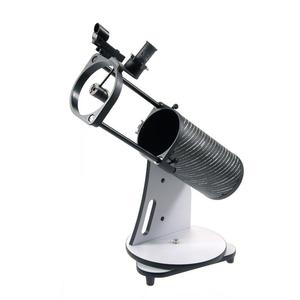
A compact tabletop Dobson with a true parabolic mirror. Folds down, fits in a bag: the Moon, planets and the bright deep-sky classics.
Price: € 265
If you want more: Sky-Watcher Skymax-127 AZ-GTi GoTo WiFi
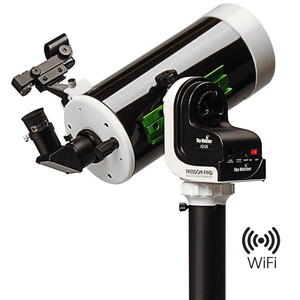
In any telescope, Venus only ever shows its phase – there are no surface details. The Skymax-127 is worth it if you mainly want to observe planets and the Moon: the long focal length delivers pin-sharp phases at high magnification, and the GoTo control finds Venus even in bright twilight. Important: never swing it near the Sun.
Price: € 775
With Venus, one thing matters above all: don’t magnify too much. Because it is so bright, it dazzles at low magnification and shows coloured fringes.
It looks best in twilight, when the sky background is still bright – the contrast then drops and the crescent looks calmer. 60 to 120 times magnification is quite enough. If your telescope doesn’t come with suitable eyepieces for that, a small set is the most sensible first addition.
For the right magnification: Omegon Eyepiece Starter Kit

Eyepieces, filters and a Barlow in one case: everything to round out your telescope at once, cheaply.
Price: € 89
The Schröter effect: when half-Venus comes too early
By calculation, Venus ought to be exactly half lit at greatest elongation – on 3 January 2027, precisely 50 percent. In reality, half phase occurs a few days early in the evening sky and a few days late in the morning sky. The Bremen astronomer Johann Hieronymus Schröter described the phenomenon around 1793; Patrick Moore later named it the Schröter effect.
The cause is the scattering of light in the Venusian atmosphere at the terminator. If you observe the crescent over several weeks and take notes, you can demonstrate this effect yourself – one of the few projects for which amateurs are still needed.
Finding Venus in the daytime sky
Venus is bright enough to be seen with the naked eye in a blue sky – you just have to know where to look. It’s easiest on a day when the Moon is nearby: find the Moon first, then search at the calculated distance from it. On 7 November 2026, the gap shrinks to just under 2 degrees by late morning – an ideal date to try it.
Caution: never point the telescope anywhere near the Sun without shading the optics. Even a brief glance at the Sun through a telescope causes permanent blindness.
Exploring Venus: from the Babylonians to Akatsuki
No other planet has been observed for so long and so early – and none has turned astronomy upside down so thoroughly.
The early naked-eye observations
The Venus tablet of Ammi-şaduqa from Babylon is one of the oldest surviving astronomical records of all: from around 1645 BC it records the risings and settings of Venus over 21 years and documents the 584-day interval.
The Maya based their calendar on the same cycle. The idea that the morning and evening star are the same celestial body only took hold in Greece with Pythagoras.
Galileo in 1610: the phases of Venus topple the world view
When Galileo Galilei pointed his telescope at Venus in 1610, he saw that it shows phases like the Moon – and the full set, right up to an almost full disc. In Ptolemy’s geocentric world view, where Venus always stays between Earth and Sun, that is impossible; there it could never show more than a crescent. The observation was one of the first hard empirical pieces of evidence for the heliocentric world view – and Galileo was so aware of this that he initially encoded it as an anagram.
Discovering the atmosphere during the transits of Venus
During the rare transit of Venus in 1761 – when Venus crosses in front of the solar disc as a black dot – several observers noticed a glowing ring around the dark planet, among them Mikhail Lomonosov and the German astronomer Georg Christoph Silberschlag. The ring is caused by sunlight refracted in the Venusian atmosphere: the first evidence of an atmosphere on another planet. Incidentally, the next transits of Venus won’t happen until 2117 and 2125.
The space probe race from 1961
Venus was the first target of planetary exploration – and became a prestige project of the Cold War. The Soviet Venera 1 launched in 1961 but lost radio contact.
The first successful flyby was achieved in 1962 by the American Mariner 2: it measured the high surface temperature and established that Venus has no magnetic field. Mariner 5 (1967) and Mariner 10 (1974) followed, the latter being the first spacecraft to visit two planets.
Venera 7: the first landing on another planet
On 15 December 1970, Venera 7 touched down on Venus and transmitted data for 23 minutes – the first successful landing on another planet ever. In 1975, Venera 9 returned the first photo from the surface of another planet: a field of sharp-edged stones under pale light.
No probe lasted longer than a little over two hours: 464 degrees and 92 bar destroy any electronics. Between 1975 and 1982, Venera 9 to 14 landed six more probes, four of which sent back images – Venera 13 and 14 even in colour.
Current situation: no probe on site since 2025
The Japanese probe Akatsuki studied the Venusian atmosphere from 2015 and, among other things, provided the explanation for the super-rotation. JAXA announced the official end of the mission on 18 September 2025, after radio contact could not be restored. Since then there has been no active spacecraft at Venus – for the first time in more than a decade.
Upcoming missions up to 2031
| Mission | Agency | Launch (as of Sept 2026) | Goal |
|---|---|---|---|
| Venus Life Finder | Rocket Lab / MIT | open, waiting for the new Neutron rocket | Small probe through the cloud layer, search for organic molecules |
| Shukrayaan-1 (Venus Orbiter Mission) | ISRO (India) | planned March 2028 | Orbiter with radar and atmospheric measurements |
| DAVINCI | NASA | targeted for December 2030 | Descent probe, measures the atmosphere on the way down |
| VERITAS | NASA | 2031 at the earliest | High-resolution radar, geology and volcanism |
| EnVision | ESA | planned November 2031 | Radar, subsurface sounding, atmospheric chemistry |
All four confirmed missions are aimed at the same question: why did a twin of Earth become an uninhabitable world – and what does that tell us about the future of our own planet?
The dates are not set in stone. NASA cut its planetary science budget in 2026, and those in charge say openly that not all Venus projects with US involvement can continue at their previous pace.
Venus for kids: the fact sheet in simple words
- Venus is the second planet from the Sun and Earth’s neighbour.
- It is almost exactly the same size as Earth – that’s why it is sometimes called our “sister planet”.
- It is 464 degrees hot there. That’s hotter than inside an oven, and it’s equally hot everywhere – even at night.
- Its air is almost nothing but carbon dioxide, and its clouds are made of acid. You couldn’t breathe there.
- Venus spins backwards and very slowly: a day there lasts longer than a year.
- It has not a single moon.
- In the sky it is the brightest object after the Sun and Moon. People call it the morning star or evening star – but it isn’t a star.
Even a small telescope shows the phases of Venus – but which one suits you depends on more than just Venus.
Six short questions, an honest answer by email.
Frequently asked questions about Venus
Is Venus a planet or a star?
Venus is a planet. Stars generate their own light through nuclear fusion; Venus only shines because its clouds reflect sunlight. The names “morning star” and “evening star” date from a time when this difference wasn’t yet understood. In the sky you can tell the difference because planets shine steadily while stars twinkle.
How far is Venus from the Sun?
On average 108.21 million kilometres, or 0.723 astronomical units. Because its orbit is almost circular, the distance only varies between 107.48 and 108.94 million kilometres. The often-quoted “110 million kilometres” is a rounded figure that gets passed around in many fact sheets.
What is the diameter of Venus?
12,104 kilometres at the equator – that is 95 percent of Earth’s diameter of 12,756 kilometres, also measured at the equator. The difference in mass is somewhat larger: Venus weighs in at 82 percent of Earth’s mass. No other planet comes as close to Earth in size.
Does Venus have a magnetic field or rings?
Neither. Venus has no global magnetic field, probably because it rotates too slowly to drive a dynamo in its core. Only where the solar wind meets the upper atmosphere does a weak, induced field arise. In the Solar System, only the four gas planets have rings.
How far is Venus from Earth?
That depends on its position: between 38.2 and 261 million kilometres. It comes closest at inferior conjunction – in 2026 on 25 October, at 40.8 million kilometres. It is farthest away when it is behind the Sun, next in August 2027 at around 259 million kilometres. Its light therefore takes between just over 2 and just under 15 minutes to reach us.
Why is Venus not habitable?
Because of the combination of 464 degrees of heat, 92 bar of pressure and sulphuric acid clouds. The cloud layer at around 55 kilometres altitude is interesting, though: there it is about 27 degrees with half a bar of pressure – the only Earth-like conditions anywhere in the Solar System outside Earth. That’s exactly why floating research stations are being discussed, and why the (still disputed) detection of phosphine at this altitude in 2020 caused such a stir.
Can you see Venus with the naked eye?
Very easily – at up to −4.9 mag it is the brightest object in the sky after the Sun and Moon, and easy to see even from a brightly lit city centre. It just isn’t always visible: around the conjunctions it disappears into the sunlight for a few weeks. Our page Which planets are visible tonight? shows you when it can be seen.
What is a transit of Venus?
A transit of Venus is the rare passage of Venus in front of the solar disc, visible as a small black dot. Because the orbit of Venus is tilted by 3.4 degrees relative to Earth’s, it only happens in pairs eight years apart, and then not again for more than a hundred years. The last ones were in 2004 and 2012; the next won’t come until 2117 and 2125.
* Links marked with an asterisk are affiliate links. If you buy through them, we receive a small commission – the price stays the same for you. All prices were checked on 2 August 2026 and may change at the retailer.
Read more
- The planets of the Solar System – all eight at a glance
- Which planets are visible tonight? – the current situation
- Mercury – Venus’s inner neighbour
- Mars – the planet on the other side of Earth
- Which telescope for the Moon and planets? – the buying guide
- Planetary photography – how to photograph the crescent of Venus
- Astronomical highlights 2026/2027 – all the dates of the year