By Alexander Merz · Updated on · Details checked on 2 October 2026
They whistle and hiss, thunder over the heads of eye- and ear-witnesses and sometimes dig deep craters into the ground where they end their flight through the Earth’s atmosphere. On 8 March 2026, a meteorite punched through the roof of a house in Koblenz, Germany, and came to rest in the bedroom – the most spectacular meteorite impact in the country for decades. This article puts such events in perspective: from the daily load of cosmic dust through the German chronicle of falls since 1785 to the craters that ended entire geological eras.
⚡ The quick answer: A meteorite impact is the strike of a rock or iron body from space on the Earth’s surface. Every day the Earth receives more than 10 tonnes of material – almost all of it burns up as a shooting star. Objects of around 100 metres hit on average only every 2,000 to 5,000 years, kilometre-sized ones every few million years. The largest confirmed crater on Earth is the Vredefort crater in South Africa (about 300 km, 2 billion years old); the most consequential was Chicxulub 66 million years ago, which wiped out the dinosaurs. In Germany, the Nördlinger Ries is the most conspicuous impact scar – and the most recent confirmed case struck a house in Koblenz-Güls on 8 March 2026.
Meteoroid, meteor, meteorite: what actually hits the ground?
The three terms sound alike and yet mean three different things – more precisely: the same object in three stages of its life. Anyone reading about meteorite impacts trips over this constantly, so here is the clean distinction first:
| Term | What it is | Where | Everyday name |
|---|---|---|---|
| Meteoroid | the solid body itself, from a dust grain to just under 1 metre (above that: asteroid) | in space, still travelling | “chunk of space rock” |
| Meteor | the light phenomenon produced when the body burns up in the atmosphere | roughly 120–80 km altitude | shooting star; very bright: fireball / bolide |
| Meteorite | the remaining piece that reaches the ground | on the Earth’s surface | “stone from the sky” |
A meteorite impact therefore requires that something is left over. And that is precisely the exception: of the more than ten tonnes that enter the Earth’s atmosphere every day according to the German Aerospace Center (DLR), practically nothing reaches the ground. Objects below about one metre are usually braked completely and pulverised – only larger, compact bodies arrive at the bottom as a chondrite or an iron meteorite. In Germany this happens statistically once or twice per decade.
Important for your expectations: a meteorite that reaches the ground is not glowing hot on impact, and usually not fast either. The atmosphere slows smaller bodies down to free fall – they hit at a few hundred kilometres per hour and are often barely warm on the surface. Real craters only form from object sizes of several metres upwards, when cosmic velocity is retained all the way to the ground.
Koblenz, 8 March 2026: a meteorite hits a bedroom
It is the most remarkable meteorite impact of modern German history so far – and it ended inside an inhabited house. On the evening of 8 March 2026, at about 6:57 p.m., a bright fireball crossed the sky over Rhineland-Palatinate. A few seconds later, in the Koblenz district of Güls, a lump smashed through the roof structure of a house, tore a hole roughly the size of a football, punched through the ceiling and landed in the bedroom, where it damaged the floor tiles.
Nobody was injured. The Koblenz fire brigade turned out with around 25 personnel; at the same time, specialists from the Karlsruhe Institute of Technology (KIT), the German Aerospace Center (DLR) and the International Meteor Organization (IMO) secured the evidence. In the neighbouring yard, search teams found 26 fragments weighing about 3.5 grams in total.
A piece of the asteroid Vesta
Analysis of the small fragments – about one gram went to the Institute of Planetology at the University of Münster (Markus Patzek) – identified a eucrite: a brecciated, basalt-like stony meteorite. Eucrites are regarded as fragments of the asteroid Vesta, the second-largest body in the asteroid belt. The stone that came through the roof in Güls has therefore most likely travelled some 300 million kilometres – and it is older than the Earth’s crust.
Why the Koblenz meteorite still has no official name
This is where the real drama of the case begins. For a meteorite to be entered into the Meteoritical Bulletin Database and officially classified, science must receive at least 20 grams of type material – or 20 percent of the total mass. The splinters secured from the neighbouring yard weigh only about 3.5 grams together. The main mass – the lump that lay in the bedroom – is with the owner of the house and has so far not been made available to research.
As long as that remains the case, the fall cannot be officially named. Stephan Decker of the Oberwesel Meteorite Museum and the institutes involved are therefore publicly asking for cooperation; the recovered small fragments are due to be exhibited in the autumn. Legally, a meteorite in Germany belongs to the owner of the land on which it comes down – at this point science depends on goodwill. And exactly this constellation runs, as the chronicle further below shows, through the entire German meteorite history.
Remember: A meteorite fall only becomes a scientific data point once material reaches the laboratories. If you find a suspicious stone: do not touch it with bare hands (contamination), photograph the find spot and note the coordinates, then contact a museum or a university – the context of the find is often scientifically more valuable than the stone itself.
How often does a meteorite strike? Frequency by size
The question “how likely is that?” has no single answer, but a curve: the bigger the object, the rarer the impact – and dramatically so. The overview below summarises the common estimates. They are averages over long periods, not a calendar of appointments.
| Object size | Impact on average | What happens | Example |
|---|---|---|---|
| dust to mm | permanently | shooting stars; > 10 t per day | every clear night |
| approx. 1 m | several times a year | bright fireball, mostly over the ocean | fireballs over Europe |
| approx. 4 m | about once a year | bolide, isolated meteorite falls | Neuschwanstein 2002 |
| approx. 20 m | a few decades | airburst, shock wave, broken glass | Chelyabinsk 2013 |
| 40–100 m | a few hundred years | regional devastation | Tunguska 1908 |
| approx. 100 m | 2,000–5,000 years | crater of roughly 1–2 km | Barringer crater |
| approx. 300 m | 70,000–120,000 years | continental consequences | — |
| approx. 1 km | a few 100,000 years | global climate consequences | Nördlinger Ries |
| > 10 km | every ~100 million years | mass extinction | Chicxulub |
Two things put the numbers into perspective. First: around 71 percent of the Earth’s surface is ocean, plus deserts, ice and rainforest – most impacts are simply never found. Second: at the genuinely dangerous sizes from one kilometre upwards, near-Earth asteroids are now largely catalogued and their orbits calculated for centuries ahead. The statistical gap lies between 20 and 150 metres: too small for reliable detection, too large to be harmless.
The largest impact craters on Earth
About 200 confirmed impact structures are known on Earth – a tiny remnant of what has actually struck in 4.5 billion years. Plate tectonics, erosion and oceans erase craters; they only survive on old, stable continental cores. These are the heavyweights:
| Crater | Country | Diameter | Age | Impactor |
|---|---|---|---|---|
| Vredefort | South Africa | approx. 300 km | approx. 2.02 billion years | approx. 10–25 km |
| Sudbury Basin | Canada | approx. 250 km | approx. 1.85 billion years | approx. 10–15 km |
| Chicxulub | Mexico | approx. 180 km | approx. 66 million years | approx. 10–15 km |
| Kara | Russia | approx. 120 km | approx. 70 million years | unknown |
| Popigai | Russia | approx. 100 km | approx. 35 million years | unknown |
| Manicouagan | Canada | approx. 100 km | approx. 214 million years | unknown |
| Acraman | Australia | approx. 90 km | approx. 590 million years | unknown |
| Chesapeake Bay | USA | approx. 85 km | approx. 35.5 million years | approx. 3 km |
| Morokweng | South Africa | approx. 70 km | approx. 145 million years | unknown |
| Nördlinger Ries | Germany | approx. 24 km | approx. 14.8 million years | approx. 1 km |
| Barringer crater | USA | approx. 1.2 km | approx. 50,000 years | approx. 50 m (iron) |
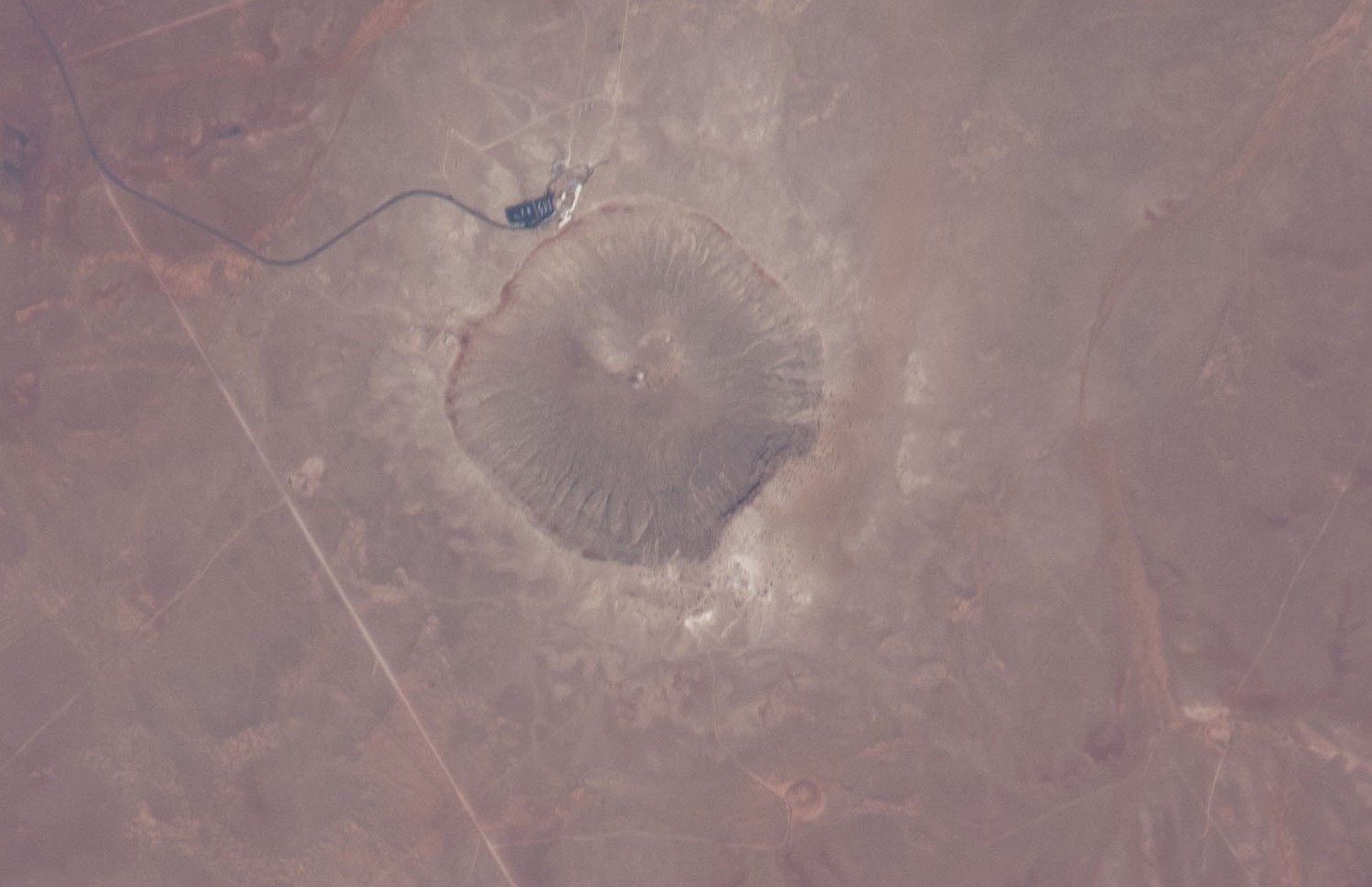
The Barringer crater in Arizona – also known as “Meteor Crater” – is listed here not for its size but for how clearly it can be read: about 1.2 kilometres across, 174 metres deep, with a sharply drawn rim. It is so well preserved because, at roughly 50,000 years, it is geologically brand new. It was caused by an iron meteorite only about 50 metres across – an impressive example of how much destruction kinetic energy delivers at cosmic speeds. Of the estimated hundreds of thousands of tonnes of impactor mass, only about 30 tonnes of fragments have been found to date; the largest piece weighs 693 kilograms.
Chicxulub: the meteorite impact that ended the Cretaceous
No impact has changed the Earth as much as this one. Around 66 million years ago, a body 10 to 15 kilometres in diameter struck the shallow sea off what is today the Mexican Yucatán peninsula. What remained is the Chicxulub crater, roughly 180 kilometres wide, now hidden beneath sediment and seawater and mapped only through gravity and magnetic field anomalies.
| Feature | Value |
|---|---|
| Date | approx. 66 million years ago (Cretaceous-Palaeogene boundary) |
| Location | Yucatán peninsula, Mexico |
| Crater diameter | approx. 180 km |
| Impactor | approx. 10–15 km in diameter |
| Impactor type | carbon-rich chondrite (CO chondrite) |
| Origin | outer asteroid belt, near Jupiter’s orbit |
| Global evidence | iridium anomaly in the boundary layer worldwide |
| Consequence | extinction of about three quarters of all species |
The origin of the “dino killer” was long considered an open question – it was only solved recently. A 2026 paper in Science Advances by Georgy V. Makhatadze and colleagues, with the participation of Vienna impact researcher Christian Köberl, analysed nickel isotopes in the boundary layer and assigned the impactor to the CO chondrites – a carbon-rich class that makes up only two to three percent of all meteorite finds and comes from the outer asteroid belt beyond Jupiter’s orbit. The body therefore came from far out, not from the neighbourhood.
What was lethal was not the impact itself but its aftermath. The strike vaporised sulphur-rich rock, threw dust and sulphate aerosols into the stratosphere and darkened the sky for months to years. Photosynthesis collapsed, food chains fell apart – an “impact winter”. The iridium-rich clay horizon found worldwide at the Cretaceous-Palaeogene boundary remains the most elegant proof to this day: iridium is extremely rare in the Earth’s crust, but common in meteorites.
Tunguska 1908 and Chelyabinsk 2013: the two warning shots
Between “shooting star” and “mass extinction” lies a class of events that really does occur within human timescales. Two of them are well documented – and both show that an object does not have to reach the ground at all to cause considerable damage.
| Tunguska | Chelyabinsk | |
|---|---|---|
| Date | 30 June 1908 | 15 February 2013 |
| Location | Siberia, Russia | Chelyabinsk region, Russia |
| Object size | approx. 50–80 m | approx. 17–20 m |
| Explosion altitude | approx. 5–15 km | approx. 27–30 km (peak brightness) |
| Energy | approx. 10–30 megatonnes TNT | approx. 500 kilotonnes TNT |
| Crater | none | none (hole in the ice of Lake Chebarkul) |
| Damage | > 2,000 km² of forest flattened | more than 7,000 buildings damaged |
| Injuries | none known (uninhabited) | about 1,500, mostly from glass splinters |
| Meteorites found | none confirmed | approx. 1 t in total, largest piece 654 kg |
Tunguska is the largest event in documented history. On the morning of 30 June 1908, an object burst apart above the deserted Siberian taiga. The shock wave flattened the forest over more than 2,000 square kilometres – directed radially outwards, like matches tipped over from a centre. Despite decades of searching, nobody has ever found a crater: the body exploded in the air and pulverised completely. It is precisely this signature that makes it the textbook example of an airburst.
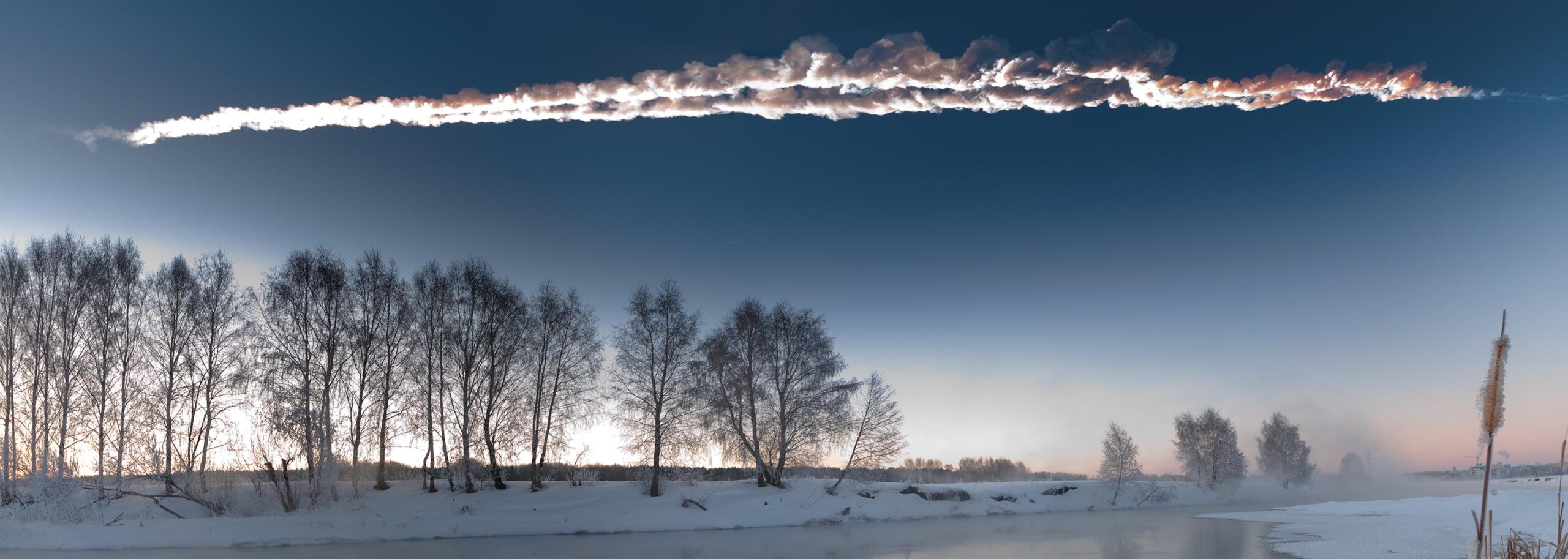
Chelyabinsk was a hundred times weaker – and still hit a city of a million people. The roughly 20-metre body broke up at about 27 to 30 kilometres altitude with an energy of around 500 kilotonnes of TNT, more than thirty times the Hiroshima bomb. The injuries came almost exclusively from windows shattering: many people had stepped to the window because of the bright flash when the shock wave arrived minutes later. In total about one tonne of meteorite material was recovered, including the 654-kilogram main fragment from the bottom of Lake Chebarkul. This makes it the fifth-heaviest meteorite fall ever documented – and the best-filmed in history, thanks to thousands of Russian dashcams.
Impact craters in Germany: Nördlinger Ries and the Steinheim Basin
Germany has one of the most impressive impact structures in Europe – you simply do not notice it, because an entire town sits inside it. The Nördlinger Ries between the Swabian and Franconian Jura is an almost perfectly circular basin about 24 kilometres wide, created roughly 14.8 million years ago by the impact of a body about one kilometre in size.
| Structure | Location | Diameter | Age | Impactor |
|---|---|---|---|---|
| Nördlinger Ries | Bavaria / Baden-Württemberg | approx. 24 km | approx. 14.8 million years | approx. 1 km |
| Steinheim Basin | Baden-Württemberg | approx. 4 km | approx. 0.5 million years younger than the Ries | approx. 150 m |
For a long time both were regarded as a double impact: two craters 40 kilometres apart, one shared binary asteroid. A study by Buchner and colleagues in Scientific Reports (2020) qualified that neat story. Precise dating showed that the Steinheim Basin formed about 500,000 years after the Ries – far too late for a simultaneous event. By current understanding these are therefore two independent impacts that happen to lie next to each other.
The Ries has a second claim to fame: the impact produced suevite – an impact rock from which, among other things, the towers of St. George’s Church in Nördlingen are built. And the ejecta contained moldavites, green impact glasses hurled as far as Bohemia and Moravia. The Apollo astronauts trained in the Ries for their Moon missions – nowhere else in Europe can impact geology be walked so directly.
Chronicle: meteorite impacts in Germany since 1785
In total, only 46 meteorites in Germany have been both observed as a fall and subsequently found. The cases below are among the best documented – and they say at least as much about people as about stones: about ownership disputes, iron lumps worked at the forge, a golden necklace and a meteorite whose landing site was calculated by Alfred Wegener.
| Year | Name | Location | Type | Mass |
|---|---|---|---|---|
| 1785 | Eichstätt / “Wittmess” | Breitenfurt, Bavaria | nickel-iron | approx. 3 kg (128 g remaining) |
| 1802 | Bitburg | Mötsch, Rhineland-Palatinate | octahedrite | approx. 1.5 t (approx. 200 g remaining) |
| 1855 | Bremervörde | Lower Saxony | chondrite | more than 7 kg (5 pieces) |
| 1869 | Krähenberg | Südwestpfalz | LL5 chondrite | several kg |
| 1880 | Aachen | North Rhine-Westphalia | chondrite | 21 g |
| 1886 | Barntrup | North Rhine-Westphalia | amphoterite | 17.3 g |
| 1916 | Treysa / Rommershausen | Hesse | octahedrite IIIB | 63.28 kg |
| 1930 | Oldenburg | Lower Saxony | L chondrite | approx. 17 kg (2 pieces) |
| 1956 | Breitscheid | Hesse | stony meteorite | 1.5 kg |
| 2002 | Neuschwanstein | Bavaria | enstatite chondrite | 6.2 kg (3 pieces) |
| 2026 | Koblenz-Güls | Rhineland-Palatinate | eucrite (Vesta) | 3.5 g secured |
The Neuschwanstein case of 2002 holds a special position: it was fully measured by camera networks, and its orbit could be traced back into the asteroid belt – one of the first meteorites in the world with a known orbit of origin. The following sections go through the historical falls in detail.
Breitenfurt / Eichstaett Meteorite Impact (1785)
The fate of a meteorite is an adventurous one from the very moment of its formation. Collisions between celestial bodies blast off the fragments. When the debris comes crashing down to Earth after several million years, its fate remains just as unpredictable.
They weather away in the soil or vanish into the ice, wait to be discovered in deserts, or on impact may even endanger human lives. In the case of the “Wittmess meteorite” in the Bavarian woodland near Breitenfurt, a roar and a great fright among the ear-witnesses preceded the meteorite find.
According to records from 19 February 1785, a meteorite fell at midday directly onto the brick pile of a farmhand from Wittmess. The finder, who had just heard a loud thunderclap, could not immediately touch the lump because of the residual heat of the fall. Originally the nickel-iron meteorite weighed about 3 kg. It was smashed apart in Eichstaett, and its fragments scattered across the whole of Europe over many years.
In the Natural History Museum of Eichstaett, only a 122 g lump and a tiny 6 g piece of the meteorite find still exist.
The “Bitburg” (1802) and “Aachen” (1880) Meteorite Impacts
In 1802, a civilian in the little village of Moetsch near the municipality of Bitburg found an iron lump weighing an astonishing 1.5 tonnes. Before it was processed into scrap metal, the “Bitburg” meteorite was an octahedrite. To this day it counts as the heaviest meteorite find in Germany.
For 12 years its material was used for blacksmithing. Only then was it recognized as a meteorite, and the remains of the iron that had proven unsuitable for smelting were dug up. Today, barely 200 g can still be found in the Natural History Museum of the Humboldt University of Berlin.
The fact that in 1880 the “Aachen” meteorite was found at all after its fall in the city of the same name in North Rhine-Westphalia is a stroke of luck. At only 21 grams and with the stony composition of a chondrite, it would otherwise have weathered away in no time.
Even meteorite hunters mention the fall only in passing. But since only 46 meteorites in Germany have been recorded both as observed falls and subsequently found, the 21 grams from Aachen belong in the noted fall history of German meteorite sightings just as much as the heavyweight finds do.
Meteorite Impacts in Bremervoerde and Darmstadt (1855)
Over the past centuries, several meteorites fell in Germany without being immortalized with special entries in the chronicles of cosmology. The rare treasures from space were indeed recovered, insofar as the fall allowed a find, and were kept and studied for their structure. Yet to this day some specimens appear at most as a “it exists” entry in the list of meteorite finds.
The ear-witness reports of the peat cutters from 13 May 1855 tell of a quiet, overcast day that was suddenly filled with a roar. The magistrate to whom the meteorite was handed over after the find learned of 8 to 12 bangs that had been heard as far as Bremervoerde. Meteorite “hunters” found five of these fragments. Together they weigh over 7 kilograms. For detailed entries, however, the pieces of the meteorite find are simply too “ordinary”.
Near Darmstadt, at roughly the same period, a meteorite was recovered that is recorded in the meteorite lists as a fall before 1804. Its “tininess” of about 120 g and its composition as an ordinary chondrite made it fit neither for sensations nor for financial disputes here either. At least this local meteorite find is explained to interested visitors during observatory tours in Darmstadt.
The Direct Eye- and Ear-Witnesses to the Impact in Rhineland-Palatinate (1869)
If a meteorite came down over inhabited areas today, it would certainly be a media spectacle. In earlier times it caused a stir at most in its immediate surroundings.
Finds such as the “Kraehenberg” came to the attention of scientists more through inquiry and hearsay. Nevertheless, the German fall events were always occurrences with a lasting effect.
On 5 May 1869 around 6:30 p.m., farmer Lauer was working his field in Kraehenberg, Sickinger Hoehe (today’s Suedwestpfalz district, Rhineland-Palatinate) together with other witnesses. Then he heard a loud roar and saw a fireball in the sky glowing a blinding white.
Immediately, a meteorite struck the ground near him, at least half a meter deep. When Lauer and his companions recovered it, the sensational “Kraehenberg” find was, in the truest sense of the word, “still warm.” People in the surrounding area believed that a train from Homburg was on its way back to the ground after an accident.
The impact could be heard as far as Wiesbaden, 100 km away. The witness reports were passed on to the naturalist Georg von Neumayer, who came from the Palatinate.
After ten days on display in the schoolhouse of Kraehenberg, the Historical Museum of the Palatinate in Speyer bought the meteorite for 100 guilders for the municipality and 100 guilders for the landowner.
For twenty years, a dispute over ownership claims dragged on between the Palatinate district association and the Royal Bavarian State Government in Munich. Today the “Kraehenberg” is housed in the Natural History Museum of the Palatinate in Bad Duerkheim.
Since the beginning of the odyssey, a few small pieces have been examined at institutes and museums in Bavaria, Great Britain and Austria. To illustrate the meteorite’s original size, a colored plaster copy is still exhibited today in the Kraehenberg village community center.
Origin and Composition of the “Kraehenberg” Meteorite
In 1871, the naturalist Neumayer surmised that the meteorite must originate from a comet, perhaps from Halley’s Comet. This theory is conceivable, since the Earth crosses the path of its tail every year. Today’s geologists and astronomers count stony meteorites like the “Kraehenberg” among the asteroids instead, because it is too heavy and too stony to be a fragment of a comet nucleus.
Given its iron content and its texture with embedded silicate melt droplets, it belongs to the class of LL5 chondrites, the stony meteorites. After all the studies, its age is estimated at about 4.7 billion years.
Find Site Next to the “Love Nest”: The “Barntrup” Meteorite (1886)
In 1886, so the chronicle reports, a farmer from Barntrup went to fetch water in the “Kraehenholz,” a nearby patch of forest. Above him there were suddenly several bangs, then the sound turned into loud thunder. Between the branches of the trees, a small stone fell down.
At 17.3 g, it was the smallest meteorite that had ever been found in Germany up to that point. The amphoterite can be seen in the Detmold Museum. Tourists still make the pilgrimage to the Kraehenholz today, though not for the sake of the “little stone” but because of a tree that is a good signpost to the former “scene of the crime.” The “Beech in the Kraehenholz” is a well-known attraction of Barntrup.


Impact of the Rommershausen Meteorite (1916)
To view a meteorite with the typical “Widmanstaetten structure,” those interested need not travel abroad. In the Mineralogical Museum of Marburg an der Lahn (northern Hesse) there is an equally spectacular cosmic “stray,” the meteorite “of Treysa,” also known as “of Rommershausen.” Like its international relatives, its very impact caused quite a stir among the population of Rommershausen and the surrounding area.
On the afternoon of 3 April 1916, eyewitnesses in and around the Rommershausen district (Schwalmstadt) heard a thunderclap and immediately afterward saw clouds of smoke. Both the flash of the material and the noise came from a meteorite that struck a nearby wooded area right afterward.
Because finds are more common in human history than visible impact events, the meteorite “of Treysa” went down in the meteorite chronicles of German astronomy as one of the most significant impact observations of the modern era. The northern Hessian find was classified as an octahedrite of medium size, medium weight and with the chemical classification IIIB.
Octahedrites are a particularly commonly found form of nickel-iron meteorite. The main constituents of such meteorites are taenite (a nickel-iron mineral) and kamacite (formerly a mineral in its own right, since 2006 classified as an iron variety). The typical separated mineral structure becomes visible when the surface is polished and etched.
This chemical group of finds became famous through spectacular fall events and heavyweight finds in Africa, eastern Siberia, Argentina, Arizona, Poland, China, Mexico and Australia. Although the German specimen “of Treysa” had eye- and ear-witnesses during its fall and is likewise heavy, it is mentioned only rarely.
A Target for Treasure Hunters and a Hiking Route: The Impact Site
The German meteorologist, polar researcher and geoscientist Alfred Lothar Wegener was able to calculate a trajectory as well as the presumed impact site for the meteorite from the reports. A reward of 300 Reichsmark was then offered for the finder.
A true treasure hunt began. Eleven months after the impact, forester Hupmann found the cosmic “crash pilot” of 63.28 kg and 36 cm across. Despite the enormous forces that had acted on “Treysa” during its fall, it was almost completely intact.
Various geological-mineralogical laboratories ground and etched the structure out of the meteorite’s surface. Since then, the thoroughly studied specimen has been on display in the Mineralogical Museum of Marburg an der Lahn. To honor the Hessian meteorite, the “Knuellgebirgsverein” erected a memorial stone at the impact site in 1986. In addition, several signposts pointing to the find site of the octahedrite “of Treysa” stand along the Ringstrasse, a path in the forest of Rommershausen.
Meteorite Impact: the Fragments of “Oldenburg” (1930)
Meteorites are rarely found after they strike the Earth. The Earth’s most extreme climate zones – deserts and eternal ice – count as the best preservation regions.
If, elsewhere, someone does happen to stumble upon fragments by chance, these are not necessarily recognized as cosmic. There are a few finds even in Germany, for example “Oldenburg,” whose heaviest fragments were recovered by eyewitnesses right after the impact.
On the afternoon of 10 September 1930, two bangs as well as a loud whooshing and whistling startled the southern Oldenburg residents Clemens Bley (Beverbruch) and Johann Schnieders (Halenhorst). Both men believed that the cause of the gruesome sounds – in reality a shattered meteorite – was flying directly over their heads before something buried itself in the ground near them.
The shepherd and the farmer recovered a black stone weighing about 5 and 12 kg with fracture surfaces that fit each other perfectly. The meteorite “Oldenburg” received the addition (1930) in its name, and the fragments were called “Bissel” and “Beverbruch.”
The direct fall of the meteorite before its impact was also observed by people in Lohne and other villages around Oldenburg. A striking light phenomenon was described that suggested a third fragment of the meteorite “Oldenburg” (1930).
So far it has not been found. The odyssey of the fragments ended in the Cloppenburg Museum Village, later – for the fragment “Beverbruch” – as a private purchase in 1995 from the estate of the lender Meyer.
Origin and Presumed Course of the “Oldenburg” Impact
The meteorite “Oldenburg” (1930) is not identical with “Benthullen” from 1951. Both belong to the same L class, but the “Oldenburg” (1930) fragments contain more chondrules (silicate inclusions).
The asteroid Eros, a cosmic victim of an asteroid collision, is considered the parent body. The debris was flung out of the asteroid belt by that event several million years ago and crashed down onto our surface at different times as an Earth-crossing object in a large meteorite impact.
The only possible means of reconstructing the fall are the eye- and ear-witness accounts, above all those of the shepherd and the farmer. According to them, the smaller portion of the meteorite, “Bissel,” plowed into the soil at roughly 53 degrees east. “Beverbruch” struck the ground vertically.
The fracture surfaces would likewise have been melted black if the whole body had already burst in the upper atmosphere. The second bang probably came from the breaking apart of “Oldenburg” (1930) at an estimated 4,100 m above the village of Doehlen.
The Eye- and Ear-Witnesses to the Meteorite Fall at Breitscheid (1956)
Private observers of the present day cannot always tell whether an aircraft is crashing, a firecracker is flying through the air, or the rumbling and thundering comes from a meteorite. If there are no sounds, the shooting star is observed at most for as long as a secret wish takes.
Some meteorite falls in Germany became known to science rather by chance through word-of-mouth description. In the case of the mixed meteorite of “Breitscheid,” an adventure story with curious twists developed afterward.
That its fall was even noticed at all, the meteorite owed to the date of the fall. In 1956, the Second World War had been over for just 11 years and was still very present in many people’s minds. When an aircraft flew over a garden, a loud hissing shortly afterward triggered panic.
The Breitscheid observers saw a trail of fire about 1 m long that became broader and redder toward the rear. Witnesses of the fall event found 4 pieces of the “Breitscheid” meteorite 40 cm deep in their Westerwald meadow.
Judging by the impact crater, the meteorite was the size of a brick. The finders took the meteorite for a 15 cm long, 10 cm wide and 4 cm thick lump of cement and assumed it had fallen out of the aircraft.
G. Thielmann, the chemical technician at the Burg Ironworks, correctly recognized the nature of the fragments immediately upon receiving them. A frantic search for the whereabouts of the remaining pieces of the “Breitscheid” meteorite began.
Science and Curiosities About the “Breitscheid” Meteorite
In total, the extraterrestrial fall piece weighed 1.5 kg. According to scientific studies, the meteorite’s former parent body had found its solid form about 3 billion years ago and had broken apart an estimated 50 million years ago.
By chance, a female chemical technician read about the “Breitscheid” meteorite in the newspaper and informed her boss, a meteorite researcher, about it. The next day his assistant sought out the witnesses.
At first he returned with 2 small pieces. Several students then helped to track down the whereabouts of all the meteorite fragments. Through bartering, all the pieces could be obtained from private ownership.
The most curious was the story of the eighth little piece. A young tourist had taken a fragment of the “Breitscheid” meteorite home as a souvenir during her holidays. As a fitting compensation for handing it over, she preferred, instead of money, a little gold necklace in whose pendant a splinter of “her” shooting star was set.
2024 YR4: why the lunar impact in 2032 is off
Hardly any object has occupied the public recently as much as 2024 YR4. The roughly 50-metre asteroid was discovered in December 2024 and quickly made headlines, because the early orbit calculations could not rule out a possible collision on 22 December 2032. A threat to Earth was soon dismissed – after that the Moon moved into focus: the probability of a hit there temporarily rose to a little over four percent.
In February 2026, observations with the James Webb Space Telescope refined the orbit far enough to rule out that scenario too: 2024 YR4 misses the Moon by about 21,200 kilometres. The chapter is therefore closed.
What remains interesting is what a hit would have meant. Model calculations gave a crater of up to one kilometre in diameter and up to 1,000 tonnes of lunar rock that could have reached the Earth – harmless for the ground, but a real risk for satellites in Earth orbit. The case shows in exemplary fashion how planetary hazard assessment works: large uncertainty at first, then every new measurement narrows the orbital corridor until the probability falls to zero. A rise in the quoted figure in the media almost always means more uncertainty, not more danger.
Planetary defence: how the Earth is protected from impacts
Protection against meteorite impacts runs in three stages: find, calculate, deflect. Survey programmes such as Pan-STARRS, the Catalina Sky Survey and ATLAS scan the sky every night for moving points; NASA’s Center for Near-Earth Object Studies and ESA’s Planetary Defence Office bring the orbital data together and publish risk lists. Objects above one kilometre are now considered more than 90 percent catalogued.
The third stage was tested for real for the first time in 2022. NASA’s DART mission struck Dimorphos, the small moon of asteroid Didymos, at about 6 kilometres per second and measurably shortened its orbital period – by about 32 minutes, far more than the mission target of 73 seconds. The kinetic impactor therefore works. ESA’s Hera probe has been on its way since October 2024 to survey the impact crater and the actual change in mass on site.
In practice this means: an object detected in time is manageable – provided the warning time is measured in years, not days. That is exactly why detection matters more than defence. And that is exactly why the gap for objects below 100 metres is the real residual risk: a Chelyabinsk event gives practically no notice.
Watching fireballs yourself: how to succeed looking up
You will almost certainly never witness a meteorite impact. The stage before it, however – the meteor, that is the light trail – you can see on any clear night. During meteor showers such as the Perseids in August or the Geminids in December there are dozens per hour, some of them bright enough to count as fireballs.
The best part: you need no instrument for this. Meteors appear anywhere across the whole sky; a telescope, with its tiny field of view, would even get in the way. What really helps is a dark site, a reclining mat and at least 20 minutes of dark adaptation. A pair of bright binoculars is nevertheless the most sensible purchase for nights like these – for the afterglow trail of bright bolides, but above all for everything else in the sky while you wait for the next shooting star:
Recommended for meteor nights: Omegon Brightsky 10x50 Binoculars

Bright, high-contrast binoculars: perfect for the Moon, star clusters and Milky Way fields, handheld.
Price: € 289
If you want to document fireballs systematically, report sightings to the International Meteor Organization or the DLR fireball network. From several independent observations the trajectory can be triangulated – and that is exactly how fall areas are narrowed down in which meteorites are then actually found. The Neuschwanstein case of 2002 is the model example.
Frequently asked questions about meteorite impacts
How often do meteorites strike the Earth?
Small particles reach the Earth permanently – every day more than ten tonnes of material enter the atmosphere, most of it as dust. Meteorites that actually reach the ground are rare: in Germany a fall is confirmed on average only once or twice per decade. Events with noticeable damage such as Chelyabinsk in 2013 occur worldwide roughly every few decades.
What is the difference between a meteor and a meteorite?
The meteor is the light phenomenon in the sky, in other words the shooting star. The meteorite is the remaining piece that reaches the ground. As long as the object is still travelling through space it is called a meteoroid. It is one and the same body in three stages.
Where was the last meteorite impact in Germany?
On 8 March 2026 in Koblenz-Güls: at about 6:57 p.m. a meteorite punched through the roof of a house and landed in the bedroom. Nobody was injured. The recovered fragments were identified as a eucrite – a fragment of the asteroid Vesta.
How large was the asteroid that wiped out the dinosaurs?
The Chicxulub impactor measured about 10 to 15 kilometres across and struck off the Yucatán peninsula around 66 million years ago. It left a crater of roughly 180 kilometres. Nickel isotope analyses assign it to the carbon-rich CO chondrites from the outer asteroid belt.
Can a meteorite hit a house?
Yes, that does happen – most recently on 8 March 2026 in Koblenz. Worldwide, a few dozen cases are documented in which meteorites hit buildings or vehicles. Personal injuries are extremely rare; to this day no confirmed death caused by a meteorite is known.
How do I recognise a meteorite?
Typical features are a dark, matt fusion crust, a weight that is striking for the size, often magnetic properties and the absence of bubbles or cavities. Only a laboratory analysis provides reliable confirmation. Suspicious finds are best photographed and reported to a museum or a university together with the find location.
Is the Earth being monitored for asteroids?
Yes. Survey programmes such as Pan-STARRS, the Catalina Sky Survey and ATLAS scan the sky continuously; NASA and ESA combine the orbital data. Objects above one kilometre are more than 90 percent catalogued. In 2022 the DART mission deflected an asteroid moon measurably for the first time and shortened its orbital period by about 32 minutes.
Will asteroid 2024 YR4 strike in 2032?
No. A threat to Earth was ruled out early, and in February 2026 observations with the James Webb Space Telescope also ruled out the lunar impact discussed for a while for 22 December 2032. The roughly 50-metre asteroid misses the Moon by about 21,200 kilometres.
Further reading
Meteorites – overview · Chondrite: what is a stony meteorite? · Neuschwanstein meteorite · Pallasite · Asteroid Vesta · Asteroids and the asteroid belt · Shooting stars · Comets