By Alexander Merz · Updated on · Details checked on 7 October 2026
A galaxy is a vast, gravitationally bound collection of stars, gas, dust, and dark matter. From modest dwarf galaxies to sprawling spirals, these structures are the true building blocks of the universe. Let’s explore what a galaxy actually is, how astronomers classify them, how they form, and how you can spot them from your own backyard.
⚡ The quick answer: A galaxy is a gravitationally bound system of billions of stars, interstellar gas, dust, and dark matter. Astronomers recognize four main types — spiral, elliptical, irregular, and dwarf — and the observable universe holds an estimated 100 to 200 billion of them. Our own galaxy, the Milky Way, is a barred spiral with a supermassive black hole at its center.
What Is a Galaxy?
Stardust condenses into solid bodies, and planets come together into solar systems. A colossal accumulation of all these pieces forms a galaxy — in other words, a star system. Galaxies come in every size, from large to small and from distant to relatively nearby. Some drift alone through the cosmos, while others cluster into sprawling galaxy groups that tug on one another through gravity.
Definition and Core Properties
A galaxy is a gravitationally bound system made up of billions of stars, interstellar matter (gas and dust), planets, and dark matter. Galaxies take on a huge range of shapes and sizes, and they are scattered across the universe in groups and clusters.
Their diameters range from a few thousand to several million light-years. The distances between them are just as staggering, spanning anywhere from millions to billions of light-years.
Why Galaxies Matter in the Universe
Galaxies are among the most captivating objects in the cosmos. They are enormous systems of billions of stars, planets, interstellar matter, and dark matter. As the building blocks of the universe, studying them lets us unlock the secrets of our cosmic neighborhood and trace how the universe has evolved over billions of years.
Astronomy has steadily expanded our understanding of galaxies over recent decades, yet many questions remain unanswered. These endless cosmic expanses aren’t just of scientific interest — they inspire wonder in anyone fascinated by the universe and its astonishing phenomena.
The Different Types of Galaxies
Astronomers sort galaxies into several categories based on their morphology, or overall shape. The most common types are spiral, elliptical, irregular, and dwarf galaxies.
Spiral Galaxies
Spiral galaxies have a flat, disk-shaped structure with spiral arms that wind around a central bulge. The spiral arms are packed with young, hot stars that give these regions their characteristic bluish tint, while older stars tend to concentrate in the bulge. Our own galaxy, the Milky Way, is a prime example of a spiral galaxy.
Elliptical Galaxies
Elliptical galaxies are more spherical or egg-shaped and typically contain older stars. They show a lower rate of star formation and hold less gas and dust than spirals. Their color usually leans reddish or yellowish, reflecting the aging stars that dominate them. Ellipticals span a wide range of sizes, from dwarf ellipticals to enormous giant galaxies.
Irregular Galaxies
Irregular galaxies have no clearly defined shape or structure and make up roughly 25% of all known galaxies. There are two main categories: Type I, with active star formation and young stars, and Type II, with a lower star-formation rate and older stars. Their chaotic appearance can often be traced back to collisions or mergers.
Dwarf Galaxies
Dwarf galaxies are small, low-mass galaxies made up mostly of a few billion stars. They break down into dwarf spirals, dwarf ellipticals, and dwarf irregulars. Often companions to larger galaxies, they play an important role in the study of dark matter and galactic evolution.
Galaxy Types at a Glance
| Type | Shape | Dominant Stars | Famous Examples |
|---|---|---|---|
| Spiral | Flat disk with winding arms | Young (arms) and old (bulge) | Milky Way, Andromeda (M31), Pinwheel Galaxy (M101) |
| Elliptical | Spherical to egg-shaped | Old, reddish | M87, M49 |
| Irregular | No defined structure | Varies by type | Large and Small Magellanic Clouds |
| Dwarf | Small, low-mass | A few billion stars | Segue 2, Sagittarius Dwarf |
How Galaxies Form and Evolve
Every galaxy is made of stars, gas, dust, and dark matter. Scientists have developed many models to understand them, yet the research is far from complete. The reason lies in the persistent contradictions that keep cropping up between calculations and simulations.
The Role of Dark Matter
Dark matter is an invisible, elusive substance that accounts for about 27% of the universe. Although it can’t be observed directly, its existence is revealed through its gravitational pull on visible matter.
Dark matter plays a decisive role in the birth and evolution of galaxies. It provides the gravitational scaffolding on which galaxies form and grow: dark matter halos draw in gas and dust, triggering star formation and, eventually, the creation of a full galaxy.
Galactic Collisions and Mergers
Galaxies aren’t static — they interact and evolve over time. Collisions and mergers rank among their most dramatic interactions. When two or more galaxies drift too close under the pull of gravity, they can merge into one.
These events cause a redistribution of gas, dust, and stars, reshaping the structure and morphology of the galaxies involved. Mergers can also ignite starbursts — intense bursts of star formation fueled by the combined gas and dust of the colliding galaxies.
Star Birth and Stellar Evolution
The birth and evolution of stars lies at the heart of a galaxy’s story. Stars form from collapsing clouds of gas and dust squeezed together by gravity. The star-formation rate depends on conditions inside the galaxy, such as how much interstellar gas is available and the galaxy’s overall dynamics.
Once formed, stars pass through different phases determined by their mass and chemical makeup. At the end of their lives, the most massive stars explode as supernovae, seeding the interstellar medium with chemical elements that give rise to new generations of stars. This cycle, known as galactic chemodynamics, shapes a galaxy’s chemical composition and steers its evolution over billions of years.
Observing Galaxies for Yourself
You can absolutely observe galaxies with your own eyes through a telescope. The catch is that galaxies have a low surface brightness, so visual observation calls for a telescope with a very large aperture. Dobsonian telescopes are the standout choice here, delivering the most aperture per dollar of any design.
Keep in mind, though, that the naked eye will never match the long-exposure results of deep-sky astrophotography. Your eyes only produce a black-and-white image, so galaxies appear as faint, milky smudges rather than the vivid, colorful photographs you may be used to seeing.
To go galaxy hunting, a large Dobsonian like the Skywatcher Skyliner 200/1200 is a fantastic starting point: its 200 mm of aperture gathers enough light to reveal the Andromeda Galaxy, the M81/M82 pair, and the Sombrero Galaxy from a dark-sky site.
Best value: Skywatcher Dobson Telescope N 200/1200 Skyliner Classic
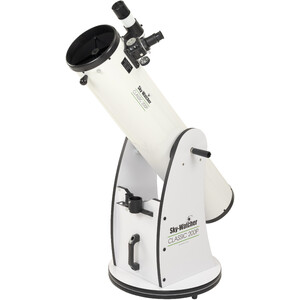
200 mm of aperture — the most sky for your money. Set it on the ground, point by hand: nebulae, clusters and galaxies for years to come.
Price: € 479
* Affiliate link: if you buy through this link we may earn a small commission from Astroshop or High Point Scientific, at no extra cost to you.
Galaxies: Mind-Blowing Facts and Figures
- The largest known galaxy, IC 1101, spans roughly 6 million light-years across, while the smallest known dwarf galaxy, Segue 2, measures only about 90 light-years.
- The observable universe holds an estimated 100 to 200 billion galaxies.
- The Milky Way and the Andromeda Galaxy are on a collision course and will merge in about 4 billion years.
- Some galaxies contain up to several trillion stars, like the giant elliptical M87.
- The Sombrero Galaxy is famous for its hat-like appearance, created by a prominent dust lane encircling its bright core.
- Galaxies can host active galactic nuclei, where supermassive black holes devour matter and blast out enormous amounts of energy.
- Gravitational lensing, caused by massive galaxies or clusters, can bend and magnify the light of galaxies behind them, producing stunning Einstein rings.
- Galaxy clusters are the largest gravitationally bound structures in the universe, made up of hundreds or even thousands of galaxies.
Using the Euclid space telescope, scientists made a lucky discovery: in a routine test image, they spotted a nearly perfect Einstein ring around the galaxy NGC 6505 — known since 1884 and located 590 million light-years away. The glowing ring comes from a far more distant galaxy, 4.42 billion light-years off, whose light is bent by the immense gravity of NGC 6505. This is exactly the phenomenon predicted by Albert Einstein’s general theory of relativity, and it is exceedingly rare to observe.
A handful of galaxies show up in binoculars; with a telescope, dozens become reachable from your garden.
Six short questions, an honest answer by email – even when binoculars are the better choice.
Frequently Asked Questions
How many galaxies are there in the universe?
Estimates place the number of galaxies in the observable universe at 100 to 200 billion. Some studies based on Hubble’s deep-field images suggest the true figure could be considerably higher.
What is the closest galaxy to the Milky Way?
The Canis Major Dwarf Galaxy is our nearest galactic neighbor. Among the large galaxies, the Andromeda spiral (M31), about 2.5 million light-years away, is the closest.
What telescope is best for viewing galaxies?
Because galaxies have low surface brightness, aim for the largest aperture you can. A Dobsonian of 200 mm or more, used under a dark sky, offers the best balance of performance and price.
Can you see galaxies in color through a telescope?
No. The human eye isn’t sensitive enough to pick up color from objects this faint. Galaxies appear in shades of gray; only long-exposure astrophotography reveals their true hues.
Is the Milky Way a galaxy?
Yes. The Milky Way is our home galaxy: a barred spiral roughly 100,000 light-years across, with a supermassive black hole at its center and our Solar System tucked within one of its arms.
Read next:
- Best Beginner Telescopes
- Deep-Sky Guide: Nebulae, Clusters, and Galaxies
- The Milky Way, Our Home Galaxy
🌍 This article is also available in German (original), French, and Italian.