By Alexander Merz · Updated on · Details checked on 14 October 2026

Photographing the Moon can be done by anyone with the right guide. Moon photography is often the starting point for astrophotography with all its subtleties and impressive results.
Why is moon photography a good way to start?
The Moon makes a great photographic subject for getting started in astrophotography for several reasons:
- Brightness: The Moon is the brightest object in the night sky and strongly reflects sunlight. As a result, you don’t need any special astronomical filters to photograph it.
- Size: The Moon is comparatively large in the sky and can be captured relatively well even with a telephoto lens or a simple digital camera. So you can achieve good results without a lot of equipment.
- Contrast: The lunar surface is full of interesting structures and contrasts that come out well in photographs. The shadows cast by craters and mountains create a beautiful 3D effect.
- Stability: Unlike stars or planets, the Moon does not move so quickly across the sky. This means you can use longer exposure times without worrying about the subject blurring.
All in all, the Moon is an ideal photographic subject for getting started in astrophotography, since you can achieve good results with comparatively simple equipment while also having the opportunity to capture interesting structures and contrasts.
In which moon phase should you photograph the Moon?
There is no universally valid answer to which moon phase is best suited for taking great photos. The choice depends on what kind of photos you want to take. The full moon works well as a light source for landscape images that are meant to be captured in the diffuse moonlight.
However, detailed shots of its surface with long focal lengths are rather disappointing during a full moon. Because the Sun illuminates the Moon head-on, the shadows on the surface are barely pronounced, resulting in a low-contrast, flat image.


Better suited for detailed shots are the waxing or waning moon as well as the half moon, since the mountains and crater walls then cast long, striking shadows that enhance the three-dimensional impression of the surface structures.
These phenomena are particularly impressive along the light-shadow boundary (terminator). With long focal-length lenses, these details can be captured well.
Moon photography in a hurry: smartphone
It is possible to photograph the Moon with a smartphone or tablet equipped with a camera, but there are a few limitations to keep in mind.
The biggest challenges when using these devices are the focus and the exposure control, as well as the lack of a sufficient zoom function to capture details of the Moon. Smartphones and tablets usually only have a wide-angle lens, which is not ideal for moon photography.
If you have a smartphone with only one camera, it is difficult to capture the Moon as a standalone subject, because the camera usually has a wide field of view. If you try to photograph the Moon at night with a wide-angle lens, the result will most likely be a small, white dot.
This is because the camera tries to capture the entire scene, and the Moon is too small in relation to it. In such cases, it is better not to include the Moon in the shot.
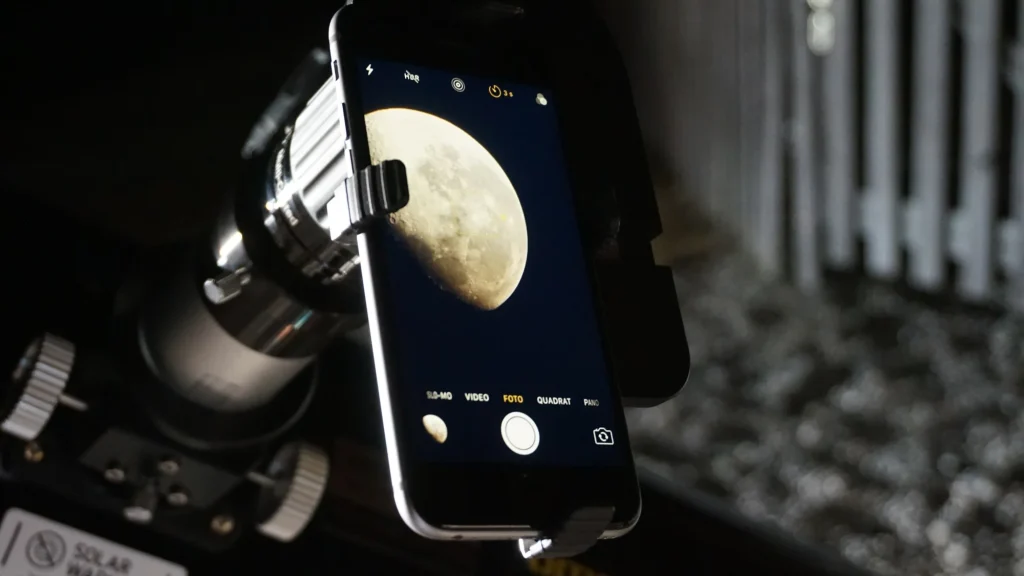
To take impressive moon photos, it is advisable to connect a monocular to the smartphone in order to get closer to the Moon and obtain good image quality.
Attaching clip-on telephoto lenses is not recommended, as they often have poor quality.
It is important that the smartphone allows manual adjustment of the exposure in order to get a good moon photo. Monoculars with smartphone mounts are relatively inexpensive and can also be used for watching birds and other animals. For photography, however, a tripod should be used, since the image quality is not comparable to that of a “real camera.”
If you already own a telescope or a monocular, the cheapest step towards a sharp moon photo is a clamp that holds the phone over the eyepiece – for example the Bresser Deluxe smartphone holder at € 14.90 In stock · ready for shipping in 24 h. It does not replace a camera, and it will not give you the fine crater detail shown further down this page.
Photographing the Moon: camera and lens
To capture the Moon with all its details, you need a lens with a focal length of 300mm or more. A longer focal length generally means better image quality. If you use a lens with teleconverters (focal length extenders, equivalent to a Barlow lens), you can increase the focal length even further, but this can lead to a loss of sharpness and a reduction of the aperture ratio. For this reason, you should not use 2.0x teleconverters for moon photography.
Since super-telephoto lenses are very expensive, high-quality zoom lenses are a good alternative. Lenses from Sigma, Tamron, or Nikon’s 200-500mm f/5.6E VR offer a long focal length and are well suited for moon photography.
When choosing the camera, it is important to note that cameras with smaller sensors allow a stronger magnification of the subject. The reason for this is the generally smaller pixels on smaller sensors (more information on this in Pixel size and sampling).
The so-called crop factor extends the focal length, which should be taken into account when choosing the lens. Although full-frame cameras can offer advantages in other areas, cameras with smaller sensors are better suited in terms of focal length in the telephoto range.
Suitable DSLR camera
For moon photography, most hobby photographers prefer cameras with interchangeable lenses equipped with an MFT or an APS-C sensor. These include, for example, the Sony Alpha 6000 or the Canon 4000D. With these cameras, you can easily achieve impressive moon photos with high resolution.
Camera settings for moon photography
- Tripod or telescope mount
- Manual mode
- Turn off image stabilizer
- Choose a small aperture (high f-number)
- Shutter speed 1/100. The longer the focal length (telescope), the shorter
- ISO 100 – 1000 (full moon – half moon – crescent – new moon)
- Shutter release: delayed or remote (to avoid camera shake)
- RAW image format for better editing
- Manual focus
Which lens makes sense for photographing the Moon?
As already mentioned, lenses with a longer focal length are suitable. From about 300mm onward, you can photograph the Moon the way you imagine it.
Wide-angle lenses are unsuitable for detail and close-up shots. Since the Moon is pretty much the brightest object in the night sky, the lens does not need to be particularly fast. This lets you save quite a bit of money.
Photographing the Moon with these popular lenses
Sigma 18-300mm 3.5-6.3:
- Offers a large zoom range that extends from wide-angle to telephoto
- Compact and lightweight, making it a good all-round lens
- Good image quality, even at longer focal lengths
- Affordably priced compared to other zoom lenses
Tamron 100-400mm F/4.5-6.3 Di VC USD:
- Very long focal length, ideal for close-ups of the Moon
- Good image stabilization, which minimizes camera shake
- Fast and precise autofocus
- Rugged and weatherproof, making it ideal for outdoor photography
- Comparatively affordable in its price range
Photographing the Moon with a telescope
If you want to take highly magnified shots of lunar details, using a telescope as a lens is the way to go. Depending on the telescope, focal lengths of over 1000-3000 mm provide very high magnification. That makes a stable setup all the more important. A sturdy and rigid mount is extremely important, since the slightest movement would result in blurry images.


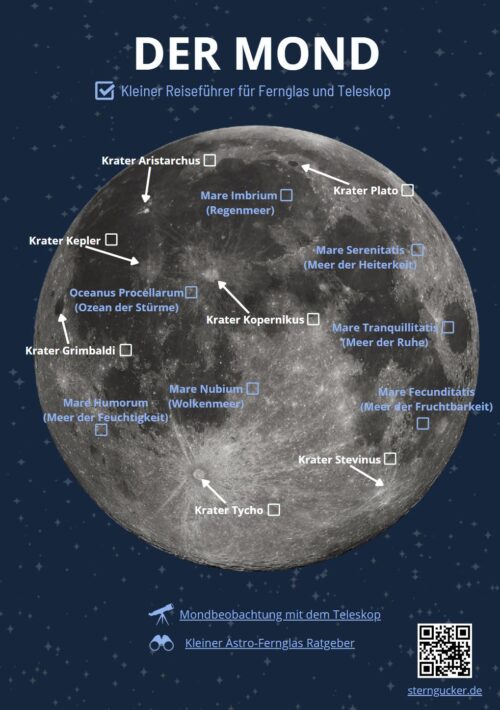
If you want to photograph the Moon, however, it is not necessary to have a tracking mount, as is indispensable for deep-sky astrophotography, for example.
Since the Moon is very bright, very short exposure times can be achieved, so the Earth’s rotation can be disregarded.
Features of a Moon and planetary telescope
Because of its proximity, brightness, and wealth of detail, the Moon offers us many advantages as an astronomical observation target.
These properties should also be taken into account when designing our telescope, in order to get the most out of observing the Moon. Here are a few key points:
- The Moon is very close, bright, and detailed, which makes it an ideal observation target.
- Our telescope should be sharp and high in contrast in order to capture all the details of the Moon.
- High magnification should be possible while a comfortable view is maintained.
- Since the Moon is very bright, the size of the aperture can be reduced in favor of imaging quality, even though it is normally maximized.
You can find more detailed information on this in Moon observation with the telescope.
Suitable telescopes would be:
- Refractor telescope: Celestron AstroMaster 102AZ RefractorCelestron AstroMaster 102AZ Refractor – $359.95€ 349*
- Maksutov telescope: Sky-Watcher Skymax 127 Maksutov-Cassegrain with AZ-GTi MountSky-Watcher Skymax 127 Maksutov-Cassegrain with AZ-GTi Mount – $995.00€ 775*
- Schmidt-Cassegrain telescope: Celestron Advanced VX 8″ Schmidt-Cassegrain GoToCelestron Advanced VX 8″ Schmidt-Cassegrain GoTo – $2,199.00€ 2,499*
Not decided yet? None of these is a beginner purchase you have to make today – our telescope buying guide walks through apertures, mounts and budgets first.
Necessary accessories
To connect the camera to the telescope, an adapter is needed. This is typically a T2 adapter. The importance of a stable mount has already been discussed. Other expensive equipment, such as that needed for planetary photography, is not required.