By Alexander Merz · Updated on · Details checked on 14 September 2026
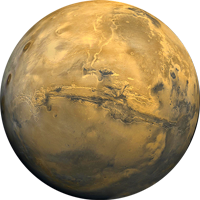
Observing Mars with a telescope ranks among the most rewarding experiences in amateur astronomy. The Red Planet has captivated stargazers for centuries — and no wonder: our planetary neighbour reveals a wealth of fascinating detail, from bright polar caps to vast canyons, towering extinct volcanoes and even its two tiny moons.
In this complete guide you’ll learn how and when to observe Mars under the best conditions, what equipment you need, and how to pick out the intriguing features on its surface. Mark your calendar for the next big date: the opposition on 19 February 2027.
⚡ The quick answer: To observe Mars with a telescope, aim for at least 80–100 mm (3–4″) of aperture so you can make out the polar caps and the larger dark markings. The best time is around opposition, when Mars is closest and brightest — the next one falls on 19 February 2027. A magnification of 100× to 200×, steady seeing and a properly cooled instrument make all the difference.

The fascination of Mars — why is this planet so special?
Mars has long stood as a symbol of the unknown and the mysterious. Its reddish hue linked it, in many cultures, to gods of war (Mars to the Romans, Ares to the Greeks). From the 19th century onward, science became captivated by the Red Planet, and early astronomers even speculated about artificial “canals” and alien civilisations. Observing Mars has held humanity spellbound long before the space age.
What makes Mars unique:
- It’s the only inner planet (besides Earth) whose surface is relatively easy to observe through an amateur telescope.
- Its distance from the Sun varies widely (a strongly elliptical orbit), so at certain oppositions Mars comes very close to Earth.
- Polar caps, giant volcanoes (such as Olympus Mons) and canyons (Valles Marineris) make Mars a thrilling observing target.
The ideal moment: when can you best see Mars?
Opposition and perihelion: the perfect window for observing Mars
Opposition is the moment when Earth and Mars lie on the same side of the Sun. This happens roughly every 26 months (2 years and 2 months). Shortly before, during and after opposition, Mars is at its brightest and shows its largest apparent diameter.
- Perihelic opposition: when opposition coincides with the point where Mars is closest to the Sun (perihelion), the distance to Earth can shrink to around 55 million kilometres. Mars then appears especially large and brilliant.
- Aphelic opposition: when opposition occurs near the point farthest from the Sun (aphelion), the distance can exceed 100 million kilometres. Mars then looks smaller and dimmer.
Historic extremes:
- August 2003: the closest approach of Mars and Earth in 60,000 years — a dream night for observing Mars!
- July 2018: another very close distance, though a global dust storm hampered observation.
- October 2020: Mars was less close than in 2018, but still nicely visible.
- 2035: the next particularly close opposition.
Oppositions at a glance
| Date | Distance (astronomical units) | Apparent size (arcseconds) | Constellation |
|---|---|---|---|
| 27 July 2018 | 0.386 AU | 24.24″ | Capricornus |
| 14 Oct 2020 | 0.419 AU | 22.33″ | Pisces |
| 8 Dec 2022 | 0.550 AU | 17.03″ | Taurus |
| 16 Jan 2025 | 0.644 AU | 14.54″ | Gemini/Cancer |
| 19 Feb 2027 | 0.678 AU | 13.81″ | Leo |
| 25 Mar 2029 | 0.649 AU | 14.42″ | Virgo |
| 4 May 2031 | 0.559 AU | 16.75″ | Libra |
| 28 Jun 2033 | 0.427 AU | 21.91″ | Sagittarius |
| 15 Sep 2035 | 0.382 AU | 24.52″ | Aquarius / Pisces |
Mars in retrograde: the curious loop in the sky
Like all superior planets, Mars goes through a retrograde interval when Earth “overtakes” it. Normally Mars drifts west to east through the constellations, but around opposition it appears to move backwards (retrograde). This “retrograde loop” is especially wide for Mars and lasts several weeks — one more reason observing Mars is so rewarding.
Which telescope is right for observing Mars?
Telescope types: pros and cons
- Refractor (lens telescope)
- Pros: sharp, high-contrast images; largely maintenance-free.
- Cons: larger apertures quickly become very expensive; budget models show chromatic aberration.
- Newtonian reflector
- Pros: large apertures at affordable prices, good image quality.
- Cons: needs collimation; long tubes can be unwieldy.
- Catadioptric systems (Schmidt-Cassegrain, Maksutov)
- Pros: compact design, fairly large apertures, versatile.
- Cons: higher price, longer cool-down time.
For observing Mars, a telescope of at least 80–100 mm aperture (3–4 inches) is recommended, enough to reveal the polar caps and some brightness variations on the surface. Larger apertures (200 mm and up) boost resolving power — but only when the atmospheric conditions (the seeing) cooperate.
My recommendation and tips 👍
Maksutov telescopes are widely regarded as superb “planet performers”. This catadioptric design combines mirrors and lenses to deliver large apertures at long focal lengths in a pleasingly compact package. A specially shaped meniscus front lens corrects the primary mirror’s spherical aberration, while a small secondary mirror “folds” the light path, keeping the tube short despite the long focal length.
Thanks to lower obstruction than Schmidt-Cassegrains, virtually no chromatic aberration and a compact tube, the Maksutov travels easily and sits happily on lightweight mounts. That said, the best entry point for observing Mars is often an instrument that gives you plenty of aperture on a modest budget — and that’s exactly where the Dobsonian shines.
Aperture, focal length and useful magnification
- Aperture: the larger it is, the more light the telescope gathers and the higher its potential resolving power.
- Focal length: determines your magnification (together with the eyepiece). Long focal lengths allow high magnifications, often ideal for planets.
- Magnification: a rule of thumb puts the useful maximum at about 2× the aperture in millimetres (i.e. 50× per inch). Push beyond that and the image quickly turns fuzzy, especially in poor seeing.
Mount and stability
A stable mount is essential so your image doesn’t wobble. You can choose between altazimuth and equatorial mounts:
- Altazimuth (e.g. a Dobsonian mount): easy to use, ideal for beginners, more affordable.
- Equatorial: allows simple tracking aligned with Earth’s rotation. Often the better choice for planetary observing, long exposures and comfortable viewing.
Our equipment recommendations
For observing Mars with a telescope, the best value comes from an instrument that’s generous on aperture yet easy on the wallet. Here are three reliable picks, from a big Dobsonian to a compact starter refractor:
Best value: Skywatcher Dobson Telescope N 200/1200 Skyliner Classic
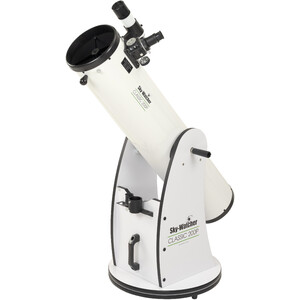
200 mm of aperture — the most sky for your money. Set it on the ground, point by hand: nebulae, clusters and galaxies for years to come.
Price: € 479
Great for beginners: Omegon Telescope AC 70/700 AZ-2
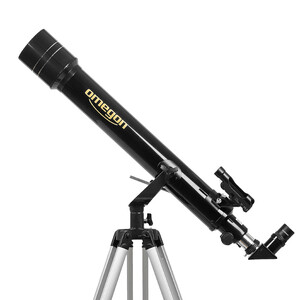
The no-pitfall starter refractor: Moon, Saturn's rings and Jupiter's moons from the very first night. No collimation.
Price: € 119
Compact & portable: Skywatcher N 100/400 Heritage Telescope
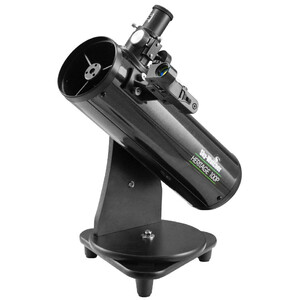
Tabletop Dobson with a 100 mm parabolic mirror. Light, portable — an ideal first real instrument on a small budget.
Price: € 179
* Affiliate link: if you buy through this link we may earn a small commission from Astroshop or High Point Scientific, at no extra cost to you.
Getting ready to observe Mars
Choosing a site and seeing conditions
Even the best telescope is of little use if the local conditions (the seeing) are poor:
- City vs. countryside: in cities, light pollution often eats into contrast. Mars is bright, yet stray light can still swallow fine detail.
- Avoid heat islands: don’t observe over rooftops or asphalt — rising warm air degrades the image.
- Altitude: a higher site with little air turbulence (mountains, for instance) improves the seeing.
Before you observe: cooling and acclimatising the telescope
A telescope should adjust to the outside temperature, otherwise the temperature gradient inside the tube creates air currents and blur. Plan a cool-down time of 30 to 90 minutes, depending on the temperature drop and telescope type (mirror-based systems often need longer).
Filters and other aids
- Colour filters:
- Red filter (Wratten #25): emphasises albedo structures (dark regions).
- Blue filter (Wratten #80A): highlights polar caps and clouds.
- Orange filter (Wratten #21): boosts contrast between light and dark areas.
- Eyepieces: high-quality eyepieces with long eye relief and good sharpness are ideal.
- Barlow lens: doubles or triples your telescope’s focal length — but it should be a quality unit.
My recommendation and tips 👍
Several eyepieces in different focal lengths beat a single one. To cover a range of magnifications, it’s better to own several eyepieces than a single zoom: budget zooms often fall short on sharpness and contrast. For observing Mars, individual eyepieces are usually the smarter choice.
Orthoscopic eyepieces offer high contrast and excellent light transmission. Given the long focal length of planetary instruments, affordable types such as (Super-)Plössl and Abbe orthoscopics work beautifully: at the medium focal lengths relevant to high magnification, they deliver a sufficient field of view, comfortable viewing and superb contrast — outstanding bang for the buck.
Observing Mars: which surface features can you spot?
The red colour — where does it come from?
Mars owes its reputation as the “red” or “orange-red” planet to the iron-oxide dust (rust) on its surface and in its thin atmosphere. You can already spot this tint with the naked eye — without a telescope, Mars looks like a reddish star.
Polar caps and bright regions
- Polar caps: even at modest magnification you can see bright, white patches at the top or bottom edge of the disc. They consist of frozen water and carbon dioxide.
- Bright regions (Planitiae): these rust-coloured desert areas were given names like Arabia Terra or Hellas Planitia in the early days of Mars research. They reflect more light than the darker areas.
Dark albedo markings and volcanoes
- Dark patches: once thought to be seas or vegetation, they are in fact areas where volcanic rock or darker sediments lie exposed.
- Famous structures:
- Valles Marineris — a gigantic canyon system stretching thousands of kilometres.
- Olympus Mons — the largest volcano in the Solar System; with a little experience you can pick out its surroundings as a darker region.
Global dust storms
Mars is repeatedly swept by dust storms that can shroud almost the entire planet within days. They occur most often when Mars reaches its closest point to the Sun and the extra warmth stokes atmospheric currents. During such storms, all surface detail becomes nearly invisible to telescope observers.
The moons of Mars: Phobos and Deimos
- Phobos: small and very close to Mars. To glimpse it you need a telescope of at least 8 inches aperture, and you should hide Mars behind an occulting bar or push it to the edge of the field to cut its blinding glare.
- Deimos: farther out and easier to see. Once Mars is out of the direct field, watch for this tiny moon.
Practical tips for successful observations
Notes and sketches
Record your observations in writing or make sketches. This trains your eye and helps you register changes or dust storms. Over time you’ll develop a sharper sense of which details are visible and when.
Astrophotography of Mars
If you want to photograph Mars, a planetary camera or a DSLR/mirrorless body with a good video function is the way to go. In planetary imaging you typically capture several thousand frames (lucky imaging) and then stack them with software (such as AutoStakkert! or Registax) to cut noise and bring out detail.
Observing Mars with a telescope: frequently asked questions (FAQ)
Do I need a very expensive telescope for Mars?
Not necessarily. From 80–100 mm of aperture you can already make out the polar caps. More aperture reveals finer detail, provided the seeing allows it.
What magnification is best for Mars?
Between 100× and 200× often gives a good balance of detail and image brightness. Under excellent conditions you can push higher.
What’s the best time of year to observe Mars?
Around opposition. Because Mars reaches opposition every 26 months, the window shifts each time — the next one falls on 19 February 2027.
Is a filter worth using for Mars?
Yes — colour filters often boost the contrast of specific features (polar caps, dust storms).
Why do I have to let my telescope cool down?
To even out temperature differences. Warm air inside the tube creates streaks and shimmer that blur the image.
Observing Mars with a telescope: the bottom line
Observing Mars is one of the most thrilling experiences in amateur astronomy. Around opposition, with a little patience and the right gear, you can catch stunning glimpses of the Red Planet. Watch for favourable seeing, take care of your telescope’s temperature adjustment, and reach for colour filters when needed to sharpen up polar caps and dark albedo markings. Follow these tips and — who knows — you might even spot Phobos or Deimos. See you on 19 February 2027!