By Alexander Merz · Updated on · Details checked on 14 September 2026
Reflector or refractor, mirror or lens — it’s the first big question every telescope buyer faces. The short answer? For the same money, a reflector telescope almost always shows you more. But there are solid reasons to choose either design. Here’s the honest reflector vs refractor telescope comparison, jargon-free, including the question that really matters: which type is genuinely worth it, and for whom?
⚡ The quick answer: For the same budget, a reflector (mirror) gives you far more aperture — more light, more objects, and a clear edge on deep-sky. A refractor (lens) wins on simplicity: a sealed tube, no adjustments, crisp high-contrast views of the Moon and planets, perfect from a balcony. Maximum performance per dollar → reflector. Maximum ease → refractor.
| Reflector (mirror) | Refractor (lens) | |
|---|---|---|
| Optical principle | a concave mirror collects light | lenses refract light |
| Aperture per dollar | a lot — 200 mm for the price of a 100 mm lens | little — you pay for glass, not aperture |
| Chromatic aberration | none (mirror) | visible on cheap achromats |
| Maintenance | occasional collimation | virtually maintenance-free |
| Tube | open (dust, cool-down time) | sealed |
| Ideal for | deep-sky, maximum performance | Moon/planets, simplicity, balcony |
| Typical designs | Newtonian, Dobsonian | achromat, apochromat |
How the two designs actually work
Both types of telescope do the same job: gather as much light as possible and bring it to a focus, where the eyepiece magnifies the image like a magnifying glass. The difference lies in how the light is brought together.
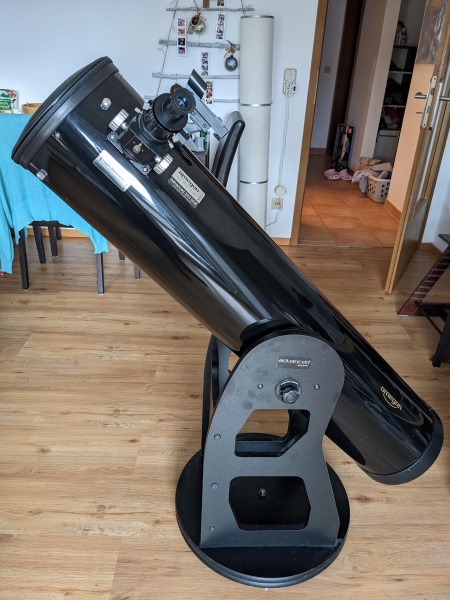
In a refractor (lens telescope), an objective lens at the front of the tube bends the light — the same principle Galileo used to revolutionize sky-watching back in 1609. Light travels straight down the tube to the eyepiece at the rear. In a reflector (mirror telescope), light strikes a curved primary mirror at the bottom of the tube, bounces off a small secondary mirror, and is directed sideways to the eyepiece — the classic Newtonian layout that Isaac Newton devised precisely to sidestep the color error of lenses. That secondary mirror sits right in the light path: this so-called obstruction costs a little contrast, but on a well-designed instrument it’s surprisingly unobtrusive in practice.
The reflector: more aperture for your money
In astronomy, one thing matters above all: aperture. More diameter = more light = more to see. And a large mirror is far cheaper to make than a large lens — which is why a Dobsonian gives you 200 mm of aperture for the price of a 100 mm refractor. There’s a bonus from physics, too: a mirror reflects all colors identically, so a reflector is free of chromatic aberration by design.
You should know the trade-offs as well. The open tube lets in air (good for cooling) but also dust (less good), and it needs 30–60 minutes to acclimatize to the outside temperature, or the image will shimmer. Every few months a quick collimation is due: the mirrors can shift slightly during transport and are realigned with two or three turns of a knob — with a collimation laser it’s a five-minute job, no rocket science. And the secondary mirror in the light path costs a whisper of contrast compared with a same-size refractor — one that, at this price, simply doesn’t exist anyway.
The refractor: rugged and low-maintenance
Refractors are the storybook telescopes: sealed tube, no collimation, barely any cool-down, ready to use the moment you set up — and, thanks to an unobstructed light path, sharp, high-contrast views of the Moon, planets and double stars. If you want an instrument that works for years without any maintenance, this is your design.
The catch is the physics of the lens: glass bends every color of light a little differently. Cheap achromats therefore show a violet fringe around bright objects — the shorter the tube, the stronger it gets. Color-true apochromats solve this with special glass, but cost several times as much and are the domain of astrophotography. Then there’s the practical limit: above 120–150 mm in diameter, lenses become heavy, long and seriously expensive. For beginners with a balcony and little appetite for tinkering, small refractors (70–102 mm) are nonetheless a fine choice.
What it means at the eyepiece: Moon, planets, deep-sky
The design question is really an object question. For the Moon and planets, contrast and sharpness rule — this is where the refractor shines, even with a small aperture, because these objects are bright. For deep-sky — galaxies, nebulae, star clusters — almost nothing matters but light-gathering power, i.e. aperture: the reflector’s clear home turf. What you’ll actually see at each aperture is laid out in our big telescope buying guide.
An important point against a widespread myth: both designs show every object. A Dobsonian delivers beautiful planetary views, and a 90 mm refractor will reveal the Andromeda Galaxy. We’re talking about advantages, not exclusive rights.
The straight duel: 200 mm of mirror vs. 100 mm of lens
The difference is starkest once you fix the budget. Our two picks below sit in the same class: the 8-inch Dobsonian at $699.95€ 479, a refractor on a mount from $199.95€ 119. Similar money, very different telescopes:
| Dobsonian 200/1200 | Refractor 100 mm | |
|---|---|---|
| Light-gathering area | 200 mm aperture — 4× as much light as 100 mm | 100 mm aperture |
| Resolution | twice as fine detail theoretically possible | baseline |
| Deep-sky | spiral arms, resolved globular clusters, hundreds of objects within reach | bright objects as faint smudges |
| Planets | very good, contrast marginally softer | very good, biting contrast, but a slight color fringe |
| Handling | big and heavy, but no tripod fuss | compact, balcony-friendly, maintenance-free |
The rule of thumb from this math: if you want maximum performance per dollar, buy mirror area. If you want maximum simplicity, buy a lens. Both are legitimate — you just want to know it going in.
Two concrete picks to settle it, one per design:
Best value: Skywatcher Dobson Telescope N 200/1200 Skyliner Classic
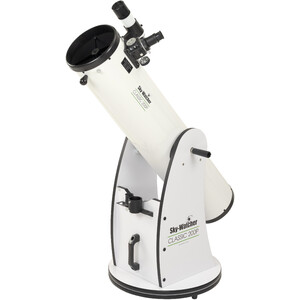
200 mm of aperture — the most sky for your money. Set it on the ground, point by hand: nebulae, clusters and galaxies for years to come.
Price: € 479
Best starter lens: Omegon Telescope AC 70/700 AZ-2
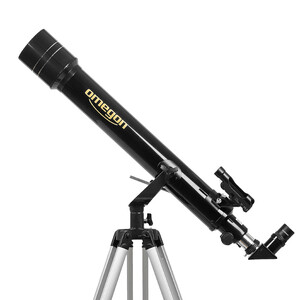
The no-pitfall starter refractor: Moon, Saturn's rings and Jupiter's moons from the very first night. No collimation.
Price: € 119
* Affiliate link: if you buy through this link we may earn a small commission from Astroshop or High Point Scientific, at no extra cost to you.
The third way: catadioptric telescopes
Schmidt-Cassegrains (SC) and Maksutovs combine mirror and lens: the light is folded several times inside the tube, so a long focal length fits into a compact, sealed body. That makes them strong on planets, easy to transport and popular as travel and GoTo scopes. The price: markedly more expensive per millimeter of aperture than a Newtonian, and the long focal length delivers only a small field of view — large nebulae won’t fit fully in the eyepiece. Rarely the best choice as a first telescope, often excellent as a second.
City balcony or country sky? Your location matters too
An often overlooked factor in the design choice is your observing site. In the city, light pollution swallows the faint deep-sky objects anyway — what remains are the Moon, planets and double stars, exactly the strengths of a compact refractor that also fits on a balcony railing. In the countryside, the picture flips: under a dark sky a large Dobsonian unfolds its full potential, and every extra millimeter of aperture visibly pays off. Live in the city but still want deep-sky? Two escape routes: load the telescope into the car — or reach for a smart telescope, which cancels out a surprising amount of light pollution through filtering and image stacking.
The everyday test: weight, space, setup time
On paper, optical specs decide; in everyday life, something else does: the best telescope is the one you actually carry outside. A 200 mm Dobsonian tips the scales at around 20 kg all in and needs its dedicated spot in both car boot and home — in return, it’s observation-ready in the garden in two minutes, with no tripod to assemble. A small refractor with mount weighs a fraction of that, disappears into a cupboard and is ready to go on the balcony instantly. So ask yourself honestly: where will you observe on an ordinary Tuesday night — and how much lugging are you willing to take on? That answer often settles the design question faster than any spec sheet.
Five myths, quickly checked
- “Collimation is for pros.” No — with a laser it takes five minutes and becomes routine after two tries.
- “Refractors are always sharper.” Only at equal aperture — and that aperture costs several times more in a refractor. A 200 mm mirror shows more than a 100 mm apo, except for the fine contrast on planets.
- “More magnification = better telescope.” Magnification is an eyepiece matter and freely changeable. Aperture determines what you see — “500x” ad promises are a warning sign.
- “Mirrors wear out.” Modern mirror coatings last many years to decades with normal care. Don’t touch them, don’t clean them like eyeglasses — that’s about all the care they need.
- “Refractor for beginners, reflector for pros.” Rather the opposite: the Dobsonian — a mirror telescope — is the single most recommended beginner instrument, precisely because it’s so simple to operate.
Our recommendation by type of buyer
- “I want to see as much as possible”: reflector — a Dobsonian 200/1200 ($699.95€ 479) or, if the budget stretches, straight to a 254/1200. Details in the Dobsonian guide.
- “I want zero maintenance and observe from the balcony”: a 70–102 mm refractor on an alt-azimuth mount.
- “I want to shoot photos”: neither — a smart telescope (a Seestar S30 Pro, for example) or, later, an apo.
- “It’s for a child”: rugged and simple beats big — see the telescope for kids guide.
- “I can’t decide”: start with the best beginner telescopes, which walk you through it step by step.
Frequently asked questions
Which is better for beginners: reflector or refractor?
For value: the reflector (Dobsonian). For carefree handling: the refractor. Both paths work — what matters is that the mount and the whole package are sound. Concrete models: best beginner telescopes.
Which telescope is better for planets?
At equal aperture, the refractor (more contrast, no secondary mirror in the way). At equal budget, often the larger reflector anyway, because aperture also brings resolution on planets. Long-focal-length instruments of both designs have the edge.
Which telescope is better suited to astrophotography?
For deep-sky imaging, short, color-true apochromats on an equatorial mount are the standard — or, as an easy entry, a smart telescope. Newtonians work too, but demand more tuning. The basics are in our astrophotography guide.
How often does a reflector telescope need collimating?
As a rule of thumb: a quick check after every transport, a real adjustment every few months. A Dobsonian that stays put often holds its collimation for many months. With a collimation laser, the process takes about five minutes.
Why are refractor telescopes more expensive than reflectors?
A lens must be made of optically perfect glass and ground precisely on both faces — and it can only be held at the edge. A mirror needs just one perfect surface and can be supported across its entire back. That’s why a lens’s price climbs far more steeply with diameter.
And what about catadioptric telescopes (SC, Maksutov)?
Hybrid designs of mirror and lens: compact tubes with a long focal length, strong on planets, easy to transport — but more expensive per millimeter of aperture. More a second telescope than a first.