By Alexander Merz · Updated on · Details checked on 21 September 2026
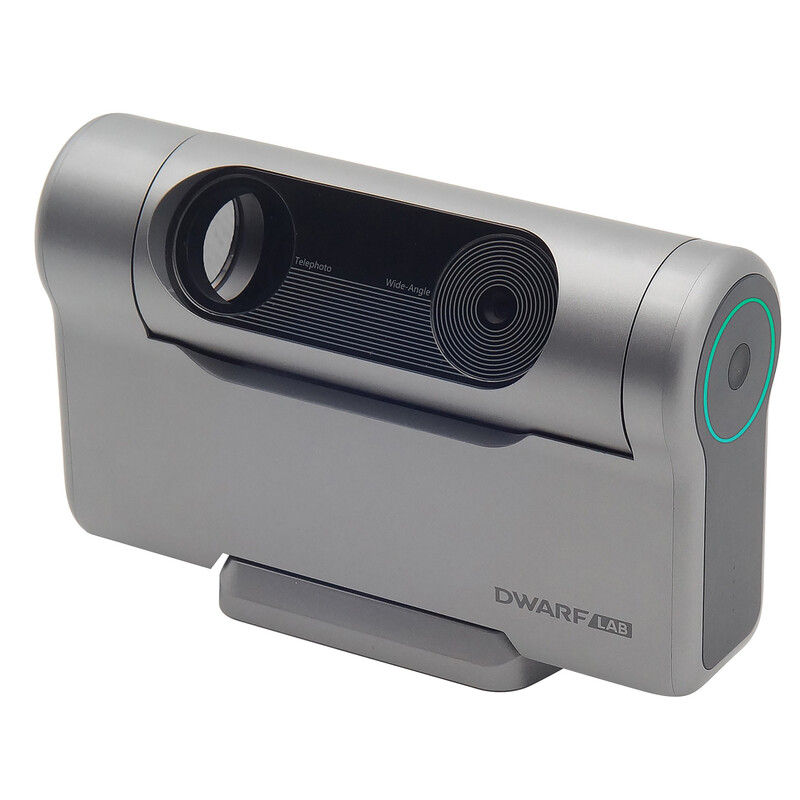
At around $549.00€ 529, the DWARFLAB DWARF 3 is the cheapest fully-fledged smart telescope on the market – and, at just 1.35 kg, the lightest too. In this DWARF 3 review we find out whether the value champion asks for any compromises, and who it’s actually the right pick for.
Transparency: this review draws on manufacturer data, verified buyer feedback and reports from the specialist press – filtered through our six-plus years of telescope consulting. It is not a hands-on lab test carried out by us.
⚡ The quick answer: the DWARF 3DWARF 3 (approx. $549.00€ 529) is the best travel smart telescope and the value champion of 2026: ultralight, fast f/4.3 optics, a low-noise 4K sensor and AI object tracking – and by day it doubles as a scope for birds and wildlife. Trade-offs: shorter battery life (~4 h) and no tripod in the box.
What is the DWARF 3?
DWARFLAB specialises in ultra-compact smart telescopes. The DWARF 3 packs a 35 mm optic with a short 150 mm focal length (f/4.3), a Sony IMX678 sensor at 3840 × 2160 pixels and a second wide-angle camera into a flat body that looks more like an action cam than a telescope. Everything runs from the app: automatic alignment via pattern recognition plus smartphone GPS, GoTo, autofocus, autoguiding and live stacking – the entire astrophotography workflow happens hands-free.
The specs at a glance
| Optics | 35 mm aperture / 150 mm focal length (f/4.3), apochromatic multi-element design |
| Cameras | Sony IMX678 (tele, 4K) + wide-angle camera |
| Filters | built-in filters, including a dual-band nebula filter to fight light pollution |
| Battery | approx. 4 h runtime, extendable via USB-C |
| Weight | 1.35 kg – the lightest full smart telescope |
| Standout feature | AI object recognition (NPU): automatically tracks birds, animals and athletes by day |
| In the box | carry case, solar filter – no tripod (a standard photo tripod with a 1/4-inch thread is enough) |
| Price | approx. $549.00€ 529 |
What makes the DWARF 3 special
- Ultra-portable: 1.35 kg in a pocket format – it fits in any backpack, and even in carry-on luggage. For trips out under dark skies (by far the biggest quality lever there is!), nothing comes close.
- Fast f/4.3 optics: gathers light more efficiently than most rivals – shorter total exposure times for comparable results.
- Two hobbies, one device: AI-assisted object tracking turns the DWARF 3 into a daytime spotting scope for birds and wildlife – automatic tracking of moving targets included.
- EQ mode out of the box: the DWARF 3 runs equatorially with no extra hardware (a tilted tripod is enough) – longer single exposures without field rotation.
- Sun from day one: the solar filter is included – sunspot observing is possible right away.
How it performs in the field
The specialist press (including heise online, in a head-to-head with the Seestar S30) rates the DWARF 3 as the most versatile device in the $500–600€500–600 class. Users praise the image quality of the low-noise IMX678 and a surprisingly mature app; the mosaic function noticeably widens the small field of view when needed. Buyers rate it 5/5 stars. As with every smart telescope: the JPEGs from the app are good – but anyone who processes the raw data (FITS) themselves visibly gets more out of it.
Strengths and weaknesses
- ✅ Best price: a full smart telescope for around $549.00€ 529
- ✅ Lightest device on the market – ideal for travel and spontaneous sessions
- ✅ Fast optics + modern sensor – a lot of image for the money
- ✅ Daytime nature watching with AI tracking
- ❌ No tripod in the box – budget for a stable photo tripod
- ❌ Battery (~4 h) shorter than the Seestar S30 Pro’s (6 h) – plan for a power bank
- ❌ Planets: like every device in this class, not suited to planetary detail
- ❌ No eyepiece: viewing is only via app/display
Handling: a night with the DWARF 3
Screw the DWARF 3 onto a photo tripod (1/4-inch thread), start the app and let it calibrate – pattern recognition handles the alignment. Then: pick a target, GoTo slews to it, autofocus sharpens up and live stacking begins. The wide-angle camera keeps you oriented the whole time; one tap switches you to the tele view. The device saves results as both JPEG and FITS raw data.
The EQ mode is the DWARF 3’s secret weapon: tilt the tripod toward the celestial pole (the app walks you through the setup) and the device exposes without field rotation – longer single frames and cleaner stars, with no accessory purchase at all.
Which targets the DWARF 3 nails
- The classics: Moon, sunspots (filter included), bright star clusters
- Nebulae with the dual-band filter: Orion, North America, Rosette and Veil – even under light pollution
- Galaxies: Andromeda, M81/82, and more under dark skies – where the travel-friendly design pays off twice
- Mosaic mode: widens the field for large objects such as a full-frame Andromeda
- By day: birds at the feeder, wildlife, aircraft – the NPU keeps moving targets in frame automatically
Worthwhile accessories
- A stable photo tripod ($50–100€60–100): a must, since none is included – the stiffer it is, the cleaner the tracking
- A USB-C power bank (20,000 mAh, ~$5020,000 mAh): stretches the ~4 h battery across the whole night
- Optional magnetic add-on filters for special uses such as comets or narrower nebula lines
DWARF 3 or Seestar S30 Pro?
The DWARF 3 is our pick for portability and price. If you shoot mostly from a balcony or garden and value a rounder, more complete package, the Seestar S30 Pro is the natural alternative. Here are the two side by side.
| Criterion | DWARF 3 | Seestar S30 Pro |
| Price | approx. $549.00€ 529 | higher |
| Weight | 1.35 kg | heavier |
| Aperture | f/4.3 | slower |
| Battery | ~4 h | ~6 h |
| Tripod | not included | included |
| Strength | portability, daytime nature | complete package |
Best value: DWARFLAB DWARF 3 Smart Telescope
A 1.3 kg smart telescope: it photographs nebulae and galaxies straight to your phone, even from the city. The simplest way into astrophotography.
Price: € 529
The alternative: ZWO Seestar S30 Pro Smart Telescope

ZWO's benchmark smart telescope: a polished app, mosaic mode and stunning results in minutes.
Price: € 699
* Affiliate link: if you buy through this link we may earn a small commission from Astroshop or High Point Scientific, at no extra cost to you.
DWARF 3 review: frequently asked questions
Is a cheap photo tripod enough?
To get started, yes – what matters is stability in wind. For EQ mode the tripod should tilt cleanly; a ball head helps.
How does it compare to the Seestar?
In short: technically a match, but with different priorities – lighter and cheaper, in exchange for fewer comfort features. We break it all down in our head-to-head comparison.
Is it really good for birdwatching?
Yes, with a caveat: it won’t replace a bright spotting scope for serious birding, but the AI tracking plus 4K video make it the most fun second use any astro device currently offers.
Can the DWARF 3 handle planets?
Not for detail: like every smart telescope in this class, its short focal length isn’t built for planets. It shines instead on the Moon, nebulae and galaxies.
Do I need a dark sky?
The built-in dual-band filter lets you capture nebulae even in the city. But for galaxies a dark sky changes everything – and that’s exactly where the DWARF 3’s featherweight design earns its keep.
Verdict: who is the DWARF 3 for?
For travellers, hikers, budget-minded stargazers and anyone who wants a single device for the sky and nature, the DWARF 3 is the clear recommendation. If you shoot mainly from a balcony or garden and want the more complete package, the Seestar S30 Pro is the call. Either way, the DWARF 3 remains the value champion of 2026.
Read next:
How would you rate this telescope?
No reader ratings yet. Yours would be the first.
Stars only, no text – one vote per device. To prevent duplicate votes we only store check values (hashes), never your IP address in plain text.