By Alexander Merz · Updated on · Details checked on 21 September 2026
Galaxies are the supreme discipline of visual astronomy: light that travelled for millions of years finally lands in your eyepiece. The good news? From just 130 mm of aperture you can catch the brightest galaxies – and under a dark sky, the Andromeda Galaxy is even visible to the naked eye. The honest truth: to tease out dust lanes or the first hints of spiral arms, two things matter above all – aperture and a dark sky. This guide shows you which telescope for galaxies and deep-sky is genuinely worth it, how to track the objects down, and which observing techniques let you see far more than most beginners.
⚡ The quick answer: For galaxies, aperture beats everything else. The best choice is a Dobsonian telescope: 130 mm is enough to get started, but observing becomes truly rewarding from 200 mm up. A dark sky, however, matters more than any dollar spent on optics – and nebula filters (UHC/OIII) do nothing for galaxies.
The key points at a glance
- Nothing replaces aperture: the entry point is 130 mm, the real payoff starts at 200 mm.
- The Dobsonian is the first choice: maximum aperture per dollar, and the simplest handling there is.
- A dark sky beats any equipment: 20 miles away from the city does more than a $500€500 upgrade.
- Nebula filters (UHC/OIII) don’t help with galaxies – unlike with gaseous nebulae.
- For colour and spiral arms: smart telescopes stack galaxies photographically in minutes.
The truth about galaxies through a telescope
Forget the colourful Hubble images: visually, galaxies appear as faint grey smudges – the eye doesn’t accumulate light over minutes the way a camera sensor does. And yet the moment stays magical when you grasp what you are actually looking at. As aperture grows, structure emerges: the dust lanes in M82, the first hints of spiral arms in M51. Anyone chasing the “photo look” reaches for a smart telescope, which stacks a galaxy into a colour image in minutes.
Incidentally, the right benchmark isn’t photographs but the sketches of experienced observers: they reproduce fairly accurately what a trained eye perceives at the eyepiece. If you get the chance before buying, spend an evening at an astronomy club or a star party looking through several apertures yourself – nothing calibrates your expectations better.
Why galaxies are so hard: understanding surface brightness
On paper the Triangulum Galaxy M33, at 5.7 mag, is “bright”. Yet beginners miss it in droves. The reason: the magnitude describes the total light of the object – but for a galaxy that light is spread across a huge patch of sky. What really counts, then, is surface brightness: how much light arrives per unit of area? A compact globular cluster of the same magnitude will look far brighter than a sprawling galaxy.
Two practical rules follow. First, for low-surface-brightness galaxies you want the brightest possible image – low to medium magnification with a large exit pupil (more on that below). Second, no object type is as sensitive to a washed-out sky – every step of light pollution literally erases galaxies, as their faint contrast drowns in the sky glow.
The aperture you actually need
For galaxies, the golden rule of deep-sky observing applies: buy as much aperture as you can afford and still comfortably carry. More aperture means more light, more reachable galaxies and more detail. The table shows what you can realistically expect:
| Aperture | What you can expect to see |
|---|---|
| 130 mm (from ~$305.00€ 265) | Andromeda (M31), M81/M82, M51 as smudges – the way in |
| 200 mm (from ~$699.95€ 479) | Dozens of galaxies, first structures under a dark sky – our best-value pick |
| 254 mm (from ~$949.95€ 622) | Dust lanes, hints of spiral arms, galaxy groups (Leo Triplet) |
| 300+ mm (12″, from ~$1,299.95€ 1,019) | Deep-sky bliss – but bulky, heavy and expensive |
You can make a fine start with a compact 130 mm tabletop Dobsonian in the $305.00€ 265 range. From the 8-inch (200/1200, $699.95€ 479) upward, you enter the territory where galaxy observing becomes genuinely fun – under a dark sky you’ll already reach dozens of objects from the Messier and NGC catalogues.
Which telescope type suits galaxies?
In principle every telescope shows galaxies – but not every design delivers aperture at an affordable price. The comparison:
| Design | Strengths | Weaknesses | Galaxy suitability |
|---|---|---|---|
| Newtonian on a Dobsonian mount | maximum aperture per dollar, stable, ready to use | no motorised tracking, occasional collimation | ★★★★★ first choice |
| Newtonian on an equatorial mount | tracking possible, imaging option | pricier, heavier, more complex setup | ★★★★ |
| Refractor (lens telescope) | high contrast, maintenance-free | large aperture gets very expensive | ★★ bright galaxies only |
| Schmidt-Cassegrain / Maksutov | compact, easy to transport | f/10 systems yield only small exit pupils | ★★★ usable, not ideal |
In short: a fast Newtonian (f/5 to f/6) with a large aperture is the born galaxy telescope. Refractors play to their strengths more on the Moon, planets and double stars.
Why the Dobsonian is the galaxy machine
For visual deep-sky, it’s aperture per dollar that counts – and there the Dobsonian is unbeatable. The 8-inch (200/1200) and the 10-inch (254/1200) are the standard recommendations for galaxy hunters. Add a wide-field finder eyepiece – and a dark sky. That dark sky matters more than any equipment upgrade: under a city sky, galaxies vanish into the light haze.
The reason for the Dobsonian’s dominance is simple: the rocker-box mount costs next to nothing, so the whole budget flows into the optics. Setup in under five minutes, no electronics, no battery – at minus five degrees in winter, an underrated advantage. And manual tracking is entirely painless at the 50× to 150× magnifications typical for galaxies.
Here are our two concrete recommendations: the big 8-inch as the best-value all-rounder, and a compact Dobsonian for tight budgets or grab-and-go nights.
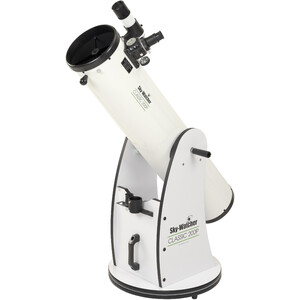
Best value: Skywatcher Dobson Telescope N 200/1200 Skyliner Classic
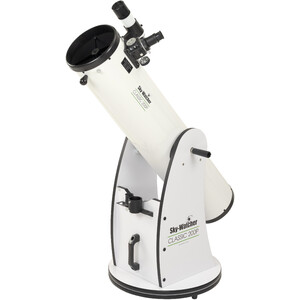
200 mm of aperture — the most sky for your money. Set it on the ground, point by hand: nebulae, clusters and galaxies for years to come.
Price: € 479
Compact & affordable: Skywatcher Dobson Telescope N 130/650 Heritage FlexTube
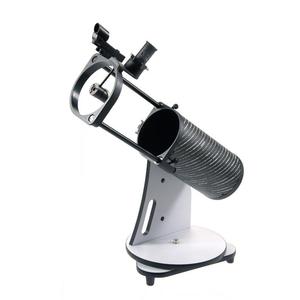
A compact tabletop Dobson with a true parabolic mirror. Folds down, fits in a bag: the Moon, planets and the bright deep-sky classics.
Price: € 265
* Affiliate link: if you buy through this link we may earn a small commission from Astroshop or High Point Scientific, at no extra cost to you.
Magnification and exit pupil: choosing the right eyepieces
The exit pupil (EP) is the cone of light that reaches your eye: aperture in mm divided by magnification. For low-surface-brightness galaxies you want 2 to 5 mm of EP. An example on an 8-inch (200/1200) Dobsonian: a 32 mm eyepiece gives 37.5× and 5.3 mm EP – the bright finding and overview image. A 10 mm eyepiece delivers 120× and 1.7 mm EP – good for small, compact galaxies and detail such as the core of M82.
- Wide-field eyepiece (30–40×): for locating and for extended objects like M31.
- Medium magnification (80–120×): the workhorse for most galaxies.
- High magnification (150×+): only for small, high-surface-brightness objects and good seeing.
More magnification is often counterproductive on galaxies – the image darkens and contrast drops.
Finding galaxies: star-hopping, Push-To or GoTo
The biggest beginner hurdle isn’t seeing, it’s finding. Three routes lead to the target. With classic star-hopping you work your way from bright stars to the object using a star chart and finder – instructive, free, and quick with a little practice. Push-To systems (such as Celestron’s StarSense technology) show you via a smartphone arrow which way to nudge the tube. GoTo mounts slew to the object under motor power – convenient, but pricier and power-hungry.
Our recommendation for the start: learn to find the five or six brightest galaxies by star-hopping – that sky knowledge stays with you for life. As tools, a planisphere and a free planetarium app are all you need.
A dark sky beats any aperture
An 8-inch (200 mm) Dobsonian under a mountain sky shows more galaxies than a 16-inch (400 mm) giant on the edge of town. So: drive out. Even 20 miles of distance from the city works wonders. Plan your galaxy nights around new Moon – even a half Moon completely swamps faint objects.
On site, technique makes the difference: give your eyes 30 minutes of dark adaptation and use only a red torch. And apply averted vision: look just beside the galaxy – the light-sensitive rods sit at the edge of the retina, and the object then practically “pops” into view. With these two tricks you’ll see twice as much on the same night, at the same telescope.
Galaxy season calendar: what’s up and when
Galaxies have a season: in spring, at night, the Earth looks out of the plane of the Milky Way into the depths of space – which is why March to May is galaxy high season. In summer, by contrast, the band of the Milky Way dominates, with its nebulae and star clusters.
| Season | Top galaxies | Note |
|---|---|---|
| Spring (Mar–May) | M51 Whirlpool, M81/M82, M101, Leo Triplet, Virgo Cluster | High season – in the Virgo Cluster, dozens of galaxies fit in one field |
| Summer (Jun–Aug) | M51 and M101 high in the north early evening | short nights, more of a nebula and cluster season |
| Autumn (Sep–Nov) | M31 Andromeda, M33 Triangulum, NGC 253 Sculptor Galaxy | M31 impressive even in binoculars |
| Winter (Dec–Feb) | M81/M82 (circumpolar), M77 | often the most transparent nights of the year |
To begin with, a simple pair of astronomy binoculars is actually enough to hunt down M31 and M81/M82 – ideal training for later star-hopping with the telescope.
The photo shortcut: galaxies in colour with a smart telescope
Visually, galaxies stay grey – photographically, they reveal colour and spiral arms after just minutes. This is exactly where smart telescopes come in: devices like the DWARF 3 or the Seestar photograph fully automatically, stack the exposures live and deliver to your phone what no eyepiece will ever show. It doesn’t replace the thrill of real photons hitting your eye – but it’s the fastest route to “wow” images of M51 and company, especially under a city sky.
Best for imaging: DWARFLAB DWARF 3 Smart Telescope
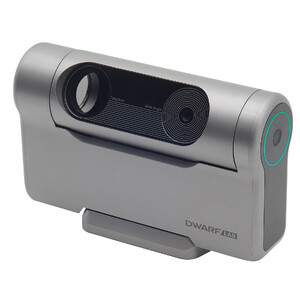
A 1.3 kg smart telescope: it photographs nebulae and galaxies straight to your phone, even from the city. The simplest way into astrophotography.
Price: € 529
The classic route – camera, equatorial mount and image processing – is considerably more demanding and expensive.
Frequently asked questions
Can I see galaxies from the city?
Only the very brightest, and faintly. Galaxies shine in a continuum – nebula filters barely help here (unlike with gaseous nebulae). The solution is to drive out; even 20 miles from the city already works wonders. Bright cores like that of M31 remain visible from the suburbs at a pinch.
Which galaxies should I observe first?
Andromeda (M31) in autumn, Bode’s pair M81/M82 year-round in the north, the Whirlpool Galaxy M51 in spring, and the Leo Triplet in spring. They all appear on any monthly sky chart.
Do nebula filters (UHC/OIII) help with galaxies?
No. UHC and OIII filters only let through the emission lines of gaseous nebulae – but galaxies emit starlight across the entire spectrum. The filter then dims the galaxy just as much as the sky. Save the money and invest it in the drive to a dark observing site.
Why can’t I see spiral arms and colours?
At night your eye works with the colour-blind rods – which is why galaxies stay grey. M51 reveals its spiral structure under a dark sky from around 254 mm of aperture, using averted vision. Colour only exists photographically, most easily with a smart telescope.
Is a 130 mm telescope enough for galaxies?
For getting started, yes: a 5-inch (130/650) in the $305.00€ 265 range shows M31 with its companions, M81/M82, M51 and a few more under a dark sky – as structureless nebulous patches. Anyone who wants structure is better off planning for 200 mm from the outset.
Which telescope for deep-sky photography?
Imaging places different demands than visual observing: here the tracking mount counts for more than aperture. The simplest way in is a smart telescope; the classic route runs via small apo refractors on an equatorial mount.
Verdict: buy aperture, seek out the dark
The best telescope for galaxies is a Dobsonian with as much aperture as possible – from the 5-inch (130/650, $305.00€ 265) for a taster, through the 8-inch (200/1200, $699.95€ 479) as the best-value king, to the 10-inch (254 mm, $949.95€ 622) for ambitious deep-sky hunters. Pair it with a wide-field eyepiece, new-Moon dates and a dark site – and the first clear spring night will already show you more galaxies than you can tick off in one evening.