By Alexander Merz · Updated on · Details checked on 14 September 2026
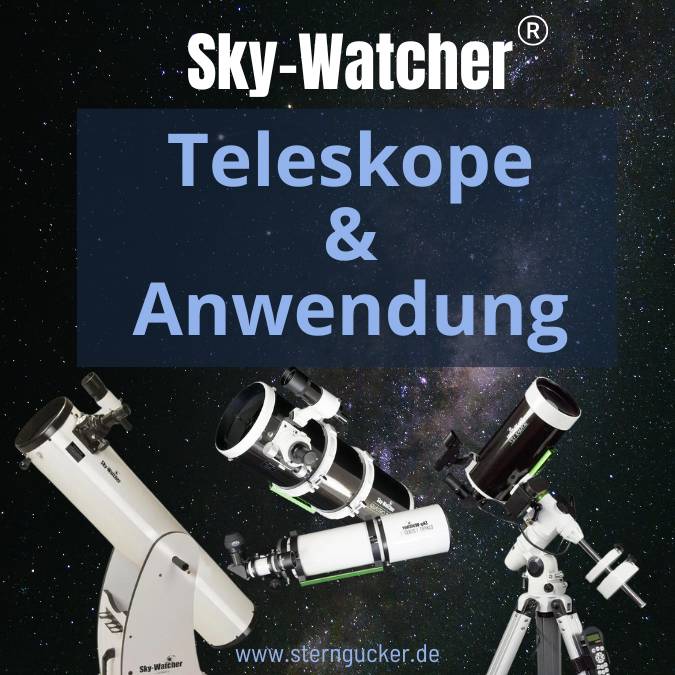
Sky-Watcher (often spelled “Skywatcher”) is one of the most popular telescope brands among amateur astronomers, mainly because it offers so much aperture for the money. From a small beginner telescope and a compact travel Dobson to a big deep-sky light bucket and an astrophotography refractor, the brand covers nearly every need. This guide sorts out the model lines, decodes those cryptic names, and helps you figure out which Sky-Watcher telescope is right for you.
⚡ Short answer: For beginners, a Heritage tabletop Dobson (130 or 150 mm) is the best pick: lots of aperture, dead-simple to use, and tiny when packed away. If you’re chasing the deep sky, step up to the Skyliner 200P (8 inch) or larger. For the Moon & planets on the go, the compact SkyMax-127 (Maksutov) is ideal, and for astrophotography an Evostar ED refractor on a solid EQ mount (HEQ5/EQ6-R). Rule of thumb: with a Dobson, aperture is king; for imaging, the mount is what matters.
Where to start: for most beginners that is the Sky-Watcher Heritage 130 Tabletop DobsonianHeritage 130/650 FlexTube ($305.00€ 265) – the full lineup with current prices is in the comparison table below.
Sky-Watcher: the story behind the brand
Sky-Watcher is the amateur brand of the Taiwanese optics group Synta, which launched in the late 1990s and today manufactures at large scale in China. That manufacturing muscle is the brand’s open secret: Synta also makes optics for other well-known names, and since 2005 it has belonged to the same group as Celestron. For you as a buyer, that means solid, consistent quality at a very fair price, and when it comes to reflectors (Newtonians and Dobsonians), Sky-Watcher is hard to beat on value.
The brand covers practically every design: Newtonian reflectors, Dobsonians, Maksutov- and Schmidt-Cassegrain systems, refractors from budget achromats to pro-grade apochromats, plus a full lineup of mounts. That makes Sky-Watcher a true “one-stop brand”: you can go all the way through the hobby, from your very first look to deep-sky imaging, with gear from a single maker.
Model lines decoded: Heritage, Skyliner, Explorer & Co.
The model name tells you almost everything about the design and its intended use. These are the lines worth knowing:
- Heritage – compact tabletop Dobsonians with a collapsible FlexTube. Small when stowed, set up in seconds, and a lot of aperture for the money. The go-to beginner and travel recommendation (76 to 150 mm).
- Skyliner – the classic large Dobsonians built for maximum aperture (150 to 400 mm). First choice for visual deep-sky observing; 250 mm and up are usually FlexTube models.
- Explorer – Newtonian reflectors on an equatorial mount. Versatile all-rounders; the PDS versions with a dual-speed focuser are built with imaging in mind.
- SkyMax – compact Maksutov-Cassegrains with long focal lengths. The specialist for the Moon and planets in a small package.
- Evostar – refractors, from budget achromats to ED apochromats. The ED models are popular, portable astrophotography optics – see how the classic of the range performs in our Sky-Watcher EvoStar 80ED review.
- Esprit – triplet pro-grade apochromats for demanding astrophotography, delivering pin-sharp, color-free images.
- Quattro – fast f/4 imaging Newtonians for short exposures and wide fields.
- Star Adventurer & EQ – the mount lineup: from the small Star Adventurer GTi travel tracker to the load-bearing HEQ5 and EQ6-R Pro imaging mounts.
Sky-Watcher abbreviations: what P, PDS, EQ and GoTo mean
There’s a system behind the numbers and letters in each model name. The key abbreviations:
| Abbreviation | Meaning |
|---|---|
| N 200/1200 | Design & specs: N = Newtonian, first number = aperture (mm), second = focal length (mm) |
| P | Parabolic mirror – sharper than a spherical mirror, standard on the good Newtonians |
| PDS | Parabolic mirror + dual-speed focuser – geared toward astrophotography |
| EQ / AZ | Mount type: EQ = equatorial (can track), AZ = alt-azimuth (simple) |
| GoTo / SynScan | Computerized control that slews to objects automatically |
| GTi | GoTo via Wi-Fi and a smartphone app, often in FlexTube Dobsonians (Virtuoso) |
| ED | Special glass in the refractor that fights color fringing – the mark of the imaging refractors |
Sky-Watcher best sellers compared
These are the models that show up most often on recommendation lists. Every model name links straight to the shop, and the prices update automatically – so what you see is the current price, not a snapshot from the day this page was written.
Heritage line: compact FlexTube Dobsonians for beginners
The Heritage line is the reason so many people start with Sky-Watcher. The collapsible FlexTube shrinks the telescope down to backpack size, and you simply set it on a table or stool to use it. No tripod, no alignment, no tools: pop the cap off and start looking. A 130- or 150-millimeter Heritage shows crisp lunar craters, Jupiter’s moons, Saturn’s rings, and the brightest deep-sky objects like the Orion Nebula and globular clusters. For families, travelers, and city dwellers, it’s the most honest recommendation in the Sky-Watcher lineup.
Beginner pick: Skywatcher Dobson Telescope N 130/650 Heritage FlexTube
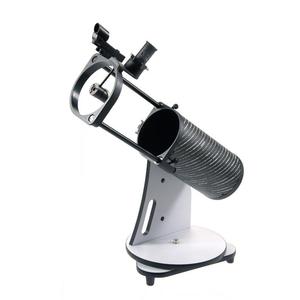
A compact tabletop Dobson with a true parabolic mirror. Folds down, fits in a bag: the Moon, planets and the bright deep-sky classics.
Price: € 265
Skyliner line: big aperture for deep-sky
When galaxies, nebulae, and faint star clusters are the goal, there’s no substitute for aperture, and Dobsonians deliver it at the lowest cost. The 8-inch Skyliner 200P is the classic choice: enough light to bring hundreds of deep-sky objects into view, while still being reasonably portable. If you’re serious about dark skies, step up to 250 or 300 mm (then in FlexTube form). The catch: a Dobson isn’t built for deep-sky imaging, which requires a tracking mount.
Deep-sky pick: Skywatcher Dobson Telescope N 200/1200 Skyliner Classic
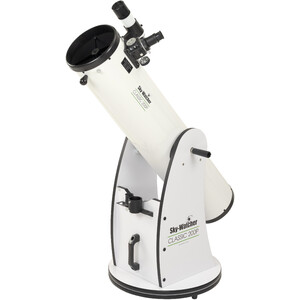
200 mm of aperture — the most sky for your money. Set it on the ground, point by hand: nebulae, clusters and galaxies for years to come.
Price: € 479
Which Sky-Watcher telescope for which purpose?
- Kids & small budget: Heritage 100P or 76 – rugged, kid-proof, and ready to go right out of the box.
- Beginners who mean it: Heritage 130/150 FlexTube – the best balance of aperture, price, and ease of use.
- Moon & planets: SkyMax-127 (Maksutov) – long focal length, high contrast, small and portable.
- Visual deep-sky: Skyliner 200P and up – every extra inch of aperture brings out more galaxies and nebulae.
- Astrophotography: an Evostar ED or Esprit refractor, or an Explorer PDS – what matters most is a solid EQ mount (HEQ5/EQ6-R).
A tip from experience: if you can buy only one instrument and you truly want to explore the sky, a telescope will serve you better than binoculars – a Dobson reveals planets, rings, and nebulae that stay hidden in binoculars. More on that in our Telescope Test 2026.
Sky-Watcher vs. the competition: Celestron, Apertura & Orion
Sky-Watcher plays to its strength with reflectors: you’ll rarely find Dobsonians and Newtonians cheaper at comparable quality. Celestron (from the same group) shines instead with computerized Schmidt-Cassegrains and clever beginner features like StarSense. Apertura has built a strong following in the US for its value-packed Dobsonian kits that bundle in plenty of accessories. Orion long served the budget and entry-level end of the market. In short: for maximum aperture per dollar, Sky-Watcher is the first place to look; for automatic object finding, it’s worth a look at Celestron.
Mounts & astrophotography: EQ6-R, HEQ5 and Star Adventurer
For imaging, it’s not the optics but the mount that’s the most important purchase. Sky-Watcher covers the full range here: the Star Adventurer GTi is a lightweight travel tracker for a camera and small telephoto lens or a small Evostar ED refractor. The HEQ5 is the proven entry point into deep-sky imaging with smaller telescopes, while the EQ6-R Pro carries heavier optics steadily and is considered a workhorse by many astrophotographers. Rule of thumb: size your mount generously – roughly 50% payload headroom over the bare optical weight pays off in round stars.
Frequently asked questions about Sky-Watcher telescopes
Which Sky-Watcher telescope is best for beginners?
For most beginners, a Heritage FlexTube Dobson with 130 or 150 mm of aperture is the best choice: lots of aperture for the money, ready to use right away with no tripod or alignment, and small when stowed. If you’re on a tight budget or buying for kids, go with the Heritage 100P.
What do “P”, “PDS” and “GoTo” mean on a Sky-Watcher?
“P” stands for the better parabolic mirror, “PDS” adds an imaging-capable dual-speed focuser, and “GoTo” (SynScan) refers to computerized automatic object finding. “EQ” is a tracking equatorial mount, “AZ” a simple alt-azimuth one.
Heritage or Skyliner – what’s the difference?
Both are Dobsonians. The Heritage models are compact tabletop units with a collapsible tube, aimed at beginners and travel. The Skyliner line covers the large, floor-standing Dobsonians with considerably more aperture – the better choice when serious deep-sky observing is the goal.
Where can you buy Sky-Watcher telescopes?
Your best bet is a specialized astronomy dealer that offers advice, accessories, and service. The models linked in this guide lead to our partner shop, High Point Scientific. Steer clear of no-name deals from the supermarket or department store.
Are used Sky-Watcher telescopes a good buy?
Yes – Dobsonians and Newtonians in particular barely age. Look for clean, unscratched mirrors, complete accessories (eyepieces, finder), and, on Newtonians, make sure the optics can be adjusted (collimated). For mounts with electronics, run a functional test first.
Is there an independent Sky-Watcher telescope test?
No major independent lab (e.g. Consumer Reports) has published a telescope test to date. More reliable are the experiences of the astronomy community and hands-on comparisons – you’ll find a cross-brand overview in our Telescope Test 2026.
Keep reading:
- Telescope Test 2026: the best telescopes for every budget
- Dobsonian telescopes: lots of aperture for little money
- Telescopes for beginners: the guide to your first purchase
- Maksutov telescopes: the Moon and planet specialist