By Alexander Merz · Published on · Details checked on 21 September 2026
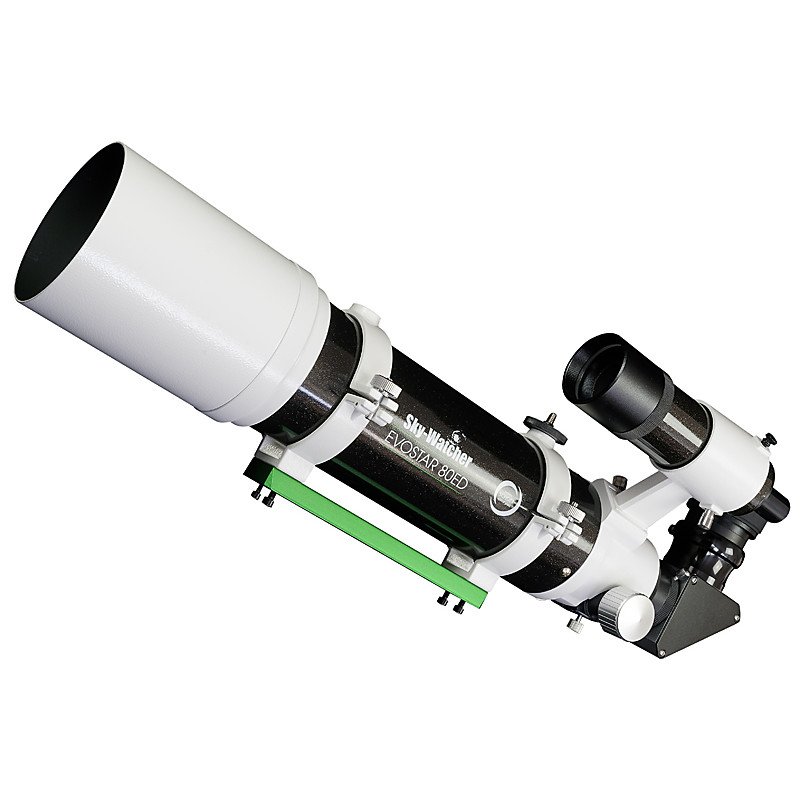
If you’re getting started in astrophotography, sooner or later you’ll land on the Sky-Watcher EvoStar 80ED. For years this small ED refractor has been the standard recommendation for stepping into deep-sky imaging — internationally, too, for example at AstroBackyard. The reason: it delivers image quality well beyond its price, and it’s light enough that even small travel mounts can carry it cleanly.
This review gives it to you straight — what the 80ED can do, and what it can’t. Because the most common beginner mistake is buying the telescope on its own and then realizing that sharp stars all the way into the corners take quite a bit more.
Sky-Watcher EvoStar 80ED: the key specs
| Feature | Value |
|---|---|
| Design | ED apo refractor (doublet) |
| Aperture / focal length | 80 mm / 600 mm (f/7.5) |
| Tube length / weight | approx. 24 in (60 cm) / approx. 6.6 lb (3 kg) |
| Focuser | 2.8″, rotatable, with 1:11 reduction |
| Strength | Wide-field astrophotography, portability |
| Price (Astroshop) | $750.00€ 795 |
Who is the EvoStar 80ED right for?
The 80ED is a photo telescope, not a planetary telescope. With 600 mm of focal length, it’s ideal for large, extended targets: the Andromeda Galaxy, the North America Nebula, the Pleiades, sweeping Milky Way fields.
For planetary observing it’s too short — Jupiter and Saturn stay small. If you’re mainly interested in visual views of the Moon and planets, a larger Dobsonian will serve you better.
Its big strength is portability: 6.6 lb, 24 in, fits in a carry-on. Paired with a compact travel mount, it becomes a complete astrophotography setup that fits in a backpack.
What the 80ED REALLY needs for astrophotography
This is the part most shop pages leave out. The telescope alone won’t give you sharp deep-sky photos. You need two more things — and together they often cost more than the telescope itself.
1. Flattener (field flattening). A refractor projects onto a slightly curved surface, but the camera sensor is flat. The flattener keeps the stars pinpoint all the way into the corners. Budget around ~$170~€150.
2. Tracking mount. The Earth rotates — without motorized tracking, the stars smear into trails within seconds. For the 80ED a small equatorial mount is enough, but expect to spend $500+€500+ for a decent one.
Only with those two components does the 80ED really shine. If you buy just the telescope, you can observe visually and shoot the Moon with your smartphone — and that’s about it.
The EvoStar 80ED compared
| Budget | Telescope | Best for | Price |
|---|---|---|---|
| Around $300Under €300 | Sky-Watcher Heritage 130/650Sky-Watcher Heritage 130/650 | Visual starter, Moon & planets — not for photography | $305.00€ 265 |
| From $700From €800 | Sky-Watcher Evostar EDX 80 APO Doublet TelescopeSky-Watcher EvoStar 80ED | ⭐ Our pick for deep-sky imagingThe wide-field classic — with a flattener & mount, a complete beginner setup | $750.00€ 795 |
| Smart alternative | ZWO Seestar S30 ProZWO Seestar S30 Pro | All-in-one, no accessories needed — but less control | $699.00€ 699 |
The links marked with an asterisk are affiliate links.
Entry-level classic for deep-sky imaging: Sky-Watcher EvoStar 80ED Apo Refractor
ED apo refractor 80/600 – the classic beginner scope for wide-field astrophotography.
Price: € 795
Frequently asked questions about the Sky-Watcher EvoStar 80ED
Is the EvoStar 80ED good for beginners?
Yes — for beginners in astrophotography. It’s forgiving, color-clean and lightweight. For purely visual beginners who want to see planets, a Dobsonian is the better and cheaper choice.
Can you observe planets with the 80ED?
In principle yes, but at 600 mm of focal length the planets stay small. The 80ED is built for wide-field targets, not for high magnification.
Do I really need a flattener?
For photos with a camera: yes. Without a flattener only the center of the frame is sharp and the stars at the edges are distorted. For visual use you don’t need one.
Which mount suits the EvoStar 80ED?
A small to medium equatorial mount with tracking. Since the tube weighs only 6.6 lb, compact travel mounts are enough — the key thing is motorized tracking.
EvoStar 80ED or a smart telescope?
Smart telescope if you want instant results with no accessories. EvoStar 80ED if you want full control over camera, exposure and image processing, and you want to learn the technique.
Read more: