By Alexander Merz · Published on · Details checked on 22 September 2026
Saturn through a telescope is a small, cream-yellow disk with a crisply separated ring: Even 60 mm of aperture and 50x magnification show it unmistakably. Cloud belts, the ring shadow and the Cassini Division need 100 to 200 mm and steady air.
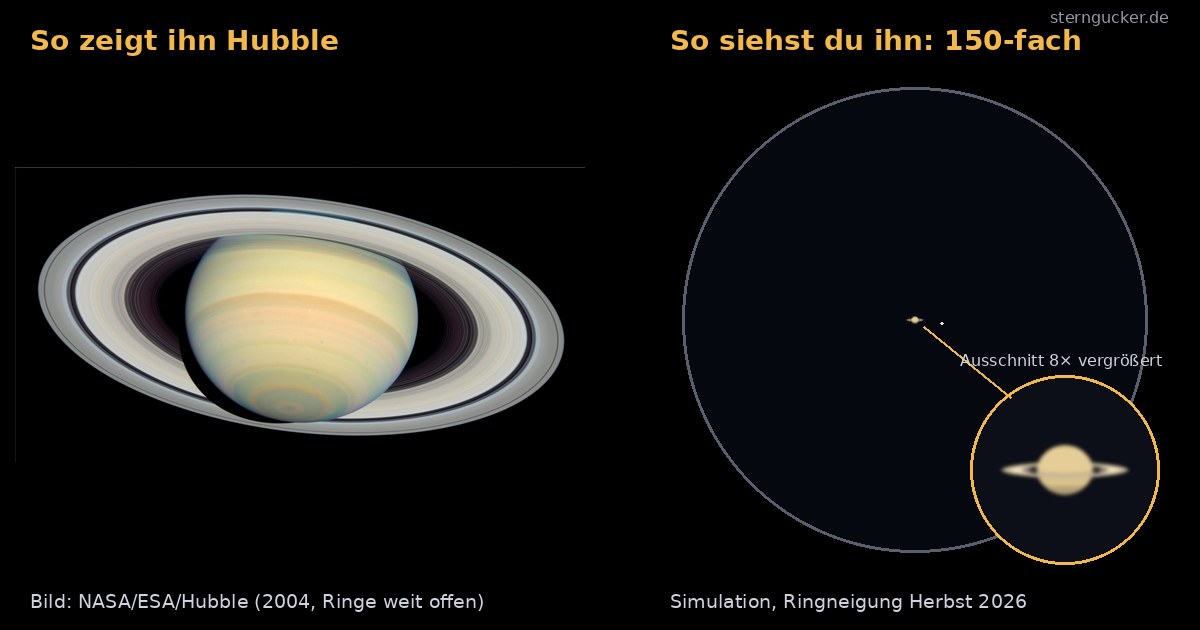
What does Saturn look like through a telescope?
In the eyepiece Saturn is tiny – and still an “aha” moment. At 150x it looks about as big as three to four full Moons seen with the naked eye. But your eyepiece’s field of view is almost 30 times wider, so it floats like a small jewel in a lot of black.
What wins you over instantly is the sharpness. The ring stands free next to the globe, you see black between ring and planet, and the image looks almost three-dimensional. Many beginners think at first glance that it’s a sticker on the eyepiece.
The color is subtle: a pale cream-yellow, the ring slightly brighter than the globe. Next to it there is usually a single “little star” – that’s Titan, Saturn’s largest moon, which circles the planet once every 16 days.
Why the rings look so thin in 2026
In fall 2026, Saturn’s rings are tilted only about 7 to 8 degrees toward us. In March 2025 they were exactly edge-on; now they are slowly opening again – until around 2032, when they reach their full tilt of roughly 27 degrees. The famous Hubble image above dates from a phase with wide-open rings.
For you this means: the ring appears as a thin, bright ellipse that crosses the globe like a band. From November on, the Sun and Earth see the ring from slightly different angles, and its shadow shows up as a thin dark line on the globe. The Cassini Division, on the other hand, is harder than in years with an open ring, because it is only visible at the ends of the ring.
Saturn through a telescope: what each aperture shows
The aperture – the diameter of the lens or mirror – determines how fine the details can possibly be. It doesn’t make the planet bigger, only more detailed. The table assumes steady air and a planet at least 30 degrees above the horizon.
| Aperture | Example scope | Saturn | Jupiter | Magnification |
|---|---|---|---|---|
| 60 mm | Omegon Telescope AC 60/700 AZ-1 | Ring clearly separated from the globe, Titan as a little star | Four moons, two main belts as fine lines | 50–100x |
| 70 mm | Celestron AstroMaster 70AZ RefractorOmegon Telescope AC 70/700 AZ-2 | Ring sharp, globe yellowish; with luck a second moon (Rhea) | Two belts clearly visible, darker polar regions | 60–120x |
| 80–90 mm | Orion Observer 90EQ Refractor TelescopeOmegon Telescope AC 90/1000 EQ-2 | Ring shadow on the globe, bright equatorial zone | Structure in the belts, moon shadows on the disk | 100–160x |
| 100–130 mm | Sky-Watcher Virtuoso GTi 130P Tabletop GoTo DobsonianSkywatcher Maksutov Telescope MC 102/1300 Starquest DX EQ | Cassini Division at the ring ends in steady moments, 3–4 moons | Great Red Spot reliably, four to six belts | 130–220x |
| 150–200 mm | Apertura AD8 8" Dobsonian TelescopeSkywatcher Dobson Telescope N 200/1200 Skyliner Classic | ⭐ Our recommendationCassini Division clearly, polar region, delicate belts, five moons | Festoons and white ovals, moons as tiny disks | 150–300x |
Links marked with an asterisk are affiliate links.
The magnifications are not a promise but an upper limit. The useful maximum magnification is about one and a half to two times the aperture in millimeters. In most places, though, the air only allows 150x to 200x on most nights, no matter how big the telescope is.
What magnification for Saturn and Jupiter?
Magnification = focal length of the telescope divided by focal length of the eyepiece. So a telescope with a 1,200 mm focal length gives 120x with a 10 mm eyepiece. The focal length is the distance light travels to the focal point – it’s printed on every tube.
30x to 50x is enough for the rings; it gets beautiful from 100x. Jupiter usually takes a little less than Saturn, because it is brighter and its contrast quickly flattens at too high a magnification. Start low and work your way up to the limit, until the image gets softer instead of bigger.
Handy for planets: Omegon Magnum Zoom Eyepiece 8–24 mm
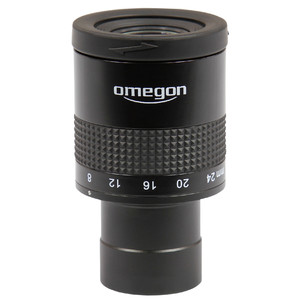
A zoom eyepiece covers 8 to 24 mm in a single unit. You find the planet at low magnification and then zoom up as far as the air allows that night – without swapping eyepieces in the dark.
Price: € 49.90
Saturn telescope images: Hubble vs. eyepiece
Almost every Saturn picture online shows more than your eye will ever see in the eyepiece. Hubble has 2.4 m of aperture and no air above it. Even the impressive amateur images aren’t taken with one click; they are built from thousands of video frames, of which only the sharpest are stacked.
Your eye works in a similar way, just without a computer: it remembers the brief moments when the air is still. That’s why you see much more after ten minutes of looking than after twenty seconds.
| Feature | Hubble image | Eyepiece, 130 mm |
|---|---|---|
| Size | Fills the frame | Small disk in a lot of black |
| Color | Strong yellow, blue, brown | Pale cream-yellow |
| Cloud belts | Dozens of stripes | One or two belts, faint |
| Cassini Division | Razor-sharp | Dark line at the ring ends, in steady moments |
| Impression | Poster | Live, three-dimensional, “it’s real” |
Jupiter through a telescope: belts, spot and moons
Jupiter is the more rewarding target for your first night. It appears almost twice as large as Saturn’s globe and is much brighter. Even a 60 mm refractor shows the two dark main belts – a refractor is a lens telescope.
The Great Red Spot is more salmon-colored than red and becomes reliably visible from about 100 mm. Because Jupiter rotates once in just under ten hours, the spot is on the side facing us only about half the time – apps like Stellarium show you when.
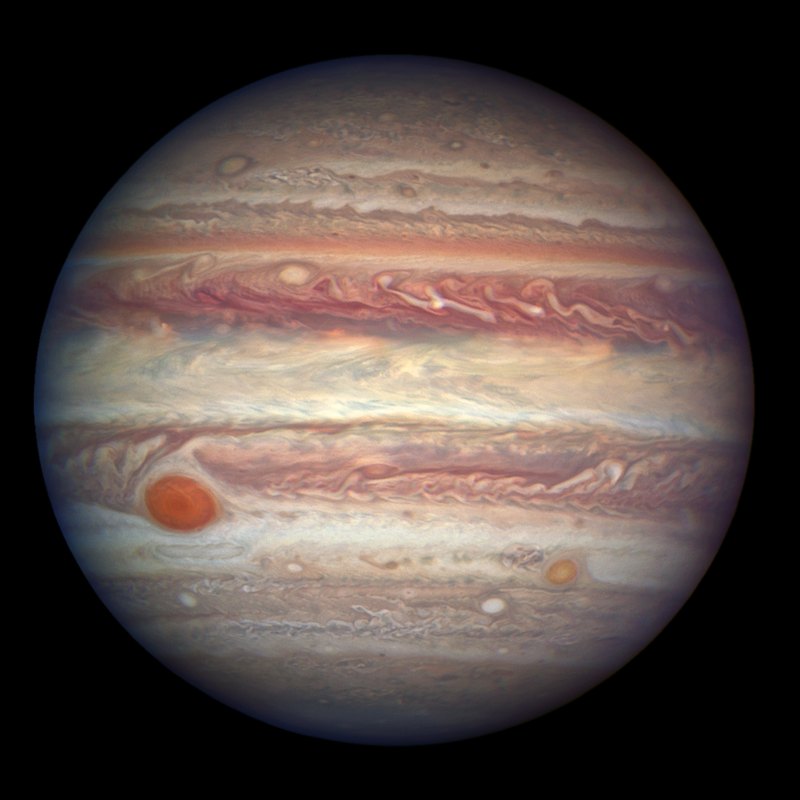
In fall 2026, Jupiter is in the morning sky in Leo. In early October it’s only worth looking from about 4 a.m., by mid-December from shortly before 11 p.m. It reaches opposition, its best position of the year, on February 11, 2027.
Observing Jupiter’s moons through a telescope
You can see Jupiter’s four large moons with any telescope, and even with steadily held binoculars. They sit almost in a line and change position from hour to hour. This is exactly how Galileo Galilei realized in 1610 that not everything revolves around the Earth.
| Moon | Brightness | Orbit | What you see |
|---|---|---|---|
| Io | 5.0 mag | 1.8 days | Moves fastest, often close to the planet |
| Europa | 5.3 mag | 3.6 days | Smallest of the four, easy to see |
| Ganymede | 4.6 mag | 7.2 days | Brightest moon, a tiny disk from 200 mm |
| Callisto | 5.7 mag | 16.7 days | Often far off to the side |
The highlight is shadow transits: when a moon passes in front of Jupiter, it casts a jet-black dot on the clouds. That works from about 80 mm of aperture, and any planetarium app like Stellarium shows the times.
What telescope do you need to see Saturn?
Any real telescope with about 60 mm of aperture and 50x magnification or more. The question isn’t whether, but how much. The three scopes below stand for the three sensible levels.
The detailed buying guide with Maksutov, Schmidt-Cassegrain and smart telescopes is in our guide Which telescope for planets? Here it’s only about what you get in the sky for your money.
Cheapest sensible start: Omegon Telescope AC 70/700 AZ-2
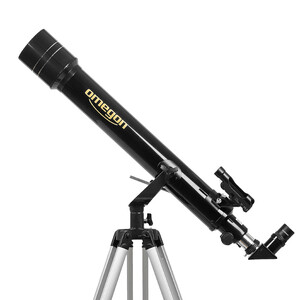
A 70 mm lens telescope: you’ll definitely see Saturn’s ring and Jupiter’s moons. For cloud detail it lacks aperture, and the light mount takes patience at high magnification – a scope to get a taste, not one for years.
Price: € 119
Compact for balcony and city: Skywatcher Maksutov Telescope MC 102/1300 Starquest DX EQ
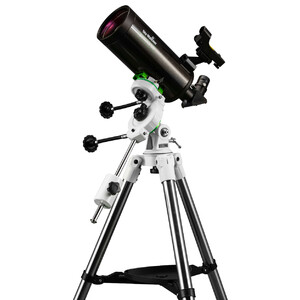
Small enough for any closet, yet with enough aperture for Saturn’s ring and Jupiter’s main belts. Give it about half an hour to cool down before you push the magnification – then it shows high-contrast planets.
Price: € 399
Our recommendation: Skywatcher Dobson Telescope N 200/1200 Skyliner Classic
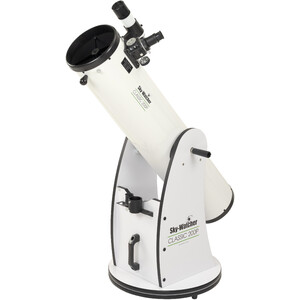
200 mm of aperture at 1,200 mm focal length: in steady air the Cassini Division, structure in Jupiter’s belts and more of Saturn’s moons. The price is its size – and you nudge the tube along by hand at high magnification.
Price: € 479
The Celestron NexStar 8SE Computerized SCTCelestron NexStar 8 SE puts 203 mm of aperture and 2,032 mm of focal length on a GoTo mount that finds and tracks Saturn by itself. In practice that means 250x on good nights without the planet drifting out of view after a few seconds – and in steady air, details you only catch for a moment with a Dobsonian. The extra cost is worth it if you observe planets regularly; if you only look now and then, the Dobsonian is the better choice.
For advanced observers: Celestron NexStar 8 SE GoTo Telescope
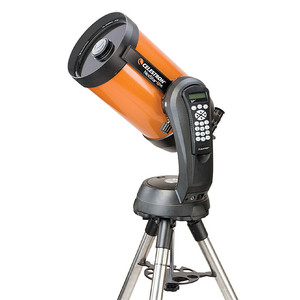
The 203 mm GoTo classic: finds over 40,000 objects at the push of a button — the advanced-level reference.
Price: € 2,149
Which planets can you see with a telescope?
All seven other planets – but only two show you real detail. Jupiter and Saturn are the stars; Mars is only worth it every two years around its opposition. If you want to know which telescope lets you see planets: from 60 mm for the big ones, from 150 mm for Mars detail.
| Planet | From aperture | What you see |
|---|---|---|
| Saturn | 60 mm | Ring, Titan; from 100 mm Cassini Division and belts |
| Jupiter | 50 mm | Four moons, two belts; from 100 mm the Red Spot |
| Venus | 50 mm | Phases like the Moon, no surface |
| Mars | 100–150 mm | Polar cap and dark markings, only around opposition |
| Mercury | 50 mm | Tiny phase low in twilight |
| Uranus | 80 mm | Greenish disk without detail |
| Neptune | 100 mm | Bluish dot, barely recognizable as a disk |
How do I find Saturn with my telescope?
In fall 2026, Saturn is in the constellation Cetus, near the border with Pisces – in an area without bright stars. It’s by far the brightest point of light there, shines steadily without twinkling and has a slightly yellowish tint.
On October 4, 2026, Saturn is at opposition: it rises in the east at sunset, stands highest in the south around 1 a.m. daylight saving time and only sets at dawn. All times are approximate local times for mid-northern latitudes such as the US and Central Europe.
- Align the finder in daylight: Focus on a distant object such as an antenna in the telescope and align the finder exactly on it – never in the direction of the Sun.
- Start with the eyepiece with the longest focal length, i.e. the lowest magnification. That gives you the widest field of view, so Saturn is quick to find.
- Center it, focus it, and only then increase magnification. Re-center at every step, otherwise the planet drifts out of view.
- An app helps the first time: Stellarium or SkySafari show you where Saturn is right now and which dot is Titan.
Seeing and air turbulence: why Saturn wobbles
Seeing is what astronomers call the turbulence of the air – it decides more about your night than the telescope. In poor seeing Saturn boils and shimmers in the eyepiece; in good seeing it looks painted on. If the stars twinkle strongly to the naked eye, the seeing is usually poor.
- High, not low: Below 20 degrees you look through three times as much air as at the zenith, the image blurs and gets color fringes.
- Not over roofs: Warm rooftops, streets and chimneys create heat shimmer right in front of the tube.
- Let it cool down: Reflector and Maksutov telescopes need 30 to 45 minutes to reach outside temperature.
- Keep at it: Look for several minutes at a time – the steady seconds keep coming back.
Hazy, windless evenings are often the best planet nights – precisely when deep-sky observers stay at home. A clear, windy sky after a cold front looks great, but usually delivers restless planets.
Photographing Saturn and Jupiter with a smartphone
A phone photo through the eyepiece works – but without an adapter it’s hit or miss. The holder clamps the smartphone exactly over the eyepiece so the camera sits in the center. This is called afocal photography.
- Video instead of photo: record 30 to 60 seconds in 4K and turn the exposure down manually until the planet is no longer blown-out white.
- Lock the focus: lock focus at infinity, focus with the telescope first, then record.
- Stacking: free programs such as AutoStakkert! and RegiStax pick out the sharpest frames and combine them.
- Moons separately: Jupiter’s moons need a longer exposure – which blows out the planet. Take two shots and combine them.
Expect a small but unmistakable image of Saturn with its ring and Jupiter’s two main belts. If you want to go further, you’ll find cameras and techniques in our guide Planetary Photography.
For phone photos: Omegon Smartphone Adapter 25–48 mm
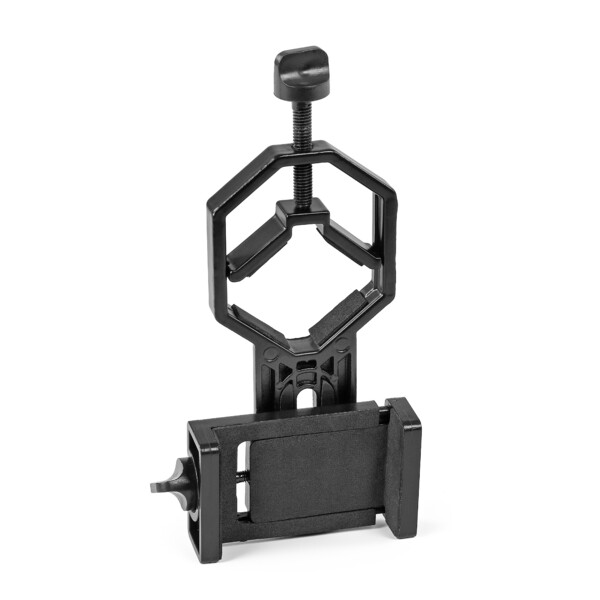
Clamps smartphones onto eyepieces with an outer diameter of 25 to 48 mm. With the adapter the camera sits steady and centered – without it every shot shakes, and you’ll barely find the planet on the screen again.
Price: € 14.90
The most common mistakes when observing planets
- Too much magnification: 300x in turbulent air just shows a big, mushy blob. Less is sharper.
- Cheap bundled eyepieces: 4 mm eyepieces and Barlow lenses from beginner kits often degrade the image more than they magnify it.
- Giving up too early: The telescope hadn’t cooled down, the planet was low over the rooftops – an hour later it would have been a different picture.
- The wrong scope: Smart telescopes with 30 to 50 mm of aperture are built for nebulae; Saturn remains a blob with ears on them.
- Expecting a poster: If you have Hubble in mind, you’ll be disappointed. If you know it’s small, you’ll be delighted every time.
A tip from practice: Sketch what you see with a pencil. It forces you to look closely, and after a few nights you’ll discover details that “weren’t there” before.
Frequently asked questions about Saturn and Jupiter through a telescope
Can you see Saturn’s rings with binoculars?
Not with 10×50 binoculars – Saturn appears as a slightly elongated dot. Large binoculars with 15x to 20x magnification on a tripod show an oval shape. You only see the ring standing free in a telescope from about 30x.
How much magnification do you need for Saturn’s rings?
From 30x you can tell that Saturn has “handles”; from 50x the ring stands clearly free. It gets really beautiful between 100x and 200x; above that, the air is usually the limit.
Why do I only see Saturn as a bright dot?
Usually the magnification is too low or the image isn’t in focus. First focus with your lowest-power eyepiece, center the planet and then switch to an eyepiece with a 6 to 10 mm focal length. If it stays a blob, Saturn is probably too low or the air is turbulent.
Can you see Saturn and Jupiter in color?
Yes, but subtly. Saturn looks pale cream-yellow, Jupiter light beige with brownish belts and a salmon-colored spot. The strong colors in photos only come from long exposures and processing.
Can I observe Saturn from the city?
Yes, very well in fact. Planets are so bright that light pollution barely dims them. What matters is a clear view to the south and no warm roof directly in your line of sight.
When is the best time for Saturn?
Around opposition, when Saturn is opposite the Sun and visible all night. In 2026 that’s October 4; you can observe it well from September to December. Opposition shifts about two weeks later each year.
* Affiliate link: if you buy through this link we may earn a small commission from Astroshop or High Point Scientific, at no extra cost to you.