By Alexander Merz · Updated on · Details checked on 14 September 2026
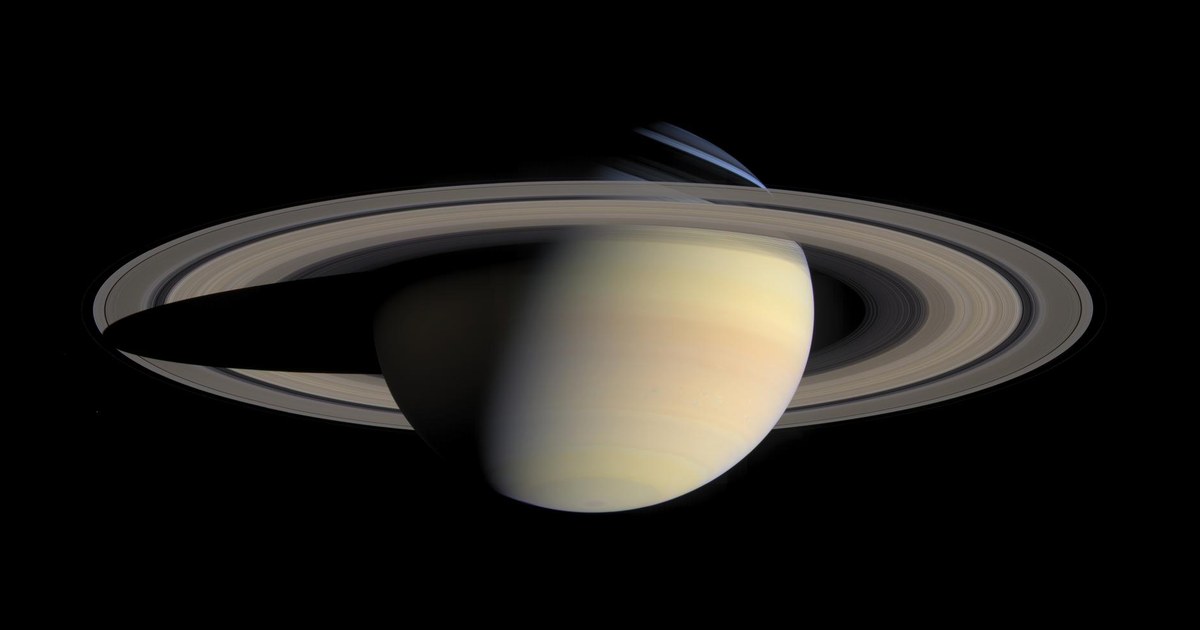
Saturn with its rings, Jupiter with its cloud belts and four moons: for most people that is the whole reason to buy a telescope in the first place. The good news: planets are bright, you can see them from the middle of a city – light pollution barely matters here. The honest news: which telescope works for planets is not decided by the price.
It is decided by focal length, by the quality of the optics – and above all by how steady the air above your head is.
For planets, long focal length counts for more than maximum aperture. A Maksutov from around 100 mm shows Saturn’s rings and Jupiter’s belts straight away, and a 200-mm Dobsonian gives you the most detail for your money when the air is steady. Smart telescopes are the wrong choice for planets.
What you actually see
Planets are small. Even Jupiter, the largest of them, spans less than a twentieth of the full Moon’s diameter in the sky. A planet never fills the eyepiece – it is a small, sharply defined disc that gives up its detail as the magnification climbs.
In return you get something deep sky never delivers: colour and movement. Jupiter’s moons stand in a different place every night, the Great Red Spot crosses the disc in a few hours, and Saturn’s rings change their tilt over the years.
In practice that means: you can separate Saturn’s rings from the globe with as little as 60 mm of aperture. The Cassini division inside the ring needs roughly 100 to 130 mm and a steady night. Jupiter’s two main belts show in every instrument; the Great Red Spot becomes reliable from around 100 mm. For a scope-by-scope comparison, see what Saturn through a telescope really looks like.
Mars is the special case: it only rewards you in the weeks around an opposition, otherwise it stays an orange dot. Venus never shows surface detail, but it does show phases like the Moon – a half or crescent “evening star” is the prettiest proof that it orbits the Sun.
Aperture or focal length?
For galaxies the rule is simple: aperture beats everything. For planets it is different. Because planets are bright, you do not need light, you need magnification – and that comes from a long focal length.
A telescope with 1,500 mm of focal length gives you 150x with a 10-mm eyepiece. A short 650-mm instrument only reaches 65x with the same eyepiece and needs extra optics to keep up.
Aperture still is not irrelevant: it sets how fine the detail is allowed to get. The rule of thumb is that the useful maximum magnification is about one and a half to two times the aperture in millimetres – so 100 mm of aperture carries roughly 150x to 200x.
Which type of telescope?
Four designs come into question, and for planets they differ far more clearly than the catalogue suggests.
| Design | Strength on planets | What you accept |
|---|---|---|
| Maksutov | Long focal length in a short tube, very high-contrast image, maintenance-free | Needs 30 to 45 minutes to cool down, small field of view, poorly suited to deep sky |
| Schmidt-Cassegrain | Like the Maksutov, but with more aperture – the classic all-rounder | Considerably more expensive, cool-down time as well |
| Newtonian / Dobsonian | The most aperture per euro, and therefore the most detail when the air is good | Bulky, needs collimating, tracked by hand at high magnification |
| Achromatic refractor | Ready to use immediately, nothing to adjust | Blue-violet fringing on bright planets, exactly where it hurts |
Recommendations by budget
All four instruments are usable as they come, tube plus mount. The prices come live from the shop and can change.
| Budget | Model | Why it suits planets | Price |
|---|---|---|---|
| up to $500up to 400 € | Sky-Watcher Virtuoso GTi 130P Tabletop GoTo DobsonianSkywatcher Maksutov Telescope MC 102/1300 Starquest DX EQ | 102-mm Maksutov with 1,300 mm focal length on a simple mount. The most compact route to Saturn’s rings and Jupiter’s belts.130-mm tabletop GoTo Newtonian. It finds and tracks the planets by itself; with only 650 mm of focal length you need a Barlow for high magnification. | $495.00€ 399 |
| up to $700up to 500 € | Apertura AD8 8" Dobsonian TelescopeSkywatcher Dobson Telescope N 200/1200 Skyliner Classic | ⭐ Our recommendation200 mm of aperture at 1,200 mm focal length. In steady air no other instrument in this price class beats it for detail – and it handles deep sky on top of that. | $699.95€ 479 |
| up to 800 € | Sky-Watcher Skymax 127 mm with AZ-GTi Mount & TripodSky-Watcher Skymax-127 AZ-GTi GoTo WiFi | 127-mm Maksutov on a motorised GoTo mount. It slews to planets by itself and tracks them – the comfortable route for small balconies. | $995.00€ 775 |
| up to 1,600 € | Celestron NexStar 6SE Computerized TelescopeCelestron NexStar 6 SE GoTo | 152-mm Schmidt-Cassegrain with 1,500 mm focal length and GoTo. More aperture than any Maksutov, still portable. | $1,199.00€ 1,549 |
The compact way in: Skywatcher Maksutov Telescope MC 102/1300 Starquest DX EQ
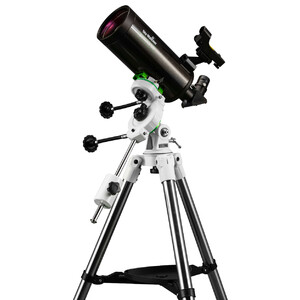
A Maksutov with 1,300 mm of focal length in a very short tube: crisp views of the Moon and planets, almost no colour fringing.
Price: € 399
Our recommendation: Skywatcher Dobson Telescope N 200/1200 Skyliner Classic
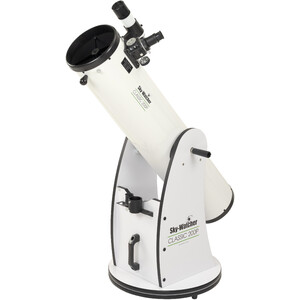
200 mm of aperture for under 500 euros – in steady air this Dobsonian shows the Cassini division, structure in Jupiter's belts and the polar cap of Mars. The price you pay: it is bulky, and you track by hand at high magnification.
Price: € 479
If you already own a sufficiently sturdy mount, a bare tube is cheaper: the Sky-Watcher Skymax 127 mm Maksutov-Cassegrain OTASkywatcher Skymax-127T MC 127/1500 (OTA) brings 127 mm of Maksutov optics for $610.00€ 455 – without mount and tripod, which you have to add separately.
A smart telescope for planets?
Short answer: no. Smart telescopes are built for faint nebulae and galaxies, not for planets – they collect light over minutes and stack many frames together. That is exactly what a planet does not need.
Then there is the physics: devices like the Seestar S30 or the DWARF 3 have 30 to 35 mm of aperture and a few hundred millimetres of focal length. Jupiter stays a bright little disc on them, with a hint of belts.
Anyone who buys a smart telescope because they want to see Saturn is disappointed afterwards – and anyone who buys a planetary Maksutov to photograph nebulae is too. Both instruments are good, but for different jobs.
For everything beyond the solar system, those little automatons are unbeatably convenient. The comparison is in our guide to the smart telescope.
Magnification and eyepieces
Magnification is the telescope’s focal length divided by the eyepiece’s focal length. For planets the useful range usually sits between 100x and 200x; above that the image gets bigger, but not better.
Because the usable magnification changes from night to night, a zoom eyepiece is more practical here than three fixed focal lengths – you turn your way up to the limit instead of swapping eyepieces in the dark.
Handy for planets: Omegon Magnum Zoom Eyepiece 8–24 mm
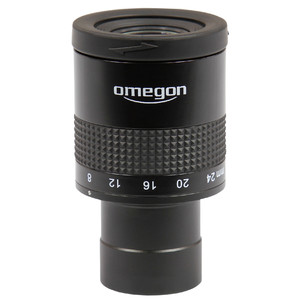
A zoom eyepiece covers the entire planetary range in one piece. You find the planet at low magnification and then turn up as far as the air allows on that particular evening.
Price: € 49.90
A Barlow lens doubles the focal length and therefore the magnification of every eyepiece. On short-focus Newtonians it is close to mandatory; on a Maksutov you rarely need one. More on choosing them is in the eyepiece guide.
Seeing beats aperture
The biggest difference between a disappointing and a spectacular planetary evening is not the telescope, it is the air. Seeing is the name for the turbulence of the atmosphere, and it decides whether 200x gives you a sharp little disc or a boiling blob in the eyepiece.
Three things help immediately and cost nothing: observe the planet as high in the sky as possible, not just above the horizon. Never aim across a roof or a street that has been storing heat all day. And give the telescope its cool-down time.
Which planet, and when?
A planet is most worthwhile around its opposition: it then stands opposite the Sun, is visible all night and is closest to Earth.
| Date | What happens | What you see |
|---|---|---|
| 4 October 2026 | Saturn at opposition | The best Saturn night of the year – rings from 60 mm, the Cassini division from about 100 mm |
| 11 February 2027 | Jupiter at opposition | Cloud belts, the Great Red Spot and the nightly ballet of the four large moons |
| 19 February 2027 | Mars at opposition in Leo | Only 13.8 arcseconds across – the polar cap and dark markings need 150 mm and steady air |
If you want to know what is above your own roof tonight, the current overview is at planets visible tonight.
Frequently asked questions
Which telescope is best for planets?
For most people a Maksutov from 100 mm upwards is the right choice: long focal length, high-contrast image, compact. If you have the space and a calm site, a 200-mm Dobsonian shows more detail for similar money – in return it is bulky and has to be tracked by hand.
Can you observe planets from a city?
Yes, and that is the big advantage over deep sky. Planets are so bright that light pollution hardly bothers them – a balcony in the middle of town is entirely enough. The warm air above roofs and streets is the bigger nuisance.
What magnification do I need for Saturn?
From about 50x you recognise the rings as rings. Saturn becomes properly beautiful between 120x and 200x, provided the air is steady. More magnification only adds something on very good evenings and with larger instruments.
Is a 200-euro telescope enough?
For a first look at Saturn’s rings and Jupiter’s moons, yes, as long as the optics are usable. The catch is usually not the tube but the wobbly mount: at 150x the image shakes for seconds after every touch. More on this in the guide to the best beginner telescopes.
Why do I only see a blurry blob?
Usually the magnification is too high for the steadiness of the air, or the telescope has not cooled down yet. Go back one eyepiece step and wait half an hour. If it stays soft, check the collimation on a Newtonian.
Can I photograph planets?
Yes, and it is surprisingly simple: planetary photography works through short videos, from which software picks out the sharpest single frames and stacks them. A smartphone held to the eyepiece already gives usable Moon shots; for Jupiter and Saturn you need a small planetary camera – the starting points are in the guide to planetary photography.
Verdict
For planets you buy focal length, not aperture records. A 102-mm Maksutov is the smallest sensible entry, a 200-mm Dobsonian the best ratio of price to detail, and a GoTo Maksutov the most comfortable route for a city balcony.
What you see through it depends in the end more on the air than on the price tag. 4 October 2026 with Saturn and February 2027 with Jupiter and Mars are the next chances to check that for yourself.
* Affiliate link: if you buy through this link we may earn a small commission from Astroshop or High Point Scientific, at no extra cost to you.