By Alexander Merz · Updated on · Details checked on 14 September 2026
Ready to get into astronomy and wondering whether you really need a telescope to start? The telescope vs binoculars question trips up almost every beginner, and the honest answer often surprises: a pair of binoculars is the best first step, a telescope the best second. Here is why nearly every seasoned stargazer owns both, when each instrument wins, and how to spend your budget wisely.
⚡ The quick answer: As a beginner, start with 10×50 binoculars (from ~€ 62) (far cheaper than a first telescope): ready in seconds, they reveal the Moon, star clusters and the Milky Way. Move up to a telescope (worthwhile from ~$305.00€ 265) once you know what excites you — planets, deep sky or imaging. The two complement each other: find with binoculars, study with the telescope.
| 🔭 Binoculars | 🔭 Telescope | |
|---|---|---|
| Entry price | from ~€ 62well below a first telescope | worthwhile from ~$305.00€ 265 |
| Ready to use | yes, in seconds | setup + learning curve |
| Field of view | huge — ideal for the Milky Way, star fields, comets | narrow — ideal for detail |
| Moon | craters visible | crater landscapes in HD |
| Planets | Jupiter’s moons as dots | Jupiter’s belts, Saturn’s rings |
| Deep sky | bright objects as faint smudges | structure visible (depending on aperture) |
| Usable by day | yes (nature, travel) | hardly |
| Transport | jacket pocket | trunk of the car |
The difference in 60 seconds
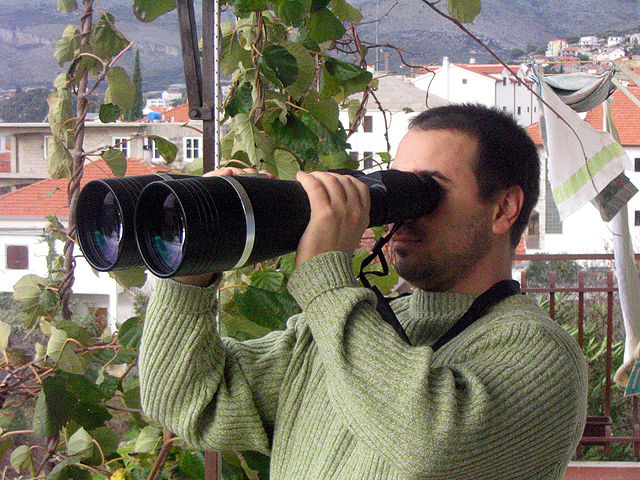
At heart, a pair of binoculars is nothing more than two small refracting telescopes mounted side by side. Built-in prisms flip the image upright and the right way round — perfect for finding your way around the sky. You look with both eyes, the magnification is fixed (say 10x), and the field is vast: a 10×50 covers roughly 6 to 7 degrees of sky, more than twelve full-Moon diameters lined up next to each other.
A telescope takes the opposite path: a single, far larger optic that you look through with one eye. The magnification is not fixed but freely chosen through interchangeable eyepieces — from 30x for the wide view to 200x for planetary detail. The trade-off: a smaller field, setup time, and an image that appears upside down (which bothers no one in the sky). In short: binoculars are built for the overview, the telescope for the detail.
When binoculars win
A pair of 10×50 binoculars shows you Jupiter’s moons, the Pleiades in full glory, the Andromeda Galaxy as a soft smudge and Milky Way fields that fit into no telescope eyepiece. They cost little, are ready in an instant, and double up for birding and hiking. There is also an often underrated point: observing with both eyes is more relaxing. The brain perceives the two-eyed image as brighter, more natural and less tiring — a real advantage on long winter nights compared with squinting into an eyepiece.
And because clear nights rarely follow a schedule, binoculars beat the telescope in one discipline every time: spontaneity. No setup, no cool-down, no collimation — grab a jacket, step outside, look up. If you are still unsure whether astronomy is “your thing”: binoculars first.
What you really see with a 10×50
- The Moon: large craters, maria and mountain ranges — especially along the terminator (the light-shadow line)
- Jupiter: the four Galilean moons as points of light, shifting position from night to night
- Pleiades & Hyades: instead of seven stars, suddenly dozens — open clusters are the binocular’s signature discipline
- Andromeda Galaxy (M31): an oval smudge — the most distant object you will ever see with your own eyes
- Orion Nebula (M42): a clear nebulous glow around the Trapezium
- The Milky Way: the diffuse veil resolves into thousands of individual stars, star clouds and dark lanes
- Comets: bright comets often look more impressive in binoculars than in a telescope, because tail and coma fit entirely in the field
When the telescope wins
As soon as you want detail — Saturn’s rings, Jupiter’s belts, chains of lunar craters, structure inside nebulae, tight double stars — there is no way around aperture and magnification. A 130 mm tabletop Dobsonian (from $305.00€ 265) outclasses any binocular on the planets: Jupiter’s dot becomes a disc streaked with cloud belts, and Saturn’s “oval” a ring that seems to float freely.
For imaging, the telescope is clearly ahead too: you cannot sensibly attach a camera to binoculars. If you would rather photograph than observe, the easiest start today is a smart telescope that captures nebulae and galaxies fully automatically to your phone. A tried-and-tested rule among experienced observers: find with the binoculars, study with the telescope.
The same-budget duel: two paths
Say you have around $305.00€ 265 — the floor for a genuinely good telescope. What does the same money buy you on the binocular path?
| Path A: binocular pack | Path B: telescope ($305.00€ 265) | |
|---|---|---|
| Contents | 10×50 binoculars (from ~€ 62) + rotating star wheel (€ 19.90) + beginner's book (€ 20)10×50 binoculars + a rotating star wheel + a beginner’s book | Sky-Watcher Heritage 130 Tabletop Dobsonian |
| Strength | learn the sky, Milky Way, clusters, start right away — and budget to spare | planetary detail, Moon in HD, bright nebulae with structure |
| Weakness | no planetary detail | needs setup, a learning curve and a place to store it |
| Ideal if … | you do not yet know whether the hobby will stick | you are sure you want to go deeper |
The beauty of it: Path A is not a detour. Everything in it still serves you later alongside a telescope — which makes it the risk-free choice for the undecided.
Which binoculars for the night sky?
The classic is the 10×50: 10x magnification, 50 mm aperture, 5 mm exit pupil — bright enough for the night sky and just steady enough to hold by hand. An 8×42 is the lighter travel alternative, a 7×50 delivers the brightest image (mostly worthwhile for younger eyes with wide pupils). Big binoculars like the 15×70 or 20×80 show far more deep sky — but absolutely require a tripod, or every image shakes.
Observing with children: binoculars or telescope?
For families, the binoculars-first rule applies doubly: children quickly lose interest in a device that takes ages to set up and that they are not allowed to operate themselves. Even elementary-school kids can hold light binoculars and make their own discoveries — the first object found on your own hits harder than any polished telescope demonstration. Once the spark has caught, a proven gift combo is binoculars plus a star wheel.
The ideal order
- Step 1: binoculars + a rotating star wheel — learn the sky, find the constellations
- Step 2: after a few months you know what fascinates you: planets → Dobsonian; imaging → smart telescope
- Step 3: the binoculars stay your grab-and-go instrument forever — no bad buy possible
This order has a concrete advantage: it prevents the classic mis-purchase. Buy a telescope with no knowledge of the sky and you often pick the wrong instrument for your — still unknown — preferences. Start with binoculars and after a few months you know exactly whether planets, deep sky or imaging draws you, then buy the telescope to fit rather than on a hunch.
Our concrete picks to get started, with two proven low-budget instruments:
Best first step: Celestron Cometron 7x50 Binoculars
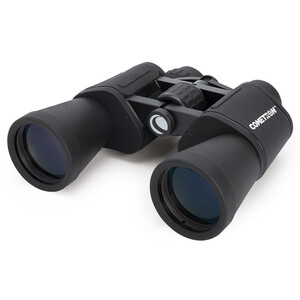
The astronomy classic among affordable binoculars: 7×50 with a large exit pupil for bright handheld views of the Moon and Milky Way – the ideal first step before a telescope.
Price: € 65
Best value: Skywatcher Dobson Telescope N 130/650 Heritage FlexTube
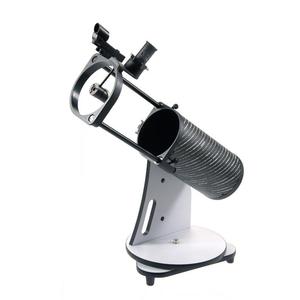
A compact tabletop Dobson with a true parabolic mirror. Folds down, fits in a bag: the Moon, planets and the bright deep-sky classics.
Price: € 265
Best for advanced observers: Skywatcher Dobson Telescope N 200/1200 Skyliner Classic
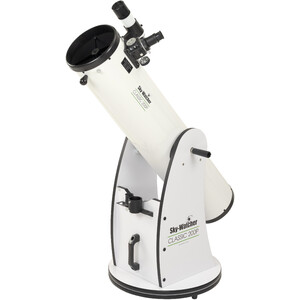
200 mm of aperture — the most sky for your money. Set it on the ground, point by hand: nebulae, clusters and galaxies for years to come.
Price: € 479
* Affiliate link: if you buy through this link we may earn a small commission from Astroshop or High Point Scientific, at no extra cost to you.
Your first binocular night: how to nail it
The most common beginner mistake is not the wrong instrument but the wrong posture — literally. Standing and staring straight up for minutes means shaking arms and a sore neck. Here is how to do it better:
- Use a deck chair or lounger: lie back, binoculars up — that way you last 20 minutes with ease
- Brace your elbows: against a wall, a car roof or a fence post, image shake drops dramatically
- Allow 20–30 minutes for dark adaptation: only then does the eye reveal faint objects — phone in your pocket, red light instead of white
- Find a dark site: even 20 minutes out of the city turns “quite nice” into “wow”
- Start with easy targets: Moon, Pleiades, Milky Way — wins first, challenges later
Self-test: 3 questions, one clear answer
- Do you already know whether this hobby will keep you hooked? No → binoculars. Yes → on to question 2.
- Do you mainly want to see planets and lunar detail? Yes → telescope (Dobsonian). No → on to question 3.
- Do you want photos of nebulae and galaxies? Yes → smart telescope. No → binoculars first, telescope later.
Frequently asked questions
Which binoculars for astronomy?
The classic is the 10×50: 10x magnification, 50 mm aperture — bright and still hand-holdable. Larger models (15×70, 20×80) need a tripod.
Can binoculars replace a telescope?
For wide-field observing, yes; for planetary and detail work, no. The two complement each other — almost every experienced observer uses both.
What do the numbers on binoculars mean, e.g. 10×50?
The first number is the magnification, the second the objective diameter in millimeters. Divide 50 by 10 and you get the exit pupil (5 mm) — the larger it is, the brighter the image at night. All common sizes from 8×21 to 25×100 are listed in our binocular magnification chart.
Are binoculars better than a cheap telescope?
In most cases, yes: a solid 10×50 gives a sharper, brighter image than a wobbly bargain-bin telescope — and does not frustrate. Only from around $305.00€ 265 (e.g. a Sky-Watcher Heritage 130) does the telescope clearly overtake binoculars.
Can you observe planets with binoculars?
Only to a limited degree: Jupiter shows its four moons as dots and Saturn looks slightly oval — real detail like cloud belts or the rings only appears in a telescope.
Do astronomy binoculars need a tripod?
Up to 10x, braced elbows or a lounger are enough. From about 12x (15×70, 20×80) a tripod is a must — otherwise the shake swallows the very faint objects you bought the big glass for.
Read next:
🌍 Other languages: Deutsch (original) · Français · Italiano