By Alexander Merz · Published on · Details checked on 22 September 2026
The magnification of a binocular is the first number in its designation: a 10×50 magnifies ten times, and the second number is the objective lens diameter in millimeters.
From these two numbers you can tell how bright, how steady and what for a binocular is good – the chart below works it out for 17 common sizes.
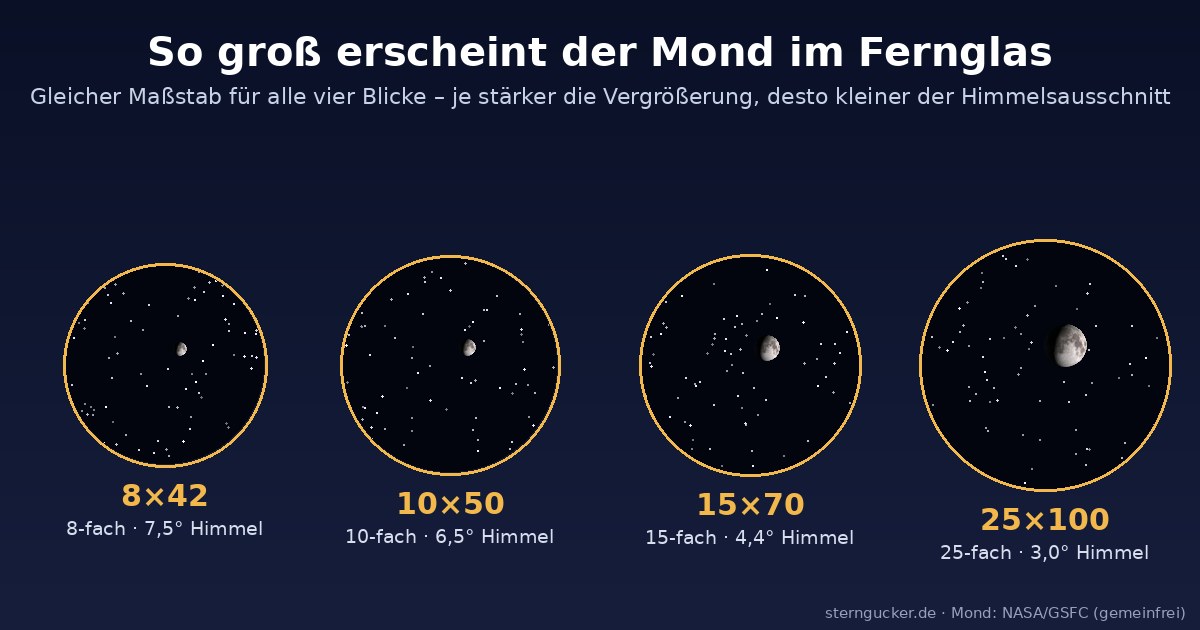
What the numbers on binoculars mean: 10×50 explained simply
Every binocular carries two numbers, separated by an “x” or “×”. The first is the magnification, the second the objective lens diameter in millimeters – in other words, the size of the front lenses that gather the light.
Everything else on the spec sheet can be calculated from these two numbers: exit pupil, twilight factor and relative brightness. The graphic shows the three calculations using a 10×50 as the example.
Magnification: the first number
A 10× binocular shows a bird 100 meters away as if you were standing 10 meters in front of it. The price you pay: the field of view shrinks, and every tremor of your hands is magnified ten times as well.
Objective diameter: the second number
The aperture determines how much light the binocular gathers. The area grows with the square: a 50 mm objective gathers four times as much light as a 25 mm one and about 40 percent more than a 42 mm one.
Exit pupil: aperture divided by magnification
The exit pupil is the diameter of the beam of light that leaves the eyepiece – 5 mm for a 10×50. Hold the binocular at arm’s length against a bright sky and you’ll see it as a small bright disk in the eyepiece.
At night it is the most important number: if the beam is smaller than your pupil, the image gets dimmer than it needs to be. If it is larger, some light misses your eye.
Twilight factor: the hunters’ figure
The twilight factor is the square root of magnification times objective diameter and describes how well you can still make out detail in low light. Hunting binoculars usually score 20 or more.
Field of view: meters at 1,000 meters
The field of view tells you how wide the area is that you see at once. It is given in degrees or as meters at 1,000 meters distance; 1 degree equals 17.5 meters.
A 10×50 with 6.5° therefore shows about 114 meters of landscape at one kilometer. For comparison: the full Moon spans half a degree in the sky.
Binocular magnification chart: 17 sizes compared
The chart lists the sizes you will actually find in stores – from pocket binoculars to giant binoculars for the sky. Exit pupil and twilight factor are calculated with the formulas above; the suitability is our assessment from practical use.
| Size | Exitpupil | Twilightfactor | Good for | Holding |
|---|---|---|---|---|
| 8×21 | 2.6 mm | 13.0 | Day: concerts, hiking, kids | Handheld |
| 8×25 | 3.1 mm | 14.1 | Day: travel, theater, hiking | Handheld |
| 10×25 | 2.5 mm | 15.8 | Day: stadium, travel – too dim at night | Handheld, a bit shaky |
| 8×30 | 3.75 mm | 15.5 | Day, hiking; Moon yes, stars barely | Handheld |
| 7×35 | 5.0 mm | 15.7 | Day, light dusk; a first look at the sky | Handheld |
| 8×42 | 5.25 mm | 18.3 | Birds, nature, dusk; good for stars | Handheld |
| 10×42 | 4.2 mm | 20.5 | Distant birds, dusk; good for stars | Handheld |
| 12×42 | 3.5 mm | 22.4 | Long distances by day, Moon | braced |
| 7×50 | 7.1 mm | 18.7 | Boating, night; Milky Way for young eyes | Handheld |
| 8×56 | 7.0 mm | 21.2 | Hunting, night stands; Milky Way | Handheld, but heavy |
| 10×50 | 5.0 mm | 22.4 | ⭐ Our tip for the night skyStars, Moon, comets – the astronomy all-rounder | Handheld, tripod more comfortable |
| 12×50 | 4.2 mm | 24.5 | Stars, Moon, star clusters | braced |
| 16×50 | 3.1 mm | 28.3 | Moon, bright star clusters | Tripod |
| 20×50 | 2.5 mm | 31.6 | Moon; too dim for faint objects | Tripod |
| 15×70 | 4.7 mm | 32.4 | Star clusters, galaxies, comets | braced or on a tripod |
| 20×80 | 4.0 mm | 40.0 | Faint nebulae and star clusters | Tripod |
| 25×100 | 4.0 mm | 50.0 | Deep sky, globular clusters, lunar craters | heavy mount |
The chart is best read from right to left: first decide whether you want to hold the binocular or mount it, then choose the use. Only after that is it worth looking at the figures.
What binocular magnification makes sense?
What makes sense is the magnification you can still hold steady – and for most people that is 7× to 10×. Anything higher shows not more but less handheld, because the image dances.
Which size within that range suits you depends on the use. The overview sums up the classic recommendations.
| Use | Size | Why |
|---|---|---|
| Stars and Moon | 10×50, braced 15×70 | 5 mm exit pupil, enough light for star clusters and galaxies |
| Birdwatching | 8×42 or 10×42 | Bright, steady image, wide field of view, under 800 g |
| Hunting, dusk | 8×56 or 8×42 | 7 mm exit pupil for the last minutes of light |
| Hiking, travel | 8×25 to 8×32 | Light and small, perfectly adequate by day |
| Boating, sailing | 7×50 | Large exit pupil forgives rocking, often with a compass |
| Stadium, theater | 8×21 to 10×25 | Fits in a jacket pocket |
| Kids | 6×21 to 8×30 | Light, wide field of view, small hands |
For birdwatching, “8 or 10” is almost a matter of faith, and both camps have good arguments. For the sky, things are clearer – more on that in a moment.
8× or 10× magnification: what the difference makes
The step from 8 to 10 sounds small, but it means a quarter more magnification and a quarter more shake. At the same time the field of view shrinks: a typical 8×42 shows about 7.5°, a 10×42 just over 6°.
| 8× | 10× | |
|---|---|---|
| Steadiness handheld | steadier | visibly shakier |
| Field of view (42 mm) | approx. 7–8° | approx. 6–6.5° |
| Detail at a distance | less | more |
| Exit pupil (42 mm) | 5.25 mm | 4.2 mm |
| In the sky | good for the Milky Way and overview | resolves star clusters better |
By day the 8× binocular usually wins, because it finds targets faster and stays steadier – especially with birds that move. If you mainly watch distant, stationary targets, take 10×.
At night the 10×50 wins: the extra magnification darkens the sky background and reveals faint stars that disappear into the gray in an 8× binocular. An 8×42 you already own is perfectly fine for getting started, though.
The common sizes: what 8×42, 10×50 and co. mean
8×21, 8×25 and 10×25: the pocket binoculars
Compact binoculars with 21 or 25 mm aperture often weigh under 300 g and fit in any jacket. At night they gather too little light: a 10×25 has only a 2.5 mm exit pupil and a quarter of the light of a 10×50.
Still, they are enough for lunar craters and the four bright moons of Jupiter. So the pocket binocular is fine for trying things out, but not as an astronomy binocular.
8×30: the light all-round binocular
An 8×30 is the compromise between weight and brightness for hikers, often around 500 g. In the sky it shows the Moon and the Pleiades nicely; for galaxies the aperture is too small.
8×42, 10×42 and 12×42: the nature observers’ class
The 42 mm class is the standard for birdwatching and nature: bright enough for dusk, light enough to carry all day. The 8×42 has a 5.25 mm exit pupil, the 10×42 4.2 mm, the 12×42 only 3.5 mm.
With the 12×42, handheld views are already getting shaky. For the sky, an 8×42 or 10×42 you already own is a good start, but we wouldn’t buy a new one in this class just for stargazing.
7×50 and 8×56: marine and twilight binoculars
Both have an exit pupil of about 7 mm – exactly as large as the fully dilated pupil of a young person. That’s why they are popular on boats and with hunters: the image stays bright even when the binocular isn’t perfectly steady in front of your eyes.
From around 40 to 50, however, the pupil often opens to only 5 mm. Then part of the light misses your eye, and a 10×50 shows more in the sky than the 7×50.
10×50: the all-rounder for the night sky
The 10×50 is the classic astronomy binocular: 5 mm exit pupil, a field of view of about 6.5° and usually under one kilogram. With it you can see lunar craters, Jupiter’s moons, the Andromeda Galaxy and dozens of star clusters.
It works by day too, but is heavier than an 8×42. If you want one binocular for both and go out at night more often, a 10×50 is the right choice.
Budget tip 10×50: Celestron UpClose G2 10x50 Porro Binoculars
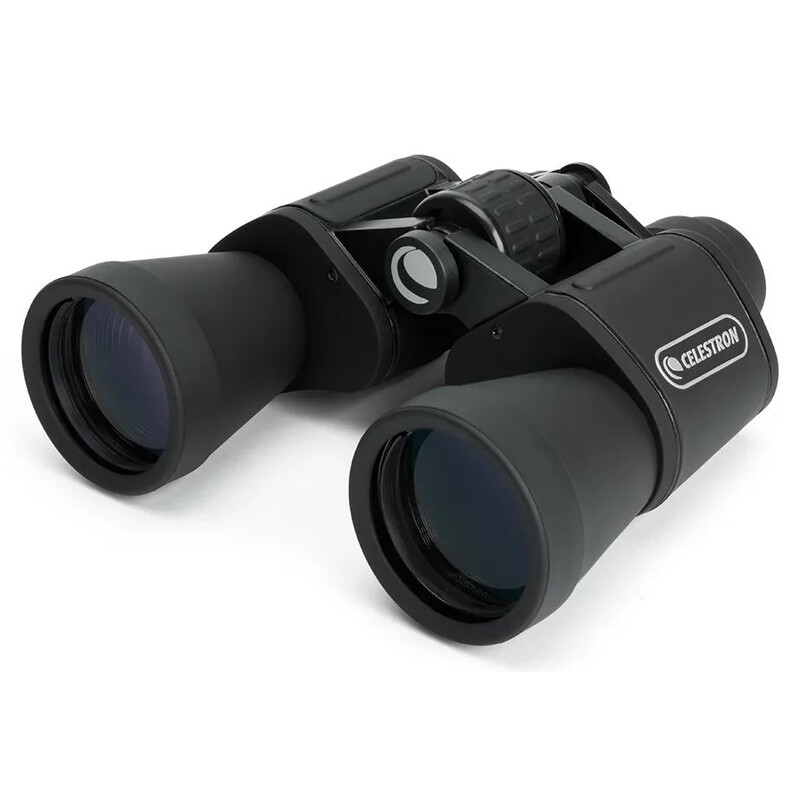
Affordable 10×50 with a 6.8° field of view, 5 mm exit pupil and 840 g – perfectly fine for your first evening under the stars. For eyeglass wearers, however, the short eye relief of 12 mm is tight.
Price: € 62
20×50: lots of magnification, little light
A 20×50 sounds like more but often shows less at night: a 2.5 mm exit pupil makes the image dim, and nobody can hold 20× steady by hand. It works for the Moon on a tripod; for star clusters a 15×70 is the better choice.
15×70, 20×80 and 25×100: giant binoculars for the sky
From 70 mm aperture begins the class bought almost exclusively by sky watchers. A 15×70 gathers twice as much light as a 10×50 and can still be held when braced; a 20×80 at a good 2 kg can’t.
A 25×100 usually weighs 4 kg or more and needs a heavy tripod or a fork mount. In return it shows globular clusters and galaxies that are mere smudges in a 10×50.
Binoculars for stars and the Moon: the figures that count at night
In the night sky, two things matter: gathering enough light and keeping the image steady. Magnification alone does little for that – aperture and exit pupil decide.
Exit pupil and age
A dark-adapted pupil opens to about 7 mm in young people, but often only to 5 mm by age 50. The target for an astronomy binocular is therefore 4 to 5 mm – that suits almost every age.
Under a light-polluted city sky, the pupil never opens fully anyway. There a smaller exit pupil is even an advantage, because the sky background looks darker.
Aperture beats magnification
Faint stars and galaxies only show up once enough light comes together. That’s why a 15×70 shows more than a 20×50, even though it magnifies less.
For the Moon it’s the other way round: it is so bright that every binocular has enough light. Here magnification really does bring more detail – as long as the image is steady.
Which specific model is worth it for the sky is compared in our guide to astronomy binoculars. There you’ll also find eye relief, weight and prism glass of the individual binoculars.
Rule of thumb: from 10× onto a tripod
The proven rule of thumb is: up to 10× handheld, from 10× a tripod pays off, from 15× it’s a must. Every hand shakes slightly, and the binocular magnifies that shake just as much as the target.
Up to 10× and about one kilogram, the handheld image stays steady enough to separate Jupiter’s moons. Even with a 10×50, though, a tripod shows noticeably more, because stars become points instead of little streaks.
| Magnification | Holding | In practice |
|---|---|---|
| up to 8× | handheld | steady image even when standing |
| 10× | handheld, a tripod pays off | bracing your elbows helps instantly |
| 12× to 15× | braced or on a tripod | only briefly handheld |
| from 16× | tripod a must | otherwise you waste the magnification |
| from 25× | heavy mount | weight usually over 4 kg |
For a photo tripod, all you need is a binocular adapter for the 1/4-inch thread that most astronomy binoculars have at the front between the barrels. The cheapest alternative is a reclining lawn chair: lying on your back, you can hold even a 15×70 steady for minutes.
If you want more magnification without a tripod, go for a binocular with image stabilization, which compensates for hand shake electronically.
1000× magnification in binoculars: an advertising myth
A binocular with 1000× magnification does not exist, and it would be useless anyway. Even large telescopes rarely work above 300× under our skies, because atmospheric turbulence blurs finer detail.
The rule of thumb for telescopes is: the maximum useful magnification is about twice the aperture in millimeters. For 1000× you would need 500 mm of aperture – that’s an observatory dome, not a binocular.
And 50×, 100× or 200×?
50× exists in giant binoculars with interchangeable eyepieces, which sit on a mount and cost as much as a good telescope. 100× and 200× are figures for spotting scopes and telescopes – a binocular with such specs is almost always a cheap zoom.
Zoom binoculars like “20–180×100” have a dark, blurry and tiny image at the top end. They are no good for the sky: stars turn into smudges, and the mechanics quickly go out of collimation.
Our binoculars for the night sky by size
We also use these binoculars in our buying guide. The stock status comes from the shop daily, and so do the prices.
| Size | Model | Why this one | Price |
|---|---|---|---|
| 7×50 | Celestron Cometron 7x50 Binoculars | 7 mm exit pupil, affordable and bright – ideal for young eyes and the Milky Way. ● In stock · ready for shipping in 24 h | € 65 |
| 10×50 | Celestron UpClose G2 10x50 Porro Binoculars | The affordable all-rounder: 6.8° field, 840 g, just right for your first time. ● In stock · ready for shipping in 24 h | € 62 |
| 10×50 ED | Omegon Hunter 2.0 10x50 ED Binoculars | ED glass for sharper stars and less color fringing, tripod thread from the factory. ● In stock · ready for shipping in 3-7 days | € 359 |
| 15×70 | Omegon Nightstar 15x70 Binoculars | ⭐ Our recommendationTwice the light of a 50 mm, still portable when braced. ● In stock · ready for shipping in 24 h | € 119 |
| 20×80 | Omegon Nightstar 20x80 Binoculars | 80 mm for the money, but a good 2 kg – only makes sense on a tripod. ● In stock · ready for shipping in 24 h | € 149 |
Our recommendation: Omegon Nightstar 15x70 Binoculars
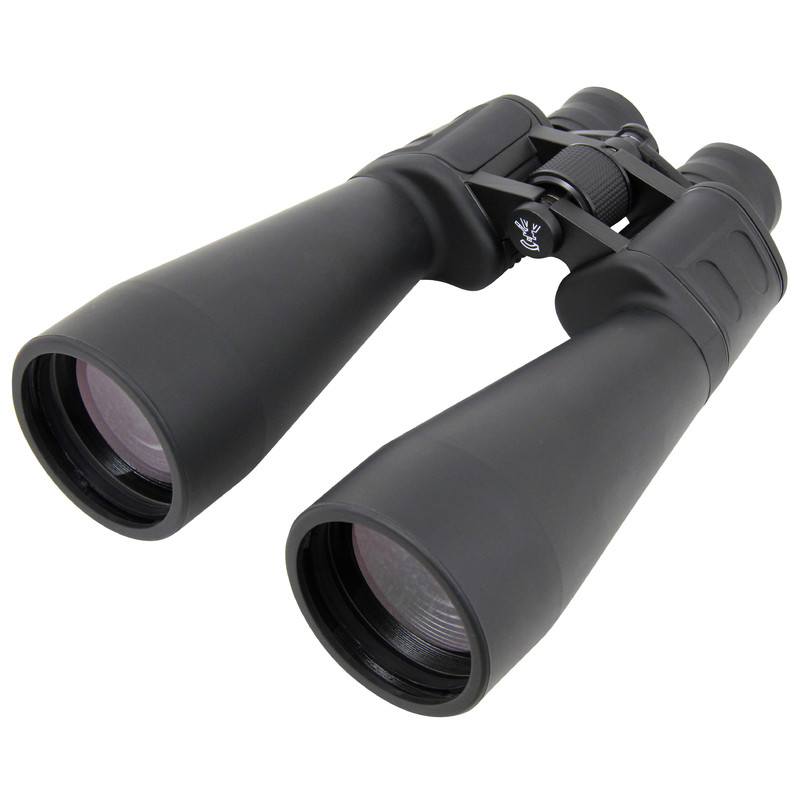
The classic astronomy binocular: 70 mm of aperture gathers twice as much light as a 50 mm, and the 4.7 mm exit pupil suits almost every eye. Easy to hold braced or from a lawn chair, even better on a tripod.
Price: € 119
Torn between 10×50 and 15×70? Then holding decides: if you want to pop out onto the balcony on a whim, take the 10×50; if you have a tripod or a lawn chair, the 15×70 shows more.
If you want more: your first telescope
Binoculars show star clusters and the Milky Way beautifully, but no rings of Saturn and no cloud bands on Jupiter. The Skywatcher Heritage 130/650 has 130 mm of aperture and magnifies over 100× with the right eyepiece.
The extra cost is worth it if planets and lunar craters in detail appeal to you; for the Milky Way and comets, binoculars remain the better choice. That’s why most observers keep both.
For advanced observers: Skywatcher Dobson Telescope N 130/650 Heritage FlexTube
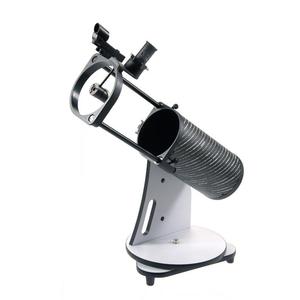
130 mm aperture on a stable tabletop Dobsonian mount – the obvious next step after binoculars if you want to see planets and lunar craters in more detail.
Price: € 265
How to choose a telescope without falling into the usual traps is explained in our guide Best telescopes for beginners. Binoculars remain the ideal complement, not a replacement.
FAQ about binocular magnification
What do the numbers 7×50, 8×30 or 10×42 mean?
The first number is always the magnification, the second the objective diameter in millimeters. So a 7×50 magnifies 7× with 50 mm objectives, an 8×30 8× with 30 mm, a 10×42 10× with 42 mm.
What magnification does a normal binocular have?
Most binoculars magnify 7× to 10×. That is the range you can still hold steady by hand; stronger binoculars need a support or a tripod.
What is the strongest useful magnification for binoculars?
Handheld about 10× to 12×, braced 15×. On a tripod 20× to 25× is common, and giant binoculars with interchangeable eyepieces reach 40× to 50×. Anything beyond that is telescope territory.
Is a 10×50 or an 8×42 better for stars?
For stars the 10×50 is better: more light and more magnification, which darkens the sky background. An 8×42 is the better daytime binocular and still a good start in the sky.
What magnification do I need for the Moon?
Even 7× to 10× shows craters, maria and the shadow line between day and night. At 15× to 20× on a tripod, individual crater walls become clear; the Moon shows its finest detail a few days before or after first or last quarter.
How do I convert field of view from meters to degrees?
Divide the figure in meters at 1,000 meters by 17.5. So 114 m at 1,000 m corresponds to about 6.5°, 131 m to about 7.5°.
Read more: Astronomy binoculars · Telescope or binoculars? · Telescopes for beginners
Links marked with an asterisk (*) are affiliate links. If you buy through them, we receive a small commission – the price stays the same for you.