
By Alexander Merz · Updated on · Details checked on 14 September 2026
The Unistellar eVscope 2 is an impressive fusion of a conventional GoTo telescope and the latest technology (smart telescope). By collecting the faint light of distant galaxies and nebulae the telescope, combined with a highly sensitive sensor, enables image intensification on a modern OLED screen that is projected through the eyepiece.
In this way, the advantages of computer-controlled telescope guidance and image intensification are combined with the classic method of observation.
Features and functions at a glance
- Combination of a traditional GoTo telescope with astrophotography
- Remote use: battery and its own Wi-Fi
- Control via app
- Very easy to use (automatic field recognition, tracking)
- Image intensification through live stacking of images
- Optics: f/4 and Sony CMOS chip
- Participation in citizen science projects
- Go to the telescope*Go to the telescope* – around $4,999.00€ 4,911
Optics and image quality
The Unistellar eVscope 2 has an aperture of 114 mm and a focal length of 450 mm. This results in a fast focal ratio of f/4. The sensor, which sits in the spider, receives its light from a parabolic mirror in the manner of a Newtonian optic. This gives us an image free of spherical and chromatic aberrations.
The sensor is the CMOS Sony IMX347. The IMX series is also used in other dedicated astronomy cameras and is designed to ensure a low-noise image thanks to low read noise.
In addition to the integrated Wi-Fi, which makes an image appear directly in the app, the resulting image is also displayed on an OLED screen on the telescope. Personally, I find this feature dispensable.
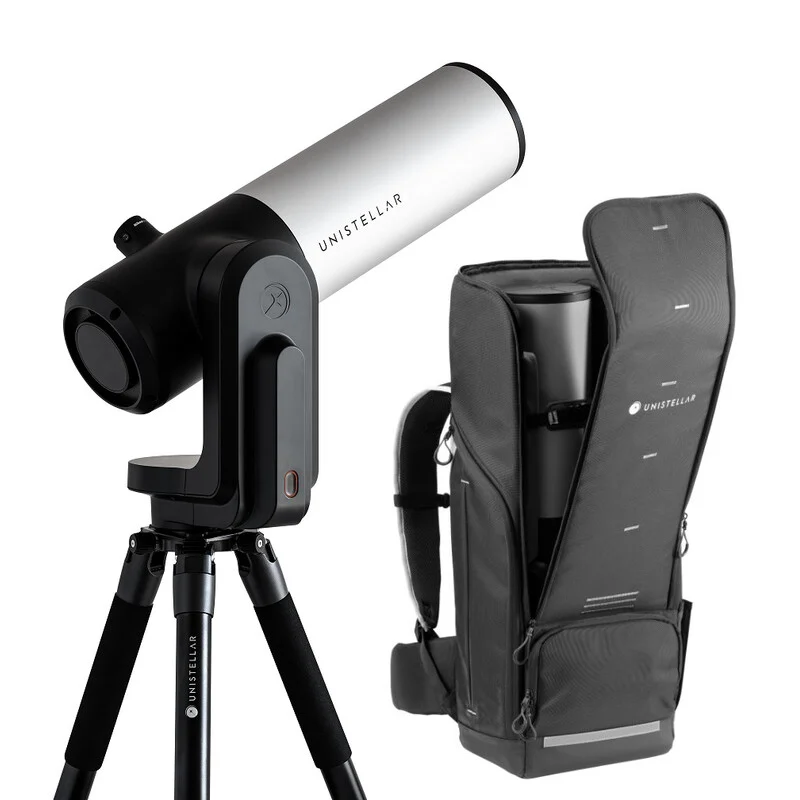
During my observation nights, I looked through the “eyepiece” only once. In all other cases, you view the live-stacked image in the app, if only because of the greater level of detail and more comfortable viewing.
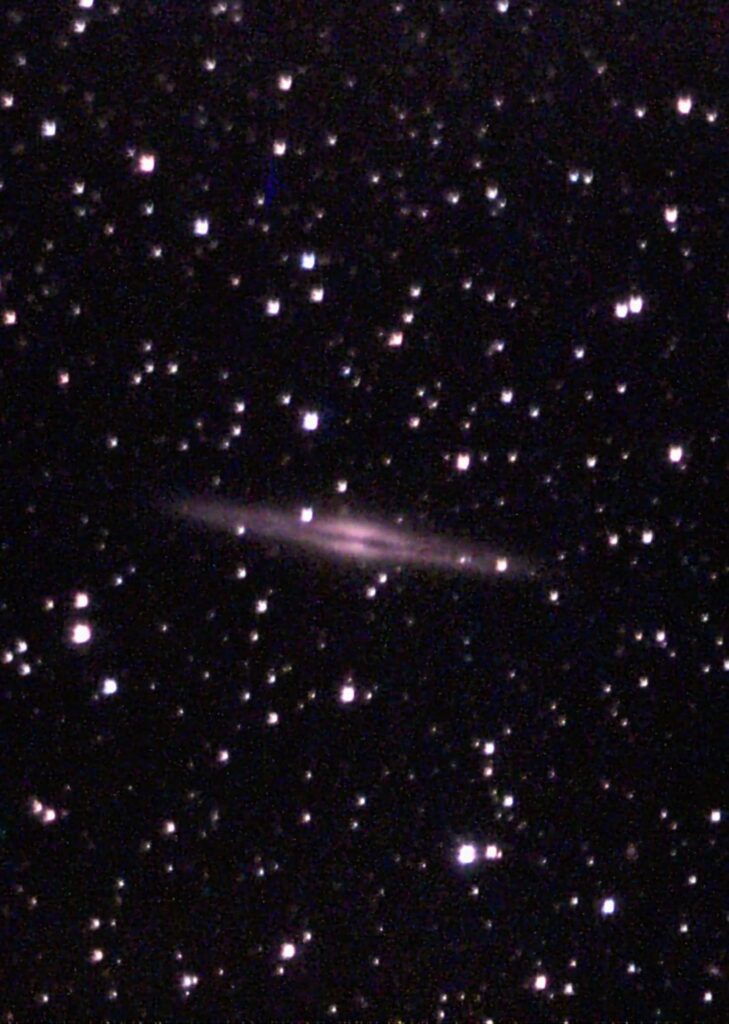
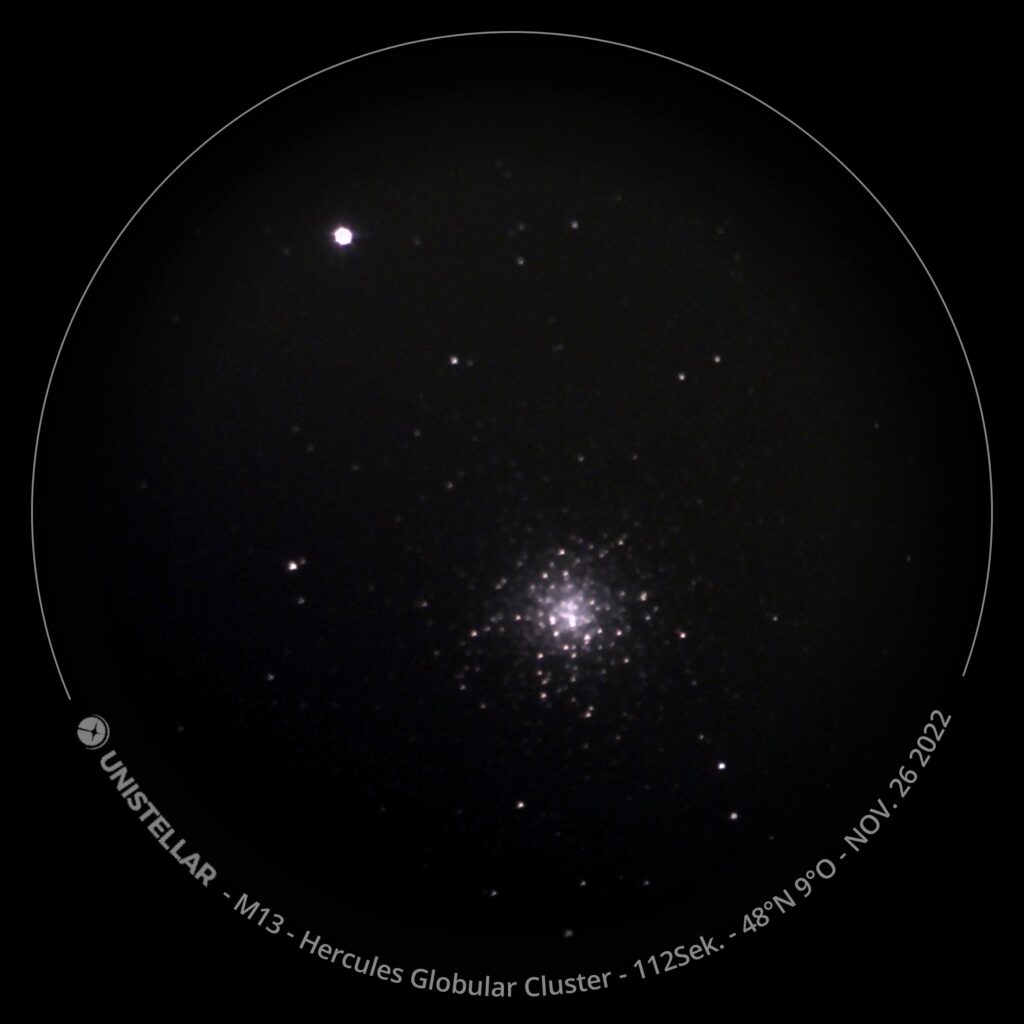
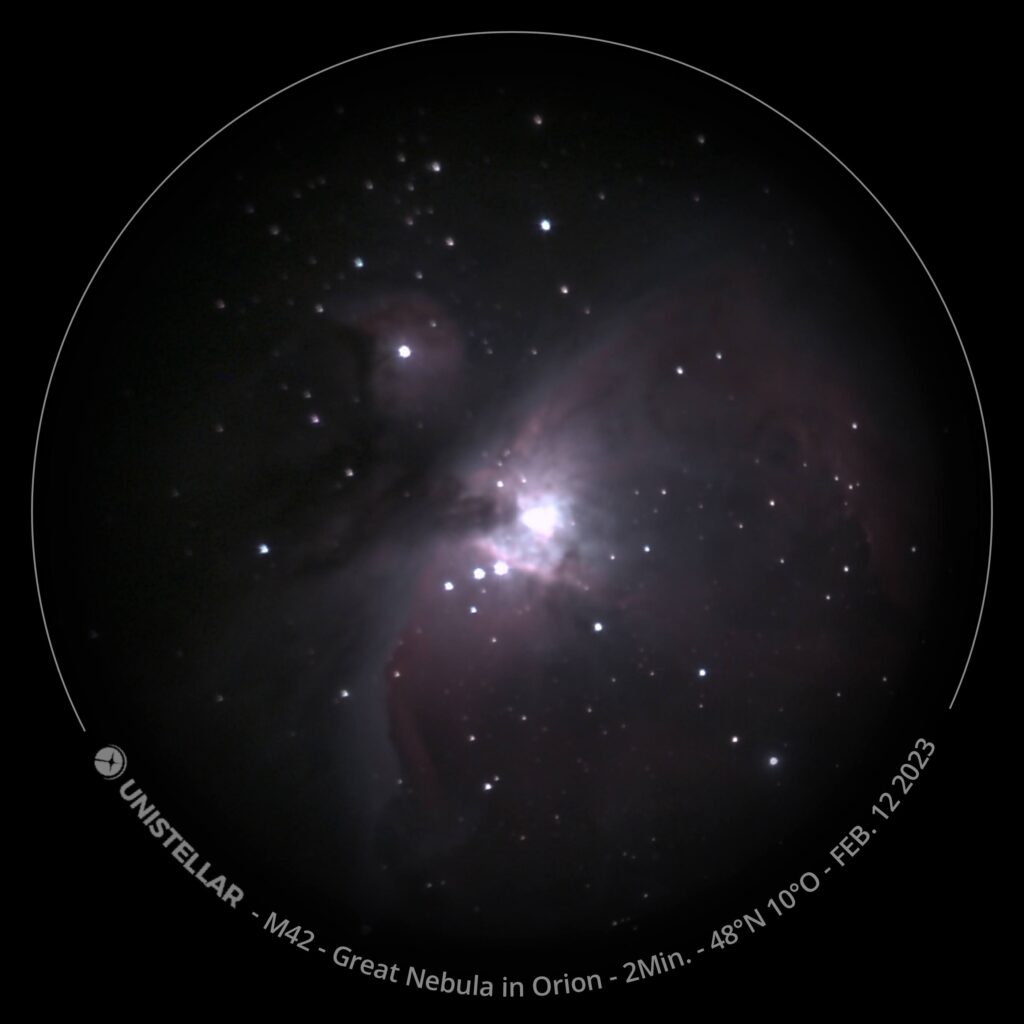
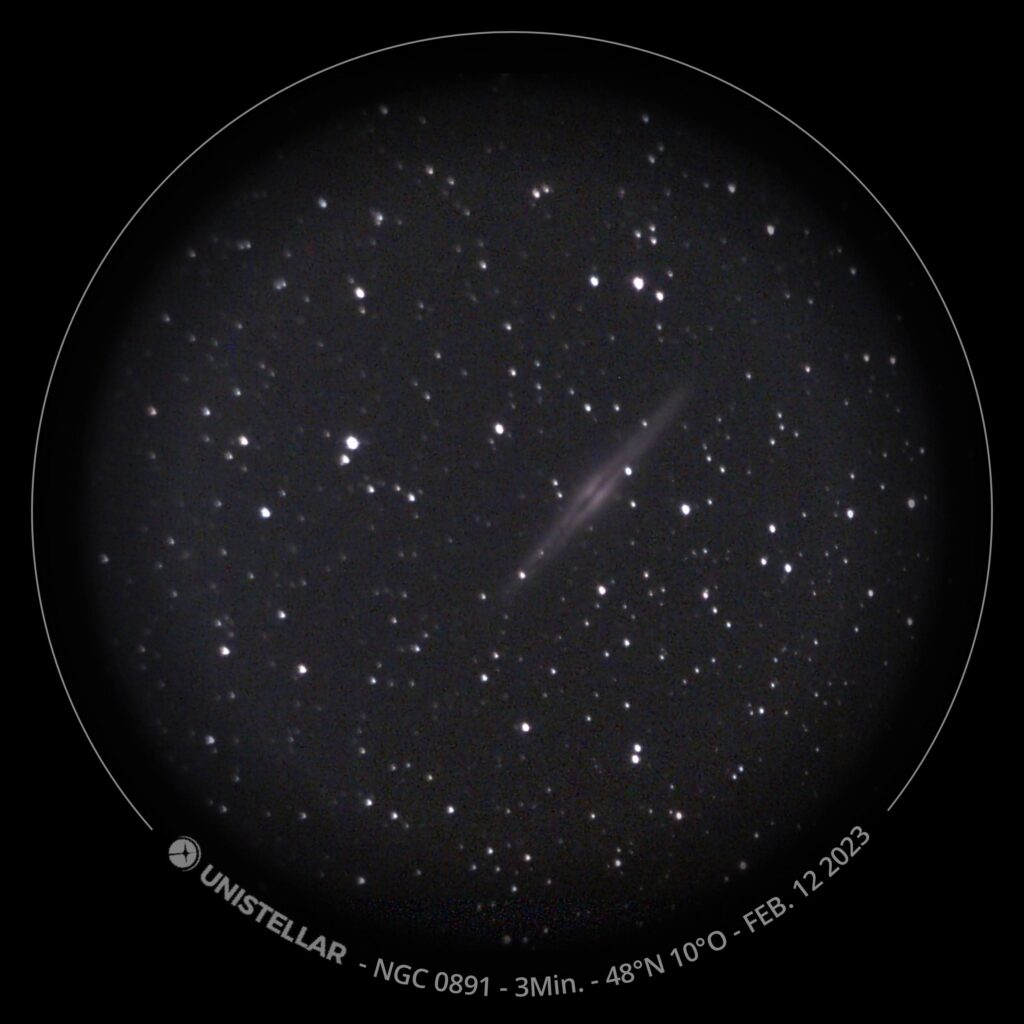
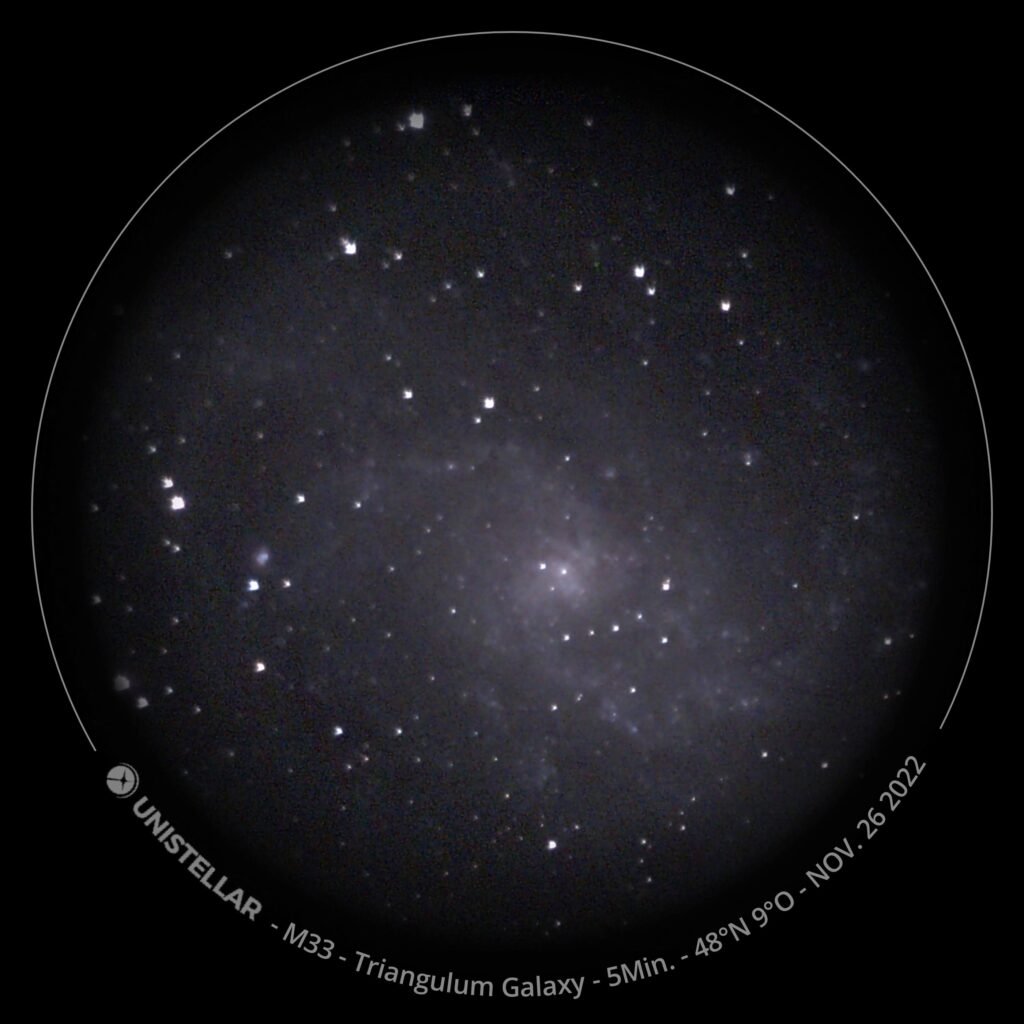
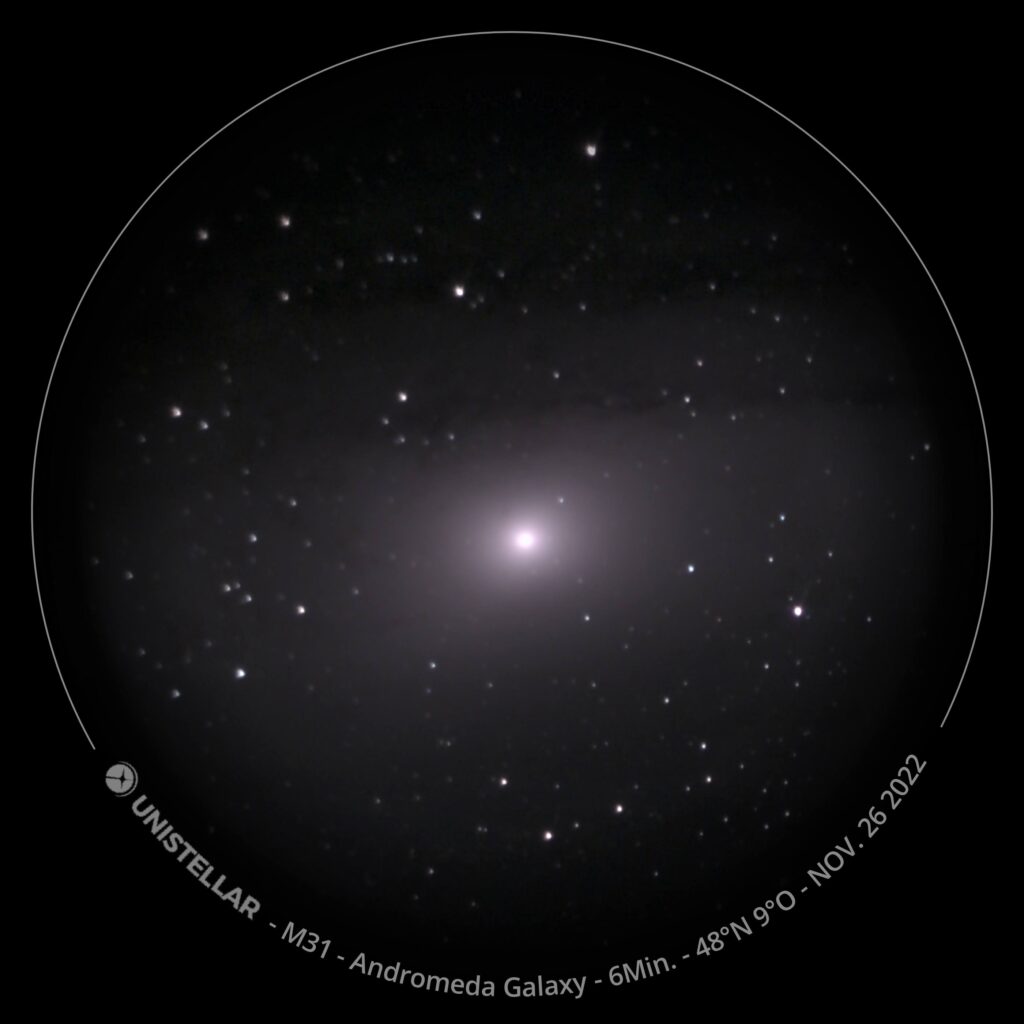
The resulting images are quite impressive if you are not an astrophotographer. Nebulae, galaxies and globular clusters in particular reveal, thanks to the automatic stacking of the captured images, a level of detail that you would rarely experience as a visual astronomer.
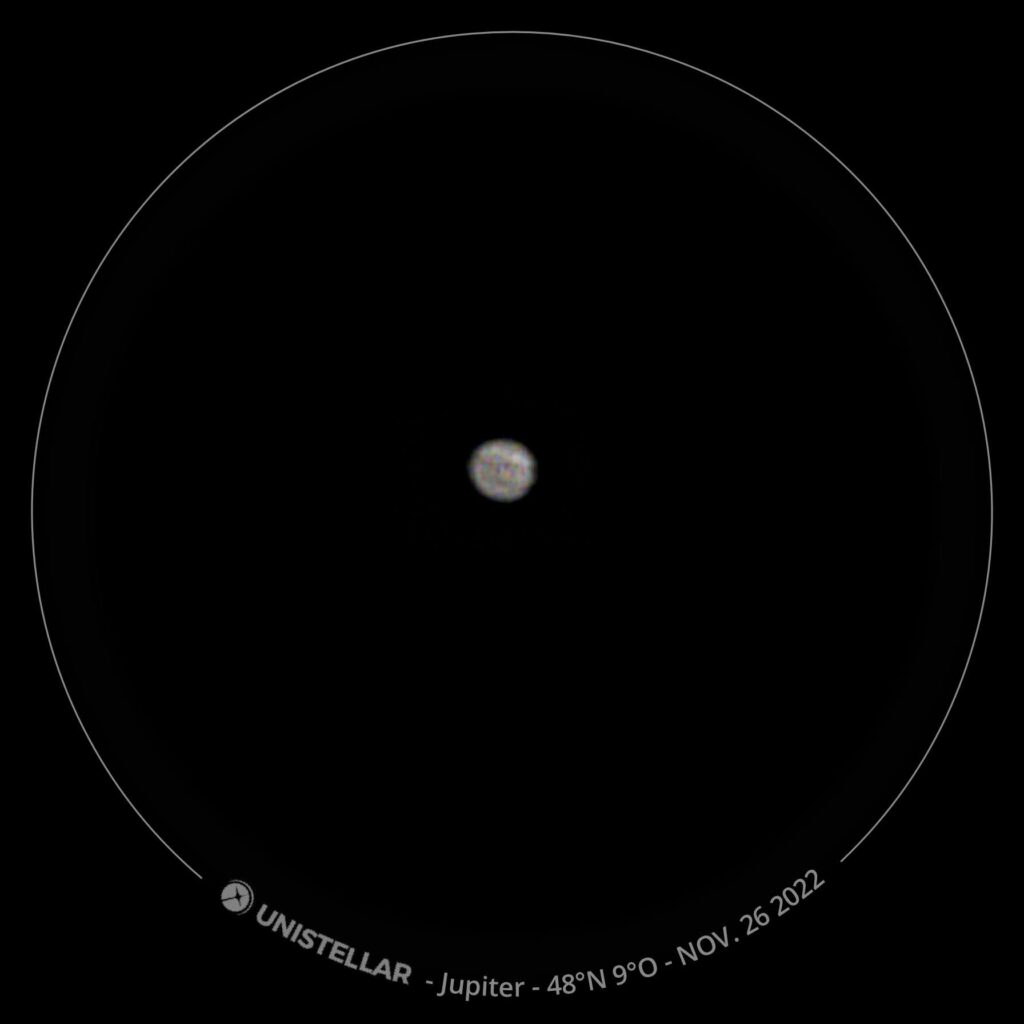
In contrast, images of bright objects such as the large planets Jupiter and Saturn, or Mars and the Moon are disappointing. You only get bright, overexposed images without any notable detail. Here, conventional telescopes such as a 200 mm Dobson telescope or an 80 mm refractor have a clear advantage.
User-friendliness and app integration
One of the main reasons for the popularity of the original eVscope was its ease of use and user-friendliness. The eVscope 2 builds on this foundation and offers an improved user experience through a more intuitive app and an optimized mount.
The automatic star recognition and tracking make it easier to locate celestial objects and allow even beginners to use the telescope effectively. Everything works flawlessly and effortlessly here.
There are only 3 images in the quick-start guide! In fact, the charged telescope is ready to observe in a maximum of 2 minutes.

The included app offers a wide range of functions, such as the ability to share observations in real time and take part in citizen science projects (asteroid discovery, planetary defense, collecting measurement data, …). Who wouldn’t want to take part in planetary defense and discover potentially dangerous celestial bodies with their telescope.
However, this aspect is rather secondary for me, as I simply want to observe nebulae and galaxies.
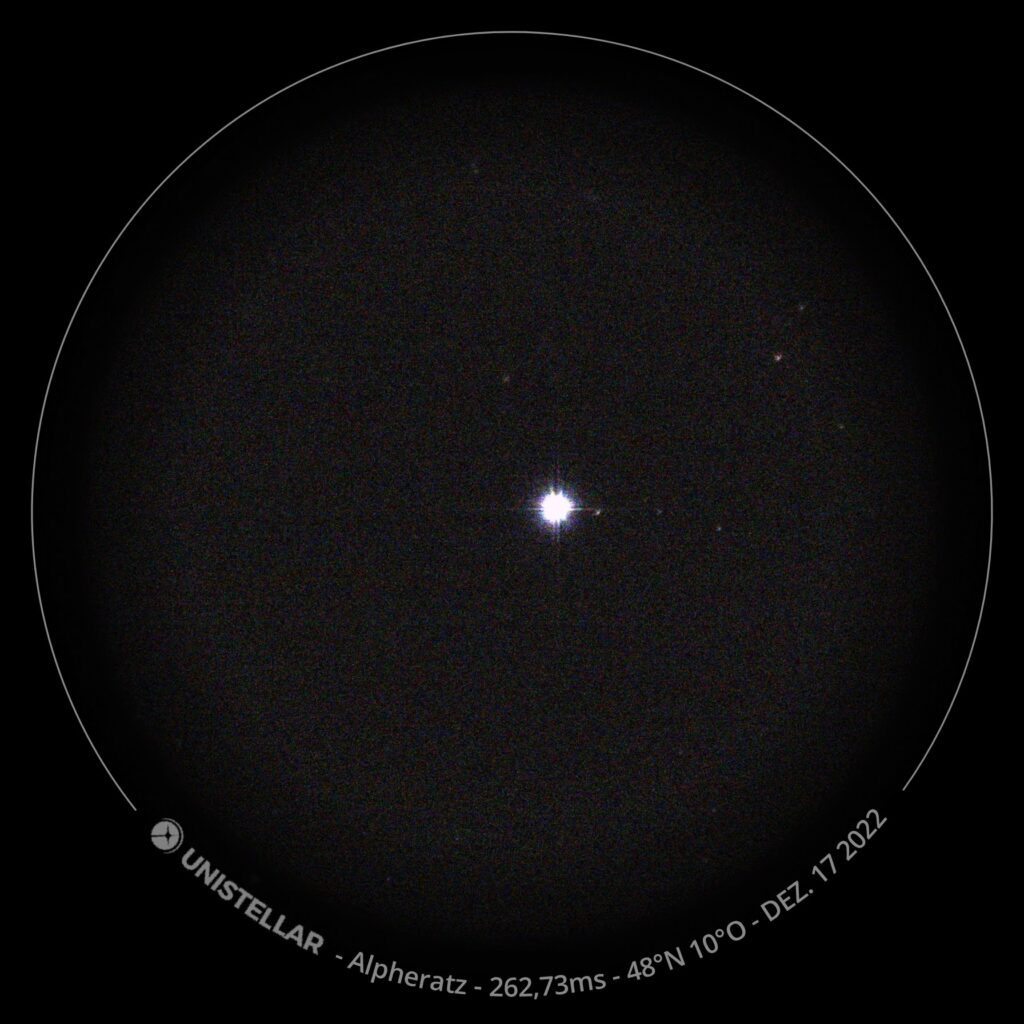
Unistellar eVscope 2: Images [Examples]
Unistellar eVscope 2 Review: Conclusion
The strengths of the Unistellar eVscope 2 come into their own especially with diffuse, faint objects that need to be exposed for longer to produce a good image.
And there are many of them: galaxies, nebulae and star clusters. Anyone who is not an astrophotographer and does not want to become one will get beautiful results here that would otherwise be hard to achieve with a visual telescope.
You can take a closer look at the telescope here.You can take a closer look at the telescope here.*
However, the telescope has clear weaknesses with popular beginner objects such as the Moon, Jupiter and Saturn. The image becomes too bright and hardly any detail can be seen. On top of that comes the hefty price of around $4,999.00€ 4,911.
But for anyone who wants to explore the night sky from the sofa via the app and has the right budget, the Unistellar eVscope 2 can be a lot of fun, not least because of the citizen science projects that can give your own observations a little meaning.
Want to buy your first telescope? Here’s a quick check.
How would you rate this telescope?
No reader ratings yet. Yours would be the first.
Stars only, no text – one vote per device. To prevent duplicate votes we only store check values (hashes), never your IP address in plain text.