By Alexander Merz · Published on
For most observers, the best telescope under 1,000 in euros or dollars is a 10-inch Dobsonian with 254 mm of aperture – ideally bought for well under the budget cap, so there’s enough left over for a good eyepiece.
⭐ In short
If you mainly want to observe, get the Apertura AD10 10" Dobsonian TelescopeOmegon Advanced X N 254/1250 for $949.95€ 622 and put the rest of your budget into eyepieces. If you don’t want to hunt for targets, go for GoTo or app navigation and accept less aperture. If you want to take photos, you’ll end up with a smart telescope – a classic imaging setup costs well over 1,000 in either currency.
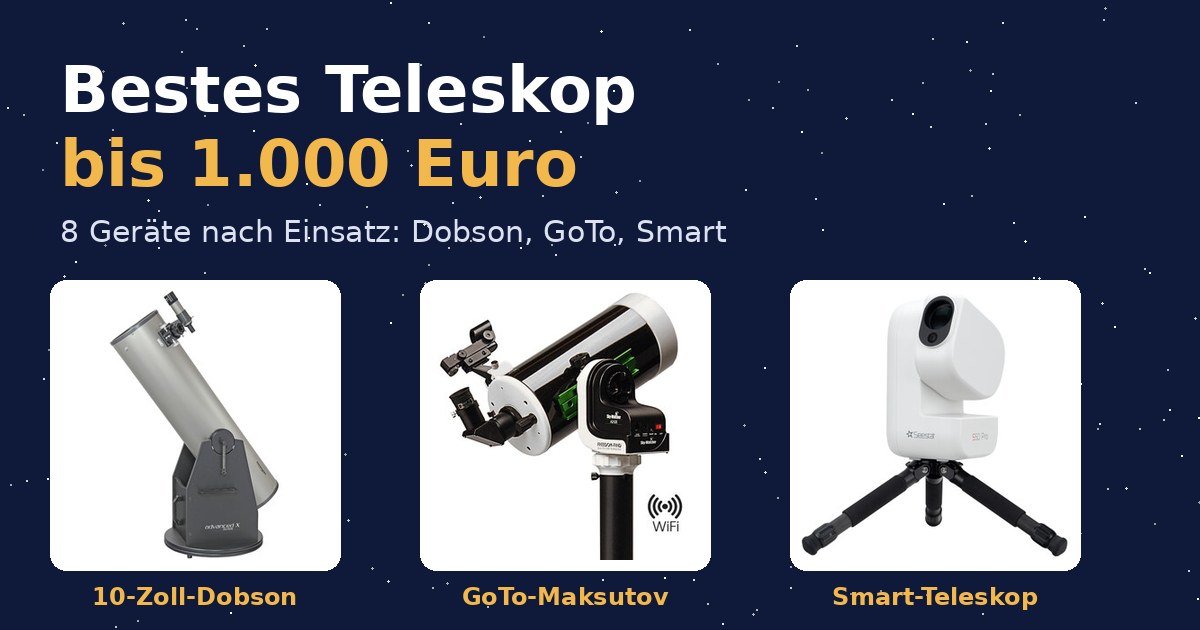
The best telescopes under 1,000 at a glance
Under 1,000, there’s no telescope that does everything. The question isn’t “which one is best?” but “what do you want to do under the night sky?” The table sorts the available models by exactly that question.
| Use | Model | Aperture | Why | Price |
|---|---|---|---|---|
| Nebulae & galaxies | ⭐ Our pickApertura AD10 10" Dobsonian TelescopeOmegon Advanced X N 254/1250 | 254 mm | 10 inches for the price of many 8-inch scopes – leaves budget for eyepieces | $949.95€ 622 |
| 10 inches, portable | Sky-Watcher 10" Flextube Dobsonian TelescopeSkywatcher Skyliner 254/1200 FlexTube | 254 mm | The tube collapses, so it fits in the car | $1,150.00€ 899 |
| Maximum aperture | Apertura AD12 12" Dobsonian TelescopeGSO Dobson N 300/1500 | 300 mm | 12 inches – only with a fixed spot and a short way outside | $1,299.95€ 899 |
| 8 inches + eyepieces | Skywatcher Skyliner 200/1200Skywatcher Skyliner 200/1200 | 200 mm | The classic – fully equipped with the rest of the budget | $699.95€ 479 |
| App-guided finding | Celestron StarSense Explorer 150/750 | 150 mm | Your smartphone shows you where to point | € 719 |
| GoTo for Moon & planets | Sky-Watcher Skymax 127 mm with AZ-GTi Mount & TripodSkywatcher Skymax-127 AZ-GTi | 127 mm | Slews to targets via app, compact tube | $995.00€ 775 |
| Observe now, photos later | Skywatcher Explorer 200P EQ5Skywatcher Explorer 200P EQ5 | 200 mm | Equatorial mount that can be motorized later | $699.95€ 824 |
| Photos without prior knowledge | ZWO Seestar S50 ProZWO Seestar S50 Pro | 50 mm | Smart telescope: images nebulae fully automatically | $999.00€ 999 |
Our selection is based on our own advice data: 35 of the last 100 requests to the Sterngucker telescope advice service named a budget in exactly this price class (as of September 2026). That makes it the second most common budget class after the entry level below it.
What do you get for 1,000 instead of 500?
At around half this budget, an 8-inch Dobsonian is the maximum. Above that, you’re no longer buying “better” – you’re buying either more aperture or more convenience, rarely both at once.
More aperture means fainter objects become visible. With 10 inches, many galaxies show structure for the first time instead of just a smudge, and globular clusters resolve into individual stars far into their core.
More convenience means a motor, an app or tracking. That costs money that’s then missing from the optics – the GoTo Maksutov in this selection has 127 mm of aperture, the cheaper 10-inch Dobsonian 254 mm.
The best telescope under 800
If 800 is your hard limit, you lose surprisingly little. The 10-inch Dobsonian from our recommendation typically comes in well below that mark, with Celestron’s app navigation and Skywatcher’s GoTo Maksutov just below it.
| If you want … | Model | Price |
|---|---|---|
| Maximum light | Apertura AD10 10" Dobsonian TelescopeOmegon Advanced X N 254/1250 | $949.95€ 622 |
| Complete with eyepieces | Skyliner 200/1200Skyliner 200/1200 + Celestron AstroMaster Accessory Kiteyepiece starter kit | $699.95€ 479 + $89.95€ 89 |
| No hunting | StarSense Explorer 150/750 | € 719 |
| Compact with GoTo | Sky-Watcher Skymax 127 mm with AZ-GTi Mount & TripodSkymax-127 AZ-GTi | $995.00€ 775 |
| Smart and affordable | ZWO Seestar S30 ProZWO Seestar S30 Pro | $699.00€ 699 |
For nebulae and galaxies: the 10-inch Dobsonian
A Dobsonian is a reflector on a simple rotating box base that you point by hand. Because you’re not paying for electronics, you get the most aperture for your money here. That’s exactly why experienced observers in buying-advice forums almost unanimously recommend it at this budget.
Our pick under 1,000: Omegon Dobson Telescope Advanced X N 254/1250
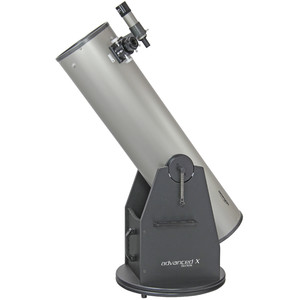
10 inches of aperture for the price of many 8-inch scopes. The mirror collects 61% more light than a 200 mm – instantly visible on galaxies and globular clusters. Leaves enough of your budget for a good eyepiece.
Price: € 622
The price you pay for aperture is weight and length. A 254/1250 tube is about 1.2 m long and has to be carried outside for every session. If you live on the third floor without an elevator, you’re better off with the collapsible FlexTube or a compact GoTo scope.
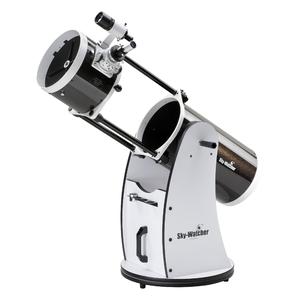
12 inches only make sense with a fixed observing spot. The GSO 300/1500GSO 300/1500 collects another 40% more light than a 10-inch, but has a 1.5 m focal length and a correspondingly long, heavy tube. Next to the patio in your backyard it’s a dream; in a stairwell it’s a reason to stop going outside.
You’ll find more on the design, collimation and the differences between models in our guide to Dobsonian telescopes.
For the Moon and planets: GoTo Maksutov or 8-inch
For the Moon, Jupiter and Saturn, aperture matters less than sharpness at high magnification. With its 1,500 mm focal length, a Maksutov reaches high magnifications even with simple eyepieces – in a compact tube.
Compact with GoTo: Sky-Watcher Skymax-127 AZ-GTi GoTo WiFi
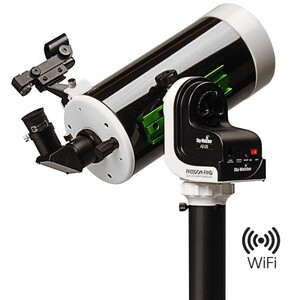
Maksutov 127/1500 on a Wi-Fi GoTo mount: tap Saturn in the app and the mount slews there. Strong on the Moon and planets, and the tube is compact.
Price: € 775
For nebulae and galaxies, 127 mm is too little. If you want both, the 8-inch Dobsonian is the better choice: it shows planets hardly any worse and deep-sky objects much better. More on the design in our Maksutov guide.
No hunting for targets: app navigation or GoTo?
The biggest hurdle at the start isn’t the optics – it’s finding things. Seven of 31 free-text answers in our advice service explicitly mention GoTo, so the wish is common, and there are two ways to get there.
| App navigation (PushTo) | GoTo | |
|---|---|---|
| How it works | Your smartphone shows arrows, you move the scope yourself | Motors slew to the object and track it |
| Power needed | just your phone | yes, battery or power bank |
| Aperture in our selection | 150 mm | 127 mm (Maksutov) |
| Example | StarSense Explorer 150/750 | Sky-Watcher Skymax 127 mm with AZ-GTi Mount & TripodSkymax-127 AZ-GTi |
For beginners, app navigation is usually the better compromise: you get to know the sky along the way, you don’t need a battery and you get more aperture. GoTo plays to its strengths when you’re short on time or searching a bright city sky without guide stars.
App-guided finding: Celestron StarSense Explorer Dobsonian 150/750
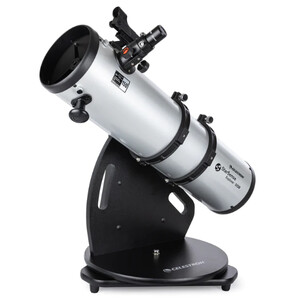
150 mm of aperture plus app navigation: your phone sits in the holder and shows you where to point. No motor, no battery, ready to go right away.
Price: € 719
Astrophotography on a 1,000 budget: what’s realistic
A photo like the one on the manufacturer’s box is made from hours of exposures on a precise tracking mount. A classic deep-sky setup of telescope, mount and camera costs well over 1,000 in euros or dollars. On this budget, there are a few honest routes.
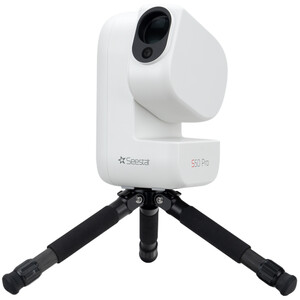
Route 1: the smart telescope. The Seestar S50 ProSeestar S50 Pro combines telescope, camera and tracking in one device and delivers colorful nebulae to your phone within minutes. You can’t look through it – more on that in our smart telescope comparison.
Route 2: a camera on a tracker. If you already own a mirrorless or DSLR camera with a telephoto lens, the Star Adventurer GTi SetStar Adventurer GTi Set ($830.00€ 665) lets you capture the Milky Way, Andromeda and large nebulae. It’s the starting point for many astrophotographers.
Route 3: observe first, photograph later. The Apertura AD8 8" Dobsonian TelescopeExplorer 200P EQ5 shows as much visually as an 8-inch Dobsonian and sits on a mount that can be retrofitted with a motor. For Moon and planetary videos, a planetary camera is then all you need – for long deep-sky exposures, though, the EQ5 is at its limit with this tube.
Where the rest of your budget should go
The eyepieces supplied with almost every telescope in this class are basic. Your first upgrade should be a wide-angle eyepiece with a medium focal length, around 16 to 24 mm – that’s the one you’ll use most of the time.
Budget-friendly start: Omegon Eyepiece Starter Kit
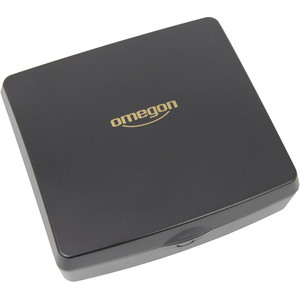
Eyepieces, filters and a Barlow lens in one case: rounds out a new telescope in one go. The most affordable complete solution for getting started.
Price: € 89
If you’d rather buy individually, you’ll find eyepieces sorted by focal length and field of view in our eyepiece guide. Filters, a case and a dew shield can come later, once you know what you’re missing.
Five common mistakes in this price range
- ⚠️ GoTo before aperture: The motor eats up a large part of the budget, and you end up with a small tube on an expensive mount.
- ⚠️ Expecting Hubble images: Nebulae and galaxies look gray and faint in the eyepiece. Only photos show color.
- ⚠️ Too big for everyday use: The best telescope is the one you’ll still carry outside on a Tuesday night.
- ⚠️ Everything at once: Start with the telescope and one good eyepiece, and buy the rest after your first few nights.
- ⚠️ Photo dreams with a visual scope: Under 1,000, visual observing and imaging are two different purchases.
Frequently asked questions about telescopes under 1,000
Is a telescope around 1,000 worth it for beginners?
Yes, if you know you’ll stick with it. A 10-inch Dobsonian will stay with you for many years, while a cheap entry-level scope often gets replaced after one winter. If you’re unsure, start with an 8-inch Dobsonian for about half this budget – it holds its value well.
Dobsonian or GoTo for 1,000?
For observing, the Dobsonian; for convenience, GoTo. For the same money, the Dobsonian has roughly twice the aperture. App navigation is a good middle ground: you move the scope yourself, but with arrows on your phone.
Can I take photos with a telescope under 1,000?
Of the Moon and planets, yes – with a simple camera or your smartphone held to the eyepiece. For nebulae and galaxies, you need a tracking mount – on this budget, that means a smart telescope or a star tracker for the camera you already own.
What can I see with a 10-inch Dobsonian?
The Cassini Division in Saturn’s rings, cloud belts on Jupiter, spiral arms in bright galaxies like M51 under a dark sky, and globular clusters that resolve into individual stars. Nebulae and galaxies stay gray, though – the eye isn’t sensitive enough for their colors at night, while the planets show theirs clearly.
Should I buy used?
With Dobsonians it can pay off, because there’s little that can break. Check the mirror for scratches, the condition of the coating and whether everything is included. Buying a used GoTo scope is riskier, because the electronics and gears are hard to check.
What is the best telescope under 800?
For observers, the Apertura AD10 10" Dobsonian TelescopeOmegon Advanced X N 254/1250 – it usually comes in below 800 and leaves room for an eyepiece. If you don’t want to hunt for targets, get the StarSense Explorer 150/750; if planets are your main interest, go for the Skymax-127 with GoTo.
Got an even bigger budget in mind? The next step up is covered in our guide to the professional telescope.