By Alexander Merz · Published on · Details checked on 17 September 2026
A professional telescope in the literal sense is a research instrument with a mirror 8 to 10 meters across, standing on a mountain in Chile or on Hawaii, with no eyepiece, handing out observing time only on application. You cannot buy anything like that. Anyone searching for a professional telescope almost always means something else: the top class for private individuals – instruments from a NexStar 6 SE up to an EdgeHD 1100 CGX that take you to the limit of what is possible from the surface of the Earth with your own eye.
⭐ In short
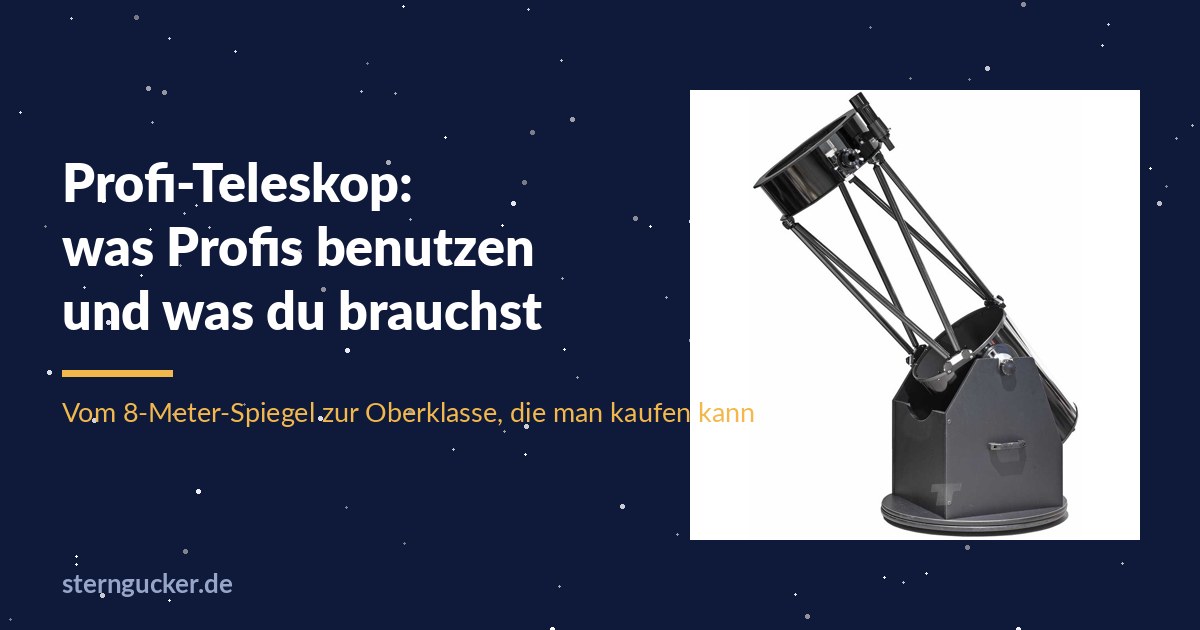
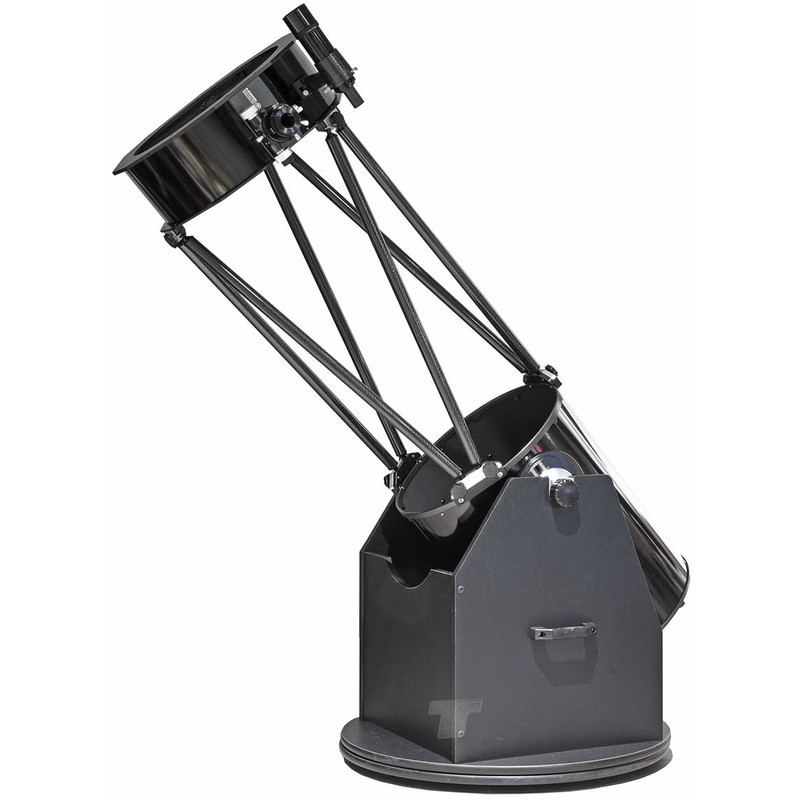
There is no such thing as the professional telescope, but there are three routes upward: maximum aperture (a large Dobsonian from $2,499.95€ 2,175), maximum comfort (a Schmidt-Cassegrain with GoTo) and maximum image quality for photography (an apochromat on a heavy mount; for the two together, count on roughly what a Celestron NexStar 8 SE costs). Which of them is yours is not decided by the budget but by what you are planning to do in the sky.
What professionals really use
A look at the real instruments makes the gap tangible. The European Southern Observatory’s Very Large Telescope in Chile works with four mirrors of 8.2 meters each – the mirror area of a single one of them is around 720 times that of a 12-inch Dobsonian.
More important than the size, though, are three things you cannot buy: the site, the post-processing and the time. Professional observatories stand on mountains between 2,600 meters (Paranal in Chile) and a good 4,200 meters (Mauna Kea in Hawaii), in the driest regions on Earth, their images come out of hours-long exposures with cooled sensors, and nobody there looks through an eyepiece.
The three routes into the top class
From roughly the price level of a NexStar 6 SE up, the question “which telescope is better” stops making sense. From here on you are no longer deciding about quality but about specialization. In practice the three directions are mutually exclusive.
| Route | Typical instrument | Strength | Price |
|---|---|---|---|
| Maximum aperture | GSO Dobsonian 406 mm TrussGSO Dobsonian 406 mm Truss | Galaxies and nebulae visually – nowhere do you get more light for the money | $2,499.95€ 2,175 |
| Comfort and versatility | ⭐ For most peopleCelestron NexStar 8SE Computerized SCTCelestron NexStar 8 SE | GoTo, 203 mm, 15 kg – set up in ten minutes | $1,699.00€ 2,149 |
| Astrophotography | Apertura 90 mm Triplet APO with Field FlattenerOmegon Pro APO 96/575 | Pinpoint stars all the way to the edge of the frame – but it needs a heavy mount | $1,799.95€ 1,290 |
| The mount for it | Sky-Watcher EQ6-R Pro EQ MountSkywatcher EQ6-R Pro | The part that makes or breaks photography – not the optics | $2,250.00€ 1,799 |
| No compromise | Celestron EdgeHD 1100 CGXCelestron EdgeHD 1100 CGX | 279 mm, flattened field, equatorial – 41.7 kg in separate pieces | $5,399.00€ 7,695 |
Route 1: aperture – the big Dobsonian
No other type of telescope delivers this much mirror area for the money. A 406 mm Dobsonian costs about as much as a 235 mm Schmidt-Cassegrain and collects three times the amount of light while doing it.
The price for that is handling. A 16-inch is transported in several pieces, setting it up takes a quarter of an hour, and for objects high in the sky you need a ladder. If you do not have a fixed spot in the yard, you should stay at twelve inches – the details are in our Dobsonian guide.
Route 2: comfort – Schmidt-Cassegrain with GoTo
A Schmidt-Cassegrain packs 2,000 mm of focal length into a tube only 43 cm long. That is the route for everyone who transports their instrument regularly and still wants high magnifications.
On top of that comes the GoTo control: 38,000 objects in the database, point at three stars, done. If you only have two hours, you spend them observing instead of searching. Which model is good for what is covered in the Schmidt-Cassegrain buying guide.
Route 3: photography – apochromat and a heavy mount
Here a rule applies that regularly surprises newcomers: the mount is more important than the telescope. A modest apochromat on a heavy, solid mount delivers better images than an expensive optic on a flimsy one.
The reason is simple: the optics draw what is there – the mount decides whether it stays sharp. As a rule of thumb, the photographic load should not exceed half of the stated payload capacity.
The fact that “for professionals” often appears in searches together with “refractor” has a real core to it: an apochromat needs no collimation, cools down quickly and has no secondary mirror in the light path. For photography that is the lowest-maintenance design there is – it just comes with a small aperture. More on that in the comparison of achromat and apochromat as well as in our astrophotography setup.
What money does not buy in the sky
You will not see colored spiral arms even with 16 inches. The human eye switches to black and white at low brightness – the colorful pictures from the internet are always long exposures, never visual impressions.
Atmospheric seeing cannot be bought either. In Central Europe the practical upper limit is usually 200x to 300x magnification, no matter how large the aperture is. On the few really steady nights of the year, a large instrument then shows what it is capable of.
Frequently asked questions about professional telescopes
What does a really good telescope cost?
The top class for private individuals starts at roughly the price of a NexStar 6 SE and goes up to that of an EdgeHD 1100 CGX. Above that it becomes specialist equipment for observatories. The biggest jump in quality, though, is further down: down in the budget class, paying four times as much doubles what you see – at the top end, where the price does not even triple, it no longer does. An overview of all the price brackets is at What a telescope costs.
Which telescopes do professional astronomers use?
Large reflecting telescopes of the Ritchey-Chrétien or a similar design, 4 to 10 meters in diameter depending on the observatory, used exclusively with cameras and spectrographs instead of eyepieces. The design also exists in small sizes: how a Ritchey-Chrétien works and who it pays off for is covered on a page of its own.
Does a professional telescope make sense for beginners?
Mostly not. A large instrument is heavier, more delicate and needs more preparation – anyone who starts with one sets it up less often. A solid mid-range instrument plus a dark observing spot makes more sense. What to start with is covered in our beginner’s guide.
Which refractor is suitable for demanding observers?
A three-element apochromat with 80 to 100 mm of aperture, for instance the Apertura 90 mm Triplet APO with Field FlattenerOmegon Pro APO 96/575 for $1,799.95€ 1,290. It shows color-pure images with no collimation effort. For visual deep-sky it is inferior to an equally expensive reflecting telescope – its strength is photography and the view of the Moon, the planets and double stars.
Can you observe during the day with a large telescope?
The Sun only with a certified front-aperture solar filter placed over the full aperture at the front – without this filter a single look leads to immediate, permanent damage to the retina. Filters that screw into the eyepiece are life-threatening. Venus and the Moon are also possible during the day; how to do that safely is described under Observing the Sun safely.
Is a used top-class instrument worth it?
Often yes, because optics barely age. There are three things you should check: the condition of the mirror coating, whether the mount’s electronics still talk to current control software, and whether accessories such as the focuser or the finder are complete. With Schmidt-Cassegrains you should also inspect the corrector plate for scratches.