By Alexander Merz · Published on · Details checked on 20 September 2026
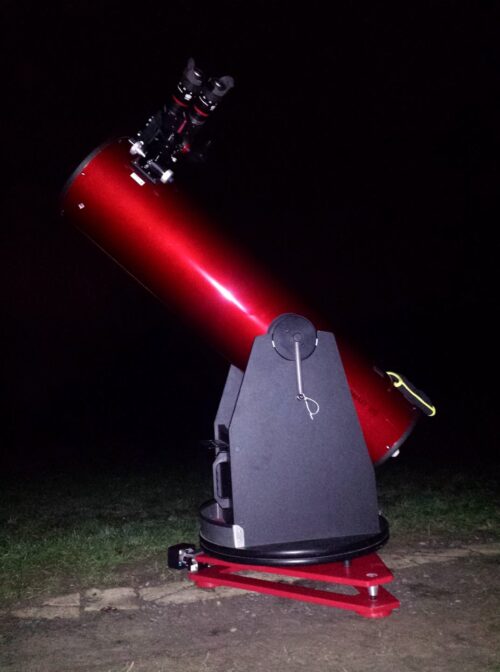
The Dobsonian telescope was invented by amateur astronomer John Dobson. His founding idea: design an inexpensive instrument so that anyone could buy a telescope.
Starting from the principle of the Newtonian telescope, he developed a portable, disarmingly simple yet remarkably capable instrument: the Dobsonian telescope.
The Dobsonian telescope: the essentials at a glance
- Dobson’s idea: to build a powerful yet affordable telescope.
- The optics are those of a Newtonian mirror telescope.
- The mount consists of a rocker box and a base plate (altazimuth mount).
- Euro for euro, the Dobsonian is one of the most capable systems available.
- Dobsonians are very affordable instruments for getting started in astronomy.
Our recommendation: Skywatcher Dobson Telescope N 200/1200 Skyliner Classic
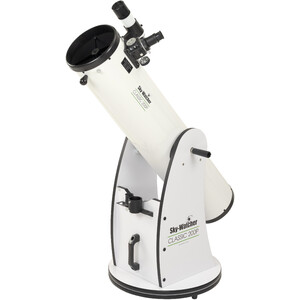
200 mm of aperture — the most sky for your money. Set it on the ground, point by hand: nebulae, clusters and galaxies for years to come.
Price: € 479
* Affiliate link: if you buy through this link we may earn a small commission from Astroshop or High Point Scientific, at no extra cost to you.
Here is the review: Skywatcher Dobson review – the N 200/1200 Skyliner DOB tested
And the overview of Skywatcher telescopes: Skywatcher telescopes: explore the universe from home
Dobson’s idea of a scrap-built design
In the 1940s, Dobson had taken a monk’s vow of poverty. His astronomical tools therefore had to cost him nothing. In the 1950s he ground his first primary mirrors from the bottoms of glass bottles salvaged from the dump. Cardboard tubes found on building sites served as his optical tube. The mount was almost non-existent: he set his very first Dobsonian telescopes onto a simple plywood box so they could swivel.
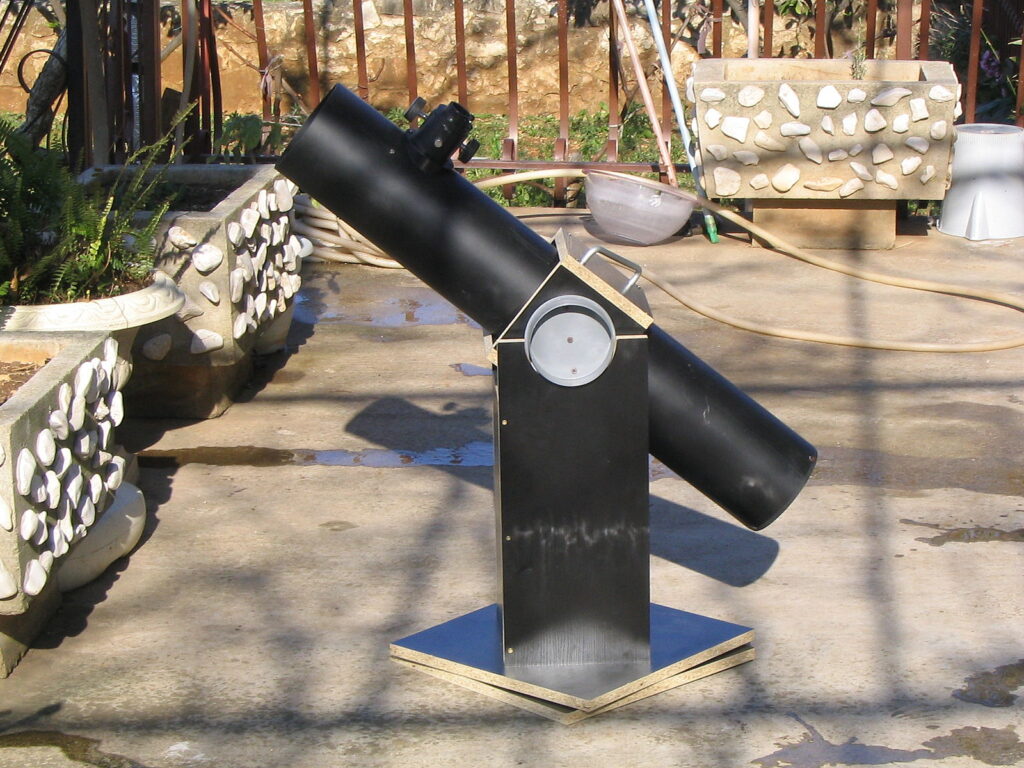
Of course, his creations were not perfect from the outset. John Dobson kept tinkering with them to iron out the flaws. Until nearly the end of the 1970s, experts at best smiled at his idea.
In 1979, amateur astronomers discovered how simple the design was and how perfectly it suited their needs. The worldwide rush for the most effective, simplest and most ingenious Dobsonian telescope began.
An overview of Dobson’s design
Broadly speaking, a Dobsonian telescope is made up of few parts. A thin primary mirror stays light, both in use and in transport.
Large mirror diameters combined with short focal lengths (focal ratio of 1:5 to 1:3.8) deliver very good results in casual field observing.
The only drawback of all that creativity: an oversized build can mean that, lengthwise, the instrument no longer fits in every car.
On a base plate sits a box (the “rocker box” or “cradle”), pivoting on three points spaced as far apart as possible. Two cut-outs are made in the side walls for the tube and optics. Because the bearing points of both axes of rotation are widely spaced, free observing with a Dobsonian telescope stays remarkably stable on almost any terrain.
For astrophotography, Dobsonian telescopes are not suitable. Deep-sky objects can only be followed in steps along their nightly arc across the sky. The tube can, however, be nudged along effortlessly for pure visual observing.
Building a Dobsonian requires neither much money nor deep optical expertise. The design of the many variants in the Dobsonian family is as simple as can be. Tutorials abound on the internet.
Dobsonian telescopes: affordable and powerful
The Dobsonian design lets astronomers use very large mirrors for observing at low cost. With mirror diameter, one rule holds: the bigger, the better! Light-gathering power is one of the decisive criteria for seeing impressive images of the night sky.
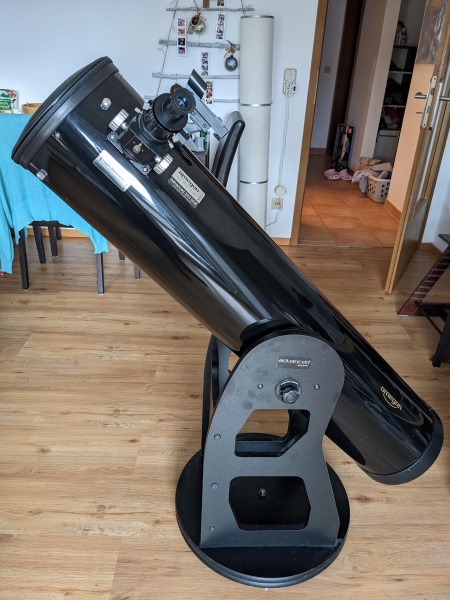
In fact, many experienced amateur astronomers build their own Dobsonian telescopes, tailored to their needs and personal specifications.
For most people, buying one is the first step towards seeing planets, galaxies and distant stars.
Mirror box and secondary mirror
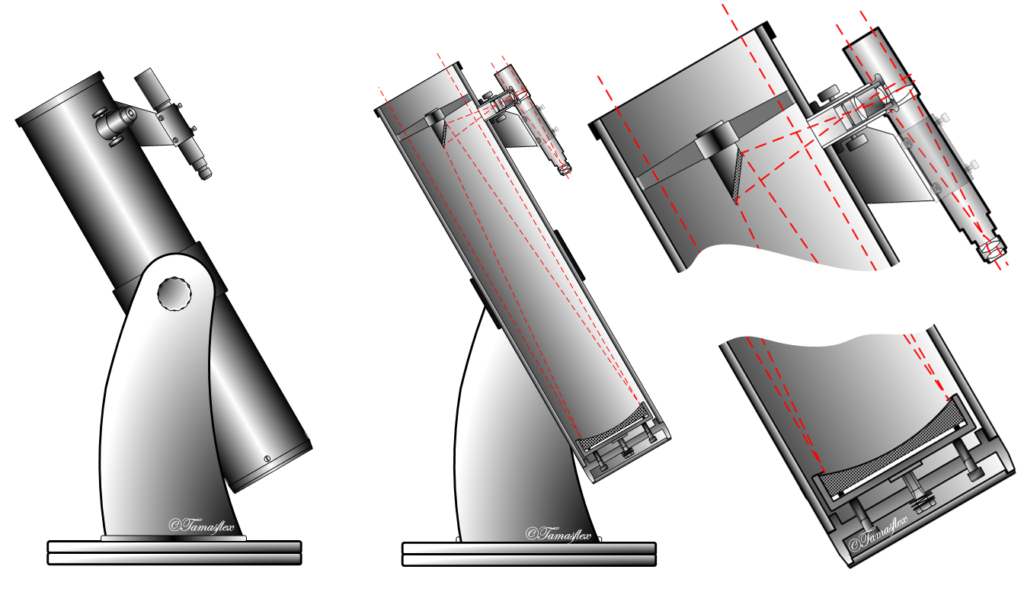
In principle, the optics of a Dobsonian telescope are those of a classic Newtonian reflector. It is an open system: light enters through a wide aperture and is redirected at the bottom of the tube, in the mirror box.
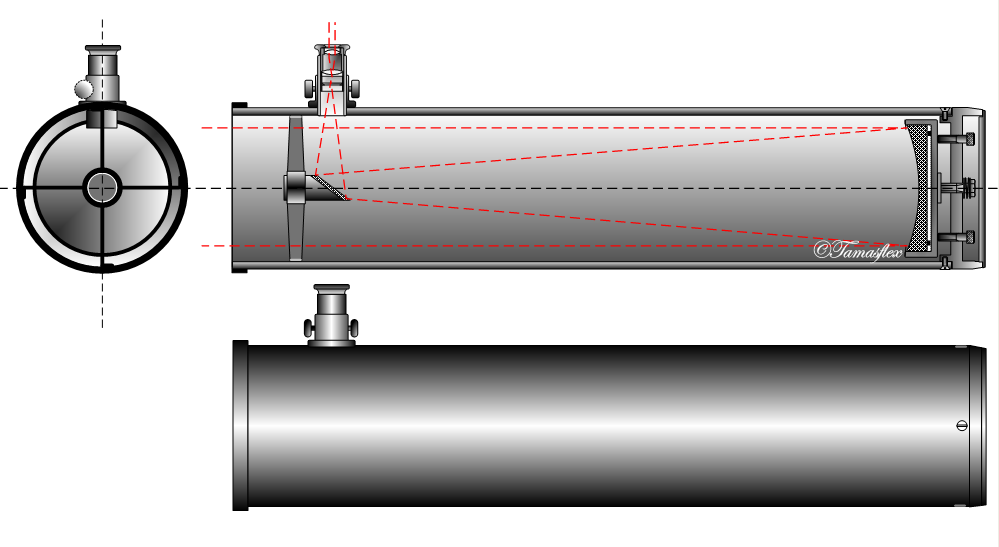
At the bottom of the telescope sits a relatively thin primary mirror. This primary gathers all the light that enters the tube. It often has fans on its back, designed to bring the mirror to ambient temperature quickly.
From the mirror box, the gathered light is sent back up the tube where, past the aperture, it strikes the secondary mirror, which directs it into the side-mounted focuser. The secondary is held in the tube by a rigid support (the “spider”). This is also where the occasionally necessary adjustments (collimation) are made. More on that below.
As with any mirror telescope, the spider in the light path causes slight obstruction, which slightly reduces contrast and sharpness compared with an unobstructed path, as in a refractor.
The size of the mirror determines the size of the telescope. It is often given in inches and refers to the diameter of the primary mirror.
8″ (inches) equal roughly 203 mm of mirror diameter
16″ (inches) equal roughly 406 mm of mirror diameter
The length of the tube is determined chiefly by the chosen focal length. As a rule, Dobsonian telescopes have a relatively short focal length in relation to the mirror diameter.
This ratio is also called the focal ratio and originally comes from photography.
A short aside: the focal ratio
The focal ratio is written as f/N, where N is the f-number. A ratio of f/4 is larger than f/10, for example (the number is in the denominator of a fraction).
The f-number is the number in the denominator. The focal ratio is found by dividing the focal length by the aperture:
Telescope with 200 mm aperture and 1000 mm focal length = 200 / 1000 = 1 / 5 = f/5
Consequences of the focal ratio
At larger focal ratios (greater than f/5), light is focused into a wider cone than at smaller ratios. This produces steeper angles of incidence throughout the optics, from the objective to the eyepiece.
Correcting optical aberrations and reflections then becomes more demanding and calls for complex aspheric surfaces, or compensation by adding lenses into the light path. More on that below.
Collimation: occasionally required
From time to time the secondary and primary mirrors have to be realigned with each other. This process, collimation, usually requires an inexpensive collimation laser.
Alternatively, this service can be carried out by a specialist.
Eyepieces for the Dobsonian telescope
Dobsonian telescopes usually have a fast focal ratio. Fast ratios can cause problems above all in astrophotography, because the image degrades towards the edges.
These image errors must then be compensated with correctors if you want sharp point-like stars right to the edge of the field.
In return, the light-gathering power is very high, and the required exposure time and the demands on mount accuracy are lower than with slow focal ratios.
For visual observing, these considerations play a minor role for most users, because the field is sharp at the centre of the image and the edge errors are barely noticed.
But anyone who wants a consistently clean image must invest in high-quality eyepieces with complex surface geometry, and possibly in field correctors (coma corrector).
The mount on the Dobsonian telescope
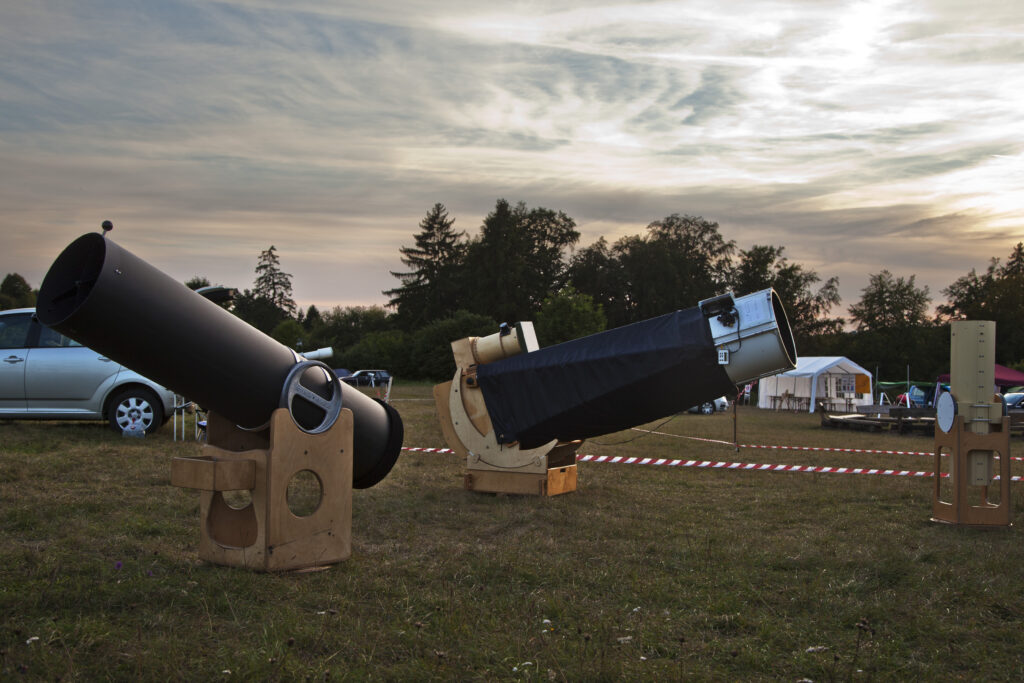
Dobson’s idea was to develop an affordable telescope for everyone. Yet the mount, with its precision mechanics, accounts for a large share of a telescope’s price.
For a beginner’s telescope in particular, such a mount is often unnecessary: its advantages only come into play with powerful instruments or in astrophotography. Even so, it swallows a large part of the budget that can then not go into the optics.
Dobson began making his own mirrors, which he ground himself, along with mounts he built from scrap.
The mount has simple controls that let the tube be moved horizontally or vertically.
The whole thing was built into a wooden box (rocker box), and the classic Dobsonian was born.
The Dobsonian mount is an altazimuth mount, moved on two axes: up and down (altitude), left and right (azimuth).
This mount is entirely sufficient for visual astronomy, since the problem of field rotation only matters in astrophotography during long exposures.
Aiming and moving the Dobsonian is very intuitive. To follow the target at higher magnifications, you keep “nudging” the telescope in the direction of motion.
A Go-To mount on a Dobsonian?
Anyone considering a large Dobsonian (> 12 inches) should think about a Go-To mount with tracking. At this aperture we are talking about telescopes for advanced users.
Object finding and tracking are then considerably more convenient, and you can focus more on the image at high magnifications.
A particularly pleasant solution is offered by Orion Telescopes, with an encoder built into the mount. Unlike many Go-To mounts, it also registers manual movements and therefore always knows where the telescope is pointing.
Realigning after a manual nudge is therefore not necessary.
What is a Push-To mount?
Unlike a Go-To mount, the Push-To mount has no motors to drive to the chosen target. After alignment, you enter the target and “push” the Dobsonian in the direction the device indicates.
Solid tube or truss tube?
Dobsonian telescopes are typically designed as solid tubes up to a mirror size of 10-12 inches. The solid tube has the advantage of holding collimation longer. On the other hand, the instrument becomes ever more unwieldy and harder to transport.
At larger mirror diameters, the mirror box and secondary box are joined by a removable connection. The truss design is advantageous here: it creates a stiff, rigid connection using angled poles.
Sliding connections are repeatedly criticised in the community and should therefore be avoided.
In this way, even very large Dobsonians break down into 3-4 small packages and can be transported too.
The Dobsonian telescope: THE telescope for visual astronomy?
The Dobsonian telescope offers an ideal starting point for getting into visual astronomy. In my opinion, the answer is yes. For your investment you get strong optical performance and get as close as possible to your expectations — or even exceed them. See the buying guide.
A Dobsonian telescope offers numerous advantages for the astronomer:
- large aperture and high light-gathering power
- affordable
- intuitive to use in the field
- transportable, especially in the collapsible versions
- very popular and valued by a large community (help when problems arise)
The limitations concern above all its almost exclusively visual use. Anyone who values the highest image quality right to the edges of the field must invest in high-quality eyepieces.
Anyone who wants more comfort at the mount should get a Dobsonian with an encoder-assisted Go-To mount.
One limit remains: for astrophotography the Dobsonian is the wrong design, because its mount does not follow the sky. Anyone wanting to move from observing to imaging starts classically with a small ED refractor on an equatorial mount — our review of the Sky-Watcher EvoStar 80ED shows what such an instrument can do and what it costs.
Dobsonian telescope recommendation
Dobsonian telescope for beginners
| Price range | Model | Current price |
|---|---|---|
| from 300 € | Apertura AD8 8" Dobsonian TelescopeSkywatcher Dobson N 200/1200 Skyliner Classic (our recommendation) | $699.95€ 479 |
| from 600 € | Skywatcher Dobson N 254/1200 Pyrex Skyliner Classic | € 695 |
| from 900 € | GSO Dobson N 300/1500 DOB DeluxeGSO Dobson N 300/1500 DOB Deluxe | $1,299.95€ 899 |
Links marked with an asterisk are affiliate links.
Ten or twelve inches: the decision that costs the most
This is the question most people get stuck on as soon as the budget goes into four figures. On paper the 12-inch collects around 40 % more light than the 10-inch – depending on the model 39 % (300 mm) or 44 % (305 mm). In the eyepiece the difference is considerably smaller than that number suggests.
| Instrument | Aperture | Tube weight | Limiting magnitude | Price |
|---|---|---|---|---|
| Sky-Watcher 10" Flextube Dobsonian TelescopeSkywatcher Dobson Telescope N 254/1200 Skyliner FlexTube BD DOB | ⭐ Our recommendation254 mm | 14.3 kg | 13.8 mag | $1,150.00€ 899 |
| Apertura AD12 12" Dobsonian TelescopeGSO Dobson Telescope N 300/1500 Deluxe | 300 mm | 19.5 kg | 14.2 mag | $1,299.95€ 899 |
| Sky-Watcher 12" Flextube DobsonianSkywatcher Dobson Telescope N 305/1500 Skyliner FlexTube | 305 mm | 21 kg | 14.2 mag | $1,895.00€ 1,299 |
0.4 magnitudes – that is the entire gain in limiting magnitude. Experienced observers who have had both instruments side by side on the same night report unanimously that they did not find a single object in the 12-inch that the 10-inch would not also have shown. The difference does not become visible as “more objects” but as a little more contrast and detail on the same objects.
The weight, on the other hand, is a hard difference. Somewhere between the 14-kilo tube and the 21-kilo tube lies the threshold beyond which many people use the instrument less often. A 10-inch fits on the back seat of any station wagon; with the 12-inch the height of the trunk becomes an issue.
Twelve inches pays off when three things come together: a fixed observing spot or a large car, a reasonably dark sky and a focus on galaxies. That is exactly where collecting area pays for itself. If you mainly look at the Moon, the planets and bright deep-sky objects, you will hardly notice the extra money.
Dobsonian telescope for advanced users
| Price range | Model |
|---|---|
| from 1000 € | Apertura AD12 12" Dobsonian TelescopeOmegon ProDob N 304/1500 Dobson |
| from 2,000 € | Apertura AD16 16" Truss DobsonianGSO Dobson N 406/1829 Truss DOB |
| from 5,000 € | Skywatcher Dobson N 508/2000 Stargate-500P Synscan GoTo DOB |
Links marked with an asterisk are affiliate links.
Which model of this design is worth it?
The design explains how the telescope works — it does not yet tell you which one to buy. These are the models we recommend in this category:
More aperture: Dobsonians from 6 to 12 inches
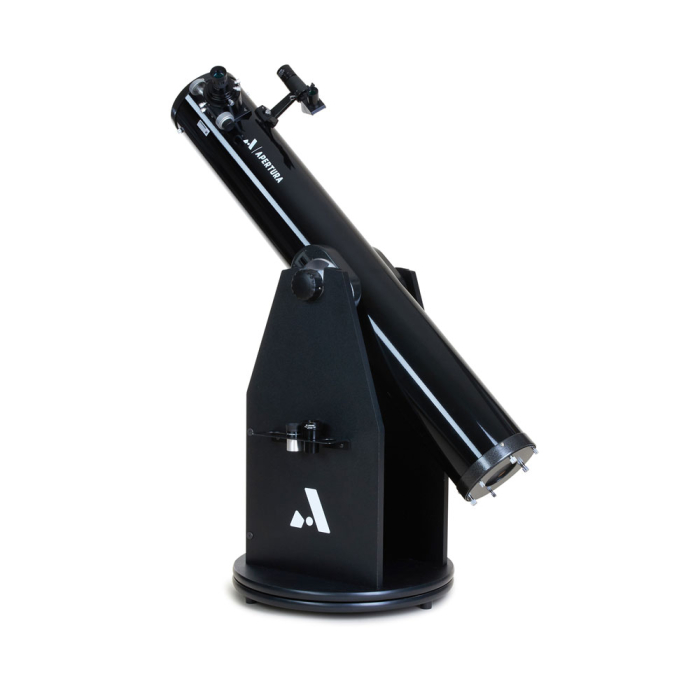 Apertura AD6 6" Dobsonian Telescope
The cheaper way into the Dobson class: 150 mm of aperture when the 8-inch is too big or too expensive.
Price: $499.95
View at High Point Scientific* →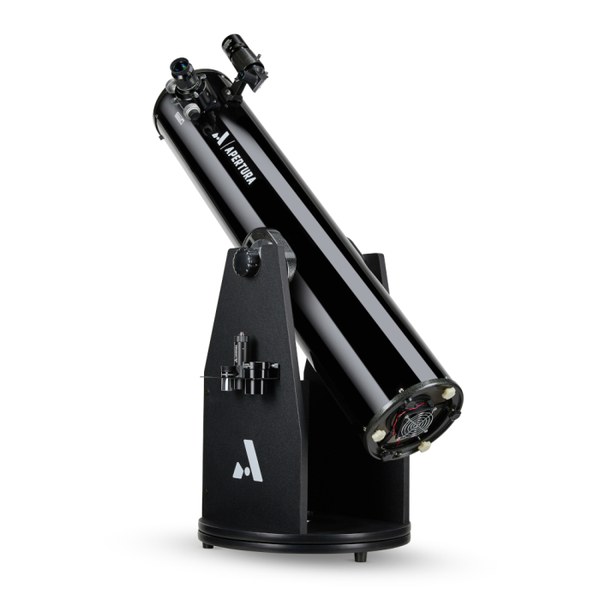 Apertura AD8 8" Dobsonian Telescope
Our best value pick. 200 mm of aperture brings globular clusters and the brighter galaxies into view.
Price: $699.95
View at High Point Scientific* →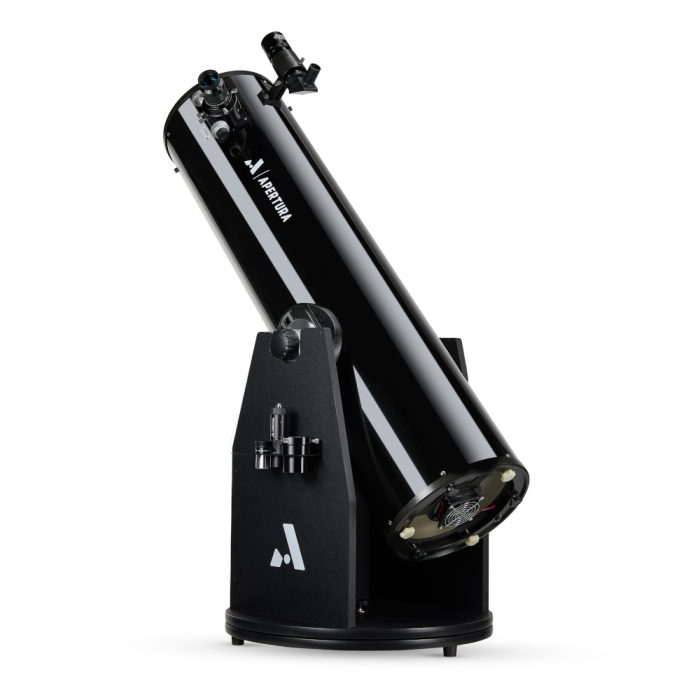 Apertura AD10 10" Dobsonian Telescope
10 inches for the price of many 8-inch scopes — the cheapest route to much fainter objects.
Price: $949.95
View at High Point Scientific* →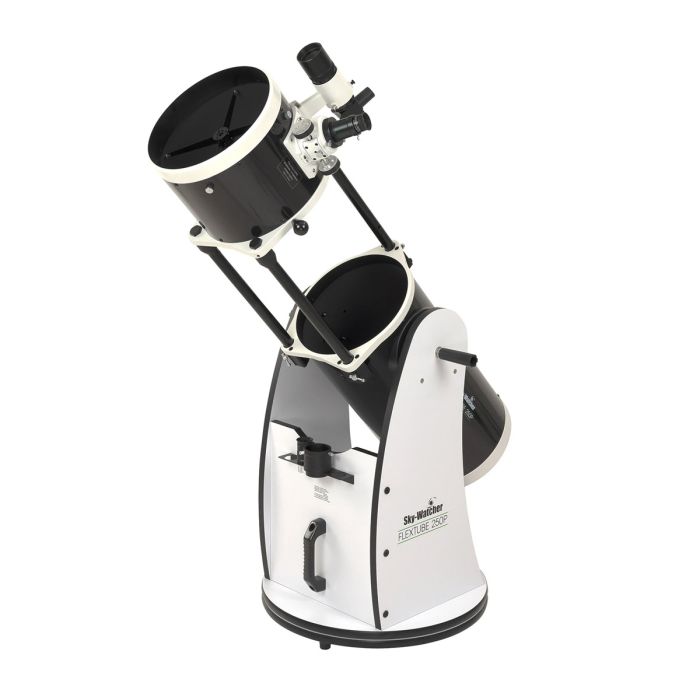 Sky-Watcher 10" Flextube Dobsonian Telescope
254 mm, yet it collapses: still fits in a car and shows noticeably more galaxies than an 8-inch.
Price: $1,150.00
View at High Point Scientific* →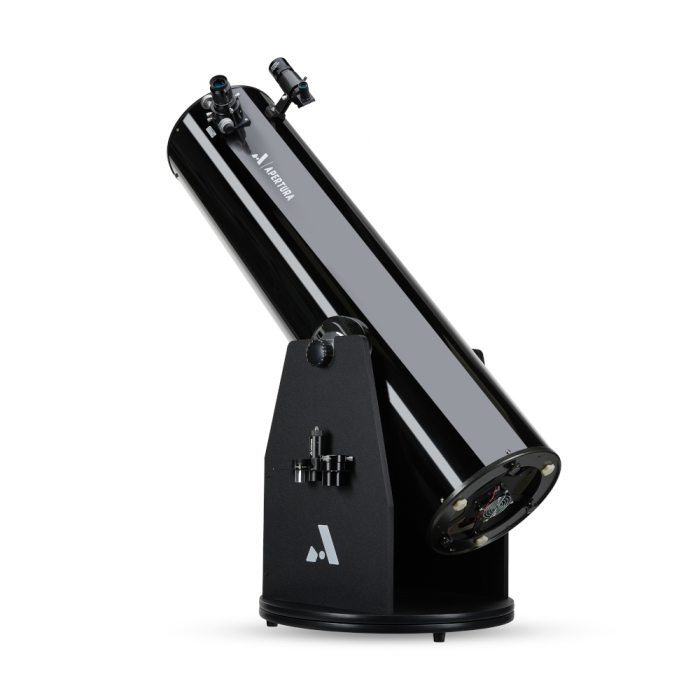 Apertura AD12 12" Dobsonian Telescope
12 inches for serious deep-sky work. Big and heavy — but structure inside galaxies instead of faint smudges.
Price: $1,299.95
View at High Point Scientific* →
* Affiliate link: if you order through it we earn a small commission, at no extra cost to you. Prices as of the last update.
All our recommendations: Buying a telescope.
Sources
- Ante Perkovic, Dobsonian, d=114mm f=910mm, Nebo na poklon (1), CC BY-SA 3.0, retrieved 12 Sept 2020
- Szőcs TamásTamasflex, Dobsonian telescopes schematic, CC BY-SA 3.0, retrieved 12 Sept 2020
- Ante Perkovic, Dobsonian, d=114mm f=910mm, Nebo na poklon (1), CC BY-SA 3.0, retrieved 12 Sept 2020
- Peter Maier, Bayerisches Teleskopmeeting auf dem Osterberg, Pfünz (Oberbayern, Naturpark Altmühltal), Abenddämmerung, Foto Peter Maier, CC BY-SA 4.0, 12 Sept 2020