By Alexander Merz · Updated on · Details checked on 14 September 2026
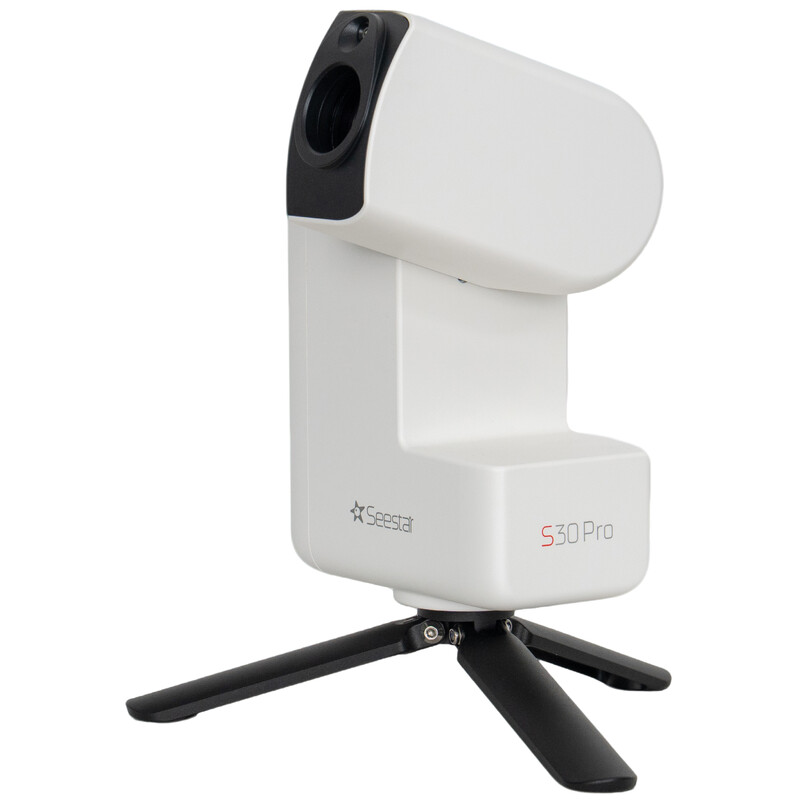
The ZWO Seestar S30 Pro is a smart telescope with 30 mm of aperture and 160 mm of focal length – official type designation AP 30/160. It aligns itself, finds the object, exposes automatically and stacks the images straight in the app. It costs $699.00€ 699 and is the successor to the Seestar S30.
Quick verdict
The Seestar S30 Pro ($699.00€ 699) is the most well-rounded smart telescope in its price class: apochromatic quadruplet optics, two cameras, three built-in filters, a solar filter, 6 h of battery life and the most mature app on the market. Weaknesses: barely suitable for planets, basic tripod. Verified buyer rating: 5/5 stars.
View the Seestar S30 Pro at High Point Scientific →View the ZWO Seestar S30 Pro Smart Telescope at Astroshop →
What is the Seestar S30 Pro?
ZWO – known for its ASI astronomy cameras – practically founded the market for affordable smart telescopes with the Seestar series. The S30 Pro is the logical evolution of the S30: a fully automatic GoTo telescope with live stacking, controlled entirely through the Seestar app. Set it up, tap an object in the app (“Tonight’s Best” suggests the most rewarding targets of the evening) and watch the image take shape.
The technical specifications at a glance
| Optics | 30 mm aperture / 160 mm focal length (f/5.3), apochromatic quadruplet lens design |
| Cameras | Sony IMX585 (tele, 4.6° field of view) + Sony IMX586 (63° wide angle) |
| Filters | permanently built in: UV/IR cut, dual-band (H-alpha + OIII), dark filter |
| Storage | 128 GB internal |
| Battery | 6,000 mAh, approx. 6 h runtime, expandable via USB-C |
| Weight | 1.8 kg (approx. 2.4 kg incl. tripod) |
| Extras | magnetic solar filter, dew heater, carrying case, mosaic mode (4K→8K), photometry function |
| Price | $699.00€ 699 |
What the Seestar S30 Pro costs
The current price is $699.00€ 699 (see the foot of the page for the date). For comparison: the smaller DWARFLAB DWARF 3DWARFLAB DWARF 3 costs $549.00€ 529, the larger Seestar S50 ProSeestar S50 Pro $999.00€ 999.
The price has been remarkably stable since launch. In our experience, anyone waiting for a discount campaign waits a long time – with smart telescopes the price usually only drops once a successor has been announced.
Is a used Seestar S30 Pro worth it?
Usually not. The device is too young for any meaningful gap to the new price to have opened up. Anyone who finds one in the classifieds often pays only €50 to €100 less – and gives up their statutory warranty and the manufacturer’s guarantee for it.
If you do buy used anyway: ask to see the battery status and a current photo of the optics. The most common faults on smart telescopes are an aged battery and dust or moisture behind the front lens – both of which show up in a photo taken against the light.
There is far more movement on the second-hand market around the older Seestar S50, because many owners are currently moving up to the Pro models.
What’s new compared to the S30 and S50
- Quadruplet apo instead of triplet: four lens elements with ED glass – noticeably better colour correction and edge sharpness than the S30.
- Second camera: The 63° wide-angle sensor makes Milky Way panoramas, nightscapes and landscape shots possible – something no Seestar could do before.
- 8K mosaic engine: The Milky Way mode stitches individual shots into large-format composites.
- Photometry: Calibrated brightness measurements – these let you track variable stars scientifically, a first in this price class.
- Good to know: The popular Seestar S50 is no longer regularly available. Since August 2026 the real successor in the 50 mm class has been orderable: the Seestar S50 ProSeestar S50 Pro ($999.00€ 999), with quadruplet optics, an 8.3 MP sensor and a second wide-angle camera – our S50 Pro guide explains when the extra cost pays off. The S30 Pro remains the more affordable step below it.
The difference between the Seestar S30 and the S30 Pro
The aperture has stayed the same, everything behind it has not. Both have 30 mm of aperture – the leap is in the optics, the sensor and the second camera.
| Seestar S30 | Seestar S30 Pro | |
|---|---|---|
| Optics | Triplet apo | Quadruplet apo with ED glass |
| Aperture / focal length | 30 / 150 mm | 30 / 160 mm |
| Second camera | none | 63° wide-angle |
| Milky Way panorama | no | yes |
| Photometry | no | yes |
| Storage | 64 GB | 128 GB |
Is the extra cost worth it? If you own nothing at all yet: yes, clearly. If you already have an S30: only if wide-angle shots and Milky Way panoramas genuinely appeal to you. On the same nebulae the difference is visible, but it isn’t another planet.
How it performs in practice
Feedback from verified buyers paints a consistent picture: setup and the first shot succeed within minutes without instructions (“unpack, install the app, search for an object – and it finds the object”), live stacking delivers recognisable galaxies after just one minute and presentable images after 30 minutes. Even under the most difficult conditions – big city, light pollution, observing through a window – users report clearly visible moons of Jupiter, detail-rich shots of the Moon and sunspots including the penumbra via the supplied solar filter.
Experienced astrophotographers who run the device alongside much more expensive systems (Vespera Pro, Celestron Origin) credit the S30 Pro with “surprisingly good” results and recommend two upgrades: post-processing the raw FITS data on a PC (which visibly gets more out of it than the app’s JPEGs) and running it in EQ mode on an equatorial wedgeequatorial wedge (€ 179) or a more stable mount, which almost completely eliminates tracking problems.
Seestar S30 Pro or S50 Pro: which is right for whom?
This is the question we get asked most often about this device. The difference is around €200 – and two things you really do notice under the sky.
| S30 Pro | S50 Pro | |
|---|---|---|
| Price | $699.00€ 699 | $999.00€ 999 |
| Aperture / focal length | 30 / 160 mm | 50 / 260 mm |
| Field of view, telephoto | 4.6° | 2.8° |
| Drive | standard | zero-backlash |
| Battery | 6,000 mAh, up to 6 h | 10,000 mAh, up to 9 h |
More aperture means more light. For the same exposure time the S50 Pro collects appreciably more of it and shows faint galaxies that stay buried in the noise on the S30 Pro. The zero-backlash drive tracks more smoothly – which counts in wind and on long nights.
In return the S30 Pro has an argument that tends to get overlooked: its field of view is considerably wider at 4.6°. Large objects such as the North America Nebula or the Pleiades fit into the frame completely – on the S50 Pro they no longer do.
Strengths and weaknesses
- ✅ Best overall package in its class: optics, filters, solar filter, case – everything included
- ✅ Most mature app with a huge community and regular firmware updates
- ✅ Dual-band filter: emission nebulae succeed even from a city balcony
- ✅ 6 h battery + 128 GB storage: entire nights without accessories
- ❌ Planets: 160 mm of focal length is not enough for detailed shots of Jupiter and Saturn
- ❌ The supplied tripod is basic and does not always stand perfectly level – a more stable tripod is worthwhile
- ❌ No eyepiece: visual observation is impossible by design
Useful accessories
For longer sessions a USB-C power bank is recommended; anyone wanting maximum image quality adds the ZWO Seestar EQ tripod headOmegon equatorial wedge (€ 179) for equatorial operation and sets the device on a more stable tripod (e.g. the ZWO TC20 carbon tripod).
For your first nights you need none of this – the tripod and the solar filter are included, and the unit is complete as it ships. Three small parts do get bought later, though, and in this order.
The Omegon Adapter Seestar S30 – M48 (€ 19.90) is the prerequisite for everything else: it is what puts an M48 thread on the unit, and filters and extension tubes only screw onto that.
If the back focus does not come out right straight away, the 30 mm M48 extension tube (€ 24.90) makes up the difference – a part you buy once you notice it is missing. The dust cover for the S30 (€ 14.90) is pure convenience: it keeps dust off the optics while the unit sits between two nights out.
Adapter and cover are listed specifically for the S30 and S30 Pro; the extension tube is a standard M48 part. If you are still weighing up devices, our smart telescope comparison puts them side by side.
Operation: what a night with the S30 Pro looks like
The routine is always the same – and that is precisely its strength: place the device on an open surface (rough alignment is enough), open the app, connect. The Seestar calibrates itself using star-pattern recognition and the smartphone’s GPS. In the app you select an object under “Tonight’s Best” or search the catalogue with over 4,000 entries; the telescope slews to the target, focuses automatically and starts stacking. Depending on the object, presentable images appear after 10–30 minutes. The shots are saved as JPEG (fully processed) and FITS (raw data) on the 128 GB storage and can be pulled onto your phone or PC via Wi-Fi.
Four modes cover everything: deep sky (nebulae, galaxies, star clusters), solar system (Moon, Sun with filter), Milky Way/mosaic (panoramas, 8K composites) and landscape – the latter uses the 63° wide-angle camera even during the day.
The objects you can capture with the S30 Pro
Saturn, Jupiter and the Moon: what really works on planets
This question reaches us regularly – most recently a reader wrote to say he had in mind “a sort of smart telescope for planets”. The honest answer: no smart telescope is built for that, and this one is no exception.
The reason lies in the aperture – the diameter of the front lens, which decides how fine a detail a telescope can separate at all. 30 mm is perfectly sufficient for faint nebulae, because those are extended objects. A planetary disc is tiny, and at this aperture the fine detail on it simply isn’t in the light that arrives.
In practice that means: Jupiter appears as a small bright disc, its cloud belts hinted at at best. Saturn shows that it has rings – as a shape, not as a cleanly separated ring with a division in it. The Moon, on the other hand, works well, because it is large and bright.
If both matter to you, you’ll find the trade-off weighed up in our buying guide for beginners.
- Rewarding all year round: the Moon (impressively detailed), sunspots with the magnetic filter, bright star clusters (Pleiades, h+χ Persei, M13)
- Emission nebulae even from the city thanks to the dual-band filter: Orion Nebula (winter), North America Nebula, Veil Nebula, Rosette Nebula
- Galaxies under darker skies: Andromeda (M31), Bode’s Galaxy (M81/82), Leo Triplet, Whirlpool (M51)
- With mosaic mode: large-area regions such as the complex around Rho Ophiuchi or the entire constellation of Orion
- Rather not: planetary detail (Jupiter’s bands, Saturn’s rings small), very faint dwarf galaxies
⬆️ If you want more: the Seestar S50 Pro
Two things the next step up genuinely does better. Its 50 mm aperture gathers almost three times as much light as the 30 mm of the S30 Pro, so small galaxies and faint nebulae show noticeably more structure. And its zero-backlash precision drive tracks more smoothly, which pays off in wind and in equatorial mode; the battery also lasts longer at 10,000 instead of 6,000 mAh.
To be honest about it: the extra cost is worth it if you regularly run long imaging sessions. For a few nights a year it is not – and the wider field of the S30 Pro (4.6° instead of 2.8°) is actually the more practical framing for large nebulae.
Seestar S50 ProSeestar S50 Pro ($999.00€ 999) · read the full S50 Pro guide
Already have your Seestar S30 Pro? Our Seestar manual walks you from unboxing to the first stacked image and links the official ZWO PDFs.
Frequently asked questions about the Seestar S30 Pro
Do I need prior knowledge?
No. Buyer experiences are unambiguous here: even complete newcomers – and, according to reviews, even users who last operated a telescope 25 years ago – get to their first images without any instructions.
Does it work with light pollution in the city?
Yes. The permanently built-in dual-band filter specifically lets H-alpha and OIII light through – emission nebulae succeed even from a brightly lit city balcony. Galaxies (continuum emitters), on the other hand, benefit significantly from darker skies.
Can I look through the telescope with it?
No, the S30 Pro has no eyepiece – all observation runs via the display. If the visual experience is important to you, take a look at our beginner’s guide.
Is the surcharge over the regular S30 worth it?
In most cases yes: the quadruplet optics, better sensor, wide-angle camera, more storage and the Pro functions (8K mosaic, photometry) justify the difference – especially as the S30 is increasingly being phased out. The Seestar S30 ProSeestar S30 Pro currently costs $699.00€ 699.
What does the Seestar S30 Pro cost?
Currently $699.00€ 699. The price has been stable since launch; the larger Seestar S50 ProSeestar S50 Pro sits at $999.00€ 999, the DWARF 3DWARF 3 at $549.00€ 529.
Can you photograph planets with the Seestar S30 Pro?
Only to a very limited extent. Jupiter and Saturn become recognisable, but small and without fine detail – the 30 mm aperture lacks the resolution for that. The Moon comes out well. For planets, a telescope with more aperture is the right choice.
What focal length does the Seestar S30 Pro have?
160 mm at 30 mm of aperture, which works out at f/5.3. The official type designation is AP 30/160. That is what gives it the wide 4.6° field of view, which takes in large nebulae in full.
Seestar S30 Pro or S50 Pro – which is better?
Neither is better in principle; they aim at different things. The S50 Pro has more aperture, a zero-backlash drive and the bigger battery, the S30 Pro has the almost twice as wide field of view and the lower price. Galaxies argue for the S50 Pro, large nebulae and the Milky Way for the S30 Pro.
Conclusion: who is the Seestar S30 Pro worth it for?
For beginners in astrophotography, city dwellers and anyone who wants results rather than technical fiddling, the S30 Pro is currently the best choice in its class. Anyone looking for maximum mobility or wanting to spend less should take a look at the DWARF 3 (the retailer's product pagethe retailer's product page, $549.00€ 529) – you’ll find the direct comparison in Seestar S30 Pro vs. DWARF 3. Our Best Smart Telescope List 2026 gives an overview of all device classes.
View the Seestar S30 Pro at High Point Scientific →View the ZWO Seestar S30 Pro Smart Telescope at Astroshop →
How would you rate this telescope?
No reader ratings yet. Yours would be the first.
Stars only, no text – one vote per device. To prevent duplicate votes we only store check values (hashes), never your IP address in plain text.