By Alexander Merz · Updated on · Details checked on 21 September 2026
The Moon and the planets are the first targets for almost every beginner — and no wonder: they’re bright, packed with detail and visible even from a light-polluted city sky. So which telescope for the Moon and planets should you buy? The short answer comes down to two things: a long focal length and good optical quality. This guide explains why, and which instruments are worth your money in 2026.
⚡ The quick answer: For the Moon and planets, choose a telescope with a long focal length and slow focal ratio (f/8 to f/13) that delivers a sharp, high-contrast image and handles high magnifications. A 70/700 achromatic refractor is enough to start; to go further, a 200/1200 Dobsonian or a long-focus Maksutov reveals craters, Saturn’s rings and Jupiter’s cloud belts with striking crispness. The two models in question: Celestron AstroMaster 70AZ RefractorOmegon Telescope AC 70/700 AZ-2 ($199.95€ 119) and Apertura AD8 8" Dobsonian TelescopeSkywatcher Dobson Telescope N 200/1200 Skyliner Classic ($699.95€ 479) — both covered in full below, along with two more.
What makes a good Moon and planet telescope
The Moon and the planets share three advantages for the observer: they’re close, bright and rich in detail. Those traits dictate exactly what the instrument needs to do. Unlike deep-sky work, where the goal is to gather as much light as possible, planetary observing lives and dies on sharpness and contrast.
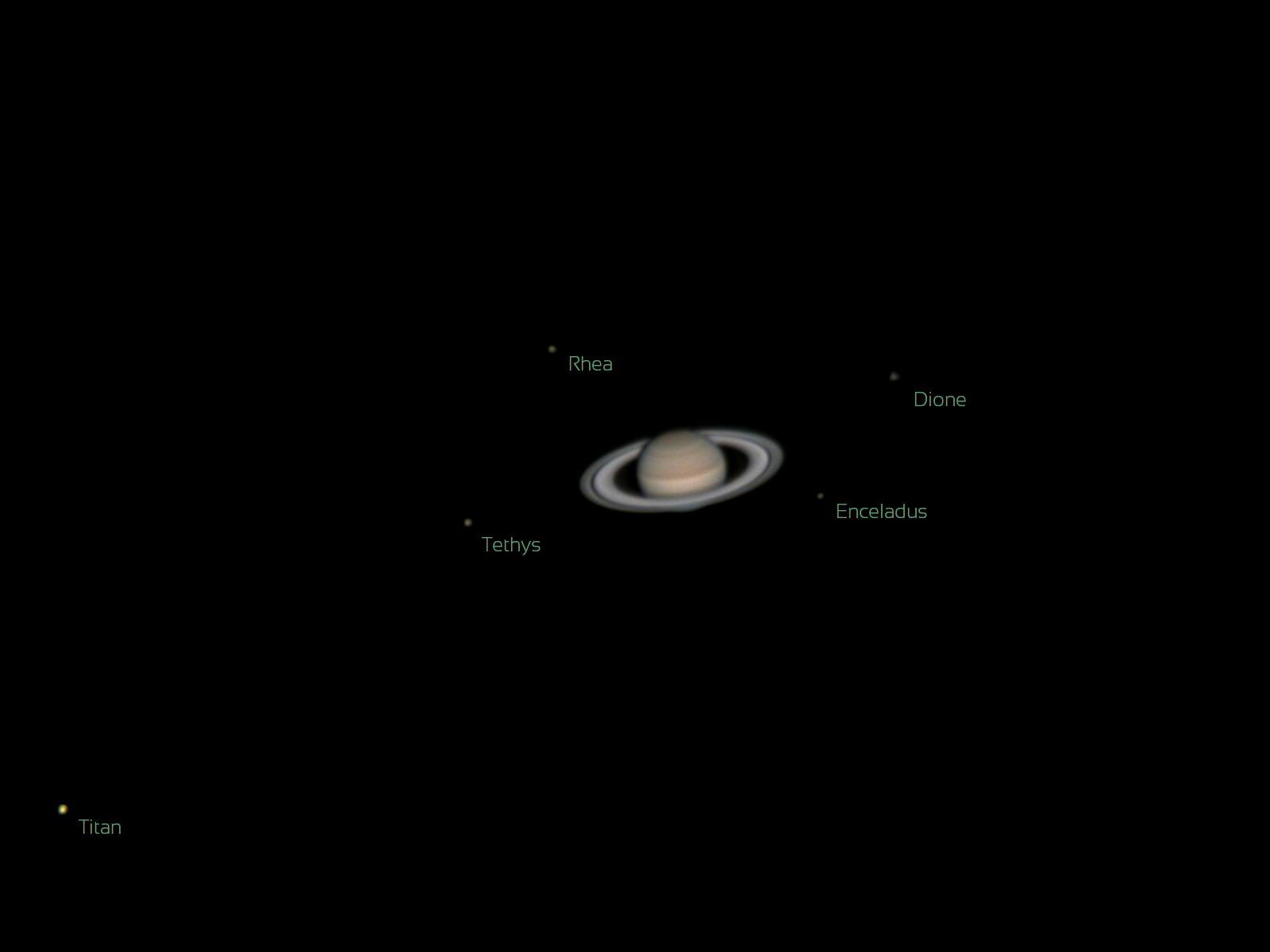
To enjoy the fine detail — lunar craters and mountains, Jupiter’s cloud belts, the Cassini division in Saturn’s rings — the telescope must produce a very sharp, high-contrast image while allowing comfortable high magnifications. Because these objects are bright, you can trade a little aperture for image quality, whereas in deep-sky observing aperture stays the top priority.
Image quality and contrast
Refractors (lens telescopes) give the best image quality for a given aperture. No secondary mirror obstructs the light path, so contrast stays maximal — a decisive edge on the planets. The downside: cheap achromatic refractors show chromatic aberration (a coloured fringe around bright objects), which apochromatic models correct at a higher price.
Mirror telescopes (Newtonians, Dobsonians) and catadioptric designs (Maksutov, Schmidt-Cassegrain) have a central obstruction, but a well-collimated instrument of decent aperture easily matches a refractor on the Moon and planets.
Long focal length: the key to magnification
The Moon and planets are among the few targets where high magnification genuinely makes sense. Magnification is the telescope’s focal length divided by the eyepiece focal length. On most nights, atmospheric turbulence limits you to 50–150×; on the rare nights of excellent seeing you can push to around 300×.
A long focal length telescope has the advantage: to reach high magnification you don’t need an eyepiece with a very short focal length. That’s a real practical benefit, because short eyepieces have tiny eye relief — impossible for spectacle wearers and tiring for everyone else. Complex eyepieces that fix this quickly cost hundreds.
Aperture: for resolution
Aperture is the diameter of the lens or mirror. Even on bright targets it matters: the maximum useful magnification is roughly twice the aperture in millimetres (about 400× for a 200 mm scope), and above all the resolving power — the finest detail you can see — depends directly on aperture. A bigger mirror reveals smaller craters and finer planetary structures.
Which type of telescope should you choose?
The achromatic refractor
A refractor suits the Moon and planets very well: a sharp, high-contrast image with no mirror in the light path. Long-focus, slow-ratio models are available at a sensible price. Increasing the aperture pushes the price up, and a long refractor needs a stable mount and is a little bulky to carry.
The Maksutov telescope
The Maksutov is a catadioptric telescope (mirror plus lens) that packs a long focal length and good aperture into a very compact tube thanks to its folded light path. Its central obstruction is small, it’s virtually free of chromatic aberration, easy to transport and light enough for small mounts. An excellent planetary choice when space is tight. One example of this design: the Sky-Watcher Skymax 127 mm with AZ-GTi Mount & TripodSky-Watcher Skymax-127 AZ-GTi GoTo WiFi ($995.00€ 775).
The Schmidt-Cassegrain
Similar in layout to the Maksutov, the Schmidt-Cassegrain (SCT) replaces the heavy meniscus lens with a Schmidt corrector plate. Its faster focal ratio (often f/10 versus f/13 for the Maksutov) makes it more versatile: it excels on the Moon and planets but also handles deep-sky objects. It’s the all-rounder favoured by seasoned amateurs.
The Dobsonian (Newtonian on an alt-az mount)
For sheer value, a Dobsonian is hard to beat. Pound for pound it gives the most aperture — and therefore the best resolving power on the planets. A 200/1200 (1200 mm focal length, f/6) shows Saturn’s rings, Jupiter’s belts and a wealth of lunar craters. Its simple, stable mount makes manual pointing easy.
Our recommendations for the Moon and planets
Here are three instruments covering every budget, from a first purchase to a scope for life.
Best for beginners: Omegon Telescope AC 70/700 AZ-2
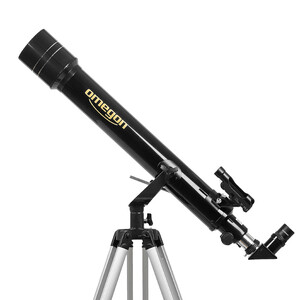
The no-pitfall starter refractor: Moon, Saturn's rings and Jupiter's moons from the very first night. No collimation.
Price: € 119
The Omegon 70/700 refractor is a great starting point: a long focal length, a contrasty image on the Moon and planets, and a very affordable price. Perfect for discovering craters, the phases of Venus and Jupiter’s moons without breaking the bank.
Best value: Skywatcher Dobson Telescope N 200/1200 Skyliner Classic
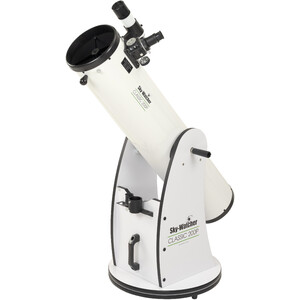
200 mm of aperture — the most sky for your money. Set it on the ground, point by hand: nebulae, clusters and galaxies for years to come.
Price: € 479
The Skywatcher 200/1200 Dobsonian is the rational pick for anyone who wants maximum planetary detail: 200 mm of aperture, 1200 mm of focal length and rock-solid stability, all at an unbeatable price.
Compact and portable: Skywatcher N 100/400 Heritage Telescope
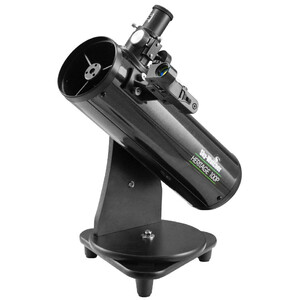
Tabletop Dobson with a 100 mm parabolic mirror. Light, portable — an ideal first real instrument on a small budget.
Price: € 179
The Heritage 100P tabletop Dobsonian is an ultra-compact alternative: easy to carry, it already reveals fine lunar detail and the major planets. Ideal as a first instrument or a travel companion.
* Affiliate link: if you buy through this link we may earn a small commission from Astroshop or High Point Scientific, at no extra cost to you.
Useful accessories
The supplied accessories are enough to get started, but a few additions make a real difference on the Moon and planets.
Eyepieces of various focal lengths
To have several magnifications you need several eyepieces of different focal lengths. Thanks to the long focal length of planetary scopes, affordable Plössl or orthoscopic eyepieces already deliver excellent sharpness, good light transmission and fine colour purity.
Starter kit: Omegon Eyepiece Starter Kit
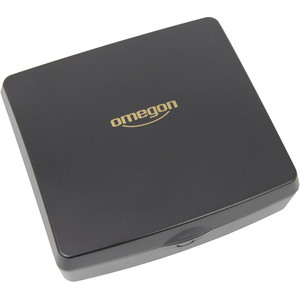
Eyepieces, filters and a Barlow in one case: everything to round out your telescope at once, cheaply.
Price: € 89
The variable polarising filter
The Moon is one of the brightest objects in the sky; through a telescope its glare can be dazzling. A variable polarising filter lets you steplessly dial down the light entering the eyepiece for the most comfortable view.
A binoviewer
For an even more spectacular view there is the binoviewer: the light path is split and divided between two eyepieces. You then observe with both eyes, which gives a strongly three-dimensional image and a striking sense of closeness on the Moon.
The drawback: you need every eyepiece twice. To be sure of your choice, get advice from a specialist (online) retailer.
A motorised mount
At high magnification the planets drift quickly across the field of view. A mount with motorised tracking keeps the object centred automatically: very comfortable for visual use and essential for planetary imaging.
Frequently asked questions
What aperture telescope do I need to see the planets?
From 70 mm you can already make out the phases of Venus, Saturn’s rings and Jupiter’s main belts. From 150–200 mm the planetary detail becomes rich: the Cassini division, cloud festoons and Jupiter’s Great Red Spot. For more on this, our guide to which telescope for planets compares Maksutovs and Dobsonians in detail.
What magnification for the Moon and planets?
Expect 50–150× on most nights, and up to about 300× on nights of very good seeing. There’s no point aiming higher: beyond the useful magnification (roughly twice the aperture in mm) the image just breaks down.
Refractor or reflector for the planets?
A refractor gives the best contrast at small aperture. But for the same budget, a reflector (Dobsonian) or a Maksutov delivers more aperture and therefore more resolution. Both approaches give excellent results on the planets.
Can I observe the Moon and planets from the city?
Yes, absolutely. Unlike deep-sky objects, the Moon and planets are bright enough to cut through light pollution. A city balcony is more than enough.
Maksutov or Dobsonian to start in planetary observing?
A Maksutov is compact and easy to store; a Dobsonian gives more aperture for the same price. If space and transport matter, choose the Maksutov; if you want maximum detail, go for the Dobsonian.