By Alexander Merz · Updated on · Details checked on 14 September 2026
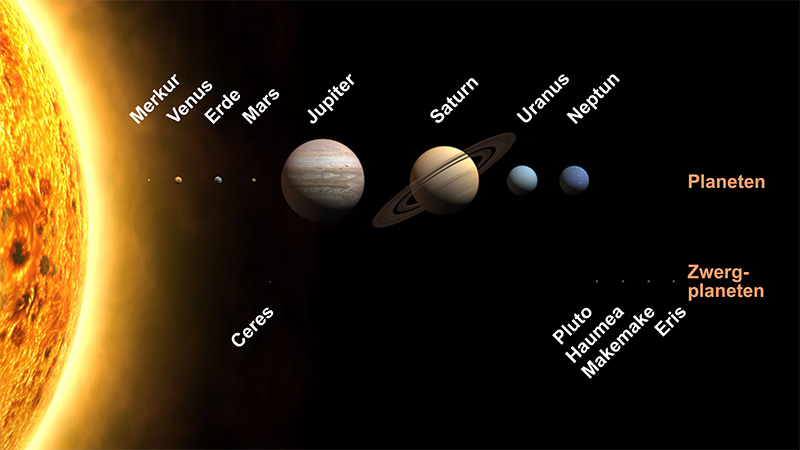
“What’s that bright star low over the horizon?” – nine times out of ten it isn’t a star at all, but a planet. This guide gives you both: a quick rundown of which planets are visible tonight, plus the simple skills to answer the question yourself in about a minute, on any night of the year.
⚡ The quick answer: Tonight Saturn is the best target – from 8:03 pm to 6:12 am, up to 41° high in the south. Also visible: Jupiter and Mars. Not visible at the moment: Venus and Mercury – they sit too close to the Sun. Saturn reaches opposition on 4 October 2026 – up all night and at its brightest. Venus returns as the morning star in early November 2026. Rule of thumb: planets glow with a steady, non-twinkling light and always sit along the ecliptic.
To be honest, the naked eye is enough to pick out Saturn, Mars and Jupiter, and a pair of binoculars already shows Jupiter’s four moons. Saturn’s rings and Jupiter’s cloud bands are a different matter: the guide to telescopes for planets explains what aperture you really need, and the binocular guide covers the cheaper first step.
Which planets are visible tonight?
The short answer: Tonight Saturn is the best target – from 8:03 pm to 6:12 am, up to 41° high in the south. Also visible: Jupiter and Mars. Not visible at the moment: Venus and Mercury – they sit too close to the Sun.
Saturn reaches opposition on 4 October 2026 – up all night and at its brightest. Venus returns as the morning star in early November 2026.
| Planet | When & where | Visibility |
|---|---|---|
| Saturn | Rises at 7:27 pm, best window 8:03 pm to 6:12 am, up to 41° high in the south | Excellent |
| Mars | Rises at 12:43 am, best window 1:27 am to 6:12 am, up to 48° high in the south-east | Excellent |
| Jupiter | Rises at 2:45 am, best window 3:27 am to 6:45 am, up to 36° high in the east | Excellent |
| Venus | Not visible right now – too close to the Sun. | Not visible |
| Mercury | Not visible right now – too close to the Sun. | Not visible |
| Uranus & Neptune | Both are up there, but too faint for the naked eye | Binoculars or a telescope needed |
Calculated for the UK and northern Europe (51.5° N / 0.1° W), as of 22 September 2026. All times local; they shift by a few tens of minutes with your longitude. This table recalculates every day.
Important: this table is a snapshot – within a few weeks the “line-up” will look different. That’s why we show you below how to find the answer yourself at any time. For a night-by-night description, see our sky this month guide.
Planet or star? The 3-second test
- Planets don’t twinkle (or barely): their light reaches us as a tiny “disc”, steadier than the pinpoint light of a star. If the object flickers strongly, it’s a star.
- Planets are bright: Venus and Jupiter outshine every star in the night sky; Mars stands out by its reddish tint, Saturn by its yellowish glow.
- Planets sit on the ecliptic: the line the Sun and Moon trace across the sky – never high in the north.
- The Moon as a pointer: if a strikingly bright “star” sits right beside the Moon, it’s almost always a planet – these encounters happen several times a month.
How to work out planet visibility yourself, anytime
The positions change constantly – so three approaches pay off. 1. Our monthly series describes each month’s planet visibility. 2. A planisphere (rotating star chart) shows the constellations and the ecliptic – planets are then the “extra bright stars” sitting on that line. 3. Stargazing apps with an augmented-reality mode (such as Stellarium or Star Walk): just hold your phone up to the sky and you’re done.
A pro tip for planning: many apps and sites show a planet’s altitude above the horizon. Anything below about 10° gets lost in haze, buildings and trees – a planet that has “technically risen” only becomes truly observable above that height. Observation windows therefore always differ slightly from the plain rise and set times.
Why visibility keeps changing
Like Earth, the planets orbit the Sun – so their “stage” changes constantly: sometimes the evening sky, sometimes the morning sky, sometimes a break of several months. Three terms explain almost everything:
| Term | What happens | What it means for you |
|---|---|---|
| Opposition | Earth sits exactly between the Sun and the planet (outer planets only: Mars, Jupiter, Saturn…) | Best visibility of the year: up all night, at its brightest and largest in the telescope |
| Conjunction | Seen from Earth, the planet lies near the Sun | Invisible for weeks or months – it rises and sets during the day |
| Greatest elongation | Maximum angular distance of Mercury or Venus from the Sun | The best window for the inner planets as a morning or evening star |
Mars takes about two years to go from one opposition to the next; Jupiter and Saturn reach one almost every year. Exact dates are in our Planets section and in the monthly guide.
The planets at a glance
| Planet | Brightness / colour | Visibility |
|---|---|---|
| Mercury | fast & hugging the horizon | only a few days a year, in twilight – the ultimate challenge |
| Venus | −4 mag (brightest object after the Moon) | only morning or evening, near the Sun – “morning/evening star” |
| Mars | −2 to +1.8 mag, reddish | brightness varies wildly; a spectacular opposition every ~2 years |
| Jupiter | −2 mag, brilliant white | visible for months at night; in binoculars: the 4 Galilean moons |
| Saturn | +0.5 mag, yellowish | more subdued – but with its rings in the telescope, the ultimate “wow” object |
| Uranus | +5.7 mag, blue-green | at the naked-eye limit in theory, a binocular object in practice |
| Neptune | +7.8 mag, bluish | only with binoculars/telescope and a finder chart |
Detailed profiles of every planet await in our Planets section.
What binoculars and a telescope reveal
To the naked eye, planets stay bright points of light – the fascination begins with optics. Even a pair of astronomy binoculars shows Jupiter’s four Galilean moons strung out like a pearl necklace, and Venus as a tiny crescent at dusk. Through a telescope it becomes spectacular:
- Venus: runs through phases like the Moon – from a full disc to a slender crescent.
- Mars: at opposition, a reddish disc with a polar cap and dark surface markings.
- Jupiter: cloud belts and the shifting dance of its four large moons – different every night.
- Saturn: the ring is unmistakable at just 50× – the “wow moment” of any observing session.
- Uranus & Neptune: small blue-green and bluish discs – here it’s all about the “I’ve seen it!”.
To start without breaking the bank, binoculars are the perfect gateway; to go further on the planets, a small refractor already does the job:
Perfect for beginners: Celestron Cometron 7x50 Binoculars
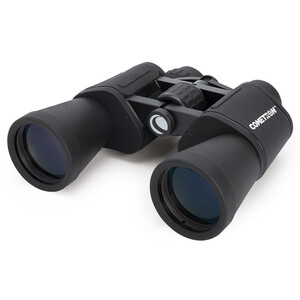
The astronomy classic among affordable binoculars: 7×50 with a large exit pupil for bright handheld views of the Moon and Milky Way – the ideal first step before a telescope.
Price: € 65
Best first telescope: Omegon Telescope AC 70/700 AZ-2
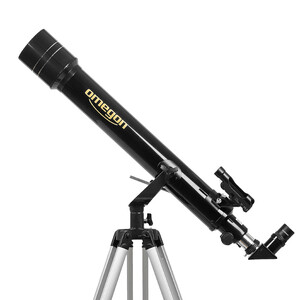
The no-pitfall starter refractor: Moon, Saturn's rings and Jupiter's moons from the very first night. No collimation.
Price: € 119
Best for advanced observers: Skywatcher Dobson Telescope N 200/1200 Skyliner Classic
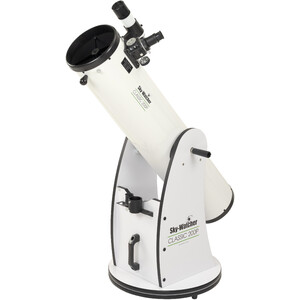
200 mm of aperture — the most sky for your money. Set it on the ground, point by hand: nebulae, clusters and galaxies for years to come.
Price: € 479
* Affiliate link: if you buy through this link we may earn a small commission from Astroshop or High Point Scientific, at no extra cost to you.
Visible means: with the naked eye. Rings and cloud belts need optics.
Six short questions, an honest answer by e-mail. Including when binoculars would do.
5 practical tips for your planet night
- High in the sky beats low on the horizon: the higher a planet stands, the fewer layers of air its light crosses – the telescope image becomes steadier and sharper.
- Let the telescope cool down: set it outside 30 minutes before observing – heat currents in a warm tube otherwise smear any planetary image.
- Use the twilight: Venus and Mercury are best observed while the sky isn’t fully dark – the contrast is gentler and the planets stand higher.
- Linger at the eyepiece: turbulence comes in waves. Stay for five minutes and you’ll catch the calm moments when Jupiter’s belts or the Cassini division suddenly snap into view.
- The Moon as a calendar: when the Moon glides past a planet, that’s the easiest way in – you simply can’t look at the wrong thing.
By the way: “evening star” and “morning star” mean the same planet. Venus swaps between the two roles on a rhythm of about a year and a half – antiquity long took it for two separate bodies (Hesperus and Phosphorus). Only an understanding of planetary orbits solved the puzzle.
Frequently asked questions
Which planets are visible tonight with the naked eye?
Tonight Saturn is the best target – from 8:03 pm to 6:12 am, up to 41° high in the south. Also visible: Jupiter and Mars. Not visible at the moment: Venus and Mercury – they sit too close to the Sun. This answer is recalculated every day; for the whole month, see our sky this month guide.
What is the bright “star” in the west after sunset?
Almost certainly Venus. After the Sun and Moon it’s the brightest object in the sky, it glows steadily (without twinkling) and always sits near the Sun – so in the west in the evening or the east in the morning.
Why don’t planets twinkle like stars?
Even in telescopes, stars are only points of light – their light is heavily “ruffled” by atmospheric turbulence. Planets, by contrast, appear as tiny discs: the flicker averages out across the surface, so their light looks steady and constant.
Can I see the planets from the city?
Yes! Planets are bright enough for any city sky – they are the number-one urban observing target, completely unbothered by light pollution. You only need a clear view to the horizon for low-lying candidates like Venus or Mercury.
Can Uranus and Neptune be seen with the naked eye?
Neptune, definitely not; Uranus, only in theory: under a perfectly dark sky its +5.7 mag just grazes the limit of vision. In practice you need binoculars plus a finder chart – or use a bright neighbour (Mars, in the morning sky) as a signpost.
When is the best time of year to see the planets?
There’s no blanket “planet season” – what matters is each planet’s opposition: then it’s up all night and appears at its brightest and largest. Mars reaches it roughly every 26 months, Jupiter and Saturn almost yearly on a slowly drifting date. Rule of thumb: if an outer planet stands due south around midnight, you’ve caught the best window.
The bottom line
“Which planets are visible tonight?” isn’t a question you need to google every time: with the 3-second test you spot a planet instantly, and with a grasp of the ecliptic plus a stargazing app you can answer visibility yourself for any night. And the day you finally see that steady point of light turn into ringed Saturn through your own telescope, the question is answered anyway – for good.
Read next: