By Alexander Merz · Published on · Details checked on 14 September 2026
The Newtonian telescope is the design most stargazers start with — and the one surrounded by the most half-knowledge. It delivers more aperture per euro than any other construction. In return it asks for one thing no refractor needs: every now and then it wants to be collimated.
⭐ In short: A Newtonian gathers light with a concave mirror instead of lenses. That makes it unbeatably cheap per millimetre of aperture and completely free of colour errors. The price you pay: both mirrors have to line up with each other — that is collimation. With a laser it takes five minutes, without one about fifteen, and depending on how much you move the scope you need it once or twice a year.
Light path: how a Newtonian telescope works
Isaac Newton built the first working reflecting telescope in 1668. His basic idea is unchanged to this day and fits into one sentence: a curved primary mirror collects the light at the bottom of the tube and throws it back to the front.
Just before the focal point sits a small secondary mirror tilted by 45 degrees. It sends the converging light sideways out of the tube — to where the eyepiece sits.
That is why you look into a Newtonian from the side, not from the back. For beginners this is the most confusing moment during the first setup — and it is completely normal.
Advantages: why a Newtonian shows so much sky for the money
The decisive value of a telescope is its aperture — the diameter of the mirror or the lens. It determines how much light arrives and how fine the details get.
A mirror only has to be ground on one side and does not need especially pure glass — light never passes through it. That is why a 200 mm mirror costs a fraction of what a 200 mm lens would cost. Refractors of that size simply are not sold on the amateur market.
On top of that comes a physical advantage: a mirror has no colour error at all. It bends every wavelength in exactly the same way. The bluish fringe that simple refractors draw around bright objects does not exist in a Newtonian.
Disadvantages: what a Newtonian asks for in return
The secondary mirror sits in the middle of the light path and blocks roughly a fifth of the area. That costs a little contrast — on planets a good refractor therefore often looks “crisper” than a Newtonian of the same aperture, even though the Newtonian collects more light.
The open tube also attracts dust and humidity, and the mirrors need time to cool down. Half an hour outside before the first observation is realistic, and more with large instruments.
And then there is collimation. It is the point where most beginners get nervous — which is why it is covered here in detail.
⚠️ Common misconception: “A telescope out of collimation is broken.” No. The mirrors are only tilted minimally against each other — that happens all by itself during transport and is fixed in a few minutes. Nothing is broken.
Collimating a Newtonian telescope: the complete guide
Collimating means: aligning the primary and secondary mirror so that their optical axes line up with the focuser. If one of them sits crooked, every star turns into a little comet with a tail.
How to tell that collimation is due
The quickest test takes a minute and needs no tools at all: deliberately defocus a bright star at high magnification. You then see a small disc with a dark hole in the middle — that is the shadow of the secondary mirror.
If that hole sits dead centre, everything is fine. If it is visibly shifted to one side, the optics are out of alignment.
In the focused image the same problem shows up differently: stars are no longer points but grow a one-sided tail. Experts call that coma.
Step 1: the secondary mirror
The secondary mirror is adjusted first, because the primary is aligned to it — not the other way round. Put the tube horizontal and lay a light-coloured cloth under the focuser, then you can see the edges much better.
Look into the empty focuser without an eyepiece. The goal: the secondary mirror appears as a clean circle, centred in the focuser, and you can see the complete primary mirror in it.
You correct it with three small screws on the secondary mirror holder and usually one central screw in the middle. The central one moves the mirror along the tube, the three tilt it. Only ever an eighth of a turn, then look again.
Step 2: the primary mirror
At the bottom of the tube, on the back of the mirror cell, there are three collimation screws as well — often accompanied by three locking screws that hold the mirror in place. Loosen the locking screws first, otherwise nothing will move.
Now you tilt the primary mirror until its image sits centred in the secondary. On most instruments there is a small ring glued to the centre of the primary mirror as a marker — that is what has to end up exactly in the middle.
At the end, carefully tighten the locking screws again and check the result once more: tightening likes to shift everything back a little.
With a laser or without? Both ways work
Without any tools you work through the view into the empty focuser described above. That costs nothing, but it needs light, patience and a good eye — realistically fifteen minutes.
With a collimation laser you drop the device into the focuser and see immediately where the beam wanders. First tilt the secondary so the dot lands on the centre mark of the primary, then the primary so the beam runs back into itself. Five minutes, even in the dark.
A laser is worth it as soon as you transport the telescope regularly. For an instrument that permanently stands in the same room you get along fine without one.
For collimation: Bresser Laser Collimator 1.25″
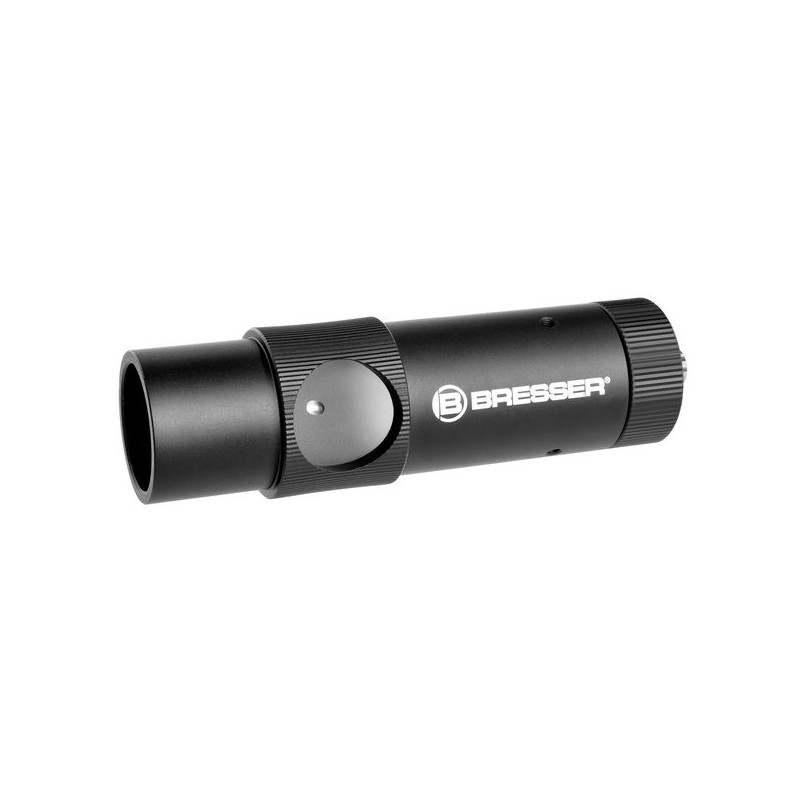
Fits any 1.25-inch focuser and shows immediately where the beam is going. Works on Newtonians just as well as on Schmidt-Cassegrains. Important: the laser itself has to be collimated — if in doubt, check it on a V-block before the first use.
Price: € 74.90
How often does a Newtonian need collimating?
There is no fixed interval — what matters is how much the instrument gets shaken about.
| Use | Check | Usually needed |
|---|---|---|
| Stays permanently in the room | before every season | 1× a year |
| Gets carried into the garden | every few months | 2× a year |
| Rides in the car regularly | before every observing night | as needed, often quickly |
| Travel Dobsonian in a backpack | after every transport | frequently |
The four most common collimation mistakes
Steps that are too big. A quarter turn looks enormous in the sky. Always work in eighth turns and look in between.
Starting at the primary mirror. As long as the secondary sits crooked, every correction at the primary leads you further astray. Stick to the order.
Trusting the laser blindly. A cheap collimation laser can be out of alignment itself. Check it: turn the laser in the focuser — if the dot wanders, the laser is off.
Confusing collimation with cooling down. If stars wobble and swell up at first glance, the optics are usually not to blame but the warm air inside the tube. Let it cool down first, then judge.
Tip: Collimate in daylight and in the warm, not at night with numb fingers out on the lawn. The star test in the evening then only tells you whether it worked.
Newtonian, Dobsonian, astrograph: same optics, three purposes
“Newtonian” only describes the optics, not the whole instrument. What it becomes is decided by the mount underneath.
A Dobsonian is a Newtonian on a simple wooden rocker box: maximum aperture for the money, but without tracking. For pure visual observing it is the cheapest way to see a lot — more on that in the Dobsonian guide.
On an equatorial mount the same tube becomes trackable — the prerequisite if photography is to follow later. And a short, fast Newtonian at f/4 to f/5 is called an astrograph and is built for photography from the start.
Which Newtonian suits you?
The design alone does not tell you which instrument to buy. These are the Newtonian telescopes we recommend — from the compact tabletop Dobsonian to the trackable tube for astrophotography:
Newtonian reflectors
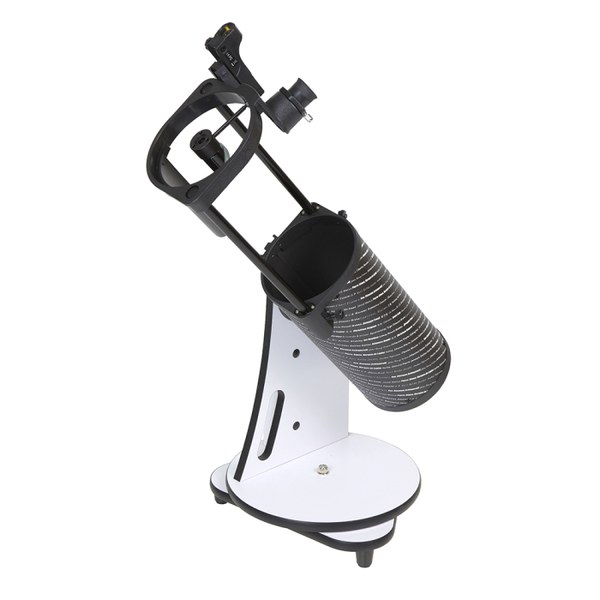 Sky-Watcher Heritage 130 Tabletop Dobsonian
Our pick for beginners: a lot of aperture for the money, a real parabolic mirror, and it folds down for transport.
Price: $305.00
View at High Point Scientific* →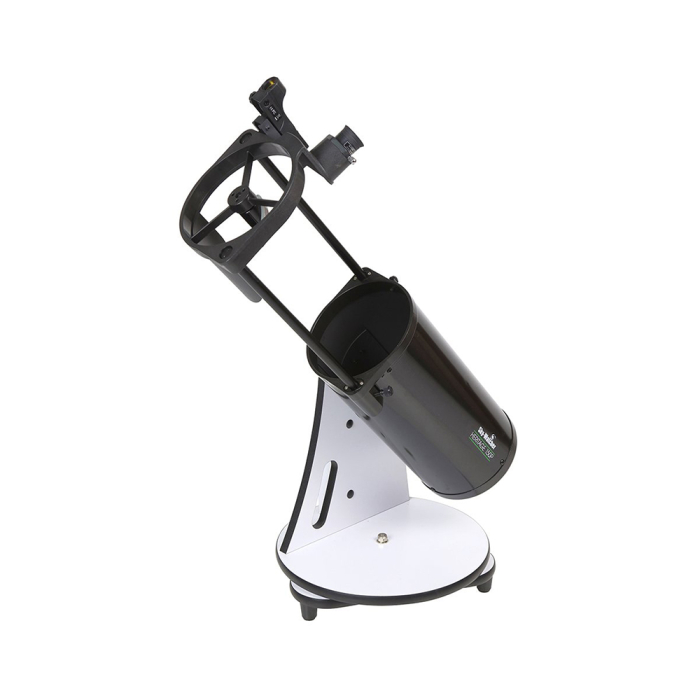 Sky-Watcher Heritage 150 Tabletop Dobsonian
A 150 mm Newtonian optic on a tabletop Dobson base: short, collapsible and noticeably brighter than the 130 mm version.
Price: $355.00
View at High Point Scientific* →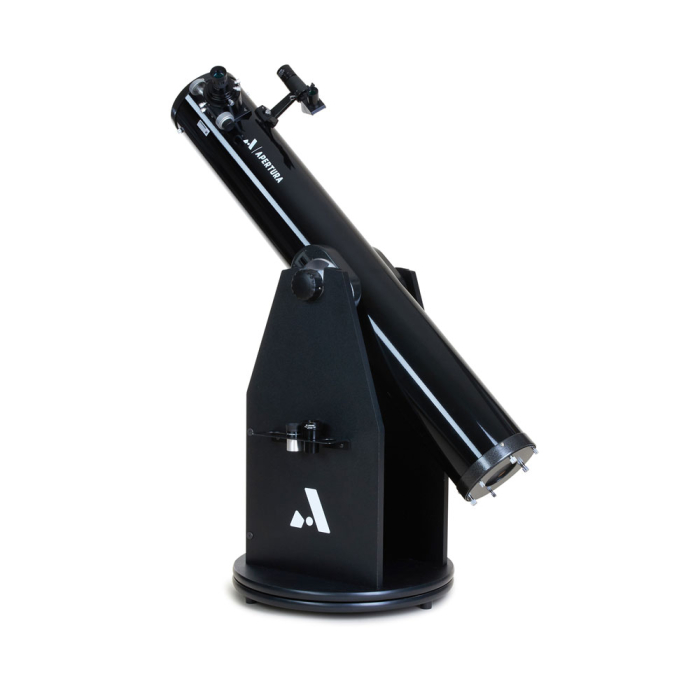 Apertura AD6 6" Dobsonian Telescope
A 150 mm Newtonian on an equatorial mount: the route to take if you want to track and later photograph.
Price: $499.95
View at High Point Scientific* →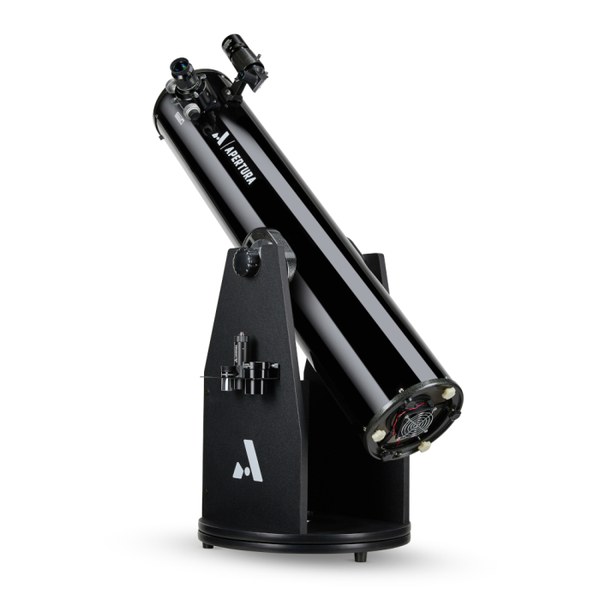 Apertura AD8 8" Dobsonian Telescope
Our best value pick. 200 mm of aperture brings globular clusters and the brighter galaxies into view.
Price: $699.95
View at High Point Scientific* →
* Affiliate link: if you order through it we earn a small commission, at no extra cost to you. Prices as of the last update.
All recommendations across every design are collected under Buying a telescope.
Frequently asked questions about Newtonian telescopes
Can I collimate a Newtonian telescope myself or does it have to go to a workshop?
You do it yourself. It is two sets of three screws, and you need nothing beyond a screwdriver. A workshop is only needed if a mirror is genuinely damaged — and that almost never happens.
What does a collimation laser cost and is it worth it for beginners?
Good ones sit at around 100 euros. For a telescope that stays in the room it is no must — the look into the empty focuser is enough. As soon as the instrument rides in the car regularly, the laser saves you ten minutes every time.
Why do I see a shadow in the middle of the image?
That is the secondary mirror, and in a focused image you never see it. It only becomes visible when you deliberately defocus — which is exactly what the star test uses. A shadow in the focused image, on the other hand, means the magnification is too low for that eyepiece.
Is a Newtonian or a refractor better for planets?
At the same price the Newtonian almost always wins, because it offers considerably more aperture. At the same aperture a good refractor draws a little more contrast, but then costs several times as much. The full story is in the comparison reflector or refractor.
Do I have to clean the mirrors?
As rarely as possible. Dust on the mirror costs surprisingly little light, while every cleaning risks scratches in the delicate coating. A primary mirror gets a serious clean every few years rather than every season.
Read on:
- Dobsonian telescopes – the Newtonian on the simplest and cheapest mount
- Maksutov or Schmidt-Cassegrain? – the compact alternatives with long focal lengths
- Achromat or apochromat? – if it is going to be a refractor after all
- Telescopes for beginners – the concrete recommendations for a first instrument