By Alexander Merz · Updated on · Details checked on 20 September 2026
An achromat for €120 and an apochromat for €1,200 share exactly the same basic idea: light passes through lenses and gets brought to a focus. The difference comes down to a single flaw that every lens inevitably has — and to how much effort the manufacturer puts into getting rid of it.
⭐ In short: An achromat brings two colours of light to the same focal point, an apochromat three. In practice that means the achromat draws a blue-violet fringe around bright objects and the apochromat doesn’t. For the Moon, the planets and for getting started, an achromat is perfectly good enough — provided it’s a long one. The apochromat pays off mainly for astrophotography and for short travel scopes. The premium is five to ten times the price.
Why every lens produces colour errors
Glass bends blue light more strongly than red. It’s the same effect that makes a prism produce a rainbow — and in a telescope it’s a problem: blue comes to a focus earlier than red, so there is no single focal point for all colours at all.
The technical term for this is chromatic aberration, or longitudinal colour error. You see it as a violet halo around bright objects: around the lunar limb, around Venus, around Jupiter, around Vega. On faint objects it doesn’t matter, because there simply isn’t enough light arriving to make a fringe visible.
The achromat: two lenses, two colours in focus
An achromat consists of two lenses made from two types of glass — usually crown glass and flint glass — either cemented together or mounted with an air gap. They bend light by different amounts, and the optical designer exploits that: most of the colour spread the first lens creates, the second one takes back out again.
The result: red and blue meet at a common focal point. Green is left out and sits slightly in front of it. This leftover is called the secondary spectrum, and it is exactly the violet fringe you see on bright objects.
The name comes from the Greek and means “without colour” — an overstatement that has been in circulation since 1729. Achromats have less colour error, not none.
What speaks for achromats: they’re robust, need no collimation, cool down quickly and cost little. A 70 mm achromat for €120 shows lunar craters, Saturn’s rings, Jupiter’s moons and the phases of Venus — everything a beginner wants to see in their first season.
The apochromat: three colours, three types of glass
An apochromat takes the same principle one step further. It uses at least three lenses made from at least three different types of glass — or two lenses, one of which is made from a particularly exotic special material. That brings three wavelengths to the same focal point.
The secondary spectrum shrinks so far that it’s no longer visible on any object. An apochromat shows a star as a white dot, without any coloured rim at all. That’s the whole difference — and it costs, because the glasses involved are expensive, hard to grind and sensitive to temperature.
What “apochromatic correction” actually means
Unfortunately the term isn’t protected. Strictly speaking, apochromatic correction requires three wavelengths to coincide exactly and spherical aberration to be corrected for two of them. In practice, though, manufacturers also call two-element ED scopes “apo” when they don’t quite meet that standard.
That’s not fraud, but it does mean this: “apo” on the tube says less about quality than the specification of the glass used. That’s the thing worth asking about.
ED, FPL-53, fluorite: what’s written on the tube
ED stands for “extra-low dispersion” — glass that splits light into its colours particularly little. It’s the umbrella term covering almost every affordable apochromat.
FPL-51 and FPL-53 are specific glass types from the Japanese manufacturer Ohara. FPL-53 is the better and more expensive of the two. A two-element apo using FPL-53 can optically keep up with a three-element one using simpler glass.
Fluorite (calcium fluoride crystal) is the benchmark and correspondingly rare. It’s mechanically delicate and temperature-sensitive, but delivers the best colour correction available in the amateur world.
Petzval, quadruplet, quintuplet don’t denote better colour correction but a built-in field flattener: these scopes are designed for camera sensors and need no additional flattener. For purely visual use, the extra cost is wasted.
Achromat and apochromat head to head
| Achromat | Apochromat | |
|---|---|---|
| Lenses / glass types | 2 lenses, 2 types | 2–5 lenses, ED or fluorite glass |
| Colours in focus | two | three |
| Visible colour fringing | yes, on bright objects | practically none |
| Typical design | long (f/10 to f/15) | short (f/5 to f/7) |
| Astrophotography | barely usable | the first choice |
| Moon and planets, visual | good to very good | outstanding |
| Cool-down time | short | longer (thicker glass) |
| Price for 80 mm aperture | around €150 | from around €800 |
How much does colour error really bother you?
This is the question most buying guides tiptoe around — and the answer is pleasingly concrete: the colour error of an achromat depends almost entirely on its focal ratio, not on its price.
The longer the tube in relation to the aperture, the shallower the angles inside the glass and the smaller the secondary spectrum. An old rule of thumb from the literature (the Sidgwick criterion) says an achromat counts as practically colour-free when its focal ratio is at least three times its aperture in inches.
| Aperture | Required for that | In practice |
|---|---|---|
| 60 mm | f/7 or slower | every off-the-shelf achromat manages that |
| 70–80 mm | f/9 or slower | 70/700 and 80/900 sit exactly right |
| 90–100 mm | f/11 or slower | 90/1000 works, 102/500 absolutely doesn’t |
| 120 mm | f/14 or slower | rarely built — tube over 1.7 m |
| 150 mm | f/18 or slower | only as a specialist scope for planetary fans |
From that follows the single most useful rule on this page: a short, fat achromat is a bad deal. The heavily advertised “travel refractors” with 102 mm at f/5 show a fringe on Jupiter that you can no longer ignore. If you want short and big, there’s no way around an apochromat — or around a reflector, which has no colour error at all.
Do the maths yourself: focal ratio = focal length ÷ aperture. So a 90/1000 works out at f/11.1 — at 90 mm (3.5 inches) you’d need roughly f/10.5, so this scope is just above the line. A 102/500 comes to f/4.9 instead of the required f/12. That calculation takes ten seconds and prevents the most common bad buy in refractors.
When is the premium for an apochromat worth it?
It’s worth it if you want to take photographs. That’s the clearest case. A camera records colour fringing mercilessly, and on long exposures an achromat produces bloated blue stars that no amount of image processing will rescue. Short apochromats of 60 to 90 mm are the standard tool of deep-sky photography.
It’s worth it if the tube has to be short. An 80 mm apo isn’t even 50 cm long and fits in a rucksack. A colour-free achromat of the same aperture would be nearly a metre long.
It’s not worth it if you observe the Moon and planets visually and have room for a long tube. A 90/1000 achromat for $124.95€ 275 shows almost the same on Saturn as an apo costing five times as much — just with a wafer-thin blue rim around the planet’s disc.
It’s not worth it as a substitute for aperture. For the price of an 80 mm apochromat you can have a 250 mm Dobsonian, which collects ten times as much light. If galaxies and nebulae are your goal, that isn’t a close call.
Recommended achromats and apochromats
Four scopes covering the sensible steps — from the entry-level achromat to the photographic apochromat:
Refractors (lens telescopes)
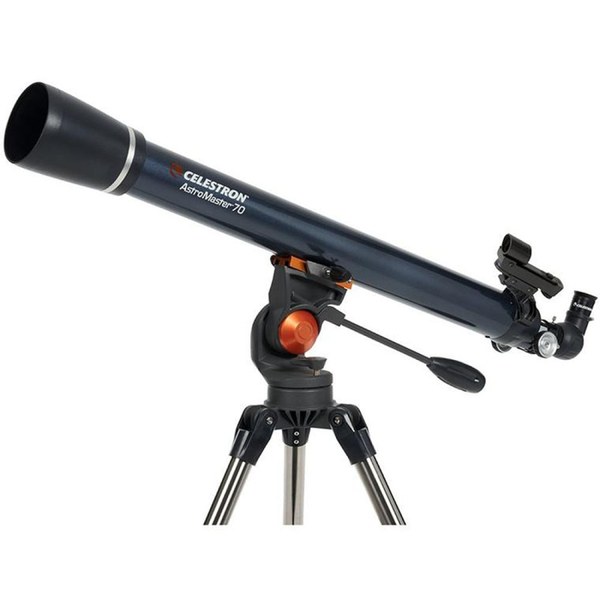 Celestron AstroMaster 70AZ Refractor
The cheapest telescope still worth buying. Moon, Saturn’s rings and Jupiter’s moons, set up in two minutes.
Price: $199.95
View at High Point Scientific* →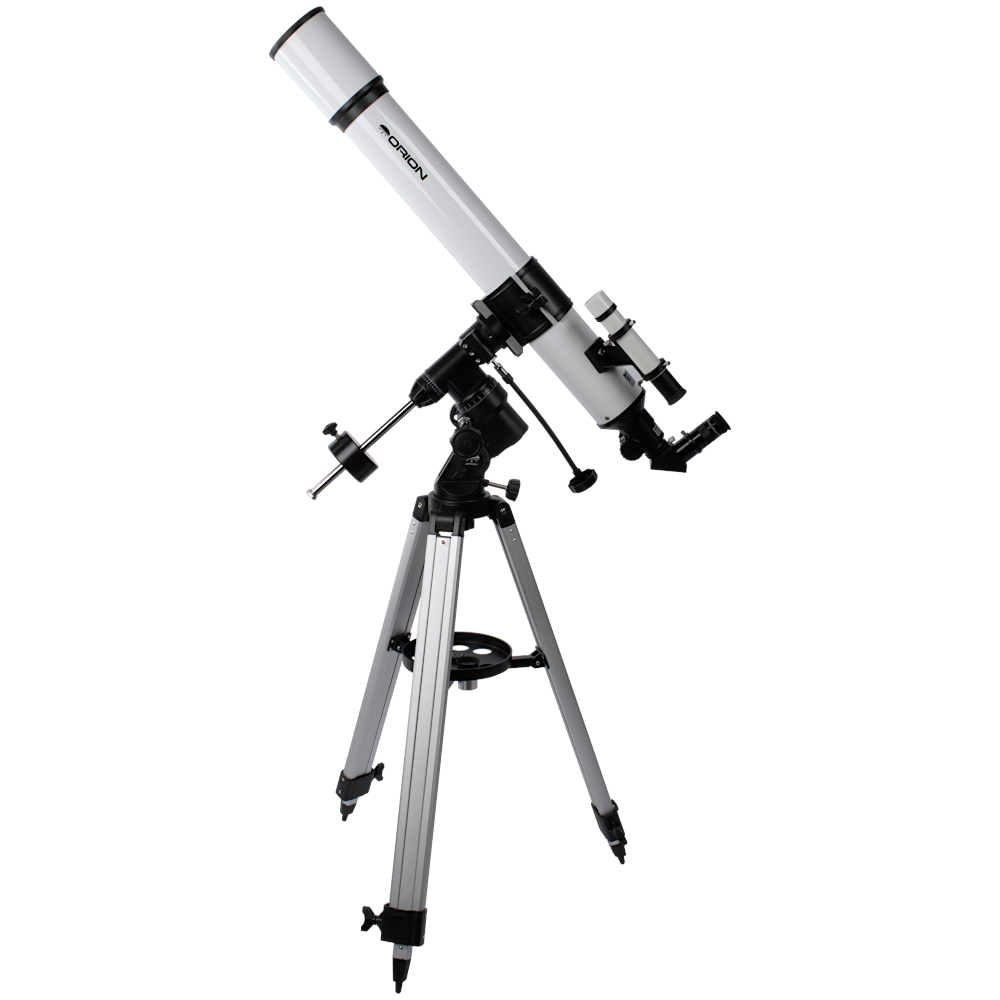 Orion Observer 90EQ Refractor Telescope
A classic 90 mm achromat with a long focal length: maintenance-free, good on the Moon and planets, with the usual faint colour fringe.
Price: $124.95
View at High Point Scientific* →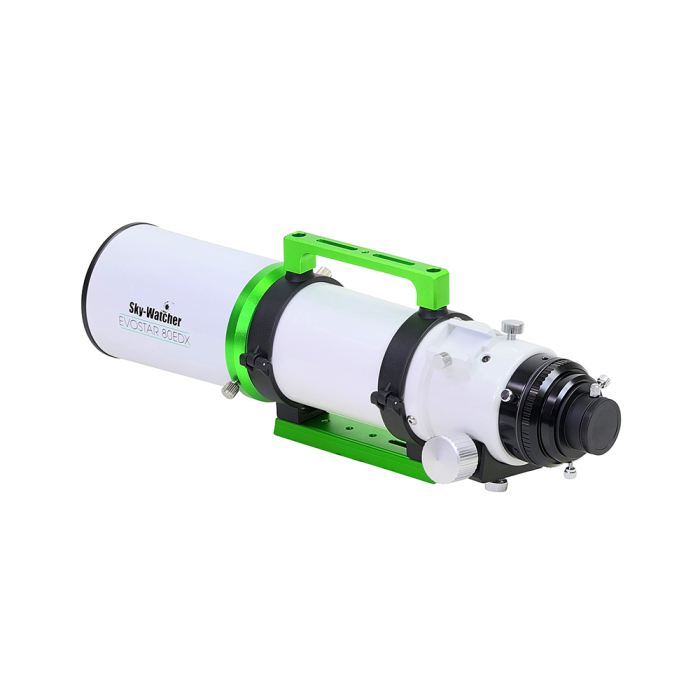 Sky-Watcher Evostar EDX 80 APO Doublet Telescope
An 80 mm ED apochromat: far less colour error than an achromat — the usual choice once astrophotography enters the picture.
Price: $750.00
View at High Point Scientific* →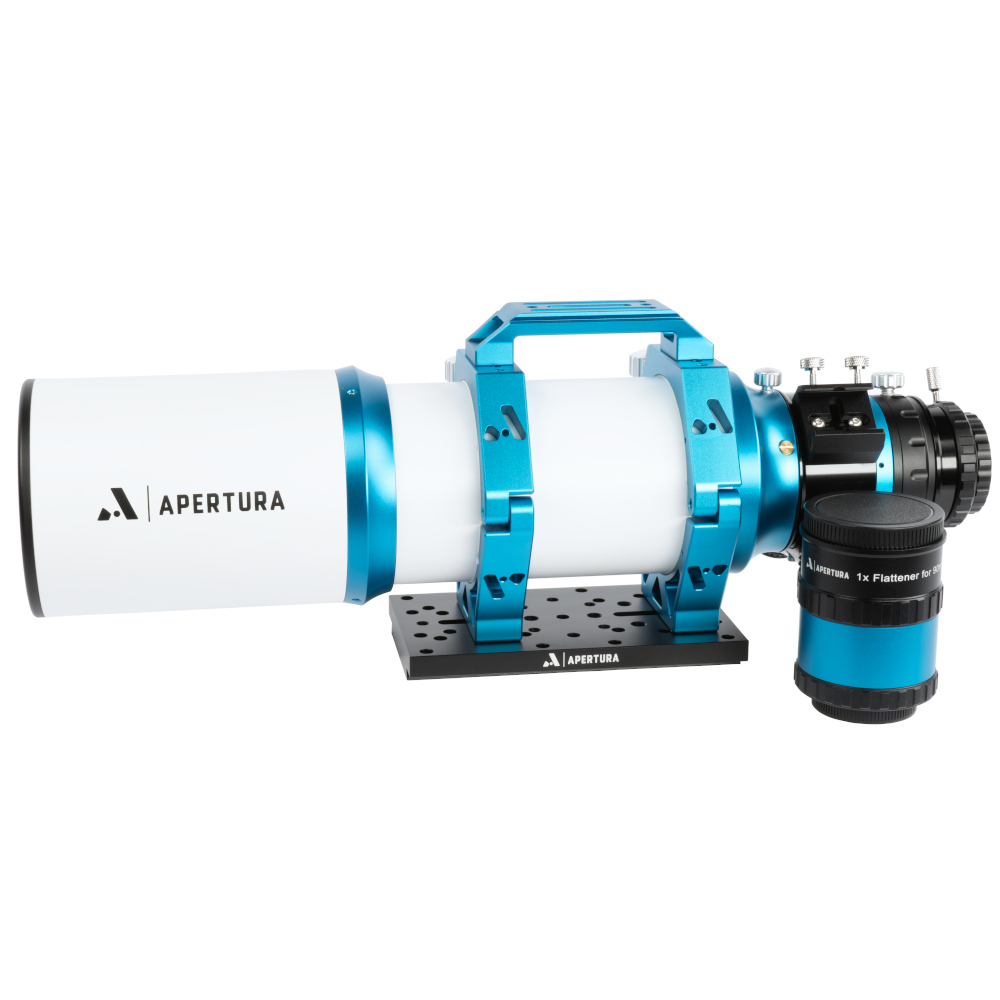 Apertura 90 mm Triplet APO with Field Flattener
A 96 mm triplet: noticeably more light than the 80ED, colour-free on planets and good enough for photography.
Price: $1,799.95
View at High Point Scientific* →
* Affiliate link: if you order through it we earn a small commission, at no extra cost to you. Prices as of the last update.
Which of the four fits your case?
Visual observing of the Moon and planets, with room for a long tube: take the achromat — paying extra for an apochromat buys you almost nothing in this role. Two sizes make sense here. Celestron AstroMaster 70AZ RefractorOmegon Telescope AC 70/700 AZ-2 at $199.95€ 119 is the smallest tube that still shows lunar craters, Saturn’s rings and Jupiter’s moons. Orion Observer 90EQ Refractor TelescopeOmegon Telescope AC 90/1000 EQ-2 at $124.95€ 275 gives you 90 instead of 70 millimetres of aperture, and its long focal length keeps the colour fringe small on its own. Which of the two is worth it depends on how much you want to carry, and on what the two prices above are doing on the day you order.
Photography, now or before long: here the apochromat is not a matter of taste but a requirement. Sky-Watcher Evostar EDX 80 APO Doublet TelescopeSky-Watcher EvoStar 80ED Apo Refractor at $750.00€ 795 is the usual entry step — 80 millimetres, short tube, ED glass. That keeps stars at the edge of the frame as pinpoints instead of swelling into blue blobs.
Both, and you don’t want to replace the tube in two years: Apertura 90 mm Triplet APO with Field FlattenerOmegon Pro APO 96/575 Triplet ED at $1,799.95€ 1,290. A triplet in the 90-millimetre class gathers noticeably more light than an 80ED and stays colour-pure on planets. That is the step at which an apochromat also shows a visible advantage visually, not just in front of a camera.
Still unsure whether it should be a refractor at all? Then achromat versus apochromat is the wrong fork in the road. For the price of an apochromat a reflector gives you several times the aperture, and aperture is exactly what galaxies and nebulae need. Our beginner’s guide puts the designs side by side before you commit.
Frequently asked questions about achromats and apochromats
Can a filter fix the colour error of an achromat?
Only partly. A minus-violet filter (also sold as a fringe killer or semi-apo filter) blocks the most troublesome part of the spectrum and makes the fringe far less obvious. The price you pay is a slight colour cast in the image and a bit less light. At €50 to €80 that’s a sensible compromise on an achromat you already own — it won’t turn into an apochromat.
Is an ED refractor an apochromat?
Usually yes, in the broader sense. Two-element ED scopes achieve a level of colour correction that’s visually indistinguishable from a true apochromatic one. At very short focal lengths, or in photography, the difference from a three-element apo does show up after all — some two-element designs leave a trace of blue there.
Why are achromats still being built at all?
Because they’re unbeatable in their niche. On the Moon and planets, a long achromat delivers an image that a reflector would need considerably more aperture to match — it’s maintenance-free, has no obstruction in the light path and costs a fraction of an apochromat. For beginners who just want to go outside at night and look, it’s still the most sensible refractor design there is.
How do I tell at the eyepiece whether my telescope has colour error?
Focus on the Moon at high magnification and look at the edge against the dark sky. An achromat draws a blue-violet band there that changes colour as you rack through focus — blue first, then yellowish. An apochromat shows a cleanly white edge in both directions.
Do reflectors have colour error too?
No. A mirror redirects all wavelengths in exactly the same way; chromatic aberration is physically impossible there. In exchange you take on other issues — collimation with a Newtonian, cool-down time with a Maksutov or Schmidt-Cassegrain. The trade-off is covered in detail in the comparison reflector or refractor.
Is a used apochromat worth buying?
Yes, this is one of the few areas where the used market makes sense. Apo optics essentially don’t age as long as they haven’t been knocked about. What you should check is the focuser for play and the lenses for condensation between the elements — those are the typical weak points, not the glass itself.
Read on:
- Reflector or refractor? – the fundamental decision before you buy
- Newtonian telescope – no colour error at all, but collimation instead
- Maksutov or Schmidt-Cassegrain? – compact and colour-free thanks to mirrors
- Buying a telescope: the big guide – all designs and recommendations