By Alexander Merz · Published on · Details checked on 22 September 2026
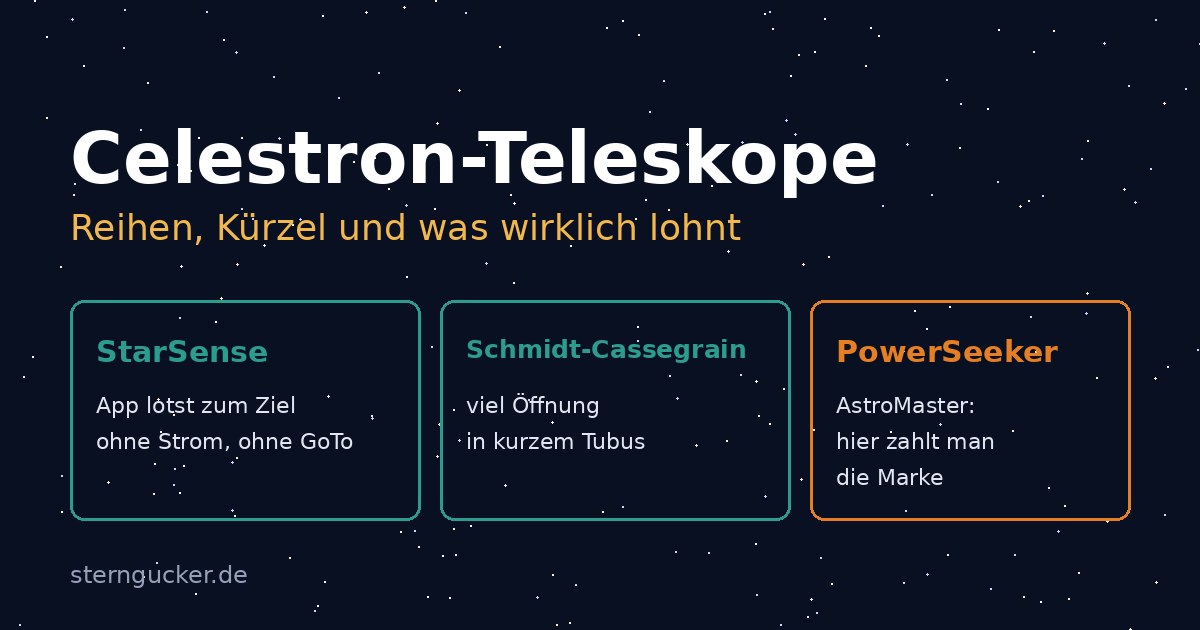
Celestron is an American telescope maker based in Torrance, California, founded in 1964. The brand made its name in 1970 with the C8 – the first affordable 8-inch Schmidt-Cassegrain. Today Celestron belongs to the Taiwanese Synta group, which makes it a sister brand of Sky-Watcher.
What is behind the Celestron brand
Tom Johnson founded Celestron in 1964, growing it out of an electronics company. His contribution to amateur astronomy can be named precisely: a vacuum process that made it possible to mass-produce the curved corrector plate of a Schmidt-Cassegrain. In 1970 an 8-inch telescope suddenly cost a fraction of what had been usual before.
Since 2005 Celestron has belonged to the Synta group, and most of the manufacturing takes place at Suzhou Synta Optical in China. Sky-Watcher is the group’s own brand. Anyone torn between the two is therefore not comparing competitors but two ranges that partly come from the same production – Celestron with the stronger Schmidt-Cassegrain and electronics line-up, Sky-Watcher with the cheaper Dobsonians and Newtonians.
Is Celestron a good brand?
Above roughly €500 yes, below that only with reservations. The reason is the same as with other brands with a broad range: at the low end the savings are made on the mount, and the mount decides whether you can see anything at all.
| Range | Series | Our verdict |
|---|---|---|
| Up to about €300 | PowerSeeker, AstroMaster, Travel Scope | Plastic focusers, useless finders, wobbly EQ mounts. For the same money other brands offer a Dobsonian that shows more. |
| StarSense Explorer | LT, DX, DOB | ⭐ The real Celestron ideaThe smartphone photographs the sky, compares it with a star catalogue and shows with an arrow where to move. No power, no polar alignment. |
| Schmidt-Cassegrain | C6 to C14, EdgeHD, NexStar SE, Evolution, CPC | Lots of aperture in a short tube. The compromise most advanced observers end up with sooner or later. |
| Imaging specialists | RASA, Origin, Advanced VX | Very good in their niche but not a starter instrument – and the RASA cannot be used visually at all. |
Celestron’s series decoded
- PowerSeeker / AstroMaster – the entry lines, small achromats and Newtonians on light mounts.
- FirstScope / Travel Scope – tabletop and travel instruments with 50 to 76 mm of aperture.
- StarSense Explorer – manual telescopes with a smartphone holder and app navigation. LT is the light version, DX the sturdier one, DOB the Dobsonian.
- NexStar SLT and SE – GoTo telescopes on fork mounts. SLT are the smaller ones, SE the orange classics with a single-arm fork.
- NexStar Evolution – the same idea as SE, but with a built-in lithium battery and Wi-Fi control via app.
- CPC – heavy dual-arm fork, much steadier than SE and Evolution, but less portable.
- Advanced VX, CGEM, CGX – German equatorial GoTo mounts, Celestron’s entry into serious astrophotography.
- EdgeHD, RASA, Origin – the imaging specialists. EdgeHD keeps the field sharp to the edge, RASA is an extremely fast f/2 astrograph, Origin a fully automatic instrument without an eyepiece.
What Celestron’s abbreviations mean
| Abbreviation | Meaning |
|---|---|
| SC | Schmidt-Cassegrain: primary mirror, secondary mirror and a corrector plate at the front. This fits a long focal length into a short tube. |
| C6, C8, C9.25, C11 | The aperture in inches. A C8 is 203 mm, a C11 is 279 mm. |
| OTA | Optical Tube Assembly – just the tube, without mount and tripod. |
| SE / SLT | Two GoTo series on fork mounts. SE is the larger and steadier line. |
| AVX | Advanced VX, a German equatorial GoTo mount for imaging. |
| EdgeHD | Schmidt-Cassegrain with extra correction in the tube: stars stay pinpoint to the edge of the field. |
| RASA | Rowe-Ackermann Schmidt Astrograph. The camera sits at the front in the light path – very fast, but no eyepiece viewing possible. |
| XLT | StarBright XLT, today’s standard coating of the optical surfaces with higher light transmission. |
| f/10 or f/2 | Focal ratio, i.e. focal length divided by aperture. f/10 means high magnification and a small field of view, f/2 short exposure times and a large field. |
Our Celestron recommendations compared
| Model | Aperture | Suits | Price |
|---|---|---|---|
| Celestron FirstScope 76 Dobsonian | 76 mm | Children and the kitchen table. Moon and bright planets, nothing more – but nothing wobbles. | € 85 |
| Celestron StarSense Explorer Dobsonian 130/650 | 130 mm | A start with app navigation, without power and without polar alignment. | € 599 |
| Celestron StarSense Explorer Dobsonian 150/750 | 150 mm | ⭐ Our recommendationThe most sensible Celestron combination for beginners: enough aperture for deep-sky, and the app solves the problem beginners really have – finding things. | € 719 |
| Celestron StarSense Explorer DX 130AZCelestron StarSense Explorer DX 130 AZ | 130 mm | The same principle on an alt-azimuth mount instead of a Dobsonian base – a little more flexible to set up. | $449.95€ 599 |
| Celestron Schmidt-Cassegrain C8 OTA | 203 mm | The classic as a bare tube. You need to add the cost of a mount. | € 1,379 |
| Celestron NexStar Evolution 6 | 152 mm | GoTo with a built-in battery and Wi-Fi – convenient, without the battery problem of the older SE series. | € 2,049 |
| Celestron NexStar 8SE Computerized SCTCelestron NexStar 8 SE GoTo Telescope | 203 mm | The best-known Celestron combination. Strong – but it takes the tripod to its limit. | $1,699.00€ 2,149 |
Our Celestron pick: Celestron StarSense Explorer Dobsonian 150/750
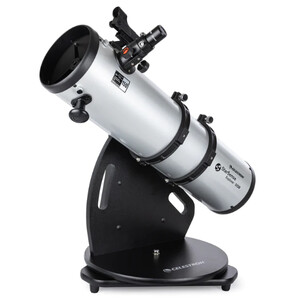
150 mm Oeffnung plus App-Navigation: die sinnvollste Celestron-Kombination fuer Einsteiger, die nicht selbst am Himmel suchen wollen.
Price: € 719
Eight inches of aperture with GoTo in a tube you can carry with one hand: on Jupiter and Saturn, the step from 150 to 203 mm is the difference between “bands visible” and “cloud belts with structure”.
To be honest: experienced observers describe the single-arm fork with this tube as fully loaded – at high magnification the image noticeably keeps shaking after you touch it. If you spend the extra purely for visual use, an 8-inch Dobsonian gives you the steadier image for less money. The extra is worth it if you really need the automatic object finding and the short tube. Celestron NexStar 8SE Computerized SCTCelestron NexStar 8 SE GoTo Telescope – $1,699.00€ 2,149
More aperture with GoTo: Celestron NexStar 8 SE GoTo Telescope
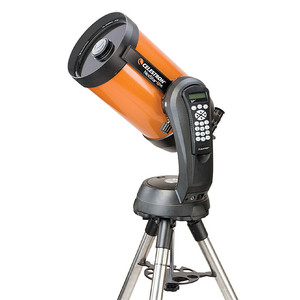
The 203 mm GoTo classic: finds over 40,000 objects at the push of a button — the advanced-level reference.
Price: € 2,149
What to plan for with Celestron
Four things come up regularly with Celestron instruments. None of them is a defect – but each costs money or nerves if you don’t plan for it.
Dew. The corrector plate at the front of the Schmidt-Cassegrain fogs up from the outside on damp nights. A dew shield only helps to a limited extent; a heater strip with a controller is reliable – but it draws extra power.
Cool-down time. The closed tube takes longer than an open Newtonian to reach the outside temperature. Until then the image is unsteady. Plan for it: put the scope outside, then have a coffee.
Field rotation. Alt-azimuth fork mounts such as SE and Evolution rotate the field during tracking. It doesn’t matter for short exposures, but it rules out deep-sky imaging – for that you need a German equatorial mount.
Which Celestron for which purpose?
| You want … | Suitable Celestron | Why |
|---|---|---|
| Not to have to search yourself | Celestron StarSense Explorer Dobsonian 150/750 | The app shows the direction, without power and without an alignment procedure. |
| Planets in detail | Celestron Schmidt-Cassegrain C8 OTA | 2,032 mm of focal length give high magnification without extra lenses. |
| Convenience from the balcony | Celestron NexStar Evolution 6 | Built-in battery, control via phone, short tube. |
| Deep-sky imaging | Celestron N 200/1000 Advanced VX AVX GoTo | German equatorial mount with tracking – without it there are no long exposures. |
| A gift for a child | Celestron FirstScope 76 Dobsonian | Robust, small, nothing to adjust. Keep expectations modest. |
How the StarSense technology works in detail and where its limits are is covered in our review of the Celestron StarSense Explorer. For imaging with the brand’s fastest instrument, we have described the Celestron RASA 8.
Celestron compared with other brands
| Brand | Strength | Weakness |
|---|---|---|
| Celestron | Schmidt-Cassegrains, StarSense app navigation, mature GoTo electronics | Little value below €300; power-hungry GoTo models |
| Sky-Watcher | Affordable Dobsonians and Newtonians, strong range of mounts | A jungle of abbreviations in the model names |
| Bresser | Messier series with a good focuser, contact partner in Germany | Very broad budget range under the same name |
| Omegon | Value for money as a retailer brand without middlemen | No manufacturer support, service via the retailer |
The brand question is secondary for a first telescope anyway. What matters more is what you want to observe and how much you are willing to carry – our guide to beginner telescopes sorts that out. How Celestron holds up against the other makers is shown in our telescope test, and the alternatives from its sister brand are under Sky-Watcher telescopes.
Frequently asked questions about Celestron telescopes
Is Celestron a good telescope brand?
From about €500 yes, especially the Schmidt-Cassegrains and the StarSense series. Below that you mainly pay for the name: PowerSeeker and AstroMaster sit on mounts that can’t cope with the tube.
What is the difference between NexStar SE and Evolution?
Same optics, different base. The Evolution has a built-in lithium battery and can be controlled from a phone via Wi-Fi; the SE series runs on AA batteries or external power and is operated with the hand controller.
How does StarSense Explorer work?
The smartphone sits in a holder on the telescope and photographs the sky. The app compares the image with a star catalogue, works out where the telescope is pointing and uses arrows to show where to move it. You move it by hand – so it needs neither power nor an alignment procedure.
What does C8 mean at Celestron?
The number is the aperture in inches: a C8 is 203 mm, a C6 is 152 mm, a C11 is 279 mm. All are f/10 Schmidt-Cassegrains. Which model is worth it for whom is covered in our buying guide to Schmidt-Cassegrain telescopes.
Can you take photos with a Celestron NexStar?
Moon and planets yes, deep-sky only to a very limited extent. The alt-azimuth fork mount rotates the field during tracking, which makes long exposures unusable. For deep-sky imaging you need a German equatorial mount such as the Advanced VX.
Do Celestron and Sky-Watcher belong together?
Yes. Both belong to the Synta group and are partly made in the same factories. Their ranges still only partly overlap: Celestron is stronger in Schmidt-Cassegrains and electronics, Sky-Watcher in Dobsonians and mounts.
Can you observe the Sun with a Celestron?
Only with a certified full-aperture solar filter fitted over the front. With Schmidt-Cassegrains this is particularly important because heat builds up in the closed tube. Filters that screw into the eyepiece are dangerous – a look without proper protection causes permanent eye damage within seconds.