By Alexander Merz · Published on · Details checked on 17 September 2026
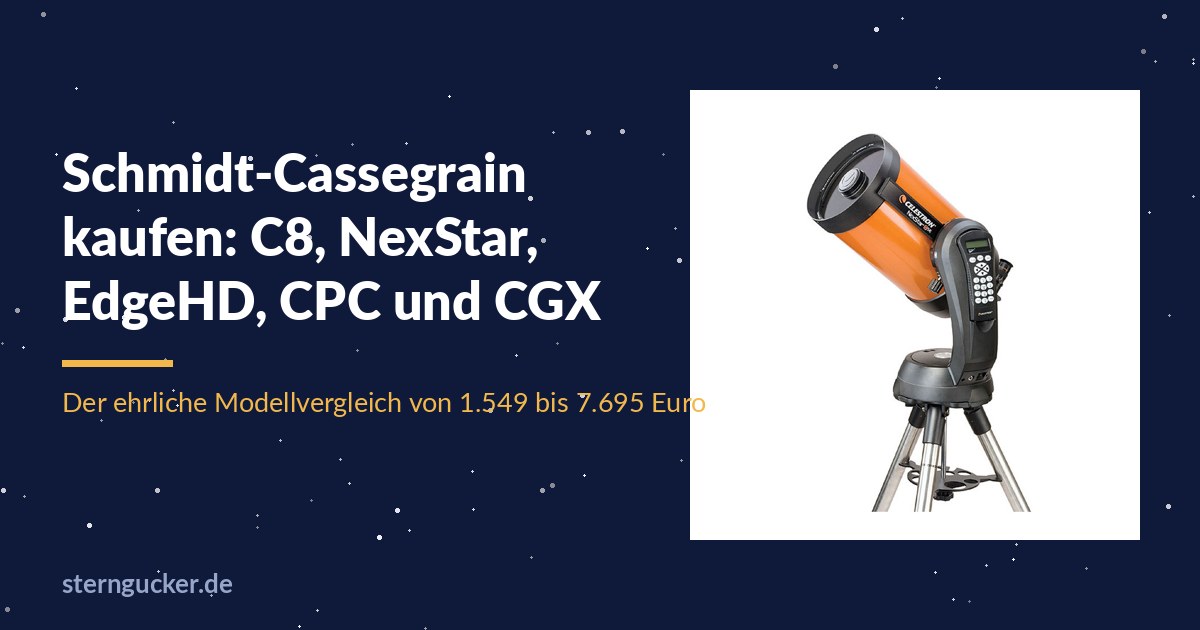
A Schmidt-Cassegrain telescope is a catadioptric telescope that guides light over a concave primary mirror, a secondary mirror and a thin corrector plate at the front of the tube. That packs a very long focal length into a short tube: a Celestron C8 fits 2,032 mm of focal length into 43 cm of tube length with 203 mm of aperture; on the fork mount of the NexStar 8 SE the complete instrument including the tripod weighs 15 kg.
⭐ In short
The Celestron NexStar 8 SE ($1,699.00€ 2,149) is the right Schmidt-Cassegrain for the vast majority: 203 mm of aperture, GoTo, 15 kg – an instrument you can carry to the car on your own. If you want to take photographs, you need an equatorial mount instead, which means the C8 on the AVX ($2,199.00€ 2,499). Everything from 9.25 inches up weighs 38 to 42 kg and is an instrument for a fixed spot, not for the trunk of your car.
Who a Schmidt-Cassegrain pays off for
The Schmidt-Cassegrain is the compromise for people who have no room for a big Dobsonian. A Dobsonian with 254 mm of aperture costs only a third of a C8 and shows more – but it is 1.20 m long and you carry it in two pieces.
That is not a theoretical trade-off. In our telescope consultation, 78 out of 100 people who write in say they want to take the instrument to a different observing site on a regular basis. This design was made for exactly those people.
The second reason is the focal length. With 2,032 mm, a C8 already gives 200x magnification with a simple 10 mm eyepiece. For the Moon, planets, double stars and small planetary nebulae this is the most comfortable design there is – you look into the eyepiece from behind, and you can sit down while you do it.
The Celestron models compared: from the NexStar 6 SE to the EdgeHD 1100
Celestron has the market for Schmidt-Cassegrains practically to itself. The series differ less in their optics than in their mount – and that is what decides price, weight and whether you can take photographs.
| Model | Aperture | Focal length | Weight | Mount | Price |
|---|---|---|---|---|---|
| Celestron NexStar 6SE Computerized TelescopeNexStar 6 SE | 152 mm | 1,500 mm | 13.6 kg | Fork, alt-azimuth | $1,199.00€ 1,549 |
| Celestron NexStar 8SE Computerized SCTNexStar 8 SE | ⭐ Our recommendation203 mm | 2,032 mm | 15 kg | Fork, alt-azimuth | $1,699.00€ 2,149 |
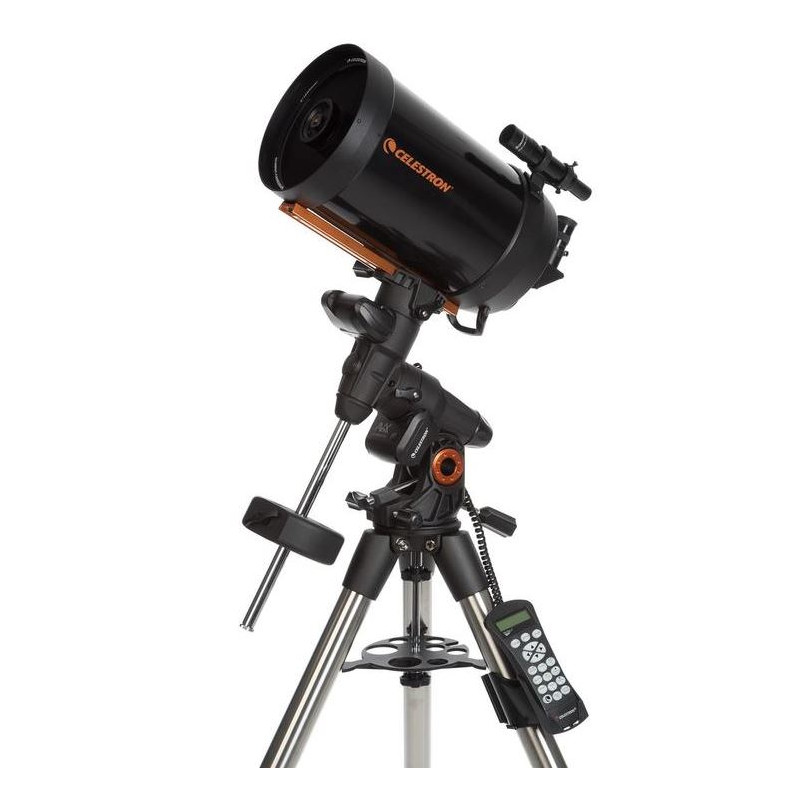
| C8 on AVXC8 on AVX | 203 mm | 2,032 mm | 27 kg | Equatorial | $2,199.00€ 2,499 |
| Celestron CPC Deluxe 925 EdgeHD GoToEdgeHD 925 CPC | 235 mm | 2,350 mm | 38.3 kg | Fork, alt-azimuth | $4,499.00€ 4,699 |
| Celestron CGX 925 EdgeHD Computerized TelescopeEdgeHD 925 CGX | 235 mm | 2,350 mm | around 40 kg | Equatorial | $4,499.00€ 5,599 |
| Celestron CGX 1100 EdgeHD Computerized TelescopeEdgeHD 1100 CGX | 279 mm | 2,800 mm | 41.7 kg | Equatorial | $5,399.00€ 7,695 |
The step from 152 to 203 mm costs about 40 % more and adds a kilogram and a half – that is the best money spent in this table. The limiting magnitude rises from 12.7 to 13.3 mag, the collecting area by 78 %.
The step from 203 to 235 mm, by contrast, takes you to more than twice the price of the NexStar 8 SE and doubles the weight from 15 to 38 kg – though that surcharge also buys the EdgeHD optics and the heavier fork, not just the aperture. The limiting magnitude rises by 0.3 to 0.4 mag in return – a difference you go looking for in the eyepiece while you are puffing your way through the setup.
Fork or equatorial: the more important decision
The mount decides more about what you can do than the aperture does. An alt-azimuth fork turns in altitude and in azimuth, an equatorial mount turns around an axis tilted toward the celestial pole. For the eye, the two are equivalent. For the camera, they are not.
On the fork, the field of view slowly rotates away over the course of the night. At exposure times longer than roughly 30 seconds, the stars at the edge of the frame therefore stretch into short arcs. For lunar and planetary videos made of a thousand single frames that does not matter – for deep-sky images it does.
EdgeHD or standard SC: what the extra money buys
A standard Schmidt-Cassegrain has a curved field. In the eyepiece you notice little of it, on a camera sensor you do: stars that are pinpoints in the center turn into little dashes in the corners.
EdgeHD is Celestron’s answer to that: two additional lenses in the baffle tube flatten the field. Depending on the model, the surcharge over the standard SC runs from about a quarter to a third of the price of the base version.
What a Schmidt-Cassegrain cannot do
The cool-down time is the biggest everyday problem. A closed tube with a thick corrector plate needs one to two hours before it has taken on the outside temperature. Experienced observers report up to three hours in winter.
Before that the image is restless, no matter how good the optics are. In practice that means: put the telescope outside, have dinner, then observe. If you want to take a spontaneous ten-minute look, you reach for a Dobsonian.
On top of that comes the fogging corrector plate. It sits exposed at the front and cools below the dew point – after an hour you are done if there is no dew shield on it. A flexible shield costs a few percent of what the telescope did and is not an option but mandatory equipment.
And then there is mirror shift: focusing works by moving the primary mirror. When you change direction, the image jumps a fraction as it does so. Celestron damps this with preloaded ball bearings, but it is not gone.
What you have to budget for on top
The purchase price is not the final price. Count on roughly 10 to 20 % of the purchase price in accessories before the instrument is really ready to use.
- Dew shield (a few percent of the telescope price) – without it the evening ends after an hour.
- Power supply or power bank – the GoTo control eats batteries. A 12 V power supply is the smallest item on this list.
- Second eyepiece – usually only a 25 mm eyepiece is included, which on the C8 gives just 81x magnification.
- Reducer (f/6.3) for everyone who wants to take photographs: shorter focal length, larger field, shorter exposure times.
Which Schmidt-Cassegrain suits you?
| What you have in mind | Recommendation | Why |
|---|---|---|
| Moon and planets, portable | Celestron NexStar 8SE Computerized SCTNexStar 8 SE | 203 mm at 15 kg – the best ratio of aperture to handling |
| Small budget, balcony | Celestron NexStar 6SE Computerized TelescopeNexStar 6 SE | 13.6 kg, 340 mm tube – fits on any balcony table |
| Astrophotography planned | C8 on AVXC8 on AVX | Equatorial from the start, trackable, expandable |
| Fixed spot, maximum aperture | Celestron CGX 1100 EdgeHD Computerized TelescopeEdgeHD 1100 CGX | 279 mm and a flattened field – but 41.7 kg in separate pieces |
| Mainly visual deep-sky | Dobsonian 254/1200Dobsonian 254/1200 | More aperture for the money – not a Schmidt-Cassegrain, but the more honest choice |
Frequently asked questions about Schmidt-Cassegrain telescopes
What does C8 mean at Celestron?
C8 stands for a Celestron Schmidt-Cassegrain with 8 inches of aperture, that is 203 mm, at 2,032 mm of focal length. Accordingly, C6 means 152 mm, C9.25 then 235 mm and C11 finally 279 mm. The number describes the optics only – which mount they sit on is given by the model name after it.
Is a Schmidt-Cassegrain suitable for beginners?
Yes, but it is rarely the most sensible first telescope. For the price of a NexStar 6 SE with 152 mm you could also get a Dobsonian with 254 mm and still have money left over for eyepieces. The Schmidt-Cassegrain pays off once transport size, GoTo and a comfortable viewing position matter more to you than maximum aperture for the money.
How long does a Schmidt-Cassegrain need to cool down?
One to two hours at moderate temperature differences, longer in winter. So put the instrument outside early, ideally while it is still daylight. You can still observe before that – only the fine details on a planet arrive once the tube has cooled through.
Can you take photographs with a Schmidt-Cassegrain?
The Moon and the planets: very well, even on the alt-azimuth fork. The Sun only with a certified objective solar filter that is placed over the full aperture at the front – with Schmidt-Cassegrains this matters especially, because heat builds up inside the closed tube. Filters that screw into the eyepiece are lethally dangerous, and a single unfiltered look damages the retina permanently (this is how to observe the Sun safely). Deep-sky: only with an equatorial mount, otherwise the field rotates. It becomes worthwhile with an EdgeHD and an f/6.3 reducer. What such a setup looks like is described in our astrophotography setup.
Which is better: Schmidt-Cassegrain or Maksutov?
The Maksutov draws a touch sharper on axis and needs less maintenance, but usually stays below 150 mm of aperture and cools down even more slowly. The Schmidt-Cassegrain is the all-rounder with more aperture. You will find the detailed comparison of the two designs under Maksutov or Schmidt-Cassegrain.
Do you have to collimate a Schmidt-Cassegrain?
Considerably less often than a Newtonian. Only the secondary mirror is collimated, via three screws, and that often holds for years. You can check it on a bright star at high magnification: the slightly defocused star disc has to be a concentric ring, not shifted to one side.
How much do you really see with 203 mm of aperture?
A C8 collects around 840 times as much light as the naked eye and reaches to about 13.3 mag. The Cassini division in Saturn’s rings, Jupiter’s cloud belts, hundreds of globular clusters and the brighter galaxies of the Virgo Cluster are everyday sights with it. You will not see colored spiral arms the way they appear in photographs – the eye is too insensitive for that.
Read on
Celestron telescopes: all the series at a glance · Maksutov or Schmidt-Cassegrain · Telescopes for advanced users · Dobsonian telescopes