By Alexander Merz · Published on · Details checked on 14 September 2026
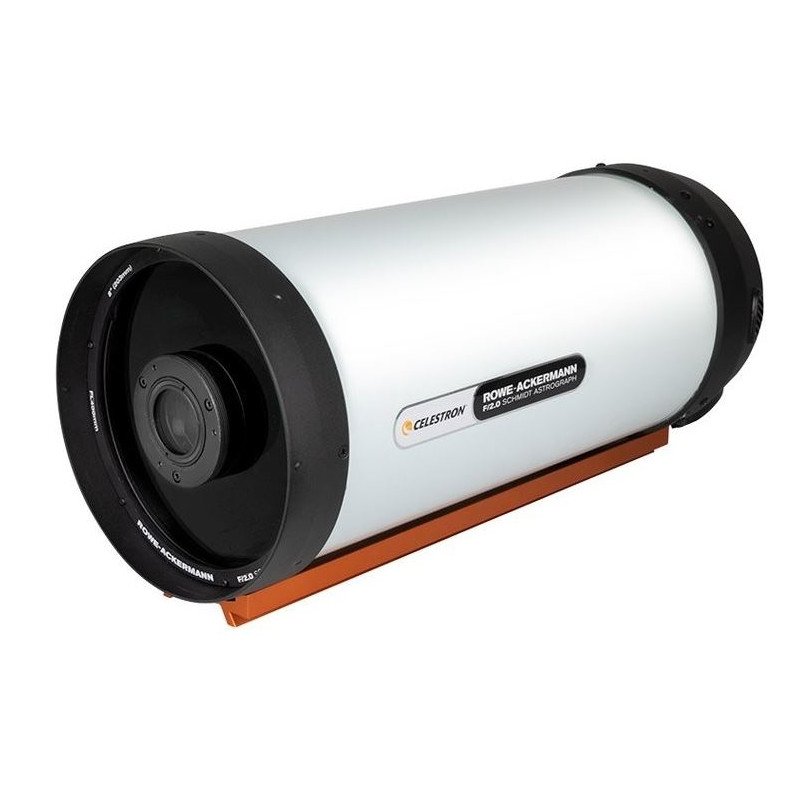
The Celestron RASA 8 (Rowe-Ackermann Schmidt Astrograph) is a statement: an 8-inch mirror system that works at f/2. For astrophotography, that means extremely short exposure times – and that’s exactly why it earned its own review over at AstroBackyard.
This guide shows you honestly what makes the RASA 8 so fast – and why it still isn’t for beginners. Because f/2 comes at a price, and not just in money.
Why f/2 changes everything
The f-number determines how much light hits the sensor per unit of time – and it scales with the square. Going from f/5.6 to f/2 is a factor of about eight.
In practice that means: faint galaxies and nebulae in a single night instead of a whole week. The RASA gathers so much signal in such a short time that even under mediocre skies you get usable results.
Celestron RASA 8: the key specs
| Feature | Value |
|---|---|
| Design | Rowe-Ackermann Schmidt Astrograph (RASA) |
| Aperture / focal length | 203 mm / 400 mm (f/2) |
| Camera position | at the front of the light path (instead of at the focuser) |
| Sensor size | up to approx. 32 mm diagonal |
| Usable visually | no – pure astrograph |
| Price (Astroshop, tube only) | $2,199.00€ 2,449 |
Who is the RASA 8 for?
The RASA 8 is for advanced astrophotographers who want maximum speed and have mastered their craft. It rewards experience and punishes carelessness.
It’s not one for getting started: no visual use, sensitive to focus and tilt, and it needs a sturdy, precise mount – the tube alone already costs as much as a complete beginner setup.
RASA 8 vs. the small astrographs
| Criterion | RASA 8RASA 8 | RedCat 51 / SQA55 |
|---|---|---|
| Aperture | 203 mm | 51–55 mm |
| Speed | f/2 (extremely fast) | f/4.8–4.9 (fast) |
| Target audience | Advanced | Beginner–mid-range |
| Handling | demanding | forgiving |
| Price | $2,199.00€ 2,449 | $878.00€ 1,190 |
| Where to buy | RASA 8RASA 8 | RedCat 51RedCat 51 / SQA55SQA55 |
The f/2 speed record for deep-sky: Celestron RASA 8 Astrograph (f/2)
f/2 astrograph 203/400 – ultra-fast deep-sky imaging for advanced users.
Price: € 2,449
Frequently asked questions about the Celestron RASA 8
Why is the RASA 8 so fast?
Because it works at f/2. Light-gathering scales with the square: f/2 gathers about 8× more light per unit of time than f/5.6 – hence the extremely short exposure times.
Can you observe visually with the RASA 8?
No. The camera sits at the front of the light path, and there’s no focuser for an eyepiece. The RASA is a pure astrograph for photography.
Which camera fits the RASA 8?
Cameras with sensors up to about 32 mm diagonal. Larger sensors get increasingly obstructed by the front camera position.
Is the RASA 8 suitable for beginners?
No. It’s demanding when it comes to focus, tilt and handling, and it needs a strong mount. For getting started, small apos are the better choice.
Is the tube price all you pay, or is there more?
The price quoted is for the tube only. On top of that come a sturdy mount, an astro camera and accessories – expect to pay several times the tube price for the complete setup.