By Alexander Merz · Updated on · Details checked on 13 October 2026
You’ve just bought a telescope — so what should you add to get the most out of it? The right telescope accessories make all the difference: they cut chromatic aberration, keep the image steady through long nights, and tame stray light. This guide walks through the accessories that genuinely matter, from your first extra eyepiece to a light-pollution filter, so you can kit out your scope for the way you actually observe.
⚡ The quick answer: The most worthwhile telescope accessories, in order, are: a set of good eyepieces (wide-field and short focal lengths), a 2x Barlow lens, a finder (red-dot or Telrad), and a filter or two (Moon and light-pollution). To start without guesswork, an all-in-one eyepiece + Barlow + filter kit in a case covers the essentials for around $89.95€ 89.
Eyepieces: the number-one telescope accessory
Eyepieces are the essential accessory: they magnify the object you’re viewing and shape the image quality. This is the optical element you look through, and it decides how much of the sky fits in the field of view. Choosing the right eyepieces therefore has an enormous impact on your observing experience.
There are several optical designs — Plössl, orthoscopic and wide-angle — differing in magnification, apparent field and eye relief. A good eyepiece set should offer a spread of focal lengths and designs to cover different targets and conditions. In practice, aim for a short focal length (5–8 mm) for planets, a versatile mid-range (10–15 mm), and a long focal length (25–32 mm) for wide-field and deep-sky views.
Tip: a parfocal (homofocal) set lets you swap eyepieces without refocusing every time — a real convenience at the eyepiece. For a deeper dive, see our full guide to choosing eyepieces.
The Barlow lens: more magnification for less
A Barlow lens is a clever accessory that expands what your gear can do: fitted between the eyepiece and the telescope, it doubles or triples the magnification of every eyepiece you own. You effectively double your eyepiece collection without buying more, revealing extra detail on planets, lunar craters and bright objects.
Barlows come in 2x, 3x, even 5x. The right choice depends on your telescope, your eyepieces and your favourite targets. Because a Barlow adds elements to the light path, pick a well-coated, multi-element model to preserve contrast. In practice, a quality 2x Barlow is the best-value upgrade for beginners.
Finders and pointers: locate objects fast
A finder helps you spot and centre celestial objects quickly before you switch to the main eyepiece. Several types suit different needs.
Red-dot finder
It projects a red dot onto a clear plate that you line up with your target. Simple, lightweight and non-magnifying, it’s the ideal finder for beginners.
Optical finderscope
This is a small telescope mounted parallel to the main tube, with low magnification and a wide field. A 9×50 model with crosshairs makes precise centring easy and is invaluable for deep-sky work.
Telrad and reflex sights
A Telrad projects concentric circles rather than a single dot, letting you star-hop from familiar constellations. It’s a long-time favourite among amateurs for fast, accurate naked-eye pointing.
Concrete picks: budget finder, upgrade finder
A red-dot finder covers most targets. Two models cover the budget and the upgrade cleanly; the triple mount is only worth it if you actually run more than one finder in parallel.
Budget: Omegon LED Red Dot Finder
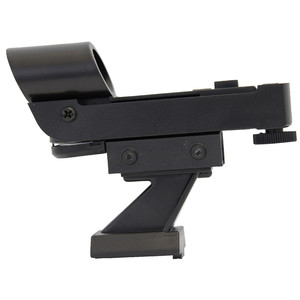
The cheapest honest red-dot finder under €20. No metal housing, no dual brightness, but everything a beginner needs to acquire targets faster than with the crosshair finder that came in the box.
Price: € 19.90
Upgrade: Baader SkySurfer V Night & Day Red Dot Finder
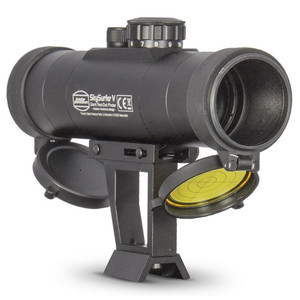
All-metal red-dot finder with two-stage brightness – bright enough for daytime solar setups, dim enough for deep-sky at night. Sealed and weather-proof. If you use the same scope for Sun and stars, this is the one finder you never need to swap.
Price: € 145
For multiple finders: Omegon Tri-Finder Finderscope Mount
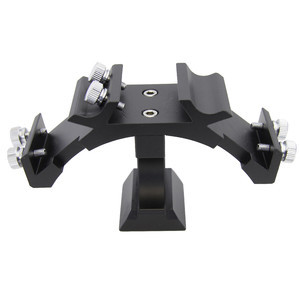
An aluminium base with three standard finder shoes. Handy if you actually run a red-dot, an optical finder and a Telrad in parallel – you stop swapping between targets. Only worth it if you own more than one finder.
Price: € 69
Filters: more contrast in the sky
Filters thread in front of the eyepiece or camera and block unwanted light to boost contrast and sharpness. The main types are:
- Moon filter: dims the Moon’s glare and brings out more surface detail.
- Solar filter: protects your eyes and scope so you can observe the Sun safely (always fit it at the front of the tube).
- Light-pollution filter: blocks artificial light from streetlamps and lifts deep-sky contrast.
- Planetary (colour) filter: enhances cloud bands and surface contrast on the planets.
In astrophotography, narrowband filters isolate specific emission lines (H-alpha, OIII) on sensitive sensors. For visual observing, the Moon-filter-plus-light-pollution-filter pairing is the most useful place to start.
Mounts, tripods and comfort accessories
A stable mount and a solid tripod guarantee crisp, shake-free views. There are two broad families: alt-azimuth mounts (two axes, very simple, perfect for beginners and for the Moon, planets and bright deep-sky — the principle behind the Dobsonian) and equatorial mounts (aligned with Earth’s axis, ideal for precise tracking and astrophotography).
On the comfort side, a few accessories are game-changers without being essential: a red-light headlamp to protect your night vision, an adjustable observing chair for long sessions, a power bank to run GoTo mounts and cameras in the field, and an observing log to record your finds. Finally, a padded case and a protective cover extend the life of your gear.
For small tubes under 5 kg: if you like the Dobsonian point-and-view simplicity but want app-guided target hints — without GoTo motors, batteries or the alignment routine — the Push+ mini is one of the few honest alternatives.
Small tubes, no motor: Omegon Push+ mini Mount
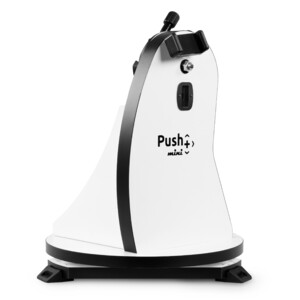
A motorless push-to mount with encoders and phone pairing – you nudge the scope by hand, the app shows live where to go. No batteries, no motor, no GoTo alignment routine, but the same object-finding help. Alt-azimuth, up to about 5 kg of tube.
Price: € 399
Star charts and software to navigate the sky
To find your way around the night sky, nothing beats a good star chart. Paper atlases (like the Pocket Sky Atlas) teach the basics of star-hopping; desktop software such as Stellarium (free) gives you a full planetarium; and mobile apps (SkySafari, Star Walk 2) use GPS and motion sensors to display the sky in real time overhead. Pick the tool you’re most comfortable with to plan your sessions.
Table: the essential accessories to start with
| Accessory | What it does | Priority | Typical budget |
|---|---|---|---|
| Eyepieces (focal-length set) | Set magnification and field of view | Essential | $40–200€40–200 |
| 2x Barlow lens | Double every eyepiece | Very useful | $40–90€35–105 |
| Finder (red-dot / Telrad) | Point at objects quickly | Essential | $25–50€20–100 |
| Moon filter | Tame the Moon’s glare | Useful | $15–30€20–40 |
| Light-pollution filter | Improve deep-sky from the city | Useful | $40–150€60–140 |
| Red-light headlamp | Preserve night vision | Comfort | $15–35from €15 |
| Power bank | Power GoTo mounts and cameras | Comfort | $30–100€40–120 |
To cover eyepieces, a Barlow and filters in one go, an all-in-one kit is the most economical route:
Best value: Omegon Eyepiece Starter Kit
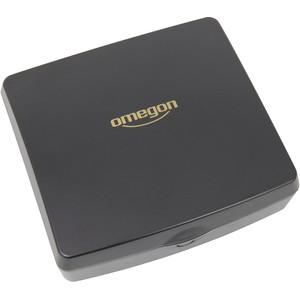
Eyepieces, filters and a Barlow in one case: everything to round out your telescope at once, cheaply.
Price: € 89
* Affiliate link: if you buy through this link we may earn a small commission from Astroshop or High Point Scientific, at no extra cost to you.
Frequently asked questions
Which telescope accessories are actually worth it?
Eyepieces are the most important. The basic set usually comes with the telescope, and you then add new eyepieces over time for better images and different magnifications. A finder, a Barlow and a couple of filters come next.
Can you buy telescope accessories used?
Yes — quality eyepieces, Barlows and finders hold their value well. From a dealer, used gear often comes with a warranty; buying privately, inspect the optics closely (scratches, fungus, coatings) before you commit.
Which eyepiece is best for planets?
A short focal length (5 to 8 mm), optionally paired with a 2x Barlow, gives the high magnification you need for the Moon and planets. Just don’t exceed your scope’s maximum useful magnification (about 2x the aperture in mm).
Is a light-pollution filter really useful in the city?
Yes for emission nebulae, which gain noticeably in contrast. It has no magic effect on galaxies or stars, though. It’s worth considering if you observe from an urban sky.
Where should I start on a tight budget?
One good extra eyepiece and a red-dot finder, or an all-in-one eyepiece + Barlow + filter kit that covers the essentials for around $89.95€ 89.
Read next: