By Alexander Merz · Updated on · Details checked on 25 September 2026
⚡ The short answer: For the night sky 10×50 is the right size if you want to hold the binoculars in your hands: a 5 mm exit pupil, almost 7° of field, under a kilogram. If you want more, take a 15×70: twice the light, but you will need something to brace against. From 20×80 upwards nothing works without a tripod. And one thing up front, so the disappointment does not come later: no binocular shows Saturn’s rings. What they do show: craters, Jupiter’s moons, star clusters, the Andromeda galaxy and comets – often more beautifully than a telescope.
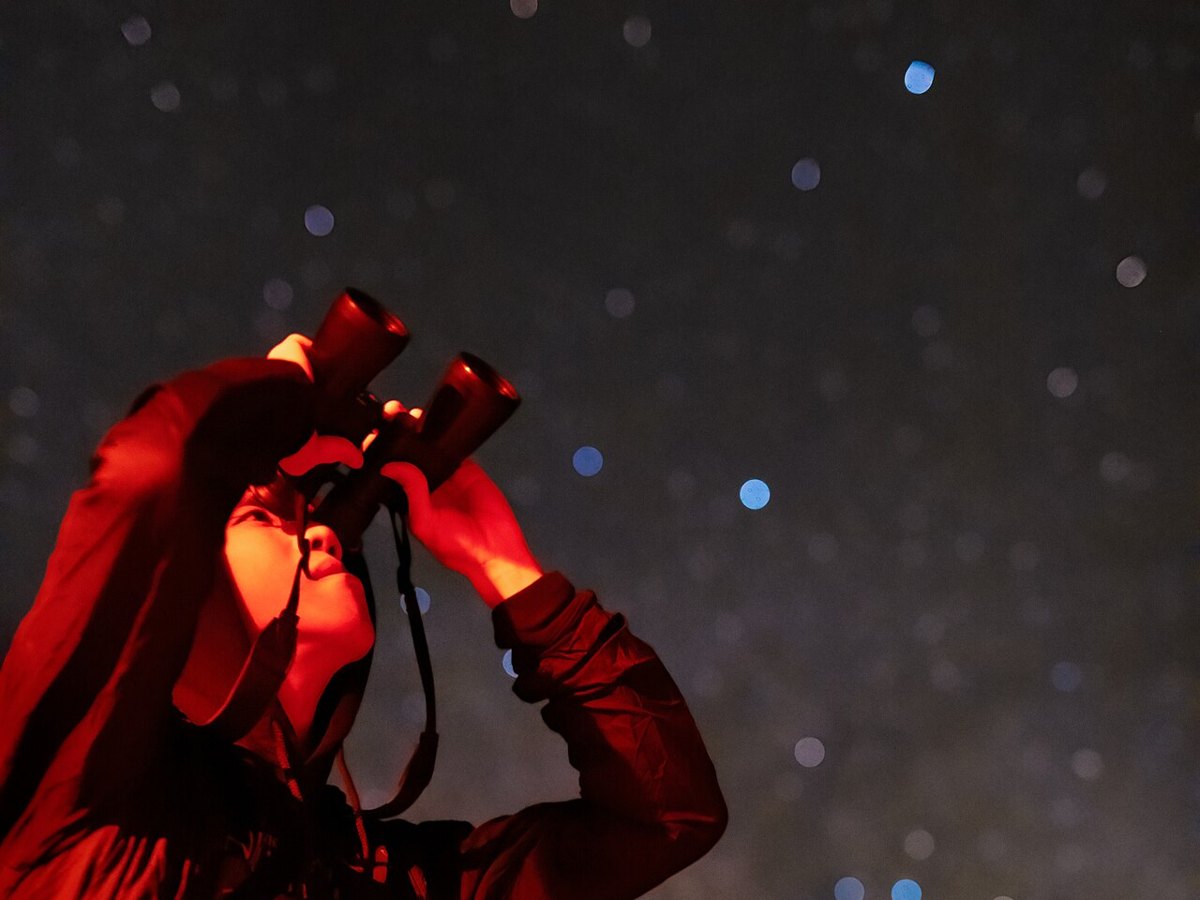
More in our overview: Best Telescopes.
Which binoculars for stargazing? Four that work
Binoculars are the most honest way into astronomy. They are not in the way, they need no setting up, and you have an image within thirty seconds – while a telescope is still cooling down. All four models below are built for the night sky, and the prices come from the shop daily, so they are not from last year.
| For whom | Model | Why this one | Price |
|---|---|---|---|
| First binoculars, small budget | Celestron 7x50 Cometron BinocularsCelestron UpClose G2 10x50 Porro Binoculars | 6.8° field, 840 g, 5 mm exit pupil. Optically what is needed and no extras – the short 12 mm eye relief is tight for glasses wearers, though. | $47.95€ 62 |
| If you mean it seriously | Celestron 15 x 70 SkyMaster Pro Waterproof BinocularsOmegon Nightstar 15x70 Binoculars | ⭐ Our recommendation70 mm gathers twice the light of a 50 mm. 1,490 g is still carryable when braced, and this is where globular clusters start to give something back. | $279.95€ 119 |
| Handheld, but properly good | Celestron SkyMaster Pro ED 7x50 BinocularsOmegon Brightsky 10x50 Binoculars | Sharp to the edge, nitrogen filled, 18.5 mm eye relief – the most comfortable of the four. It does not show more than the 15×70, but it shows it more cleanly. | $219.95€ 289 ● Currently unavailable (Product can be shipped as of 15.11.2026) |
| Maximum aperture for the money | Celestron 15 x 70 SkyMaster Pro Waterproof BinocularsOmegon Nightstar 20x80 Binoculars | 80 mm for the price of a good 10×50 – the catch is 2,130 g. Handheld the image shakes so much that the aperture is wasted. | $279.95€ 149 |
| Premium 10×50 with ED glass | Celestron SkyMaster Pro ED 7x50 BinocularsOmegon Hunter 2.0 10x50 ED Binoculars | ED coating, noticeably sharper stars and less colour fringing than the Brightsky – 970 g, tripod thread from the factory. If you want the best you can hold, the surcharge earns its keep here. | $219.95€ 359 |
Our recommendation: Omegon Nightstar 15x70 Binoculars
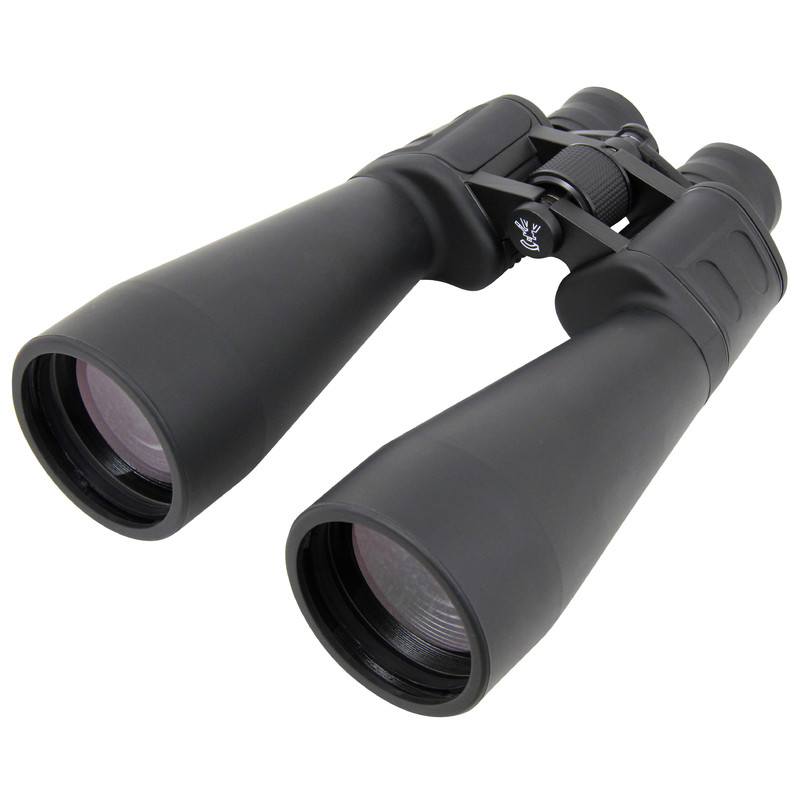
The classic astronomy binocular. 70 mm of aperture, a 4.4° field, 18 mm eye relief – and a tripod thread, in case you want to brace it later.
Price: € 119
One more 10×50 outside the table, if you settle in this class: Nikon Action 10x50 CF Binoculars is the brand-name classic in a rugged housing (about $149€ 149). If you want a cheaper way in, stick with the Celestron 7x50 Cometron BinocularsCelestron UpClose G2 10x50 Porro Binoculars from the first row of the table ($47.95€ 62).
What you actually see through binoculars
This is the question most buying guides talk around. Binoculars show neither colourful nebulae nor planetary discs with cloud bands. They show light and structure – and more of it than you would expect.
The Moon is the first revelation. At ten times magnification the smooth disc turns into a landscape: craters near the terminator cast shadows, the maria gain edges.
Just not at full moon – the light then falls straight down and everything looks flat. Two days either side of first or last quarter is the moment.
Jupiter shows its four large moons as points of light in a row – the same observation with which Galileo overturned the world view in 1610. You have to hold steady for it; braced against something it is much easier.
Star clusters are the real domain. The Pleiades fill almost half the field of a 10×50 and resolve into dozens of stars – a telescope shows less here, because its field is too narrow.
The double cluster h+χ in Perseus sits in the same image as a double ball. In summer the fields in Cygnus and Sagittarius are so dense with stars that you stop counting.
The Andromeda galaxy appears under a dark sky as an elongated bright patch – light 2.5 million years old, barely guessed at with the naked eye, unmistakable through binoculars. The Orion Nebula shows as a hazy glow around three stars. And comets, when there is one, belong to binoculars entirely: they are large, diffuse and faint – exactly what a wide, bright field is made for.
⚠️ What does not work: Saturn’s rings need roughly 30× magnification – no binocular manages that. At 20× Saturn looks oval at best. Mars stays an orange dot, and coloured nebulae exist only in photographs, never in the eye. Anyone expecting that needs a beginner telescope.
10×50, 15×70 or 20×80 – which size suits you?
The two numbers on every binocular are magnification and aperture in millimetres. They are linked, and you cannot maximise both: more magnification means less field and more shake, more aperture means more light and more weight. The whole decision sits in this table. More sizes, from 8×42 up to 25×100, are compared in our binocular magnification chart.
| 10×50 | 15×70 | 20×80 | |
|---|---|---|---|
| Field of view | 6,5–6,8° | 4,4° | 3,4° |
| Exit pupil | 5,0 mm | 4,7 mm | 4,0 mm |
| Weight | 840–1.300 g | 1.490 g | 2.130 g |
| Handheld? | yes | briefly, better braced | no |
| Strength | overview, clusters, comets | the compromise that shows the most | faint objects, globular clusters |
In practice: if you are unsure, take a 10×50. A binocular you grab on the way to the balcony will show you more over a year than one that stays in the cupboard because of its weight. The 15×70 is the right choice if you know you will go out regularly and can brace against a car roof, a fence or a walking pole.
Value pick: Celestron UpClose G2 10x50 Porro Binoculars
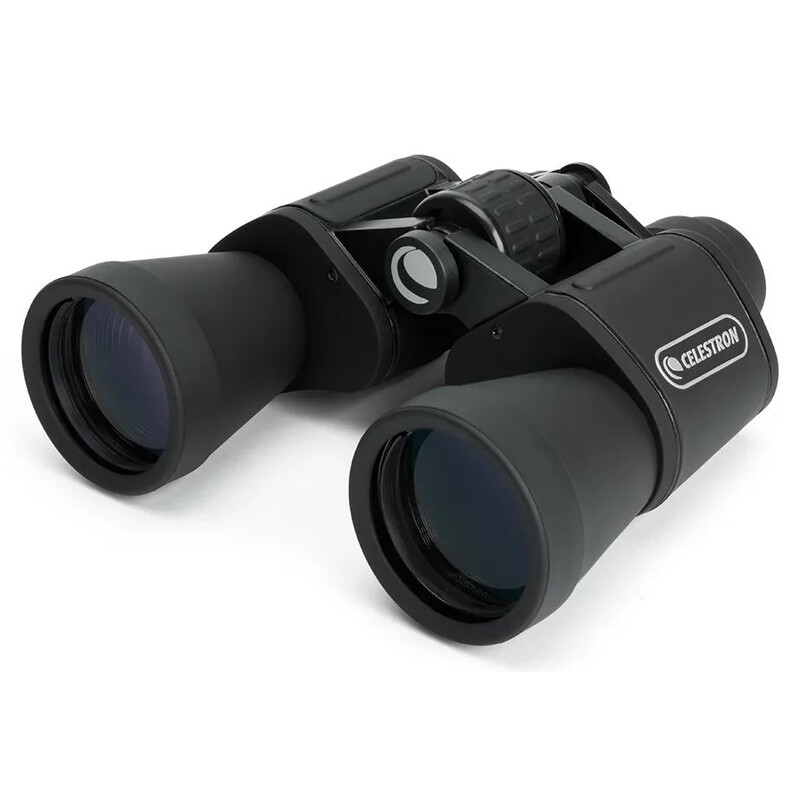
If these are your first binoculars and the price has to work: 10×50 with a 6.8° field and a 5 mm exit pupil. For glasses wearers the short eye relief makes them only partly suitable.
Price: € 62
Understanding the numbers on a binocular
Exit pupil: the most important number, printed nowhere
Divide the aperture by the magnification and there it is: 50 ÷ 10 = 5 mm. That is the diameter of the light beam leaving the eyepiece. If it is wider than your pupil you throw light away; if it is narrower, the image is darker than it needs to be.
A dark-adapted pupil opens to about 7 mm in teenagers, but often only 5 mm by the age of fifty. That is exactly why 5 mm is the practical target for astronomy binoculars – and why the classic 7×50 marine glasses with their 7 mm are no longer an advantage for most adults, only heavier.
Field of view: how much sky you see at once
It is given either in degrees or as metres at 1,000 metres – 118 m corresponds to 6.8°. For orientation: the full Moon measures half a degree, your fist at arm’s length about ten. A wide field helps with finding, and with binoculars you find without a chart and without GoTo.
Maximum is still not optimum. Beyond a certain point stars at the edge turn into streaks, and on cheap glasses that happens early. A clean 6.5° field is worth more than a blurred 8° one.
How to recognise a good binocular
Three things separate an astronomy-capable binocular from a souvenir: fully multi-coated optics on every glass-to-air surface rather than just the front lens, BaK-4 prisms instead of BK-7 (held against a bright sky, a BK-7 glass shows a clipped, squared-off light circle instead of a round one), and a nitrogen filling so the glass does not fog from the inside on a damp night. All three are in every spec sheet – you only have to look.
When you need a tripod – and when you do not
The common rule “above 10× you need a tripod” is too strict. The more honest version: up to about 1 kg and 10× you hold steady enough to separate Jupiter’s moons. Above that it is not magnification that decides, but weight and how you hold your arms.
A 15×70 can be held standing for about a minute before the arms start to shake. Braced – elbows on a car roof, back against a tree, resting on your knees in a deckchair – that becomes half an hour. With a 20×80 at over two kilos nothing helps any more: without a tripod you see less than with a good 10×50, because the image drifts constantly. One alternative to a tripod is a pair of image-stabilized binoculars: they cancel the shake electronically, but cost considerably more and need batteries.
Each of the four models here has a 1/4-inch tripod thread. You do need a binocular adapter for it, though, and for looking upwards a tripod that extends high enough – otherwise you end up kneeling in wet grass.
Looking at the zenith without wrecking your neck
The finest objects stand high in summer, and that is exactly where binocular observing is least comfortable. The cheapest solution is also the best: a deckchair or a sleeping mat.
Lying on your back you can hold the glass with bent arms almost indefinitely, and your neck is relieved. Anyone observing often with a heavy glass will find 45° or 90° angled prisms as well as parallelogram mounts – but both cost more than the binocular itself.
Wearing glasses behind binoculars
If you wear glasses you need at least 15 mm of eye relief, better 18. Below that you only see part of the field – as if looking through a keyhole. Among the four models here that ranges from the tight 12 mm of the Celestron UpClose to the comfortable 18.5 mm of the Omegon Brightsky.
Short- or long-sighted? Then you can take the glasses off and correct with the dioptre adjustment on the right eyepiece. With astigmatism that does not work – only spectacles correct it, and then there is no way around sufficient eye relief.
For glasses wearers: Omegon Brightsky 10x50 Binoculars

18.5 mm eye relief, an edge-sharp 6.5° field and a nitrogen filling. The most comfortable glass in the comparison – you can feel what the surcharge is for.
Price: € 289
Binoculars for the northern lights?
Briefly: no. Aurorae are enormous – they often stretch across half the sky – and binoculars show only a few degrees of that. For aurorae the naked eye is the best instrument, because only it takes in the movement of the whole structure.
Binoculars help at most with the question of whether a pale shimmer on the northern horizon is really green or just a cloud lit by the city.
What binoculars do not replace
Binoculars and telescopes solve different problems, and neither makes the other redundant. Binoculars win at everything large and extended: star clusters, Milky Way fields, comets, finding your way around the sky. The telescope wins at everything small and bright: planets, lunar craters in detail, double stars, globular clusters resolved into individual stars.
Most observers who have been at it a while own both and reach for the binoculars more often – because they are already outside while the telescope is still cooling. If you are unsure which instrument suits you, take our short telescope quiz; the recommendation arrives by email.
Not sure whether binoculars are enough or a telescope makes more sense?
Six short questions, an honest answer by email – even when binoculars are the better choice.
Kids need different binoculars: less magnification, less weight and a narrow eye spacing. Our picks by age are in the guide to kids binoculars.
Frequently asked questions about astronomy binoculars
Which binoculars are best for stargazing?
For most people a 10×50: enough aperture for star clusters and the Andromeda galaxy, a wide field for finding your way, and light enough to hold. Anyone willing to brace while observing will see noticeably more with a 15×70.
Can you see Saturn’s rings with binoculars?
No. That needs around 30× magnification; handheld binoculars sit between 10× and 15×. At 20× Saturn looks at most slightly oval. Seeing the rings as rings remains the telescope’s job.
Are ordinary household binoculars good enough?
For trying it out, certainly – an 8×30 or 10×25 already shows lunar craters and Jupiter’s moons. For the night sky they lack aperture: 25 mm gathers only a quarter of the light of 50 mm. Try before you buy; if the image feels too dark, you will know why.
What do the numbers 10×50 mean?
The first number is the magnification, the second the objective diameter in millimetres. A 10×50 magnifies ten times and has 50 mm front lenses. Aperture decides how much light is collected – and therefore how much you see at night.
At what point do you need a tripod?
From about 1.5 kg it becomes tiring, from 2 kg impossible. A 10×50 you hold freely, a 15×70 you should brace, a 20×80 belongs on a tripod – otherwise you waste exactly the aperture you paid for.
Zoom binoculars for astronomy – yes or no?
No. Zoom binoculars have a narrower field in every position and weaker optics than a fixed glass in the same price class, and the image dims noticeably at the top of the zoom range. For the night sky a fixed magnification is almost always the better choice.
How much should astronomy binoculars cost?
They become usable from around $70€70 and good from around $120€120. Below that, edge sharpness and coatings suffer; above it you pay for comfort, edge sharpness and build quality – not for more stars.
Read on
- Beginner telescopes – if it should be more magnification after all
- Eyepieces – the difference many underestimate
- Astronomical events – what is worth seeing right now
- Buying a telescope – the full guide