By Alexander Merz · Updated on · Details checked on 20 September 2026
You have mastered the basics and you are ready for an instrument that will genuinely push your skills further. This guide to the best advanced telescopes is written for seasoned amateur astronomers who already know their way around the night sky and now want to pick a telescope that matches their ambitions — whether those lean toward pure visual observing or toward astrophotography. The goal is simple: help you choose without needless compromise, based on what you actually want to observe.
⚡ The quick answer: For an experienced amateur, the best advanced telescope depends first on how you plan to use it. For pure visual observing, a large-aperture Dobsonian (200 mm and up) delivers the best aperture-per-dollar value. To combine observing and imaging, a Schmidt-Cassegrain on an equatorial mount, or a smart telescope such as the Seestar S30 Pro and the DWARF 3, produces detailed images with almost no post-processing. There is no single perfect telescope — you choose by priority: maximum aperture for visual, a stable tracking mount for photography.
Looking to buy a telescope? Here is the quick check.
Visual or astrophotography: the first question to settle
The telescope that perfectly satisfies every requirement simply does not exist. Before comparing models, ask yourself the real question: do you only want to observe at the eyepiece, or will you sooner or later dive into astrophotography? That answer drives everything else — optics, mount, budget.
For each of these two uses there are all-rounders and specialists. If you take the specialist route, be aware that you will not avoid buying two separate optical tube assemblies (OTAs): one for deep sky, one for high-resolution planetary work. This guide helps you navigate those trade-offs.
A telescope for demanding visual observing
Optics: aperture above all
If you observe exclusively by eye, the golden rule is simple: maximize aperture. Reflecting telescopes offer by far the best value for a large diameter, and for visual observing diameter is the decisive factor.
The larger the aperture, the greater the resolving power and the finer the detail you can pull out. Higher resolving power also allows higher useful magnifications. Above all, a large aperture gathers more light, so faint targets — distant galaxies, diffuse nebulae — finally reveal themselves. Many of the most spectacular deep-sky objects need little magnification but plenty of light-gathering area. And with the right accessories, the Moon and planets look superb at high power too.
The mount
Large reflectors support high magnifications, which makes motorized tracking genuinely worthwhile. Once the telescope is aligned, motors keep the object centered and compensate for Earth’s rotation. You focus on the view instead of constantly nudging the tube to chase a drifting target.
Portability
If you live under light-polluted skies, portability becomes an essential criterion. Skyglow dulls the experience and will often force you to travel to a darker site. A compact tube or a collapsible truss Dobsonian changes everything: the truss poles link the secondary mirror rigidly to the mirror box and hold collimation despite repeated setup and teardown.
Our pick for the seasoned visual observer: the Dobsonian
A Dobsonian telescope offers the best value the moment you think in centimeters of aperture. It is a Newtonian reflector sitting on a simple, stable alt-azimuth base — the famous rocker box. Choosing a motorized base markedly increases observing comfort.
Be aware, though: a motorized rocker box is still an alt-azimuth mount and is therefore unsuited to deep-sky astrophotography. On long exposures, field rotation appears — stars smear into arcs toward the edge of the frame. For visual observing, that flaw is completely irrelevant.
If you live under bright skies or frequently change sites, a truss-tube Dobsonian is the ideal companion: rigid, compact when folded, and dependable at holding collimation over time.
Best value: Skywatcher Dobson Telescope N 200/1200 Skyliner Classic
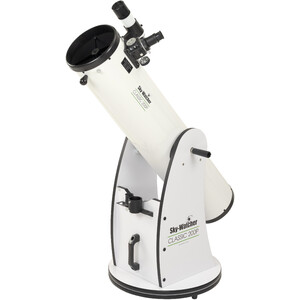
200 mm of aperture — the most sky for your money. Set it on the ground, point by hand: nebulae, clusters and galaxies for years to come.
Price: € 479
The accessories that make the difference
Eyepieces
The more capable your telescope, the more a set of quality eyepieces pays off. This is especially true on fast focal-ratio instruments like Dobsonians, where premium eyepieces show their full worth. Cheap eyepieces distort heavily toward the edge of the field, spoiling the view of extended objects. High-end eyepieces — TeleVue being the classic example — deliver a sharp, color-pure field right to the edge.
For lasting comfort, aim for 15–20 mm of eye relief and an apparent field of at least 65°. Generous eye relief is a must for eyeglass wearers. On light-hungry instruments, wide-field 2-inch eyepieces make large deep-sky objects sing. Finally, steer clear of zoom eyepieces, whose field is usually too narrow: a set of fixed-focal-length eyepieces is the better investment.
The Barlow lens
A Barlow lens extends the telescope’s focal length and multiplies magnification by two or three depending on the model. Because it adds elements to the light path, its quality is critical. On a large, fast reflector like a Dobsonian, it lets you reach high magnifications without resorting to very short — and often uncomfortable — eyepieces. The result: an instrument built for deep sky becomes equally capable of resolving lunar detail and planets.
The binoviewer
A particularly rewarding upgrade, the binoviewer lets you observe with both eyes. The image gains striking depth and comfort. If the price gives you pause, ask your local astronomy club or public observatory for a look through one: many observers were won over in a single night.
A telescope to observe AND photograph (the all-rounder)
The mount: top priority
The moment photography enters the equation, the mount becomes the most critical component — far more than the optics. You need a sturdy mount that carries the load with headroom to spare. Equatorial mounts rule here: once polar-aligned, they keep the target centered and track it without field rotation. That is the essential condition for long exposures on deep-sky objects.
Optics: the Schmidt-Cassegrain, a versatile compromise
Catadioptric systems such as the Schmidt-Cassegrain (SCT) strike a fine balance between aperture and focal length. Thanks to a folded light path, they pack a large diameter and a long focal length into a short, portable tube. You reach high magnifications with medium-focal-length eyepieces and comfortable eye relief, while enjoying strong light-gathering power.
With a focal reducer you lower the focal ratio (typically f/10) for wide-field imaging; with a Barlow you raise it for planetary work. On modern SCTs (Celestron EdgeHD and the latest series), placing a camera at prime focus even turns the instrument into an ultra-fast Schmidt camera around f/2. The catch is that this versatility demands an investment in accessories. The SCT remains an excellent, upgradeable foundation for both demanding visual observing and astrophotography.
Versatile all-rounder: Celestron NexStar 8 SE GoTo Telescope
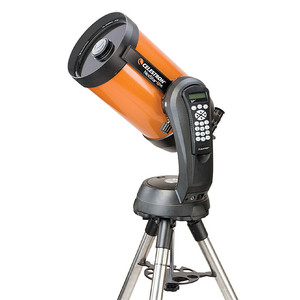
The 203 mm GoTo classic: finds over 40,000 objects at the push of a button — the advanced-level reference.
Price: € 2,149
The smart telescope: beautiful images at the push of a button
A smart telescope is an automated device that puts cutting-edge technology at the service of simplicity. With a built-in camera, automatic alignment and an intuitive smartphone app, it captures images without any complex post-processing. The results are striking and far more detailed than what the eye perceives at the eyepiece — especially on faint targets like nebulae and galaxies. For the seasoned amateur who wants to bring home images without assembling a full imaging rig, it is a remarkably effective route.
Effortless imaging: ZWO Seestar S30 Pro Smart Telescope

ZWO's benchmark smart telescope: a polished app, mosaic mode and stunning results in minutes.
Price: € 699
Specialist telescopes: planetary, deep sky, imaging
For the Moon and planets
To observe planets, the Moon and deep sky all at their best, you often need two instruments. High-resolution planetary work calls for high magnification and a high-contrast image. Long focal lengths excel here: the classic refractor or a catadioptric like the Maksutov. The refractor offers superior contrast because no secondary mirror obstructs the beam; but reaching a large aperture without chromatic aberration is costly. The Maksutov, by contrast, has small central obstruction and an image nearly free of spherical and chromatic aberration in a compact tube — an outstanding Moon-and-planet specialist.
How much aperture you really need for the Cassini division, the Great Red Spot or the polar cap of Mars — and which instruments manage it from $400400 € upwards — is covered in detail in our guide to which telescope for planets.
Moon & planet specialist: Skywatcher Maksutov Telescope MC 127/1500 SkyMax 127T OTA
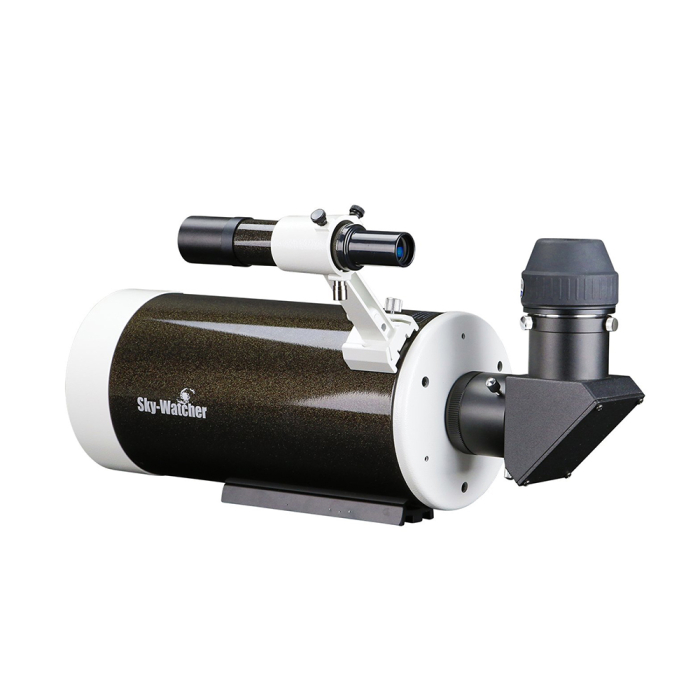
A compact, high-contrast Maksutov – the classic Moon-and-planet specialist.
Price: € 455
For deep sky
To observe or photograph deep-sky objects at their best, favor a large aperture to gather as much light as possible. Fast Newtonians are advantageous here; short-focal-length refractors are an appealing imaging alternative. For automated imaging, compact smart telescopes like the DWARF 3 stack exposures on nebulae and galaxies with disarming ease.
Automated deep sky: DWARFLAB DWARF 3 Smart Telescope
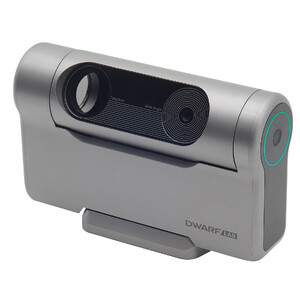
A 1.3 kg smart telescope: it photographs nebulae and galaxies straight to your phone, even from the city. The simplest way into astrophotography.
Price: € 529
The mount for two specialists
If you go for two specialist tubes, choose a mount that carries both comfortably. Plan for a possible move into photography too: keep around 50% payload in reserve compared with a visual-only setup. Finally, a motorized tracking mount — ideally equatorial — is indispensable the moment you want to photograph the deep sky.
Comparison table: which instrument for which profile?
| Instrument | Type | Best for | Astrophotography | Portability |
|---|---|---|---|---|
| Apertura AD8 8″ DobsonianSkywatcher Dobson Telescope N 200/1200 Skyliner Classic | Newtonian on Dobson mount | Visual deep sky, large aperture | No (visual) | Moderate |
| Celestron StarSense DX 130Celestron StarSense Explorer DX 130 AZ | Smartphone-guided Newtonian | Assisted star-hopping, all-round | Limited | Good |
| ZWO Seestar S30 ProZWO Seestar S30 Pro Smart Telescope | Smart telescope | Deep sky & wide field, auto imaging | Yes (auto) | Excellent |
| DWARF 3DWARFLAB DWARF 3 Smart Telescope | Smart telescope | Portable astrophoto, auto stacking | Yes (auto) | Excellent |
Tip: at this weight the setup itself becomes the obstacle — a 12-inch Dobsonian or a heavy mount does not want to go back in the cellar every night. What a permanent solution in the garden looks like, and what it costs, is in Garden observatory: dome, roll-off roof or tent.
* Affiliate link: if you buy through this link we may earn a small commission from Astroshop or High Point Scientific, at no extra cost to you.
Frequently asked questions
What is the best telescope for an advanced visual observer?
A large-aperture Dobsonian (200 mm or more) remains the top choice: it maximizes diameter for a contained price and reveals a wealth of detail in galaxies and nebulae. A truss-tube version makes it easier to travel to dark-sky sites.
Can you do astrophotography with a Dobsonian?
Not for long-exposure deep sky: even motorized, an alt-azimuth mount causes field rotation. The Dobsonian excels visually and can at best handle short planetary videos. To photograph the deep sky you need an equatorial mount or a smart telescope.
Is a smart telescope worth it for an advanced amateur?
Yes, as a complement. A model like the Seestar S30 Pro or the DWARF 3 lets you quickly capture images of nebulae and galaxies without a complex imaging rig — ideal for portable nights or as a secondary imager alongside a visual instrument.
Do you need one or two telescopes to do everything?
No single instrument is perfect for everything. A Schmidt-Cassegrain is the best all-round compromise. But for excellence in both planetary AND deep sky, two specialist tubes (a Maksutov or refractor for planetary, a fast Newtonian for deep sky) remain the better path.
Which accessories should you prioritize on an advanced telescope?
Good wide-field, fixed-focal-length eyepieces (15–20 mm of eye relief), a quality Barlow lens, and — for visual use — a binoviewer. These three investments transform the experience far more than swapping tubes.
Read next:
This article is also available in: Deutsch (original) · Français · Italiano