By Alexander Merz · Updated on · Details checked on 24 September 2026
The short answer by budget: Up to $150€150 you get a simple refractor for the Moon and the bright planets. Up to $200€200, a compact tabletop Dobsonian that also shows your first deep-sky objects. Up to $300€300 is the best compromise between aperture, price and space. Up to $500€500 gets you 200 mm of aperture – from here on, galaxies become more than just smudges. Which Dobsonians have proven themselves in these classes is covered in our Sky-Watcher Dobsonian review. Below $100€100 we don’t recommend any telescope: that’s where you find plastic optics with made-up magnification claims, and the evening your child can’t make out anything is the evening the hobby ends. Dollar amounts on this page are approximate: our budget brackets are based on European prices, and US prices for the same model usually land in a similar range. The current price is always the one on the product page.
If you are interested in astronomy, or already an astronomy enthusiast, and want to buy a telescope, the question is what kind of beginner telescope it should be. If you are already more experienced, you will find our telescope recommendations for advanced observers here.
First, a word about your personal expectations. As described in the article, even a good beginner telescope won’t deliver images like the ones you see in magazines or documentaries. But if your excitement comes from knowing the dimensions, distances, speeds and meaning of what you’re looking at, the views through a good beginner telescope will truly fascinate you.
That said, very impressive images – even in colour and without doing any elaborate photo editing yourself – are now possible. The solution is the new smart telescopes, which take over the astrophotography process instantly and on their own.
For a better understanding of the arguments for one telescope type or another, we refer you at this point to the article on the basics of telescopes and optics (telescope guide).
Our 3 telescope picks for beginners in 2026
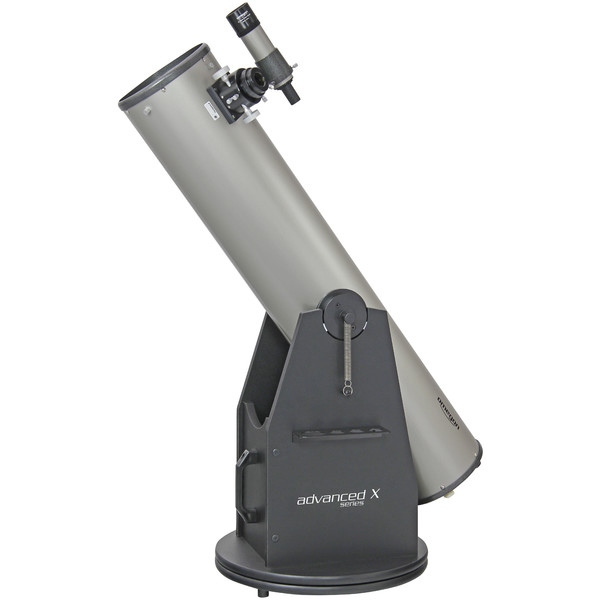
The 8-inch Dobsonian has been the most recommended choice in our community for years: 203 mm of aperture delivers impressive deep-sky views, and the simple Dobsonian mount is set up in minutes and practically indestructible. Our pick in this class is Astroshop’s house brand Omegon – same aperture and focal length as the Sky-Watcher classic. ● In stock · ready for shipping in 24 h
- You won’t get more telescope for your money right now
- 203 mm aperture: nebulae and galaxies, not just the Moon
- Set up in minutes, practically maintenance-free
- Alternative in the same class: Apertura AD8 8" Dobsonian TelescopeSkywatcher Dobson Telescope N 200/1200 Skyliner Classic ($699.95€ 479)
- Every Omegon model reviewed individually: Omegon telescopes reviewed
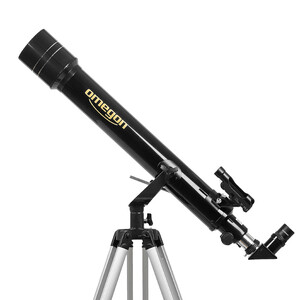
The cheapest start that won’t disappoint: a 70 mm refractor on a simple alt-azimuth mount, set up in five minutes and usually in stock. ● In stock · ready for shipping in 3-7 days
- Lunar craters, Jupiter’s moons and Saturn’s rings are a sure thing
- Maintenance-free: no collimation, no cool-down
- Light enough for kids and the balcony
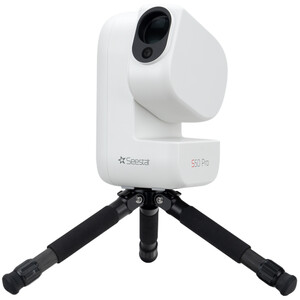
If astrophotos are what really tempt you and you don’t want a learning curve: the Seestar S50 Pro aligns itself fully automatically and photographs nebulae and galaxies in 4K at the push of a button via the app. ● Available to order
- 50 mm aperture: almost three times as much light as the S30 Pro
- Finished astrophotos on your phone in minutes, up to 9 h of battery life
- Cheaper alternatives with the same app: Seestar S30 Pro ($699.00€ 699) and DWARF 3 ($549.00€ 529)
Prices are synced with the shop automatically every day – details and alternatives follow further down in this guide.
Looking to buy a telescope? Here’s the quick check.
Beginner telescopes compared
What each instrument is good for
No telescope does everything equally well. This table tells you, for every model above, what it is good for and what it isn’t – calculated from aperture, focal length, design and mount, using the same rules for every instrument.
| Model | Price | Planets | Deep sky | Beginners |
|---|---|---|---|---|
| GSO 300/1500 DeluxeGSO 300/1500 Deluxe · 300 mm | $1,299.95€ 899 | excellent | excellent | unsuitable |
| Skywatcher 254/1200 Pyrex Skyliner ClassicSkywatcher 254/1200 Pyrex Skyliner Classic · 254 mm | $1,199.00€ 695 | excellent | excellent | limited |
| Omegon Advanced X 203/1200Omegon Advanced X 203/1200 · 203 mm | $699.95€ 499 | excellent | excellent | good |
| Skywatcher 200/1200 Skyliner ClassicSkywatcher 200/1200 Skyliner Classic · 200 mm | $699.95€ 479 | excellent | excellent | good |
| Omegon 150/750 EQ-3 · 150 mm | about $299€ 299 | excellent | good | unsuitable |
| Sky-Watcher Heritage 130 Tabletop DobsonianSkywatcher Heritage 130/650 FlexTube · 130 mm | $305.00€ 265 | good | good | excellent |
| DWARF 3DWARF 3 · 35 mm | $549.00€ 529 | unsuitable | unsuitable | excellent |
| ZWO Seestar S30 ProZWO Seestar S30 Pro · 30 mm | $699.00€ 699 | unsuitable | unsuitable | excellent |
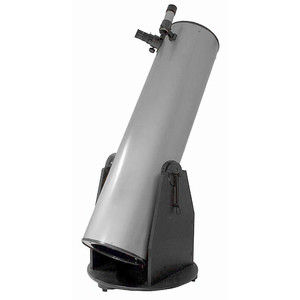
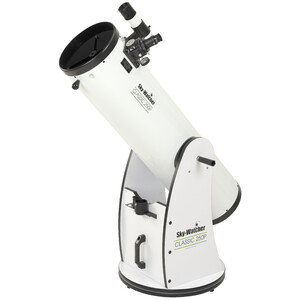
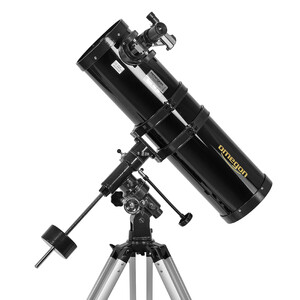
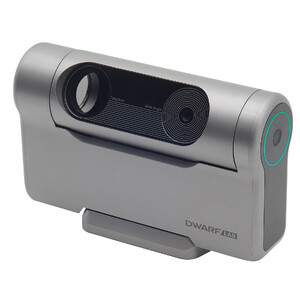

We derive the rating from aperture, focal length, design and mount – using fixed rules, the same for every instrument.
Prices are synced with the shop automatically every day; product names link straight to the offer. Not sure which type suits you? Our telescope finder takes you to the right instrument in 2 minutes.
What is a good telescope for beginners?
To get a satisfying answer to this question, you first have to be clear about what you want to observe.
| Budget | Recommended telescope* | Price |
|---|---|---|
| up to $150150 € | Celestron AstroMaster 70AZ RefractorOmegon Telescope AC 70/700 AZ-2 | $199.95€ 119 |
| up to $200200 € | Orion SkyScanner 100mm Tabletop Reflector TelescopeSkywatcher N 100/400 Heritage Telescope | $129.95€ 179 |
| up to $300300 € | Sky-Watcher Heritage 130 Tabletop DobsonianSkywatcher Dobson Telescope N 130/650 Heritage FlexTube | ⭐ Best-value tip$305.00€ 265 |
| up to $500500 € | Orion SpaceProbe 130ST EQ Reflector TelescopeOmegon Advanced Telescope 130/650 EQ-320 | $329.95€ 399 |
| up to $1,0001,000 € | Celestron StarSense Explorer 10" DobsonianSkywatcher Dobson Telescope N 254/1200 Pyrex Skyliner Classic | $1,199.00€ 695 |
| up to $1,5001,500 € | Apertura AD12 Dobsonian 12" Telescope with AccessoriesSkywatcher Dobson Telescope N 305/1500 Skyliner FlexTube | $1,299.95€ 1,299 |
What do you want to observe?
Every telescope type has strengths and weaknesses from which its preferred observing area can be derived. Broadly speaking, there are three areas to distinguish for observing with a beginner telescope:
If you don’t immediately answer the question about your favourite observing area with “planets”, you’re certainly best served by a deep-sky or all-round telescope. Why is that?
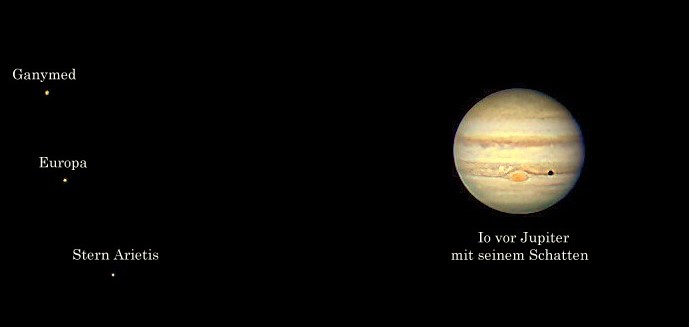
Equipment: Celestron Next Star 6 SE* mit ASI 120 MC
The objects you can observe even with a good planetary telescope (refractor) are fairly limited compared with the wealth of deep-sky objects that only become accessible above a certain aperture, and therefore with good light-gathering power. The key point: on a limited budget, reflecting telescopes (reflectors) give you larger apertures than a lens telescope (refractor).


Telescope or binoculars: which is the better start?
Before you decide on a model, it’s worth asking an honest question in between: Does it have to be a telescope at all? For many beginners, binoculars are the better first step.
A pair of 10×50 – ten times magnification, 50 millimetres of aperture – shows you the large lunar craters, Jupiter’s four bright moons as points of light, the Pleiades and the Andromeda galaxy as a faint smudge. It’s at your eyes in thirty seconds instead of twenty minutes on the tripod.
The limit is just as clear: In binoculars, planets remain tiny discs, and Saturn’s rings can’t be separated from the planet. If that’s exactly what you want to see, you need a telescope.
When choosing, one number helps that is rarely explained: the exit pupil. It is aperture divided by magnification, so 5 millimetres for a 10×50.
That matches the pupil of an adult eye in the dark. Much larger values waste light because your eye can no longer take in the whole cone of light – which is why a 20×80 is not automatically the better astronomy binocular.
We cover the detailed comparison with a worked example in a separate article: Telescope or binoculars? Which sizes are worth it is explained in our buying guide for astronomy binoculars.
The honest first step: Celestron Cometron 7x50 Binoculars
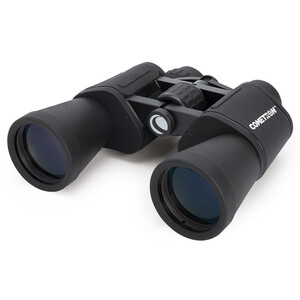
The astronomy classic among affordable binoculars: 7×50 with a large exit pupil for bright handheld views of the Moon and Milky Way – the ideal first step before a telescope.
Price: € 65
What you’ll really see – and what you won’t
Before you read on: choose the instrument you’re interested in here and see how large Jupiter, Saturn or the Andromeda galaxy really appear in the eyepiece – calculated to scale, not photographed.
Object
- Magnification
- –
- True field of view
- –
- Exit pupil
- –
- Limiting magnitude
- –
- Resolution (Dawes)
- –
Drawn to scale: the circle is the eyepiece view, the objects appear at the size that follows from magnification and field of view. Colours and brightness are simplified – the nebula stays grey in the eyepiece, the galaxy a faint glow.
This telescope delivers this view
Skywatcher Dobson Telescope N 130/650 Heritage FlexTube
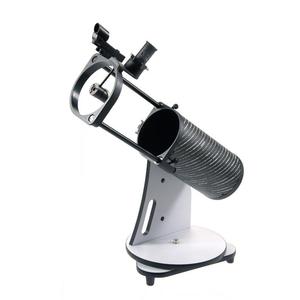
A compact tabletop Dobson with a true parabolic mirror. Folds down, fits in a bag: the Moon, planets and the bright deep-sky classics.
Price: € 265
This telescope delivers this view
Skywatcher Dobson Telescope N 200/1200 Skyliner Classic
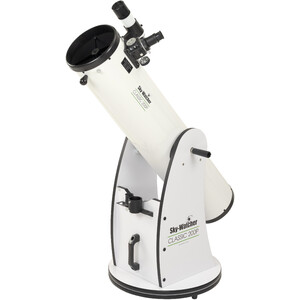
200 mm of aperture — the most sky for your money. Set it on the ground, point by hand: nebulae, clusters and galaxies for years to come.
Price: € 479
This telescope delivers this view
Omegon Telescope AC 70/700 AZ-2

The no-pitfall starter refractor: Moon, Saturn's rings and Jupiter's moons from the very first night. No collimation.
Price: € 119
This telescope delivers this view
ZWO Seestar S50 Pro Smart Telescope

The direct successor to the Seestar S50: a 50/260 apochromatic quadruplet, two cameras and a built-in dual-band filter that pulls nebulae out of a city sky.
Price: € 999
This telescope delivers this view
Celestron Cometron 7x50 Binoculars
The astronomy classic among affordable binoculars: 7×50 with a large exit pupil for bright handheld views of the Moon and Milky Way – the ideal first step before a telescope.
Price: € 65
The most common reason a telescope disappears into the basement after three evenings is not a technical one, but a mistake in expectations.
The images you know from Hubble and the James Webb Space Telescope are exposures lasting hours, often in false colour. They don’t show what actually reaches the eyepiece.
What a beginner telescope really shows: Lots of lunar craters casting shadows, the phases of Venus, Saturn’s rings as a clearly separated structure, Jupiter’s cloud belts and its four large moons, plus double stars, bright star clusters and the Orion Nebula.
What it doesn’t show: colourful nebulae and the spiral arms of galaxies. Visually, deep-sky objects appear as grey, misty patches.
That’s down to your eye, not the instrument: in low light only the colour-blind rods of the retina are at work. Even a 300 mm Dobsonian won’t show colour.
The best-known telescope types at a glance
What follows is a short summary of the main advantages and disadvantages of the most important telescope types. For more details and how they follow from optics, see the basics article on telescopes.
| Refractor (lens telescope) | |
| Advantages | Disadvantages |
|
|
| Reflector (mirror telescope) | |
| Advantages | Disadvantages |
|
|
| Catadioptric telescopes (lens-mirror telescopes) | |
| Advantages | Disadvantages |
|
|
In short: what matters for your first telescope
Three things decide whether your first telescope will be fun: Aperture before magnification (the diameter of the lens or mirror determines what you can see at all), a stable mount (a wobbling image ruins even the best optics) and accessories later (what comes in the box is enough to start with; most of the budget belongs in the optics). A tracking motor and a GoTo system aren’t needed for getting started. All buying criteria, designs and price classes are explained in detail in our buying guide Buying a Telescope.
Does it make sense to buy a telescope kit?
Almost all complete telescopes come with accessories. As mentioned above, the basic equipment of a telescope kit from a reputable brand is perfectly sufficient to start with and should, if at all, only be supplemented with very specific accessories such as a solaror moon filter. If you want to get deeper into astronomy later, you can improve your astronomy experience with targeted purchases.
We strongly advise against department-store telescopes from no-name manufacturers that come with a many-part accessory set. The quality and workmanship of the parts are almost always inadequate for serious astronomical observing.
Beginner telescopes: the most common mistakes!
There are a number of pitfalls that can permanently spoil your first astronomical observing experiences.
- Unrealistic expectations
- Wrong priority
Putting more value on maximum magnification than on maximum aperture (see telescope guide) - Budget not focused on the best optics
- Accessories with a barrel size of 0.96 inch (24.5 mm) instead of 1.25 inch – there are hardly any usable eyepieces for it, and the supplied ones are rarely any good
How much does a telescope cost?
A decent beginner telescope costs about $250€250 to $350€350. Below that begins the range where the optics do show an image but the wobbly mount spoils every view. There’s no upper limit – but from around $500€500 you’re already buying considerably more than a beginner needs.
What you get in each price class, at a glance:
| Price class | What you get | Example |
|---|---|---|
| under $150150 € | Toy optics on a wobbly tripod. The Moon works, everything else is frustrating – the most common bad buy | — |
| 150–$250250 € | Small tabletop Dobsonians. Lunar craters and Jupiter’s moons are within reach; for detail on planets the aperture is lacking | Sky-Watcher Heritage 130 Tabletop DobsonianSkywatcher Heritage 130/650 |
| 250–$350350 € | ⭐ Our pick for getting started150 mm aperture: Saturn’s rings clearly separated, cloud belts on Jupiter, first galaxies and nebulae | Sky-Watcher Heritage 150 Tabletop DobsonianSkywatcher Heritage 150/750 FlexTube |
| 350–$600600 € | A full-size 8-inch Dobsonian. More aperture means more light – the biggest leap you can make for the money | Skywatcher Dobson 200/1200Skywatcher Dobson 200/1200 |
| from $700700 € | Tracking, GoTo or photo capability. Makes sense if you want to take photos – not to see better | Skywatcher Explorer 150/750 PDS with EQM-35 GoTo |
Links marked with an asterisk are affiliate links. Current prices: Heritage 130/650 $305.00€ 265, Heritage 150/750 $355.00€ 345, Dobson 200/1200 $699.95€ 479.
How much does a good telescope cost?
Around $300€300 to $500€500. In this range you get 150 to 200 mm of aperture on a stable Dobsonian mount – the combination that carries beginners for years and that experienced observers still use. It only gets more expensive once photography comes into play.
How much does a telescope for kids cost?
about $80€80 to $200€200. Here robustness counts for more than aperture – details in our buying guide for kids’ telescopes.
How much does a beginner telescope cost?
The exact price depends on the telescope type, mount and accessories – the range above shows what’s realistic in each class.
Usable beginner telescopes start at around $250€250 to $300€300 – typically compact tabletop Dobsonians like the Heritage FlexTube from our comparison table. A full-size 8-inchDobsonian (i.e. a reflector) costs just under $500€500. If you lean towards a refractor, you should plan on around $800€800 for the telescope.
The best observing dates, explained in plain language, plus honest buying advice without the marketing noise. Free, unsubscribe any time.
You will get a confirmation email in a moment. Your address stays with us – no sharing, no third-party ads.
Hobby telescope for adults: observing from home
Most people looking for a beginner telescope are adults fulfilling the old dream of their own telescope for the stars – they want a real telescope for their new hobby, not a toy. That’s why all recommendations on this page are aimed at adults and teenagers. For the next generation we have our own buying guide for kids’ telescopes.
You can observe right from home: for getting started, a balcony, a patio or the garden behind the house is perfectly enough. The Moon, planets and bright double stars are so bright that you can observe them despite street lighting, even from the middle of a city – exactly the objects with which the astronomy hobby begins for almost everyone.
Only for faint deep-sky objects such as galaxies and nebulae is a trip to a darker site worthwhile. So before buying, think about where your telescope will stand: for a permanent spot in the garden it can be a large Dobsonian; for a balcony or a car boot, a compact tabletop Dobsonian or a short refractor fits better.
Test winners: what do independent consumer tests say?
Short and honest: there is no telescope test by Stiftung Warentest, Germany’s best-known consumer testing organisation – it has never tested astronomical telescopes so far (as of August 2026). The “test winners” crowned by comparison sites are almost always based on spec sheets and shop reviews, not on nights at the eyepiece.
Instead, our recommendations come from practice: from our own observing and from what has proven itself as the beginner standard in the astronomy community for years – above all the 8-inch Dobsonian and the compact Heritage FlexTube from the comparison table above.
Recommended beginner telescopes
If you follow the flowchart for choosing a telescope, you’ll be asked to pick your main observing focus.
Reflectors
If you choose a beginner telescope for observing deep-sky objects or for all-round observing, a reflector is the one to go for.
They offer the best value for money in the beginner range.
Dobsonian telescope
If you want to invest your budget in the best possible optics for your telescope, a Dobsonian telescope is exactly right. Almost your whole budget goes into the optical tube. In return you get a large aperture for your money, a parabolic mirror and high-quality components (focuser).
The mount is kept simple, basic and robust (rocker box). If you want more comfort from your mount at a later stage, you can keep your optical tube. You only need to buy a sufficiently stable mount of your choice and the tube rings that fit the tube. The supplied accessories are enough to start with and can be sensibly extended later.
| Recommended Dobsonian | Aperture | Strength | Price |
|---|---|---|---|
| Apertura AD8 Dobsonian 8" Telescope with AccessoriesOmegon Advanced X N 203/1200 Dobsonian | 203 mm | our pick: the most telescope for the money, Astroshop house brand ● In stock · ready for shipping in 24 h | $699.95€ 499 |
| Apertura AD8 8" Dobsonian TelescopeSkywatcher Dobson Telescope N 200/1200 Skyliner Classic | 200 mm | the Sky-Watcher classic, same class ● In stock · ready for shipping in 3-7 days | $699.95€ 479 |
| Celestron StarSense Explorer 10" DobsonianSkywatcher Dobson Telescope N 254/1200 Pyrex Skyliner Classic | 254 mm | more aperture, still portable | $1,199.00€ 695 |
| Apertura AD12 12" Dobsonian TelescopeGSO Dobson Telescope N 300/1500 Deluxe | 300 mm | maximum aperture for deep sky | $1,299.95€ 899 |
Newtonian reflector
If you value a comfortable mount, you either have to invest a little more or accept small compromises on the optics. A reflector on an equatorial mount makes a very good all-round telescope for beginners. Good light-gathering is combined here with the more convenient equatorial mount. The supplied accessories are enough to start with and can be sensibly extended later.
| Recommended Newtonian | Aperture | Strength | Price |
|---|---|---|---|
| Orion SpaceProbe 130ST EQ Reflector TelescopeOmegon Advanced Telescope 130/650 EQ-320 | 130 mm | compact and bright | $329.95€ 399 |
| Skywatcher Telescope N 150/750 Explorer 150P EQ3-2 | 150 mm | proven mechanics, good optics | about $590€ 590 |
| Apertura AD8 8" Dobsonian TelescopeSkywatcher Telescope N 200/1000 Explorer 200P EQ5 | 200 mm | lots of aperture, photo-capable later (EQ5) | $699.95€ 824 |
Refractors
If you commit from the start to the best possible planetary and lunar observing, you’re best served by a refractor or a Maksutov. Bright refractors need large lenses. To reduce colour fringing caused by chromatic aberration, different lens glasses have to be cemented together (apochromat, achromat). This makes bright apochromatic refractors very good but also very expensive telescopes. Depending on the budget, compromises have to be made on the optics. Refractors are almost exclusively mounted on tripod mounts, so part of the budget also has to go into the mount. Good beginner telescopes of this type therefore require a bigger investment than reflectors.
| Recommended refractor | Aperture | Strength | Price |
|---|---|---|---|
| Celestron AstroMaster 70AZ RefractorOmegon Telescope AC 70/700 AZ-2 | 70 mm | slim start for the Moon and planets | $199.95€ 119 |
| Orion AstroView 102 mm EQ Refractor TelescopeBresser Telescope AC 102/1000 Messier Hexafoc EXOS-2 | 102 mm | sharp planetary views on a stable mount | $349.95€ 778 |
| Bresser Telescope AR 152L/1200 Messier Hexafoc EXOS-2 | 152 mm | the big classic refractor | about $1,287€ 1,287 |
There’s obviously no one-size-fits-all answer. Every telescope type has advantages and disadvantages, as explained in this article.
Basically, you should decide whether you’re more interested in planetary or deep-sky observing. Of course there are also very good all-round telescopes, but at a noticeably higher price. You’ll find decision help with explanations of the basics here.
Depending on the type you choose, quality beginner telescopes start at around $250€250. Dobsonian telescopes offer the most optical performance for the money in the beginner range and are particularly suited to deep-sky observing.
With quality telescopes, you can usually start observing straight away and without problems using the included accessories. They’re perfectly sufficient to start with.
If you want to improve your observing results further, you can later add useful accessories such as filters and eyepieces.
There are also general tips that may be of interest to beginners.
How we choose these telescopes
We want to be straight about what this list is and what it is not. We do not run a laboratory, and we do not claim to have taken every one of these instruments out under the sky ourselves. What we do:
- Aperture per dollareuro comes first. Aperture decides what is visible at all. Anything that spends the budget on motors, gadgets or a bundle of cheap accessories instead of glass drops out.
- The mount has to carry the optics. A tube on a wobbly tripod is unusable above about 100×, no matter how good the optics are. That rules out most of what the big-box stores sell.
- It has to be available from a specialist dealer, with a return policy and someone to ask. Marketplace listings with no service behind them are not on this list.
- Prices are checked automatically against the shop every day, so the numbers on this page are not months out of date.
- We name the trade-offs. Every recommendation here has a downside, and you will find it written next to the recommendation.
Where we do have first-hand experience with an instrument, we say so on the individual review page rather than implying it here.
More questions about your first telescope
Which telescope to see Saturn’s rings?
From 70 mm of aperture and 100× magnification the rings are clearly visible — even the Celestron AstroMaster 70AZ RefractorOmegon AC 70/700 AZ-2 ($199.95€ 119) shows them. With an 8″ (200 mm) Dobsonian you’ll make out the Cassini division between the rings.
Which telescope to see the planets?
A 70–90 mm refractor or a 114–130 mm reflector is enough for Jupiter (cloud bands, four moons), Saturn and the phases of Venus. For fine detail on Mars, aim for 150 mm and up.
Which telescope to observe galaxies?
Galaxies are faint: you need aperture. From 130 mm under a good sky you’ll see Andromeda and the bright Messier galaxies; a 200 mm (8″) Dobsonian reveals dozens. Alternative: a smart telescope, which photographs them even from the city.
Do I need a GoTo (automatic pointing) telescope?
For visual beginners, no: finding objects is part of the fun and the GoTo budget is better spent on aperture. If locating objects worries you, the Celestron StarSense Explorer DX 130AZCelestron StarSense Explorer DX 130AZ ($449.95€ 599) guides you via smartphone — or go straight to a smart telescope.
Do I have to collimate a reflector, and how often?
Yes, a Newtonian reflector needs its mirrors aligned occasionally — that is called collimation. In practice: check when you unpack it, then after transport, and otherwise a few times a year. It takes minutes once you have done it, and a simple collimation cap is enough to start. Refractors and smart telescopes need none of this.
Which eyepiece should I buy second?
Not the strongest one. Most beginners buy a very short focal length, discover the image is dark and mushy, and stop there. A better first purchase is a wide-field eyepiece around 25–30 mm for clusters and nebulae, and a good 2× Barlow, which doubles what you already have. Skip the 4 mm and 5 mm eyepieces that come in cheap kits.
Where do I store it, and does the cold do any harm?
Cold is fine — condensation is not. Store the telescope somewhere unheated if you can, a garage or a shed, so it is already close to outside temperature when you observe. If it lives indoors, put it out 30 to 45 minutes before you start and let it cool. When you bring it back in, leave the caps off for an hour so any moisture can evaporate. Measure the storage spot before you buy an 8-inch Dobsonian: it is roughly the size of a large suitcase and you will carry it out every time.
Do I need power or batteries?
A Dobsonian needs nothing at all. GoTo mounts, smart telescopes and StarSense-style systems need power, and the supply is often not included — check that before you order, and plan for a power bank if you observe away from the house.
Smart telescopes: the easy route to your first astrophotos
For a few years now there has been a class of instruments that makes getting started radically simpler: smart telescopes. Camera, mount, tracking and image processing are all in one housing – set it up, open the app, tap an object, and the instrument photographs nebulae, galaxies and star clusters fully automatically. For classic visual observing (looking through the eyepiece yourself), Dobsonians & co. remain the right choice; but if pictures are what you want most, this is where you get the fastest results.
The smart telescopes we recommend for beginners
- DWARFLAB DWARF 3 ($549.00€ 529): Ultra-light (under 1.5 kg), weatherproof, with a built-in filter wheel – the most versatile instrument in the budget class and perfect for travel.
- ZWO Seestar S50 Pro ($999.00€ 999): The successor to the bestselling Seestar S50, with a 50 mm quadruplet apo, 4K sensor and wide-angle camera – our first choice if the budget allows. Details in the Seestar S50 Pro review, the direct comparison in Seestar S50 Pro vs. S30 Pro.
- ZWO Seestar S30 Pro ($699.00€ 699): The smaller sibling with four-element apo optics and a dual camera – the same app, a wider field of view, and $200€200 cheaper.
- For the ambitious: Vaonis Vespera Pro 2 Smart TelescopeVaonis Vespera Pro II ($2,990.00€ 2,990) or the Unistellar eVscope 2 – we tested the latter in detail: to the eVscope 2 review.
You’ll find a detailed overview of the technology, strengths and limits of this class of instrument in our guide smart telescopes for beginners.
Our smart pick: ZWO Seestar S50 Pro Smart Telescope
The direct successor to the Seestar S50: a 50/260 apochromatic quadruplet, two cameras and a built-in dual-band filter that pulls nebulae out of a city sky.
Price: € 999
📚 Read on: even more targeted buying advice
- 💶 Telescopes under 300 – the three best budget telescopes of 2026 (prices currently verified)
- 📱 DWARF 3 review – the most versatile smart telescope under $700€700
- 🔭 Seestar S50: is it still worth buying? – and which alternatives are available right away
- 🧒 Telescopes for kids – age-appropriate recommendations
- 🏆 Telescope test 2026 – the 6 best telescopes compared head to head
- 🎒 First accessories for your telescope – what you really need
- 📱 Celestron StarSense Explorer review – a smartphone-guided finder for beginners