By Alexander Merz · Updated on · Details checked on 21 September 2026
Looking to buy a telescope for children? – Your child is fascinated by constellations, planets and the universe, and you would like to support this interest by getting your child a telescope, but aren’t quite sure what really matters?
The following article aims to give a comprehensive overview of the most important considerations and particularities when buying a telescope for children. We have also put together some basic knowledge about the optical properties of telescopes for you.
In the end you should be able to understand the telescope recommendations or make a deliberate decision in favor of a different telescope.
Our children’s telescope recommendations by age (2026)
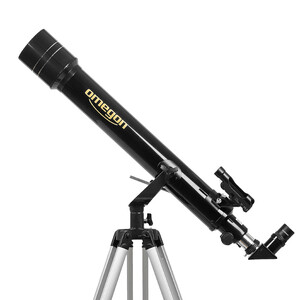
A rugged, simple refractor: barely any maintenance, ready to use straight away, ideal for the Moon and bright planets. The perfect first taste of astronomy.
- Set up in a few minutes – no tools needed
- Survives even impatient little hands
- Sharp lunar craters on the very first night
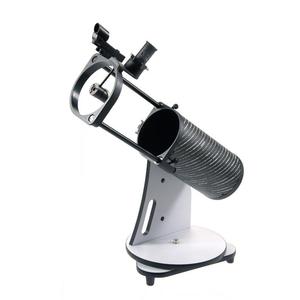
Plenty of aperture for first deep-sky views, has a compact tabletop design and, thanks to the Dobsonian principle, is child’s play to operate.
- 130 mm aperture reveals star clusters and bright nebulae
- Compact enough to sit on a table or shelf
- Intuitive panning with no tech frustration
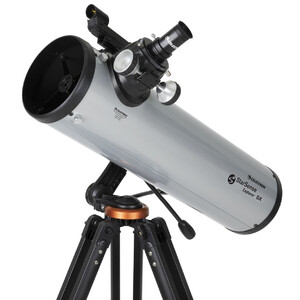
Finds celestial objects via smartphone navigation – the app guides you to the target. Motivates teenagers who want quick results.
- The app leads you to the object in real time
- Large 130 mm optics for planets and deep-sky
- Ideal when patience isn’t (yet) a strong point
All prices browser-verified on 07/15/2026 – you’ll find details and alternatives further down in the guide.
If you want more: the Dobsonian that lasts a lifetime
The three instruments above are built for children’s hands: light, set up in minutes, hard to get wrong. But if your child has been at it for a year, finds objects unaided and starts asking about galaxies, the next sensible step is not another children’s telescope – it is a full-size Dobsonian with 200 mm of aperture (the diameter of the mirror). That is more than twice the light-gathering area of the 130 mm, and it is where faint smudges first turn into globular clusters in which you can tell individual stars apart.
To be honest about it: the instrument weighs a good 25 kg and is carried outside in two parts. Until roughly age 14 that is a job for the grown-ups. For a six-year-old it is therefore not the better telescope but simply the wrong one – the extra cost only pays off once curiosity has turned into a hobby and someone is there to help carry.
For more advanced observers: Skywatcher Dobson Telescope N 200/1200 Skyliner Classic
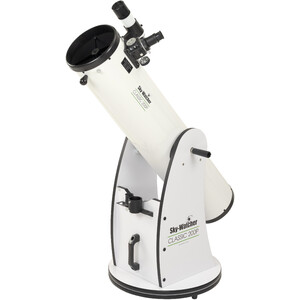
200 mm of aperture — the most sky for your money. Set it on the ground, point by hand: nebulae, clusters and galaxies for years to come.
Price: € 479
Children’s telescopes compared by price
Prefer to decide by budget? Here are our tested budget alternatives – from an affordable first optic all the way to a full-fledged beginner’s instrument. The prices update themselves, so what you see below is the current one:
| Entry level $79.95€ 125 | Mid range $329.95€ 319 | Most aperture $359.95€ 349 |
|---|---|---|
| Celestron Travel Scope 70mm Portable Refractor | Celestron AstroMaster 90AZ Refractor | Celestron AstroMaster 102AZ Refractor (102mm, f/6.5) |
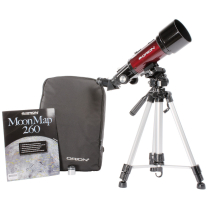 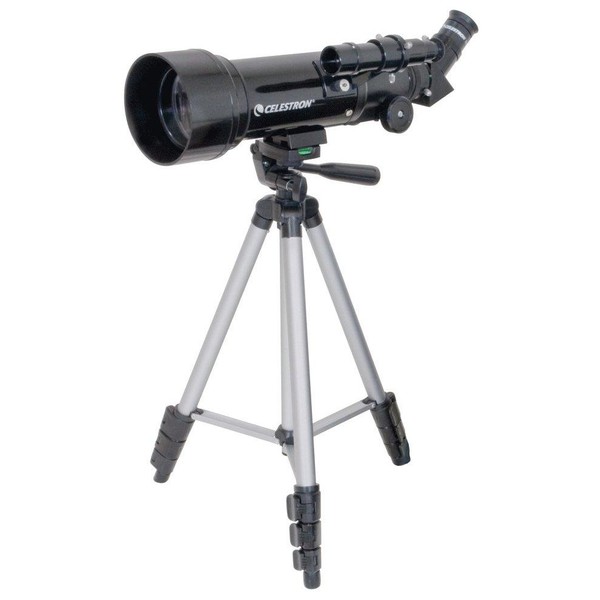 | 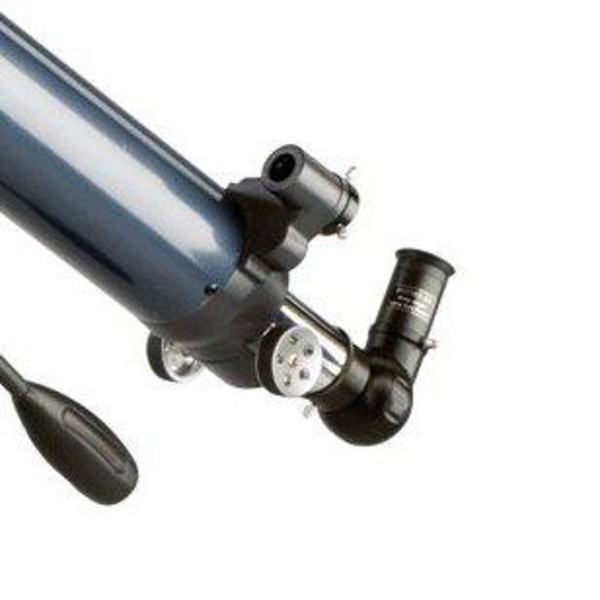 | 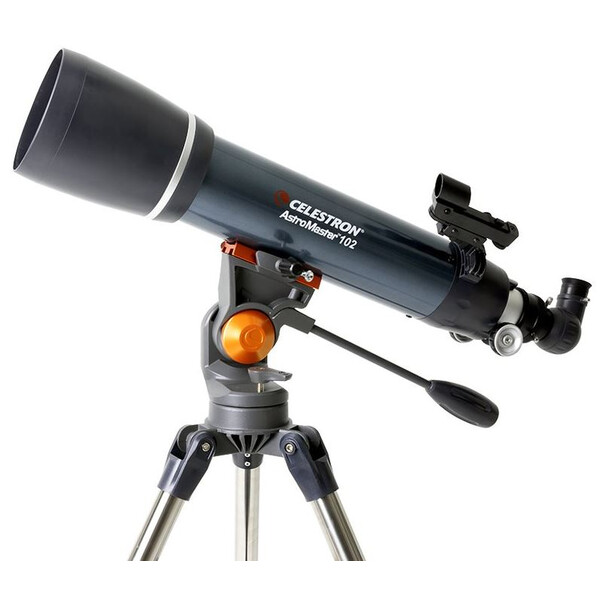 |
| Check availability*Check availability* | Check availability*Check availability* | Check availability*Check availability* |

Looking to buy a telescope? Here is the quick check.
Telescope for children – how skilled does the child need to be?
The most important quality your child should have is an interest in astronomy. Of course your child needs a certain amount of dexterity (see the next section), but to make a sensible investment in a telescope it is important to correctly gauge their interest and expectations.
If the interest is only a flash in the pan and expectations are very high, the astronomical experience is bound to end in disappointment and the telescope will be put away for good. This aspect should be taken into account when setting the budget.
At what age can I put a telescope in a child’s hands?
There is certainly no general age limit for using a telescope, but it is clear that the child should have sufficient dexterity to operate it. For this reason a telescope with a stable, rugged mount is recommended, even if this reduces the optical performance for the same budget. Aiming the telescope should be done intuitively via two slow-motion knobs, which is why an altazimuth mount is primarily the best choice.
With a telescope for children you should aim for a compromise between stability, intuitive operation and optical performance.
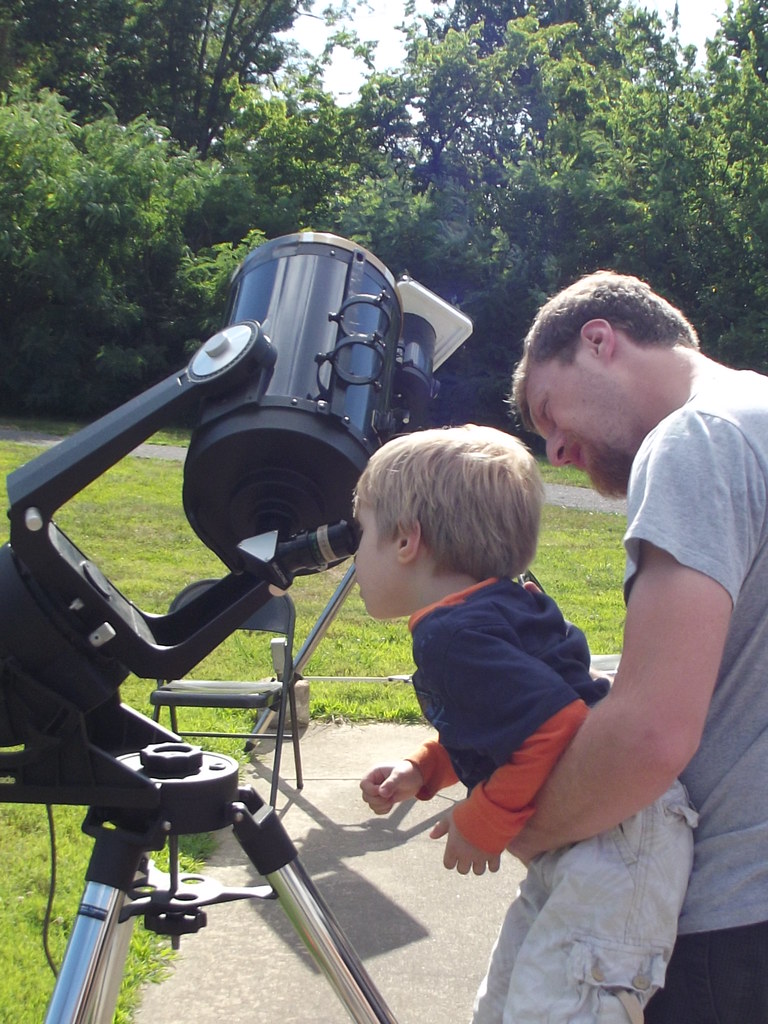
What to look for in a telescope for children (children’s telescope)?
Mount and tripod
As mentioned above, an altazimuth mount has advantages:
- intuitive operation
- simple, rugged design
- low cost
Alternatively an equatorial mount is also possible, even if its advantages will probably not be used.
The mount should sit on a tripod with three extendable aluminum legs for individual height adjustment.
Mounts that allow automatic pointing to a celestial object (so-called Go-To mounts) are expressly discouraged. The advantages of such a system only come into play with correspondingly powerful optics. For beginners the disadvantages outweigh them:
- Installation, calibration and use are not trivial (often in English, astronomy knowledge required)
- combined with weak optics, most of the stored objects are not visible
- expensive
Optics
A refractor is recommended as the optical system for a children’s telescope. A refractor is best at showing easy and frequently observed objects such as the Moon and planets. Some deep-sky objects (the Orion Nebula, star clusters) can be observed too. In addition, aiming the telescope at the night sky is simple when the viewing direction and the optical axis are the same. Furthermore, a refractor can also be used for nature observation (with an erecting prism) during the day.
Answer a few short questions and we will send you a personal recommendation that fits your budget, your experience and what you want to observe.
Find my telescope →The alignment of the lenses to one another (collimation) is fixed by the tube and normally stays in place. This makes the lens telescope (refractor) a rugged, low-maintenance telescope.
Unlike refractors, mirror telescopes (reflectors) have to be adjusted from time to time. Most children would be overwhelmed by this.
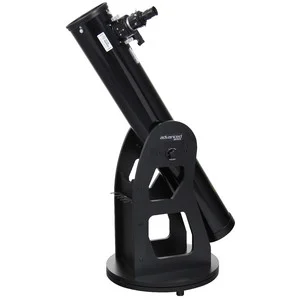
But if you really want to get the most optical performance out of your children’s telescope, a small tabletop Dobsonian is a very good and inexpensive entry point. You should, however, keep in mind the disadvantages of mirror telescopes described above.
Beware of department-store telescopes
Department-store telescopes are strongly discouraged. They are often advertised with higher performance figures than telescopes from a reputable manufacturer (e.g. a Skywatcher telescope) at the same price. The reason for this is that department-store telescopes cut back massively on the quality and workmanship of their components.
Star oracle
Find out which star you are!
Lenses are made of plastic, as are moving, wear-prone parts, and the collimation of the optical components is so imprecise that no usable image can form at all. The abundant accessories are often useless and completely superfluous. Buying one is a recipe for disappointment.
The image quality of a telescope from a reputable manufacturer, at the same price, beats the department-store telescope by a mile – even if the quoted performance figures look much weaker at first glance.
What can I observe with a telescope for children?
As described above, a telescope for children is a compromise. Squeezing the maximum optical performance out of a given budget is not sensible, because operation and aiming would otherwise become considerably more demanding. With a refractor, however, many objects that are easy to aim at can be shown:
- the Moon with its cratered landscapes (especially along the terminator)
- Saturn with rings
- Jupiter with its four moons and coarse cloud bands
- Venus as a disc in various phases
- Mars as a disc
- Orion Nebula
- Star clusters (Pleiades)
- Nature observation (with a prism for a correct image)
Here is an overview: Astronomical highlights in the Northern Hemisphere: a comprehensive year-round overview
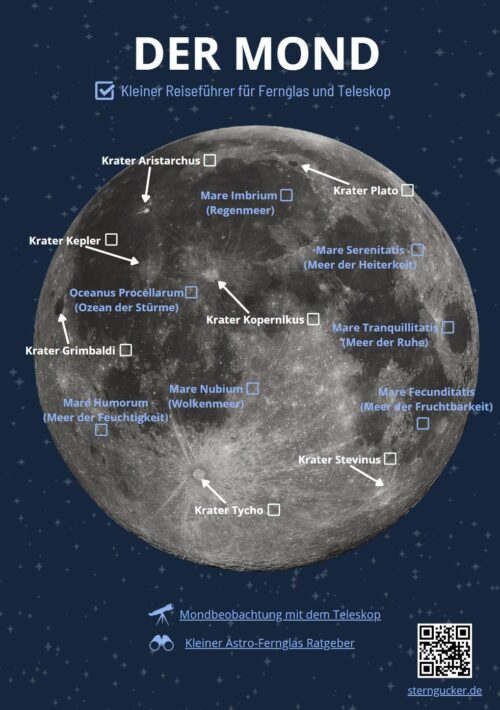
Parents often ask themselves “How do you explain the stars to children?“. I have tried to answer this question in the linked article. Using simple examples and comparisons from everyday life, the aim is to foster the child’s understanding.
Where is the best place to use a children’s telescope?
At the start you should use the children’s telescope on your own balcony or in the garden. This has the advantage that you can warm up indoors now and then, or check something about the evening sky on your star chart or online (even if this means losing your eyes’ dark adaptation).
Once you have a routine with the telescope and the accessories, you should also head out to a remote, dark spot to experience the difference between the city (light pollution) and the countryside.
Telescope for children: which accessories make sense?
With accessories you should be very sparing at first. The accessories supplied with the telescope are perfectly sufficient to begin with. If the interest in astronomy persists or deepens, you can always add more. There are, however, a few sensible additions to the telescope and its accessories:
- Moon filter
Improves contrast and reduces the brightness of the otherwise dazzling Moon - Solar filter
ABSOLUTELY essential if you want to observe the Sun! - Planisphere
An adjustable star chart made of sturdy material showing the most important objects - Red light
Home-made or ready-bought
Children’s telescope recommendation
For a children’s telescope, based on the aspects explained above, a refractor with a simple mount is recommended. A specific telescope is recommended depending on your budget.
You’ll find our specific model recommendations with a price comparison at the top of the article.
Before the first telescope, binoculars are often the better start. Which pair suits which age is covered in our guide to kids binoculars.
Frequently asked questions about telescopes for children
Most entry-level models for children fall within a price range of $100 to $500about 90 to 300 euros.
The important thing is to find a good compromise between stability, optical performance and ease of use in a children’s telescope.
For this we have explained a recommendation for each price category.
It is certainly not possible to define a general age limit for using a telescope for children, but it is clear that the child should have sufficient dexterity to operate it.
For this reason a telescope with a stable, rugged mount is recommended.
Once you have informed yourself – for example in a guide article about children’s telescopes – about what matters when buying, you can conveniently order the telescope online.
A very good and affordable telescope to get children started is a tabletop Dobsonian.
Sources
- “Golden Pond Observatory” by LandBetweentheLakesKYTN is licensed under CC BY-SA 2.0 , retrieved 04.01.2020