
By Alexander Merz · Updated on · Details checked on 14 September 2026
The next new moon is on Saturday, 10 October 2026 at 16:50 BST (UK time). The nights dark enough for deep-sky run from 6 to 14 October.
At new moon, the Moon stands between the Earth and the Sun – its lit side faces away from us and its night side towards us. That is why the Moon is invisible in the sky during this phase. For stargazers this is no loss but a gift: new moon nights are the darkest and best observing nights of the whole month.
What happens at new moon?
The Moon circles the Earth in about 29.5 days (the synodic month). Once per orbit it stands in the same direction as the Sun as seen from Earth. Astronomers call this conjunction.
Because the Sun then lights only the side of the Moon facing away from Earth, we see – nothing. The Moon rises and sets roughly with the Sun and stands invisibly in the daytime sky.
Only when the geometry is perfect and the new moon passes exactly in front of the Sun’s disc do we get a solar eclipse. That happened on 12 August 2026, and the next opportunity follows on 2 August 2027 – all the details are in the guide to the 2027 solar eclipse.
New moon in October, November and December 2026
| Month | New moon | dark nights |
|---|---|---|
| October 2026 | Sat, 10 Oct, 16:50 BST | 6–14 Oct |
| November 2026 | Mon, 9 Nov, 07:02 GMT | 4–13 Nov |
| December 2026 | Wed, 9 Dec, 00:51 GMT | 4–13 Dec |
The October new moon is the most rewarding of the three: the Andromeda Galaxy stands high in the evening, and the nights are already long but rarely frosty.
All new moon dates for 2026, 2027 and 2028
The dark nights column is the real value of this table: it lists the nights on which the Moon is less than 20 per cent illuminated.
That is the window in which galaxies, nebulae and the Milky Way are worth it – not just the one new moon night itself. In practice that means seven to nine nights a month.
New moon 2026
| New moon | Weekday | Time (UK) | Dark nights |
|---|---|---|---|
| 18 January 2026 | Sunday | 19:51 GMT | 14 Jan – 22 Jan |
| 17 February 2026 | Tuesday | 12:01 GMT | 13 Feb – 20 Feb |
| 19 March 2026 | Thursday | 01:23 GMT | 14 Mar – 22 Mar |
| 17 April 2026 | Friday | 12:51 BST | 13 Apr – 20 Apr |
| 16 May 2026 | Saturday | 21:01 BST | 13 May – 19 May |
| 15 June 2026 | Monday | 03:54 BST | 11 Jun – 18 Jun |
| 14 July 2026 | Tuesday | 10:43 BST | 10 Jul – 17 Jul |
| 12 August 2026 | Wednesday | 18:36 BST | 9 Aug – 16 Aug |
| 11 September 2026 | Friday | 04:26 BST | 7 Sep – 14 Sep |
| 10 October 2026 | Saturday | 16:50 BST | 6 Oct – 14 Oct |
| 9 November 2026 | Monday | 07:02 GMT | 4 Nov – 13 Nov |
| 9 December 2026 | Wednesday | 00:51 GMT | 4 Dec – 13 Dec |
New moon 2027
| New moon | Weekday | Time (UK) | Dark nights |
|---|---|---|---|
| 7 January 2027 | Thursday | 20:24 GMT | 3 Jan – 11 Jan |
| 6 February 2027 | Saturday | 15:56 GMT | 1 Feb – 10 Feb |
| 8 March 2027 | Monday | 09:29 GMT | 3 Mar – 11 Mar |
| 7 April 2027 | Wednesday | 00:51 BST | 2 Apr – 10 Apr |
| 6 May 2027 | Thursday | 11:58 BST | 2 May – 9 May |
| 4 June 2027 | Friday | 20:40 BST | 31 May – 7 Jun |
| 4 July 2027 | Sunday | 04:02 BST | 30 Jun – 7 Jul |
| 2 August 2027 | Monday | 11:05 BST | 29 Jul – 5 Aug |
| 31 August 2027 | Tuesday | 18:41 BST | 28 Aug – 3 Sep |
| 30 September 2027 | Thursday | 03:36 BST | 26 Sep – 3 Oct |
| 29 October 2027 | Friday | 14:36 BST | 25 Oct – 2 Nov |
| 28 November 2027 | Sunday | 03:24 GMT | 23 Nov – 1 Dec |
| 27 December 2027 | Monday | 20:12 GMT | 23 Dec – 31 Dec |
New moon 2028
| New moon | Weekday | Time (UK) | Dark nights |
|---|---|---|---|
| 26 January 2028 | Wednesday | 15:12 GMT | 21 Jan – 30 Jan |
| 25 February 2028 | Friday | 10:37 GMT | 20 Feb – 29 Feb |
| 26 March 2028 | Sunday | 05:31 BST | 21 Mar – 29 Mar |
| 24 April 2028 | Monday | 20:46 BST | 20 Apr – 28 Apr |
| 24 May 2028 | Wednesday | 09:16 BST | 19 May – 27 May |
| 22 June 2028 | Thursday | 19:27 BST | 18 Jun – 25 Jun |
| 22 July 2028 | Saturday | 04:01 BST | 18 Jul – 25 Jul |
| 20 August 2028 | Sunday | 11:43 BST | 16 Aug – 23 Aug |
| 18 September 2028 | Monday | 19:23 BST | 15 Sep – 21 Sep |
| 18 October 2028 | Wednesday | 03:56 BST | 14 Oct – 21 Oct |
| 16 November 2028 | Thursday | 13:18 GMT | 12 Nov – 19 Nov |
| 16 December 2028 | Saturday | 02:06 GMT | 12 Dec – 19 Dec |
Times for the UK (GMT, or BST in summer), calculated from the ephemerides. The time is the moment of exact conjunction – for observing, the whole night before and after counts.
Source: astronomical calculation. For a complete overview of all phases, see the Moon calendar 2026.
Why new moon is the best time for deep-sky
Without moonlight the sky reaches its maximum darkness. Galaxies, nebulae and star clusters that drown in the brightened sky at full moon now show their full splendour. Experienced observers therefore plan their deep-sky nights strictly around new moon – ideally in the five or so nights before and after.
Three tips for your new moon night: find a dark site away from light pollution, give your eyes 20 to 30 minutes to adapt to the dark, and pick faint objects on purpose. Which telescope really shows galaxies is explained in our guide Telescope for galaxies.
What is worth observing on a new moon night
At new moon you see what the Moon otherwise outshines. The Milky Way is the most striking sight in summer – under a dark sky a structured cloud, not a pale glow.
In spring the galaxies are well placed: the Virgo Cluster, Bode’s Galaxy in Ursa Major, and the Andromeda Galaxy in autumn. They need a dark sky more urgently than aperture.
In winter the nebulae are worth it: the Orion Nebula, the Pleiades, the Double Cluster h and χ Persei. Much of this already shows in a pair of binoculars.
What really helps on a new moon night
Most new moon nights fail at dark adaptation. A single glance at a bright screen resets the 20 to 30 minutes of adjustment to zero; red light does not. A Omegon LED Headlamp (red/white) for € 14.90 is therefore the cheapest piece of equipment with the biggest effect.
For finding your way around, the Oculum Swivelling Sky Map 29 cm for € 19.90 is enough. And a pair of binoculars you may already have in the cupboard will show the Pleiades and the Double Cluster h + Chi Persei on a moonless night. You don’t need to buy anything new for that.
Only when you go looking for galaxies and nebulae on purpose does aperture decide: it collects the light that a dark sky lets through in the first place. At new moon every centimetre of aperture brings more than at any other lunar phase – that is why this is the night when a larger instrument pays off.
For deep-sky on a new moon night: Skywatcher Dobson Telescope N 200/1200 Skyliner Classic
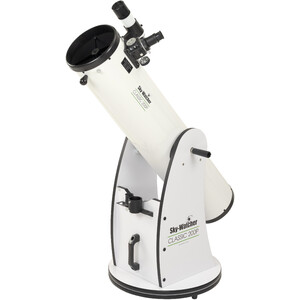
200 mm of aperture — the most sky for your money. Set it on the ground, point by hand: nebulae, clusters and galaxies for years to come.
Price: € 479
If you don’t have a telescope yet, don’t start with the biggest: the beginner’s guide explains why aperture and a steady mount count for more than any magnification figure on the box.
When does the young crescent Moon return?
About 24 to 48 hours after new moon, the wafer-thin young crescent Moon appears low in the west in the evening sky – a popular photo subject and, for many cultures, the start of the new month. From then on the Moon grows from evening to evening: the waxing moon phase begins.
Frequently asked questions
When is the new moon in October 2026?
On Saturday, 10 October 2026, at 16:50 BST (17:50 CEST). The nights dark enough for galaxies and nebulae run from 6 to 14 October.
Can you see the new moon?
No – at new moon the side facing us is unlit, and the Moon stands close to the Sun in the daytime sky. It only becomes visible during a solar eclipse, as a dark disc in front of the Sun.
How often is there a new moon?
Every 29.5 days – once per synodic month. There are twelve new moons in 2026.
What is a Black Moon?
An unofficial term for the second new moon within one calendar month – the counterpart to the Blue Moon for full moons.
Why isn’t there a solar eclipse at every new moon?
The Moon’s orbit is tilted by about 5 degrees to the Earth’s orbit. So the new moon usually passes above or below the Sun – only when it hits exactly the line where the two orbits cross is there an eclipse.
* Affiliate link: if you buy through this link we may earn a small commission from Astroshop or High Point Scientific, at no extra cost to you.
🌙 Related: The night sky in September 2026 – the occultation of Venus on 14 September, the opposition of Neptune and the Harvest Moon.