
By Alexander Merz · Updated on · Details checked on 14 September 2026
Next full moon
Calculating …
Times shown in Central European Time (CET/CEST). The full moon happens at the same instant worldwide — only the local clock time differs. A full conversion table for the UK, the US, India and Australia follows below.
Is tonight a full moon?
The short answer is right below – it is recalculated every time the page loads. Astronomically, full moon is an exact instant rather than a whole day: the moment when the Moon and the Sun stand directly opposite each other as seen from Earth. To the naked eye, though, the Moon already looks full the night before and still does the night after.
No – today is not a full moon.
The next full moon falls on Saturday 26 September 2026 at 18:49 CEST – the Harvest Moon. That is 4 days away.
Our full moon calendar shows when during the year the Moon is almost completely full. This happens when the Sun and Moon are in opposition, meaning they are as far apart as possible. At that moment almost the entire lunar surface is illuminated. The full moon reflects a considerable share of the sunlight, which makes full moon nights very bright.
The opposite of the full moon is the new moon. In this case the Moon lies between the Sun and the Earth, and we look at the side of the Moon that faces away from the Sun.
The dates worth seeing are often months apart and easily forgotten. So you do not miss one:
One short email, in good time – with the times and an honest take on whether it is worth getting up for.
You will get a confirmation email in a moment. Your address stays with us – no sharing, no third-party ads.
When is the next full moon?
The next full moon is on Saturday, September 26, 2026 at 18:49 (CEST, Central European Time). The upcoming full moon is called the “Harvest Moon” – the bright moon near the autumn equinox that lit the late harvest. The Moon looks practically full for about a night on either side of this date, so any clear evening around it is ideal for observing. After that: October 26 · November 24 · December 24
All times on this page are Central European Time (CET in winter, CEST in summer). The conversion table further down gives the same moments in UK, US, Indian and Australian time. The full moon occurs at the same instant everywhere in the world – only the local time differs.
Full Moon Calendar 2026: All Dates at a Glance
2026 is a special full moon year: there are 13 full moons instead of the usual twelve. In May two full moons appear in the sky – the second one, on 31 May, is therefore called a “Blue Moon”.
| Date | Time (CET/CEST) | Traditional Name |
|---|---|---|
| Saturday, January 3, 2026 | 11:02 | Wolf Moon |
| Sunday, February 1, 2026 | 23:09 | Snow Moon |
| Tuesday, March 3, 2026 | 12:37 | Worm Moon |
| Thursday, April 2, 2026 | 04:11 | Pink Moon |
| Friday, May 1, 2026 | 19:23 | Flower Moon |
| Sunday, May 31, 2026 | 10:45 | Blue Moon |
| Tuesday, June 30, 2026 | 01:56 | Strawberry Moon |
| Wednesday, July 29, 2026 | 16:35 | Thunder Moon |
| Friday, August 28, 2026 | 06:18 | Sturgeon Moon |
| Saturday, September 26, 2026 | 18:49 | Harvest Moon |
| Monday, October 26, 2026 | 05:11 | Hunter's Moon |
| Tuesday, November 24, 2026 | 15:53 | Beaver Moon |
| Thursday, December 24, 2026 | 02:28 | Cold Moon |
Full moon 2026 in your time zone: the conversion table
The full moon is an instant, not a day. The Moon reaches exactly 180° elongation from the Sun at one single moment, and every clock on Earth reads that same moment differently. That is why an American calendar sometimes prints a date one day earlier than a European one for the very same full moon — nobody is wrong, the time zones simply straddle midnight.
The calendars further down this page are in Central European Time, because that is where most of our readers watch the sky from. Here are the next five full moons converted into the eight time zones we get asked about most:
| Full moon | London (BST/GMT) | New York (ET) | Chicago (CT) | Denver (MT) | Los Angeles (PT) | Berlin (CET/CEST) | Mumbai (IST) | Sydney (AEST/AEDT) |
|---|---|---|---|---|---|---|---|---|
| Sturgeon Moon | Aug 28, 05:18 | Aug 28, 00:18 | Aug 27, 23:18 | Aug 27, 22:18 | Aug 27, 21:18 | Aug 28, 06:18 | Aug 28, 09:48 | Aug 28, 14:18 |
| Harvest Moon | Sep 26, 17:48 | Sep 26, 12:48 | Sep 26, 11:48 | Sep 26, 10:48 | Sep 26, 09:48 | Sep 26, 18:49 | Sep 26, 22:18 | Sep 27, 02:48 |
| Hunter’s Moon | Oct 26, 04:11 | Oct 26, 00:11 | Oct 25, 23:11 | Oct 25, 22:11 | Oct 25, 21:11 | Oct 26, 05:11 | Oct 26, 09:41 | Oct 26, 15:11 |
| Beaver Moon | Nov 24, 14:53 | Nov 24, 09:53 | Nov 24, 08:53 | Nov 24, 07:53 | Nov 24, 06:53 | Nov 24, 15:53 | Nov 24, 20:23 | Nov 25, 01:53 |
| Cold Moon | Dec 24, 01:28 | Dec 23, 20:28 | Dec 23, 19:28 | Dec 23, 18:28 | Dec 23, 17:28 | Dec 24, 02:28 | Dec 24, 06:58 | Dec 24, 12:28 |
Notice the December entry: in North America the Cold Moon falls on 23 December, in Europe and Asia on the 24th. Same moment, different calendar page. The same thing happens to the Hunter’s Moon in October across the Central, Mountain and Pacific zones.
Month by month: August to December 2026
Knowing the exact minute of the full moon is less useful than it sounds, because that minute often falls in broad daylight. What actually matters for going outside is moonrise. Around full moon the Moon rises almost exactly at sunset and sets at sunrise, so it is above the horizon all night — and the most photogenic half hour of the whole month is the one right after it clears the horizon, when it looks huge and orange.
Full moon August 2026: the Sturgeon Moon on 28 August
Exact full moon on Friday, 28 August 2026 at 06:18 CEST (05:18 BST, 00:18 EDT). Because the instant falls at dawn in Europe, the best viewing is the evening of Thursday 27 August: the Moon rises at 19:44 in London, 19:51 in Berlin and 19:24 in New York, already 99.9 % illuminated. And then there is the reason this particular night is special — a partial lunar eclipse takes place at the same time. Details in the section below.
Full moon September 2026: the Harvest Moon on 26 September
Exact full moon on Saturday, 26 September 2026 at 18:49 CEST (17:48 BST, 12:48 EDT). This is the pick of the year for Europe: the instant of full moon and moonrise fall within minutes of each other. In London the Moon rises at 18:27, in Berlin at 18:31 — you step outside, and there it is, perfectly full and low over the rooftops. This is also the true Harvest Moon, the full moon closest to the September equinox.
Full moon October 2026: the Hunter’s Moon on 26 October
Exact full moon on Monday, 26 October 2026 at 05:11 CET (04:11 GMT, 00:11 EDT). Europe has already switched back to standard time by then. Watch the evening of Sunday 25 October, with moonrise at 16:00 in London and 16:03 in Berlin — remarkably early, and in full daylight, which makes for the classic pale daytime moon low in the east.
Full moon November 2026: the Beaver Moon on 24 November
Exact full moon on Tuesday, 24 November 2026 at 15:53 CET (14:53 GMT, 09:53 EST). This is the first of the two supermoons of 2026: the Moon is 360,765 km away, well inside the usual range. Moonrise in London 15:17, Berlin 15:15, New York 16:15 — and since the Moon is full while still rising, that evening delivers a genuinely oversized orange disc against a twilight sky.
Full moon December 2026: the Cold Moon on 24 December
Exact full moon on Thursday, 24 December 2026 at 02:28 CET — in North America still the evening of 23 December, 20:28 EST. A Christmas Eve full moon in Europe, and the closest and largest of the entire year at 356,738 km. It is also the highest: from London the Moon stands 60° above the horizon at the moment of full moon, because a winter full moon takes the summer Sun’s path across the sky.
Lunar eclipse on 28 August 2026: where it is actually visible
The Sturgeon Moon of 28 August 2026 does not just rise full — it passes through Earth’s shadow. This is a partial lunar eclipse with 93.8 % of the lunar disc covered at maximum, which in practice looks very nearly like a total one: the covered part glows a deep copper red while a thin bright rim survives at the edge.
| Phase | UTC | What you see |
|---|---|---|
| Penumbra begins (P1) | 01:23 | Barely perceptible dimming on one side |
| Umbra begins (U1) | 02:34 | A dark bite is clearly visible |
| Maximum | 04:13 | 93.8 % covered, copper-red |
Whether that is worth setting an alarm for depends entirely on where you are — and the differences are dramatic:
| City | Umbra begins (local) | Maximum (local) | Moon altitude at max | Verdict |
|---|---|---|---|---|
| Miami | Aug 27, 22:34 | Aug 28, 00:13 | 50.6° | Excellent |
| New York | Aug 27, 22:34 | Aug 28, 00:13 | 38.3° | Excellent |
| Toronto | Aug 27, 22:34 | Aug 28, 00:13 | 34.3° | Excellent |
| Chicago | Aug 27, 21:34 | Aug 27, 23:13 | 33.4° | Excellent |
| Denver | Aug 27, 20:34 | Aug 27, 22:13 | 26.7° | Very good |
| Los Angeles | Aug 27, 19:34 | Aug 27, 21:13 | 21.3° | Good, Moon low in the east |
| Cape Town | Aug 28, 04:34 | Aug 28, 06:13 | 11.3° | Difficult, dawn |
| Dublin | Aug 28, 03:34 | Aug 28, 05:13 | 10.3° | Difficult, dawn |
| London | Aug 28, 03:34 | Aug 28, 05:13 | 7.9° | Difficult, dawn |
| Mumbai | — | — | below horizon | Not visible |
| Sydney | — | — | below horizon | Not visible |
The short version. This eclipse belongs to North America. From the US and Canada it plays out during the evening of Wednesday 27 August, with the Moon high in a dark sky — no alarm clock needed. From Britain and Ireland it is a dawn event with the Moon only 8–10° above the western horizon, so you need a genuinely flat, unobstructed view and you will be racing the brightening sky. From India and Australia the Moon is below the horizon throughout: nothing to see. Central Europe sits with the UK — technically visible, practically marginal.
The pairing with the solar eclipse of 12 August 2026 is not a coincidence: both eclipses belong to the same lunar node, two weeks apart. Eclipses always come in pairs like this. The next total lunar eclipse visible from Europe is on 31 December 2028; our lunar eclipse page lists every date up to 2032.
Supermoon 2026: which full moons are the big ones
The Moon does not circle the Earth in a perfect circle. Over the course of a month its distance swings between roughly 356,000 and 407,000 km, and if a full moon happens to coincide with the near point of that orbit, it is called a supermoon. The effect is real but modest: about 14 % larger in diameter and 30 % brighter than a full moon at the far point. Side by side in photographs the difference is obvious; on two separate nights, weeks apart, almost nobody notices it.
| Full moon | Distance | Apparent size | Category |
|---|---|---|---|
| 31 May 2026 | 406,135 km | 29.46′ | Micromoon — smallest of 2026 |
| 28 August 2026 | 390,397 km | 30.6′ | Average |
| 24 November 2026 | 360,765 km | 33.16′ | Supermoon |
| 24 December 2026 | 356,738 km | 33.54′ | Supermoon — largest of 2026 |
So the two supermoons of 2026 are the Beaver Moon on 24 November and the Cold Moon on 24 December, and the December one is the biggest full moon of the year — a Christmas Eve supermoon.
Worth knowing: supermoon is not an astronomical term. It was coined in 1979 by the astrologer Richard Nolle, who defined it loosely as a full or new moon within 90 % of its closest approach. That definition is generous enough that most years produce three or four of them, which is why different websites disagree about how many supermoons a given year has. Nothing else follows from it: a supermoon does not cause earthquakes, and the difference it makes to the tides is a few centimetres.
The calendar tells you when. It does not tell you what to look through.
Six short questions, an honest answer by e-mail – including when the naked eye is the best instrument for the full moon.
Why is the Moon orange tonight?
This is the single most-asked question about the Moon, and it has an unglamorous answer: the colour is in our atmosphere, not on the Moon. When the Moon is low on the horizon its light reaches you through up to 40 times more air than when it is overhead. Air molecules scatter short blue wavelengths far more strongly than long red ones — the same Rayleigh scattering that makes the sky blue and sunsets red — so by the time the light gets to your eye, the blue has been scattered away and the warm end of the spectrum is what is left.
Which is why an orange Moon is almost always a rising or setting Moon. Watch it for an hour: as it climbs, the colour drains out of it and it turns the usual bone white. Haze, dust and wildfire smoke deepen the effect, and that is the real reason moons look unusually red during a fire season — the extra particles are very good at removing blue light.
Orange moon or blood moon? They are different things. The everyday orange Moon is atmospheric scattering along your line of sight, and it fades as the Moon rises. A blood moon only happens during a total lunar eclipse, when the Moon is inside Earth’s shadow and the only light reaching it is sunlight bent through the rim of Earth’s atmosphere — in effect, the light of every sunrise and sunset on the planet at once. That red persists no matter how high the Moon stands. More on it on our blood moon page.
Waxing or waning? How to tell at a glance
The Moon takes 29 days 12 hours 44 minutes to run through its cycle from one full moon to the next. That is the synodic month, and it is noticeably longer than the 27.3 days the Moon actually needs to orbit the Earth — because in the meantime the Earth has moved along its own orbit, and the Moon has to catch up a little to get back into line with the Sun.
Telling waxing from waning takes one second once you know the trick, and it depends on which hemisphere you are standing in:
| Shape | Northern hemisphere | Southern hemisphere | Visible |
|---|---|---|---|
| Lit on the right | Waxing | Waning | Evening sky, in the west |
| Lit on the left | Waning | Waxing | Morning sky, in the east |
The classic English mnemonic is DOC: from the northern hemisphere the Moon grows as a D, becomes a full O, and shrinks as a C. From Australia, South Africa or South America it runs the other way round — COD — because you are looking at the same Moon while standing upside down relative to a northern observer. And a much more reliable rule than any mnemonic: if you can see the Moon in the evening, it is waxing; if you first notice it in the morning after sunrise, it is waning.
Where the full moon names come from
Wolf Moon, Snow Moon, Sturgeon Moon, Hunter’s Moon — these names have circulated in English since the 1930s through the Old Farmer’s Almanac, which attributed them to Native American, Colonial American and European traditions. Their history is messier than the tidy lists suggest: different nations used different names, many tracked more than twelve moons a year, and the twelve-name set that gets reprinted every year is a later editorial tidying-up. They are folklore, not astronomy — but they are good folklore, and each one records something about the season it belongs to.
Two of them are genuinely astronomical rather than merely seasonal. The Harvest Moon is the full moon nearest the September equinox, and its name comes from a real effect: at that time of year the Moon’s path meets the horizon at a shallow angle, so on successive evenings it rises only 20 to 30 minutes later instead of the usual 50. The result is several consecutive evenings with bright moonlight arriving right at dusk — enough, before electric light, to keep bringing the harvest in after sunset. The Hunter’s Moon that follows in October does the same thing, one month on.
The Sturgeon Moon of August is named after the giant lake sturgeon of the Great Lakes, most easily caught in that month. Its colour is not part of the name — a Sturgeon Moon is no more orange than any other, it just tends to be noticed low on warm August evenings, when the atmosphere is doing the colouring described above.
A Blue Moon is the odd one out: it is not a colour and not a tradition, but a counting artefact. Because the 29.5-day lunar month is shorter than most calendar months, a second full moon occasionally falls inside the same month — as in May 2026, with full moons on the 1st and the 31st. That second one is the Blue Moon, and the phrase once in a blue moon simply means rarely.
Full Moon Calendar 2027: All Dates at a Glance
| Date | Time (CET/CEST) | Traditional Name |
|---|---|---|
| Friday, January 22, 2027 | 13:17 | Wolf Moon |
| Sunday, February 21, 2027 | 00:23 | Snow Moon |
| Monday, March 22, 2027 | 11:43 | Worm Moon |
| Wednesday, April 21, 2027 | 00:27 | Pink Moon |
| Thursday, May 20, 2027 | 12:59 | Flower Moon |
| Saturday, June 19, 2027 | 02:44 | Strawberry Moon |
| Sunday, July 18, 2027 | 17:44 | Thunder Moon |
| Tuesday, August 17, 2027 | 09:28 | Sturgeon Moon |
| Thursday, September 16, 2027 | 01:03 | Harvest Moon |
| Friday, October 15, 2027 | 15:47 | Hunter's Moon |
| Sunday, November 14, 2027 | 04:25 | Beaver Moon |
| Monday, December 13, 2027 | 17:08 | Cold Moon |
More about the Moon: Moon Calendar 2026 (all phases) · New Moon dates · Waxing Moon · Waning Moon · Lunar eclipse dates until 2032
Observing the full moon: our recommendations
Here is the paradox every new telescope owner runs into: the full moon is the worst night of the month to look at the Moon through a telescope. The sunlight arrives head-on, nothing casts a shadow, and the surface flattens into a dazzling white disc. Craters are spectacular around first and last quarter instead, along the terminator — the line dividing lunar day from night — where low sunlight throws long shadows and every mountain and crater rim stands out in relief.
What the full moon is superb for is the naked eye and a pair of binoculars, especially in the first half hour after it rises. A 10×50 already shows the dark maria and the bright ray system splashing out from the crater Tycho, and it does it while you stand in your garden with no setup at all.
🌕 Binoculars for the full moon
Celestron Cometron 7x50 Binoculars
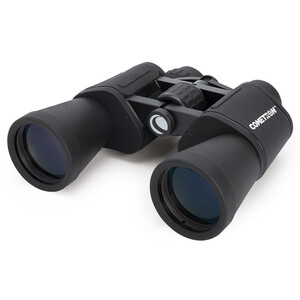
The astronomy classic among affordable binoculars: 7×50 with a large exit pupil for bright handheld views of the Moon and Milky Way – the ideal first step before a telescope.
Price: € 65
Omegon Premium Moon Filter 1.25″
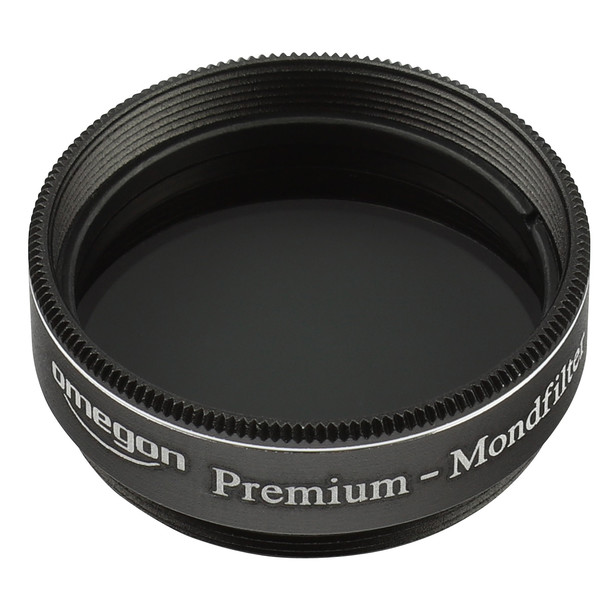
Dims the harsh moonlight, is easy on the eyes and brings out far more contrast and detail – our best-selling filter and the number-one pick to start with.
Price: € 19.90
A 10×50 binocular is exactly the right instrument on full moon nights: wide field, bright image, steady enough to hold by hand. The lunar filter earns its keep later, when you move to a telescope during the intermediate phases and the glare becomes genuinely uncomfortable.
When you actually need a telescope
Binoculars win on the full moon, but the full moon is a special case. For craters with long shadows, the rings of Saturn, the moons of Jupiter, the polar caps of Mars or any nebula, binoculars simply run out: those targets need aperture and magnification. If you can only buy one instrument and you want to really explore the sky, buy the telescope; binoculars are the complement, not the substitute.
Skywatcher Dobson Telescope N 130/650 Heritage FlexTube
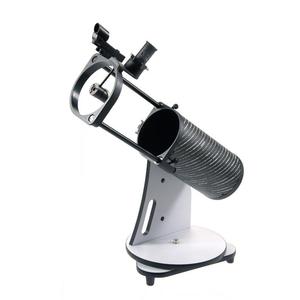
A compact tabletop Dobson with a true parabolic mirror. Folds down, fits in a bag: the Moon, planets and the bright deep-sky classics.
Price: € 265
If you want more: the 130 mm tabletop Dobsonian is deliberately the entry point – small, set up in seconds, honestly good on the Moon. If you already know this will stick, it makes sense to go straight to 200 mm of aperture (the diameter of the mirror). That is more than twice the light-gathering area, and it is exactly the threshold at which not only the Moon but also globular clusters, galaxies and nebulae start to deliver – the Moon on its own does not need the extra aperture.
So the extra cost is only worth it if you want to go beyond the Moon and have room for an instrument of a good 25 kg that is carried outside in two parts. For a quick look from the balcony, the 130 mm remains the more practical choice.
For more advanced observers: Skywatcher Dobson Telescope N 200/1200 Skyliner Classic
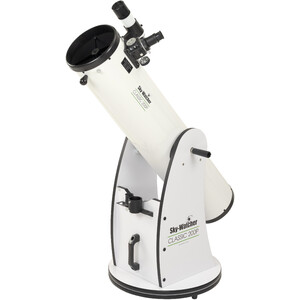
200 mm of aperture — the most sky for your money. Set it on the ground, point by hand: nebulae, clusters and galaxies for years to come.
Price: € 479
Going deeper: best telescopes for beginners · telescope for children · astronomy binoculars · telescope vs binoculars.
* Affiliate links: if you buy through these links we receive a small commission from the retailer. The price is the same for you. Prices verified in August 2026.
Full moon FAQ
Can you photograph the full moon with a phone?
Yes, but not by pointing it straight up at a high Moon: on automatic the phone exposes for the dark sky and hands you a featureless white blob. Two changes fix it. First, shoot while the Moon is still low, just after moonrise — you get a foreground for scale and the brightness gap between Moon and sky is much smaller. Second, use manual or “pro” mode and pull the exposure down two or three stops, or simply tap the Moon on screen and drag the brightness slider down. With the optical zoom of a recent phone and the phone braced against a wall, the maria show up clearly.
How many full moons are there in 2026?
Thirteen, one more than usual, because May 2026 has two — on the 1st and the 31st. That second full moon in a single calendar month is the Blue Moon.
Are full moon dates the same in the USA and in Europe?
The moment is identical everywhere; the date is not always. When the full moon falls in the small hours European time, it is still the previous evening in North America. That is exactly what happens on 24 December 2026 (23 December in the US) and again on 26 October (25 October in the Central, Mountain and Pacific zones). Our conversion table above gives both.
Is there a printable full moon calendar for 2026?
The two tables on this page — 2026 and 2027 — are laid out to print cleanly: use your browser’s print function, or save the page as a PDF. Between them they cover date, time and traditional name for all 25 full moons through December 2027.
When is the next supermoon?
The next supermoon is on 24 November 2026, when the Moon is 360,800 km from Earth. It is followed by 24 December (356,758 km) and 22 January (357,661 km). The closest full moon of the coming twelve months falls on 24 December 2026 at 356,758 km.
What zodiac sign is the next full moon in?
The next five full moons fall in the tropical signs of Aries (26 September 2026), Taurus (26 October), Gemini (24 November), Cancer (24 December) and Leo (22 January). One point of accuracy: the signs of Western astrology are pinned to the March equinox, not to the actual constellations, which have drifted about 30° since the system was fixed. Astronomically, the full moon of 26 September 2026 sits in front of the constellation Pisces.
Does the Sturgeon Moon have a spiritual meaning?
Not an astronomical one. The names are agricultural folklore recording what a given month brought — August was when the lake sturgeon were caught. The meanings attached to full moons in modern spiritual practice are a twentieth-century layer on top of that, not something handed down with the names, and nothing measurable about the Moon changes from one month to the next apart from its distance and its position in the sky. Which does not make the ritual less enjoyable — it just is not astronomy.
Does the full moon affect sleep?
Through light, not magnetism. Large studies have failed to find a direct biological effect, but a full moon delivers up to about 0.3 lux, and in a bedroom without blackout curtains that is genuinely enough to disturb sleep. The culprit is illumination, not lunar influence.
Does the full moon cause more births?
No. Analyses covering millions of births have found no correlation between lunar phase and birth rate. The persistent impression comes from confirmation bias: a busy full moon night is memorable, a quiet one is not.
Why does the Moon look so big near the horizon?
That is the moon illusion, and it is purely perceptual. Near the horizon your brain compares the Moon with trees, buildings and hills and judges it enormous. Measured properly, the Moon on the horizon subtends exactly the same angle as it does overhead — very slightly less, in fact, because you are further away from it. Test it: look at it upside down between your legs, or photograph it. The illusion vanishes instantly.
📚 Read next:
- Moon calendar 2026: every phase, month by month
- Lunar eclipses: every date through 2032
- Blood moon: why the Moon turns red
- Which telescope should you start with? Our top 3
- The best smart telescope: the comparison
- Astrophotography: how to get started
- Everything about the Moon: origin, phases, missions
Sterngucker.de is an independent astronomy guide. This article also exists in German, French and Italian.
Full moon by month: the date you are looking for
Looking for the full moon in a particular month? Every month has its own page with the exact date, the time, the name of that full moon and the dates for the coming years.