By Alexander Merz · Updated on · Details checked on 13 October 2026
No other planet delivers quite the same jaw-drop at the eyepiece: the first time you spot Saturn and its rings through a telescope, you never forget it. The sixth planet from the Sun and the second largest in the solar system, this gas giant shines to the naked eye as a calm, yellowish “star” – but it takes a telescope to reveal that famous ring system. And 2026 is a great year to look: after the rare edge-on ring crossing of 2025, Saturn’s rings are opening up again and growing more dramatic month by month.
More in our overview: Planets of Our Solar System.
⚡ The quick answer: Yes, you can see Saturn’s rings through a beginner telescope. At just 40–50× magnification the rings clearly separate from the planet’s disc – a small 70 mm refractor is more than enough for that first “wow” moment. The best nights are the ones around opposition – 4 October 2026, the next one on 18 October 2027 – when Saturn is visible all night long.
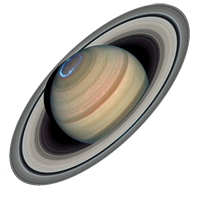
Saturn fact sheet
- Gas giant, 6th from the Sun
- Large ring system
- Diameter: 120,536 km
- Orbital period: 29.45 years
- Length of day: 10 h 39 min
- Distance from the Sun: 1.43 billion km
- Temperature: −139 °C
- Atmosphere: 96 % hydrogen, 3 % helium
🪐 Saturn at opposition on 4 October 2026: just past – Saturn is still a highlight
On the night of 4–5 October Saturn was closest to Earth and reached magnitude 0.33. In the weeks that follow it is still visible for most of the night, more than 40° above the southern horizon. The rings are open to 7.5°. Next opposition: 18 October 2027.
Which telescope do you need to see Saturn’s rings?
This is the question every beginner asks, and the good news is that you need surprisingly little. Unlike faint galaxies or nebulae, Saturn is bright and compact: what matters is not a huge aperture but enough magnification and a steady image. Plan for at least 40–50× to see the rings clearly, and 100–150× to start glimpsing the Cassini Division on a calm night.
Even a modest 70 mm achromatic refractor handles this easily. It’s the ideal first instrument for exploring the ringed planet, the Moon and Jupiter’s main moons without breaking the bank. For a wider look at picking an instrument, see our best beginner telescopes guide; if Saturn and Jupiter are your main targets, which telescope for planets goes into aperture, focal length and eyepieces, and the best telescopes of 2026 list covers every budget.
Best for beginners: Omegon Telescope AC 70/700 AZ-2
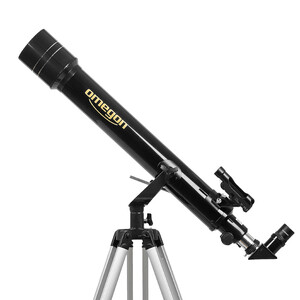
The no-pitfall starter refractor: Moon, Saturn's rings and Jupiter's moons from the very first night. No collimation.
Price: € 129
Best for advanced observers: Skywatcher Dobson Telescope N 200/1200 Skyliner Classic
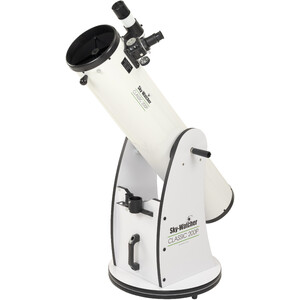
200 mm of aperture — the most sky for your money. Set it on the ground, point by hand: nebulae, clusters and galaxies for years to come.
Price: € 479
* Affiliate link: if you buy through this link we may earn a small commission from Astroshop or High Point Scientific, at no extra cost to you.
What magnification do you need for the rings?
Saturn is bright, so aperture matters far less than magnification and steady air. This is roughly what each step buys you:
| Magnification | What you see |
|---|---|
| 10–20× (binoculars) | An oval, slightly “stretched” dot – no separate rings |
| 30–40× | The rings appear as Galileo’s famous “handles” |
| 50–80× | Rings clearly separated from the disc – the classic first “wow” |
| 100–150× | Cassini Division on a steady night, Titan as a faint star |
| over 200× | Cloud bands and further moons – only with excellent seeing |
Reaching 100–150× is a question of eyepieces, not of a bigger telescope. A small set of quality eyepieces plus a Barlow lens is the cheapest upgrade most beginners can make:
Omegon Eyepiece Starter Kit
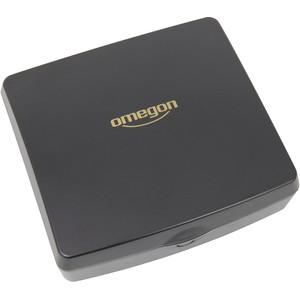
Eyepieces, filters and a Barlow in one case: everything to round out your telescope at once, cheaply.
Price: € 89
Observing Saturn in 2026: the opposition on October 4
At opposition Saturn stands exactly opposite the Sun as seen from Earth: it rises at sunset, culminates around midnight and sets at dawn – visible all night, at its brightest and its largest. In 2026 that moment falls on 4 October at 14:15 CEST, with Saturn in the constellation Cetus at magnitude 0.33 and an apparent diameter of 19.7 arcseconds.
| Date | Rises | Culminates | Altitude | Brightness | Ring opening |
|---|---|---|---|---|---|
| August 1 | 23:18 | 05:40 | 42° | 0.63 mag | 9.1° |
| September 1 | 21:15 | 03:37 | 42° | 0.48 mag | 8.5° |
| October 4 | 19:01 | 01:18 | 41° | 0.33 mag | 7.5° |
| October 15 | 18:18 | 00:30 | 41° | 0.38 mag | 7.1° |
| November 1 | 16:07 | 22:16 | 40° | 0.45 mag | 6.6° |
| December 1 | 14:07 | 20:11 | 40° | 0.60 mag | 6.1° |
Times for central Europe (10° E, 51° N) in local civil time. Add roughly four minutes for every degree you live west of that meridian, subtract four minutes per degree east. Positions and brightness: NASA/JPL Horizons; ring opening: own calculation (Skyfield/DE421).
💡 The best moment: don’t wait for the exact opposition date. Saturn stays essentially unchanged for weeks either side, and what really decides the view is altitude and air steadiness. Observe when the planet is highest – around 01:00 in early October, around 22:00 in November – and give the telescope 30 minutes outside to reach ambient temperature.
What is Saturn?
Among the planets of the solar system, Saturn is the second largest and the most distant one visible to the naked eye from Earth. It’s a classic Jovian planet: a gaseous surface of very low density with a rotation that varies by latitude. A rather “leisurely” world, Saturn follows an almost circular, barely eccentric orbit and completes one lap of the Sun every 29 years and 166 days.
What made the giant famous, of course, are its bright rings – already sharp at low magnification. Made of water ice and rocky debris, this ring system is accompanied by 285 confirmed moons (as of March 2026), led by the giant Titan. Saturn’s density is so low (0.69 g/cm³) that the planet would actually float on water – the only planet in the solar system that would.
Saturn at a glance: fact file
| Property | Value |
|---|---|
| Type | Gas giant, 6th planet from the Sun |
| Equatorial diameter | 120,536 km (9.4 × Earth) |
| Polar diameter | 108,728 km – the most flattened planet in the solar system |
| Mass | 5.683 × 1026 kg (95.2 Earth masses) |
| Density | 0.687 g/cm³ – would float on water |
| Surface gravity | 10.44 m/s² (Earth: 9.81) |
| Mean distance from the Sun | 1.434 billion km (9.58 AU) |
| Distance from Earth at the 2026 opposition | 1.262 billion km (8.43 AU) |
| Orbital period | 29.45 years |
| Rotation period | 10 h 39 min |
| Axial tilt | 26.73° – which is why the rings open and close |
| Mean temperature | −139 °C |
| Atmosphere | Hydrogen (96%), helium (3%) |
| Confirmed moons | 285 (as of 26 March 2026, IAU Minor Planet Center) |
| Largest moon | Titan, 5,150 km – larger than Mercury |
| Ring system | 282,000 km across, only 10–100 m thick |
| Age | approx. 4.5 billion years |
Saturn’s rings: what you actually see
The ring system is nearly a million kilometres across, yet in places barely a hundred metres thick. When they were discovered, the rings were given letters rather than names: the A and B rings, either side of the Cassini Division, are the easiest to spot. Space probes have since revealed astonishingly fine structure – each ring is itself made up of thousands of narrow ringlets, with gaps swept clear by small “shepherd” moons.
Where did the rings come from?
In the 19th century, the French astronomer and mathematician Édouard Roche proposed a theory that remains popular: a moon strayed too close to Saturn and, crossing the “Roche limit,” was torn apart by tidal forces. Other material likely came from captured comets and leftovers from the formation of the solar system.
Why were Saturn’s rings almost invisible in 2025?
Roughly every 15 years, Earth lines up exactly with the plane of the rings. During this edge-on crossing in 2025, the wafer-thin rings shrank to a nearly invisible sliver of light. Since that crossing on 23 March 2025 they have been tilting open again – by mid-July 2026 the angle had reached 9.1°, at the October 2026 opposition it is 7.5°, and over the coming years it keeps growing until 2032.
How far open are Saturn’s rings – and when are they best?
Because Saturn’s axis is tilted by 26.73°, we alternately look at the northern and the southern face of its rings over the planet’s 29.45-year orbit. Twice per orbit the Earth passes exactly through the ring plane and the rings all but vanish – that happened last on 23 March 2025. Since then they have been opening again, and every season until 2032 shows a more dramatic Saturn than the one before.
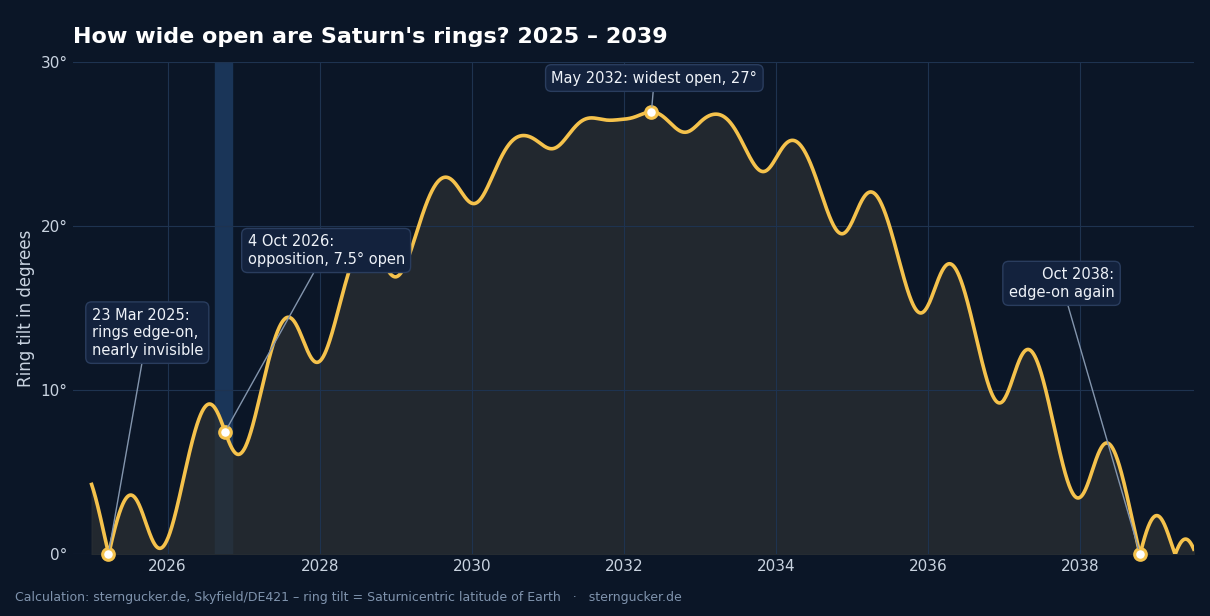
| Opposition | Ring opening | Brightness |
|---|---|---|
| October 4 2026 | 7.5° | 0.33 mag |
| October 18 2027 | 12.9° | 0.09 mag |
| October 31 2028 | 17.9° | −0.13 mag |
| November 14 2029 | 22.0° | −0.32 mag |
| November 28 2030 | 25.0° | −0.45 mag |
| December 12 2031 | 26.5° | −0.54 mag |
The maximum of almost 27° is reached in May 2032; the next edge-on crossing follows in October 2038. In other words: the view gets better every year for the next half decade.
Internal structure and atmosphere
Saturn’s outer layers are almost entirely low-density hydrogen. As you descend toward the core, pressure and temperature climb: hydrogen shifts from gas to liquid and finally to a metallic form. The pressure never reaches the threshold needed to trigger the nuclear fusion that powers stars. At the very centre, scientists suspect a solid rocky core of roughly 16 Earth masses.
The upper cloud deck shows less contrast than Jupiter’s famous belts, but broad structures are still visible. At the north pole sits an extraordinary hexagonal vortex spanning about 25,000 km and reaching several hundred kilometres deep – a weather phenomenon found nowhere else in the solar system.
How many moons does Saturn have?
With a single Moon, Earth is one of the “poorer” planets. Saturn treats itself to a spectacular retinue: 285 natural satellites are confirmed today (as of March 2026), orbiting both forwards and backwards. The largest, Titan, is bigger than the planet Mercury and wrapped in a thick atmosphere. Mimas, only 396 km across, keeps the famous Cassini Division between the A and B rings swept clear through its orbital resonance.
Exploring Saturn, from Galileo to Cassini
In 1610, Galileo thought he saw “handles” around Saturn. It was the Dutchman Christiaan Huygens who realised, in 1655, that they were a tilted ring. Twenty years later Giovanni Cassini noticed the gap that now bears his name. Probe exploration began in 1979 with Pioneer 11, continued with the Voyager flybys of 1980–1981, and reached its peak with Cassini-Huygens, in orbit from 2004, which returned images of the moons and rings in unprecedented detail.
Why is the planet called Saturn?
The name comes from Roman mythology: Saturn was the god of agriculture. The legacy survives in our word Saturday – literally “Saturn’s day.”
Saturn’s rings show up from about 50x magnification – with a telescope that holds steady.
Six short questions, an honest answer by email – even when binoculars are the better choice.
Frequently asked questions
At what magnification can you see Saturn’s rings?
From about 40–50× the rings stand out clearly – a magnification within reach of virtually any beginner telescope.
What telescope is best for viewing Saturn?
A small 70 mm refractor or a 100–130 mm telescope is plenty. The key is reaching 40–150× magnification with a steady image.
Can you see Saturn with the naked eye?
Yes. Saturn shines as brightly as the brightest stars and stands out for its steady, non-twinkling yellowish light.
When is the best time to see Saturn in 2026?
The prime window is opposition on October 4, 2026, when the planet is closest to Earth and visible all night. The surrounding weeks are almost as good.
How many confirmed moons does Saturn have today?
Saturn holds the solar system record with 285 confirmed moons (IAU Minor Planet Center, March 2026). The largest is Titan, at 5,150 km wider than the planet Mercury.
Read next:
- Best beginner telescopes: the complete guide
- The planets of the solar system: an overview
- Saturn’s rings explained in detail
This article is also available in German (original), French and Italian.