By Alexander Merz · Updated on · Details checked on 29 September 2026
A black hole is an object of unimaginable mass concentrated in the smallest of spaces. Its gravity is so strong that not even light can escape it.
In the constellation of “Coma Berenices” (northern night sky) lies the small spiral galaxy M100, at the edge of the Virgo Cluster (a grouping of several galaxies). In 1979, an amateur astronomer discovered supernova 1979C in this star system.
Sixteen years later, X-ray telescopes registered steady radiation coming from the direction of the explosion, presumably emitted by a young black hole. This phenomenon is in fact the youngest remnant of a star’s death discovered to date.

Key Facts at a Glance
- Formation: Black holes form through the gravitational collapse of massive stars that are at least three times as massive as our Sun.
- Gravity: The gravity of a black hole is so strong that nothing, including light, can escape from its interior.
- Types of black holes: There are three main types – stellar black holes, supermassive black holes and intermediate-mass black holes.
- Gravitational waves: The merger of two black holes generates gravitational waves, which are distortions of spacetime that propagate at the speed of light.
- Hawking radiation: Black holes slowly lose mass through Hawking radiation, a phenomenon predicted by Stephen Hawking, and can theoretically evaporate.
- Galaxy evolution: Supermassive black holes play an important role in the formation and evolution of galaxies.
What Is a Black Hole?
A black hole is an astronomical object with such strong gravity that nothing, not even light, can escape from its interior. They form when stars at least three times as massive as our Sun explode at the end of their life cycle and their mass collapses in on itself. The extreme compression of the mass leads to the formation of a region from which nothing can escape – the black hole.
The Discovery of Black Holes
Although black holes themselves are invisible, we can detect their presence through their interaction with their surroundings. The British geologist and mathematician John Michell first described in 1783 the concept of a “dark star” whose gravity is so strong that it traps light.
In 1915, Albert Einstein published his general theory of relativity, which paved the way for a mathematical description of black holes. The first concrete solution for a black hole, the so-called “Schwarzschild solution“, was found in 1916 by Karl Schwarzschild.
The discovery of the first black hole, Cygnus X-1, did not occur until 1971, however, when X-rays were detected from the region of a massive star.
It was determined that these rays came from an invisible object drawing gas from the massive star, and so Cygnus X-1 was identified as the first known black hole.
Black Hole: Different Types
There are essentially three types of black holes: stellar, supermassive and intermediate-mass black holes.
Stellar black holes form from the collapse of massive stars and have masses of up to 20 solar masses.
Supermassive black holes are the giants among black holes, with masses that can amount to millions or even billions of solar masses. They are located at the centres of most galaxies, including our own Milky Way. The supermassive black hole at the centre of our galaxy is called Sagittarius A* and has a mass of about four million solar masses.
Intermediate-mass black holes are a lesser-known and rare category, with masses ranging from hundreds to thousands of solar masses. Their formation is still a mystery to scientists.
The End of a Star and the Birth of a Black Hole
The formation of black holes is still regarded as mere theory. The assumption is that, when a star collapses, its mass is preserved but shrinks to a vanishingly small volume. Due to the rapidly increasing gravity, space and time become distorted around the black hole.
Precisely such a phenomenon was registered in the autumn of 2010 by NASA scientists in the star system M100, at the coordinates of supernova 1979C. If their assumptions are confirmed, it will be possible in the future to study, at these coordinates, the formation of black holes practically on the front line, that is, immediately after their formation.
 Our partner shop: a trusted US astronomy retailer – telescopes, binoculars & accessories.Visit High Point Scientific* →
 Our partner shop: Europe’s large astronomy retailer – telescopes, binoculars & accessories, shipping across Europe.Visit Astroshop* →
Even with the best telescopes, scientists can only explore in space what can be observed easily and/or continuously. In distant star systems, many supernovae or their residual radiation have already been discovered. Likewise, galaxy clusters teem with black holes. But according to the theories established so far, these holes form quite differently.
They emit gamma-ray bursts. Rather than calling this interstellar birth via supernova 1979C atypical, it is far more likely that here, for the first time, the truly usual formation of black holes was observed, while all other sightings were atypical special cases.
Black Hole or Neutron Star?
The discovery is still merely an assumption on the part of astronomers. They regard the steady radiation as evidence that the phenomenon is drawing in surrounding material from the star system, such as remnants of supernova 1979C or from a star within a binary system.
Equally, however, the 1979 event could have produced a neutron star that is now emitting particles of high energy. Such clarification would suit scientists’ thirst for knowledge just as well. Black hole or pulsar wind nebula – at such proximity to our own galaxy, both galactic births are an astronomical sensation.
In addition, Chinese researchers recently discovered a black hole with 70 solar masses, whose existence baffles them.
The Event Horizon Telescope Collaboration and the First Image of a Black Hole
In April 2019, the Event Horizon Telescope Collaboration (EHT) published the first direct image of a black hole. The photographed black hole is located at the centre of the galaxy M87, about 55 million light-years from Earth, and has a mass of 6.5 billion solar masses.
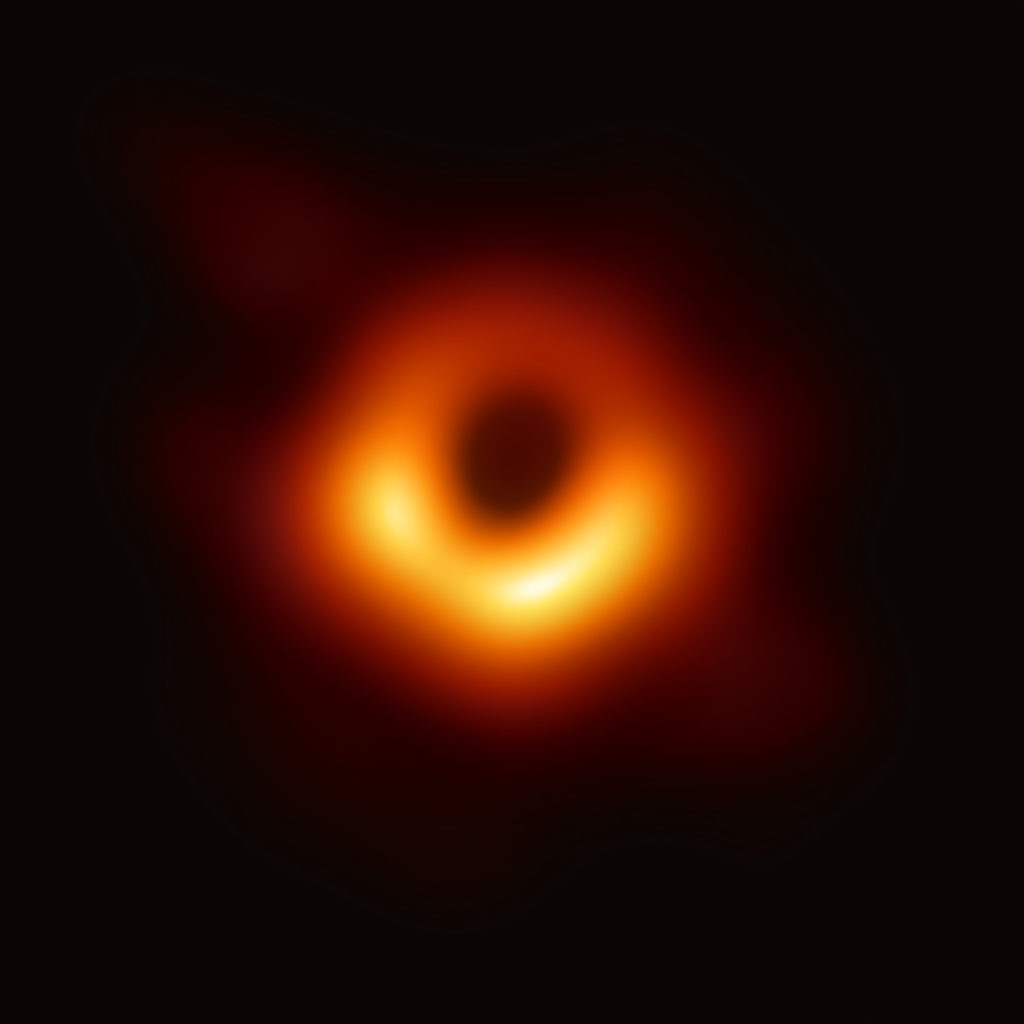
The image shows a glowing ring of gas and dust surrounding the black hole, referred to as the black hole’s “shadow”. The publication of this image was a major milestone in the study of black holes and once again confirmed the predictions of the general theory of relativity.
Gravitational Waves and the Merger of Black Holes
Another fascinating aspect of black holes is the discovery of gravitational waves, which are produced by the merger of two black holes. Gravitational waves are ripples in spacetime that propagate at the speed of light.
They were first directly detected in 2015 by the Laser Interferometer Gravitational-Wave Observatory (LIGO) scientific collaboration and confirmed another important prediction of Einstein’s general theory of relativity.
Hawking Radiation and the Disappearance of the Black Hole
The famous physicist Stephen Hawking showed in the 1970s that black holes can, due to a phenomenon known as “Hawking radiation“, actually lose energy and eventually disappear.
This radiation arises from quantum fluctuations near the event horizon of a black hole and causes the black hole to lose mass. The process is extremely slow, however, and it would take billions of years for a stellar black hole to evaporate completely.
The Role of Black Holes in the Formation of Galaxies
It is assumed that supermassive black holes play a decisive role in the formation and evolution of galaxies. The interaction between the black hole and the surrounding clouds of gas and dust can lead to the formation of new stars.
Likewise, the presence of a supermassive black hole at the centre of a galaxy can help keep the stars and gas clouds in the galaxy on stable orbits.
Black Hole: Tidal Disruption Events (TDEs)
A tidal disruption event occurs when a star gets too close to a black hole and is torn apart by its enormous gravitational force. The star is thereby transformed into an elongated stream of matter that is drawn into the black hole.
TDEs offer astronomers a rare opportunity to study the properties of black holes, as they emit intense radiation across various wavelength ranges.
Sources
- Representation calculated from radio observations of the Event Horizon Telescope , showing the supermassive black hole of the galaxy M87, retrieved 09.02.2020