By Alexander Merz · Updated on · Details checked on 6 October 2026
⚡ The quick answer: June and July are the weakest shooting-star months of the year. The showers of these weeks usually bring only around five meteors per hour, the strongest ones peak in daylight – and in northern Germany it never gets properly dark between mid-May and late July. Only the Perseids in mid-August deliver a real shooting-star night again. The first worthwhile shower before that is the Southern Delta Aquariids at the end of July.
📅 All meteor showers of the year with a Moon rating are in the meteor shower calendar.
June nights are short, often clear – and still the worst of the year for shooting stars. If you want to watch a meteor shower at this time of year, you are hunting for single meteors. The rates are low, the strongest peaks fall in the daytime hours, and for some showers the parent body has still not been identified with certainty.
Why you see hardly any shooting stars in June
The main reason has nothing to do with the meteor showers, but with the height of the Sun. Real darkness only begins when the Sun is at least 18 degrees below the horizon – that is astronomical night. In midsummer the Sun no longer gets that low across large parts of Germany.
| Place | Lowest Sun altitude on 21 June | Astronomical night? |
|---|---|---|
| Hamburg | −13.0° | no |
| Berlin | −14.1° | no |
| Munich | −18.4° | yes, for a few minutes |
In Berlin this period without astronomical night lasts from 17 May to 24 July, 69 days in a row. The sky stays in a residual twilight all night, and faint meteors – which is most of them – simply disappear in it. The further north you live, the stronger the effect. If you want to observe in June or July, you get the same result more easily in southern Germany.
The meteor showers of June and July at a glance
| Shower | Peak | Meteors per hour | Visible? |
|---|---|---|---|
| Arietids | 7/8 June | up to 54 | no – daytime shower, radar only |
| Zeta Perseids | 13/14 June | up to 40 | no – daytime shower |
| June Lyrids | 15/16 June | under 5 | yes, weak |
| June Bootids | 27 June | 0 to outburst | yes, very irregular |
| Beta Taurids | 29/30 June | up to 30 | no – daytime shower |
| Southern Delta Aquariids | 29/30 July | up to 25 | yes – the strongest of the period |
| Alpha Capricornids | 30 July | about 5 | yes – few, but very bright fireballs |
| Perseids (start) | from 17 July | single ones at first | yes, peak only in August |
Daytime showers: Arietids and Zeta Perseids
With up to 54 meteors per hour at their peak on 7/8 June, the Arietids would deserve more attention. But they happen entirely in daylight: their radiant in the constellation Aries sits close to the Sun, so only radar detectors can follow them. Comet 96P/Machholz is considered the parent body, but that has not been proven.
The Zeta Perseids from the constellation Perseus (peak 13/14 June) were completely unknown until after the Second World War. A British radio operator discovered the shower by chance. The Jodrell Bank Observatory then watched for such signals on purpose and, in the same summer, found the Beta Taurids from the constellation Taurus, which reach up to 30 meteors per hour at their peak on 29/30 June. You cannot see them either – they are daytime showers as well.
A peak almost every night – and still an empty sky
In June one peak follows the next, just at a very low level: no night-time shower gets above about five meteors per hour. First come the slow Chi Scorpiids (28 May to 5 June), the Omega Scorpiids (3 to 6 June) and, after a short break, the Tau Herculids (9/10 June). For most of the other weak June showers the parent body is unknown.
The June Lyrids are a comparatively recent discovery. They were first observed in 1966 at their peak on the night of 15 to 16 June, with fewer than five meteors per hour. The orbit of their parent body crosses Earth’s orbit in the direction of the constellation Lyra. Since their discovery the rate has occasionally risen, most recently in 1996.
The only June shower for which staying up is occasionally worth it is the June Bootids around 27 June. Normally they show practically nothing – but in 1998 and 2004 there were unexpected outbursts of more than 50 meteors per hour. This cannot be predicted.
Shooting stars in July
Midsummer evenings are only suitable for observing late and for a few hours. In return, things get measurably better during the month: from 24 July Berlin has astronomical night again, and at the end of the month two showers peak at once.
Southern Delta Aquariids: the strongest shower of the period
With up to 25 meteors per hour, the Southern Delta Aquariids are the strongest shower between the Lyrids in April and the Perseids in August. Their peak is around 29/30 July, but the activity stretches over several weeks. Their radiant lies in the constellation Aquarius and therefore quite low in the south as seen from Germany – a clear southern horizon helps more here than any equipment. Their origin is not a classic comet but the comet complex around 96P/Machholz.
They are often confused with the Northern Delta Aquariids: that is a separate, much weaker shower whose peak comes only in mid-August. If you observe at the end of July, you see the southern component.
Almost at the same time, on 30 July, the Alpha Capricornids peak. Their rate is low at around five meteors per hour, but they are famous for slow, very bright fireballs – some of them are among the most impressive sights of the whole summer. In between come the weak Sigma and Tau Capricornids (from 10 and 12 July), the Alpha Lyrids on the night of 14 to 15 July and the Omicron Draconids on the night of 17 to 18 July, all below five meteors per hour.
When the wait pays off in 2027
Because the rates are so low, in these weeks the Moon alone almost decides whether a night is worth it. For 2027 the end of July looks very good:
| Date 2027 | Shower | Moon illuminated | Rating |
|---|---|---|---|
| 7 June | Arietids | 13 % | dark – but no use, daytime shower |
| 27 June | June Bootids | 43 % | usable, if there is an outburst |
| 17 July | Perseids start | 100 % | full Moon – hopeless |
| 30 July | Delta Aquariids & Alpha Capricornids | 9 % | very good – the best night of the period |
For comparison: in 2026 exactly this double peak on 30 July coincided with a 98 percent illuminated Moon, one day after full Moon – the night was practically lost. In 2027 the Moon is three days before new Moon and does not interfere at all.
How to observe properly
For shooting stars you need no telescope and no binoculars – both even hurt, because they narrow your field of view to a tiny patch. Meteors can flash up anywhere in the sky. What really helps: lying down so you can comfortably look up for half an hour, a view to the south that is as open as possible, and patience. The best time is between midnight and the start of dawn, because Earth is then moving head-on into the dust stream.
Allow at least 20 minutes for dark adaptation and keep your phone screen off during that time. A spot away from street lighting brings more with these weak showers than with any other event of the year – see light pollution.
🌠 What really helps on a summer night
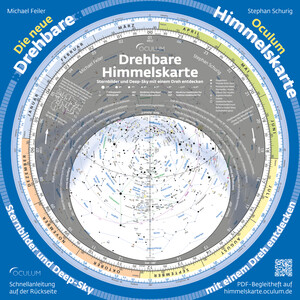 Orion Star Target PlanisphereOculum Swivelling Sky Map 29 cm for $7.95€ 19.90 – to find the radiants: where is Aquarius? Where is Capricornus? With weak showers in particular, it helps to know roughly which way to look.
Check availability* →
You explicitly do not need a telescope here. If you are looking for one anyway, the telescope guide will help.
*Affiliate link: if you buy through it, we receive a small commission. The price stays the same for you.
What comes next
From mid-July the Perseids start and end the lull: their peak around 12/13 August brings up to 100 meteors per hour under good conditions. All other dates of the year with a Moon rating are in the meteor shower calendar; how meteor showers form in the first place is explained on the page meteor shower.