By Alexander Merz · Updated on · Details checked on 6 October 2026
Barlow lenses are part of the basic equipment for any astronomical observation. They are among the more expensive accessories in astronomy, but they also offer a wide range of applications.
Experienced amateur astronomers usually own custom-built setups that they upgrade with all kinds of filters and eyepieces for various observing purposes.
Barlow Lenses as a Magnification Aid
Barlow lenses have been among the common and capable accessories for telescopes since the very beginnings of sky observation.
Barlow lenses extend the focal length of the objective. The magnification of a planet, for example, increases by a factor of 2 to 3, depending on the lens. This gives you a second magnification stage for each eyepiece.
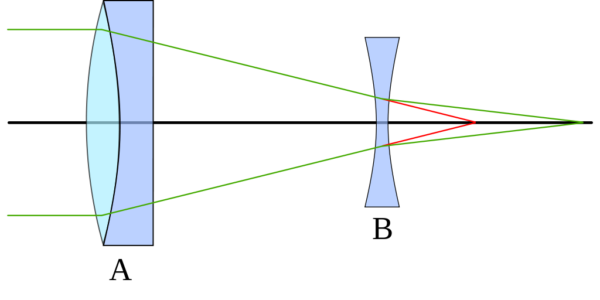
Surface details become clearly visible. Such sharp renderings are also well suited for capturing astrophotos in professional quality.
They are especially useful with telescopes that have short focal lengths (telescopes with a large aperture ratio). Under certain conditions, several “Barlows” can even be combined on a telescope. For newcomers to amateur astronomy, however, this is a risky and usually unsuitable undertaking.
Because instead of further improving the desired magnification, incorrect use can severely degrade the image quality. Barlow lenses often consist of several lens elements. More components in the light path always mean a loss of information through absorption, refraction and reflection. With lower-quality lenses, image defects increasingly appear.
Furthermore, the usefulness of a higher magnification must always be considered in relation to the optical performance of the telescope. Important relationships and rules of telescope optics can be found here.
For amateur astronomers, the purchase of a Barlow lens should therefore not be a question of price. Poor quality can quickly spoil the enjoyment of observing and turn the hobby into just another attic find.
If you decide to use a Barlow lens, you should choose a high-quality model. The resale value of flawless branded systems is high.
Barlow Lens Recommendation
🔭 Our Barlow Recommendations
Celestron Omni 2x Barlow, 1.25″ ($41.95, checked 12 Sep 2026$41.95€ 52) – the price-performance tip for beginners: doubles the magnification of any eyepiece, with fully multi-coated optics. Check availability* →Check availability* →
Celestron X-Cel LX 2x Barlow, 1.25″ ($124.95, checked 12 Sep 2026$124.95€ 125) – the higher-quality choice with a three-element apochromatic design, ideal for planetary observation. Check availability* →Check availability* →
Tip: If you are still missing the right eyepieces, take a look at our eyepiece guide – or get the Celestron AstroMaster Accessory KitOmegon Eyepiece Starter Kit ($89.95€ 89), which already includes a 2x Barlow. Check availability* →
Affiliate link: If you buy through it, we receive a small commission – the price does not change for you.
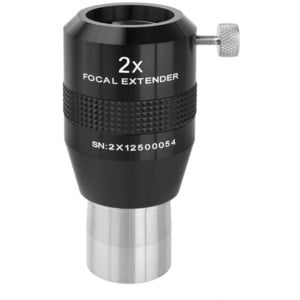
Explore Scientific 2x 1.25″ Focal Extender ($119.99, checked 12 Sep 2026) — High Point Scientific*
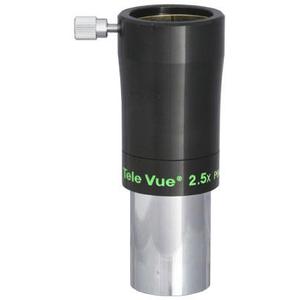
Tele Vue 2.5x 1.25″ Powermate ($260.00, checked 12 Sep 2026$260.00€ 349) — High Point Scientific*Astroshop*
A Barlow doubles the focal length – but it is only as good as the telescope under it.
Six short questions, an honest answer by e-mail. Including when your current setup is fine.
Finding the Right Combination by Sharing Experience
Of course, the basic equipment of the amateur astronomer includes a suitable telescope and usually a whole case full of accessories. Another article has already explained which items make sense and won’t immediately overwhelm beginners with sheer technology. To seriously compare Barlow lenses in practical use with telescope observations without an attachment, the best help is exchanging ideas with other astronomers. Many tricks and additional applications are not even advertised by manufacturers or dealers. On the one hand, they naturally want to sell as many telescopes and various accessories as possible. On the other hand, some unusual combinations of Barlow lenses are simply (still) unknown to them.
✅ What is a Barlow lens?
A Barlow lens extends the light path (focal length) of a telescope.
✅ What do I need a Barlow lens for?
By extending the focal length, higher magnifications can be achieved.
✅ What should I look for when buying a Barlow lens?
Since a Barlow lens introduces additional optically active surfaces into the light path, the highest quality should be ensured so that image quality is affected as little as possible.
Sources
- Andreas 06, Barlow lens, marked as public domain, details on Wikimedia Commons, retrieved 19 Jan 2020
