By Alexander Merz · Updated on · Details checked on 6 October 2026
Of all the planets in the solar system, our Earth is one of the “poorest,” with just a single natural satellite. The gas giants, by contrast, are surrounded by a sprawling entourage of worlds. Between its spectacular rings and its collection of 285 confirmed moons of Saturn, the ringed planet remains one of the most fascinating destinations in the sky.
More in our overview: Saturn Through a Telescope.
⚡ The quick answer: Saturn has 285 confirmed moons (as of March 2026, IAU Minor Planet Center) – more than any other planet in the solar system, and the count keeps climbing with every new survey. The largest, Titan, is bigger than the planet Mercury and hides a thick nitrogen atmosphere; tiny Enceladus shoots plumes of water ice into space and ranks among the most promising places in the solar system to search for life.
What are the moons of Saturn?
Saturn’s many moons circle the planet on a wide range of orbits, some traveling forward and others backward. Their appearances are just as varied. Among them are simple rock-and-ice worlds like Mimas and Enceladus, plus one moon with an atmosphere all its own: Titan. Other bodies, especially the smaller ones, are lumpy, potato-shaped objects that were most likely asteroids captured by Saturn’s gravity as they drifted past.
How many moons does Saturn have?
285 moons and their orbits are currently confirmed (IAU Minor Planet Center, March 2026), and new satellites are being found all the time thanks to ever-more-powerful telescopes and systematic surveys of the planet’s neighborhood. That haul makes Saturn one of the most richly attended planets in the entire solar system.
The best-known moons of Saturn
Titan, the most Earth-like moon
At a hefty 5,150 km across, Titan (or Saturn IV) is Saturn’s largest moon, trailing the solar system’s biggest satellite, Jupiter’s Ganymede, by only about 100 km. Titan stands out for its dense, nitrogen-rich atmosphere, beneath which liquids flow across the surface. Just above the ground, that gaseous shell is five times denser than Earth’s air, and the pressure is half again as high.
Titan was discovered by the Dutch astronomer Christiaan Huygens in 1655. Today, a good pair of binoculars is enough to spot the moon from Earth; a small telescope shows it more clearly, though its thick haze completely hides the surface from view.
Scientists and science-fiction writers alike are captivated by Titan, because no other world resembles Earth so closely. Traces of organic compounds and hydrocarbons make it especially intriguing and have reopened the debate over what “habitable zone” really means. Until recently, the emergence of life outside such zones seemed unlikely: at an average surface temperature of 94 kelvin, no prebiotic chemistry as we understand it is thought to take hold on Titan.
Enceladus and its water-ice geysers
The discovery of liquid water around Saturn caused a worldwide scientific stir. From the southern hemisphere of the moon Enceladus, towering fountains of water ice erupt from the surface, and their steady resupply builds a thin atmosphere. Astronomers believe this active cryovolcanism also feeds Saturn’s E ring.
William Herschel discovered the moon in 1789; some sixty years later his son John proposed the name “Enceladus,” after the giant of Greek mythology. Like our own Moon, Enceladus always shows the same face to its planet: it rotates once in about two and a half days, exactly one orbit around Saturn. Its ice reflects nearly all the sunlight that reaches it, making it very bright, but that same reflectivity keeps its surface bitterly cold, below minus 200 degrees Celsius.
Habitable clues on an icy moon
In 2008, the “Cassini” spacecraft swept closer to Enceladus than any probe had ever passed a celestial body, flying straight through the remnants of a south-polar geyser plume. Analyzing the particles produced a surprise: alongside water vapor, Cassini detected carbon dioxide, carbon monoxide, and twenty times more organic material than expected. That means Enceladus offers three ingredients regarded as essential building blocks of biological evolution: heat, water, and organic chemistry. Given enough time together, they could nudge a process much like the one that once sparked life on Earth.
The “vanished” moon: the myth of Themis
In 1899, the American astronomer William H. Pickering discovered Phoebe, Saturn’s ninth known satellite. Early in the 20th century, he believed he had spotted an undiscovered moon on his photographic plates and announced it in the spring of 1905 under the name Themis. By his calculations, this world would follow a highly eccentric but prograde orbit between Titan and Hyperion, completing a lap in just under 21 days. Pickering was even awarded the Lalande Prize in 1906 for “discovering Saturn’s 9th and 10th moons.” Yet no one ever saw Themis again, not even with modern instruments.
Mistake or real phenomenon? Later discoveries
The supposed tenth moon remained a topic in astronomical journals into the 1960s. It was Audouin Dollfus who, in late 1966, spotted a satellite that might have been that elusive companion, though its orbit differed sharply from Pickering’s figures. The tenth moon’s existence was scientifically confirmed in 1980 and it was named “Janus,” after the two-faced god.
Moons that travel in groups
Around Saturn, several moons appear to move as a team. Atlas, Prometheus, Pandora, Janus, and Epimetheus orbit very close to the planet and interact with one another: Atlas “shepherds” the A ring, while Prometheus and Pandora tend the F ring. Epimetheus and Janus tug on each other so strongly that they take turns slowing down and overtaking, swapping orbits every four years. A second group, on nearly circular orbits close to the equator, includes Mimas, Enceladus, Tethys, Dione, Rhea, Titan, Hyperion, and Iapetus.
Trojan moons and a suspected “captive”
In the solar system, only asteroids were previously known to hold Trojan orbits (the Lagrange points). Yet the small moons Tethys and Dione have them too: Tethys is escorted by Telesto and Calypso, Dione by Helene and Polydeuces. On an eccentric, retrograde orbit, astronomers stumbled on an irregular object in 1900, Phoebe, now grouped with the “Norse group.” These bodies most likely did not form alongside the planet; instead, Saturn’s gravity captured them as they journeyed past.
Table of Saturn’s major moons
| Moon | Diameter | Discovery | Notable feature |
|---|---|---|---|
| Titan | 5,150 km | Huygens, 1655 | Dense nitrogen atmosphere, surface liquids |
| Rhea | 1,527 km | Cassini, 1672 | Second-largest moon, icy world |
| Iapetus | 1,469 km | Cassini, 1671 | Two-toned hemispheres, inclined orbit |
| Dione | 1,123 km | Cassini, 1684 | Accompanied by Trojans Helene and Polydeuces |
| Tethys | 1,062 km | Cassini, 1684 | Accompanied by Trojans Telesto and Calypso |
| Enceladus | 504 km | W. Herschel, 1789 | Water-ice geysers, cryovolcanism |
| Mimas | 396 km | W. Herschel, 1789 | Enormous Herschel crater |
| Phoebe | 213 km | Pickering, 1899 | Retrograde orbit, Norse group |
Observing Saturn’s moons from your backyard
Be honest with yourself about what this target needs: Saturn’s moons are a telescope subject. Titan, at about 8.5 mag, can just be picked out of Saturn’s glare in steady 10×50 binoculars on a good night – but only Titan, and only as a featureless dot. Everything that makes the moon system interesting begins at the eyepiece of a telescope.
From roughly 100 mm of aperture Titan is obvious and Rhea and Iapetus join in; 130–150 mm at 100× and up reliably adds Tethys and Dione, so on a single evening you can watch four or five worlds shift their positions around the planet. That is the moment the system stops being a fact table and starts being something you actually observe.
Best for beginners: Skywatcher Dobson Telescope N 130/650 Heritage FlexTube
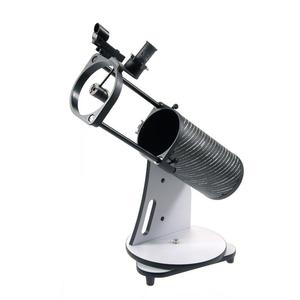
A compact tabletop Dobson with a true parabolic mirror. Folds down, fits in a bag: the Moon, planets and the bright deep-sky classics.
Price: € 265
If you can only buy one instrument and you genuinely want to explore the sky, buy the telescope; binoculars are the addition, not the substitute. They stay useful for sweeping the Milky Way and large open clusters – just not for resolving Saturn’s retinue.
For more moons: Skywatcher Dobson Telescope N 200/1200 Skyliner Classic
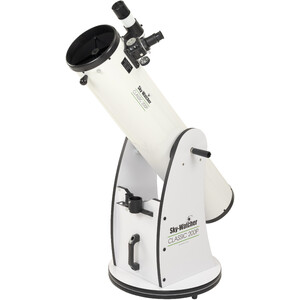
200 mm of aperture — the most sky for your money. Set it on the ground, point by hand: nebulae, clusters and galaxies for years to come.
Price: € 479
* Affiliate link: if you buy through this link we may earn a small commission from Astroshop or High Point Scientific, at no extra cost to you.
Saturn’s moons and its rings
Some theories tie the formation of the rings directly to the moons. On eccentric orbits, satellites face powerful tidal forces that can shatter them, and their fragments would then become part of the ring system. Conversely, shepherd moons help explain the nearly empty gaps in the rings: these moons sweep out and keep clear the zones between the bands.
Frequently asked questions about Saturn’s moons
What is the largest moon of Saturn?
Titan, at 5,150 km in diameter. It is the second-largest moon in the solar system after Ganymede and the only one with a dense atmosphere.
Can you see Saturn’s moons with binoculars?
Only just, and only Titan. At about 8.5 mag it sits close to a very bright planet, so you need steady 10×50s, a dark sky and some patience. For everything else – Rhea, Iapetus, Tethys, Dione – you need a telescope of at least 100–130 mm.
Is there life on Saturn’s moons?
No life has been detected, but Enceladus combines liquid water, heat, and organic molecules, making it one of the most closely studied worlds for potential habitability.
Why doesn’t the moon Themis exist?
Announced by Pickering in 1905 from photographic plates, Themis was never seen again, even with modern instruments; it was almost certainly a misinterpretation.
Exactly how many moons does Saturn have?
285 moons are currently confirmed (March 2026), and new discoveries keep adding to the list.
Read next:
- The best beginner telescopes for astronomy
- Saturn: the ringed planet up close
- A quick tour of the solar system
Also available in German (original), French, and Italian.