By Alexander Merz · Published on · Details checked on 29 October 2026
For most beginners, the best telescope under 500 (euros or dollars) is an 8-inch Dobsonian with 200 mm of aperture: the Apertura AD8 8" Dobsonian TelescopeSkywatcher Dobson Telescope N 200/1200 Skyliner Classic for $649.95€ 479, mount included.
More in our overview: Best Telescopes.
A note for US readers: 8-inch Dobsonians currently sell for a little more than $500 in the US. With a strict $500 cap, the 6-inch Dobsonian from the table is the pick – it collects about 44 % less light, but you can carry it in one piece.
⭐ In short
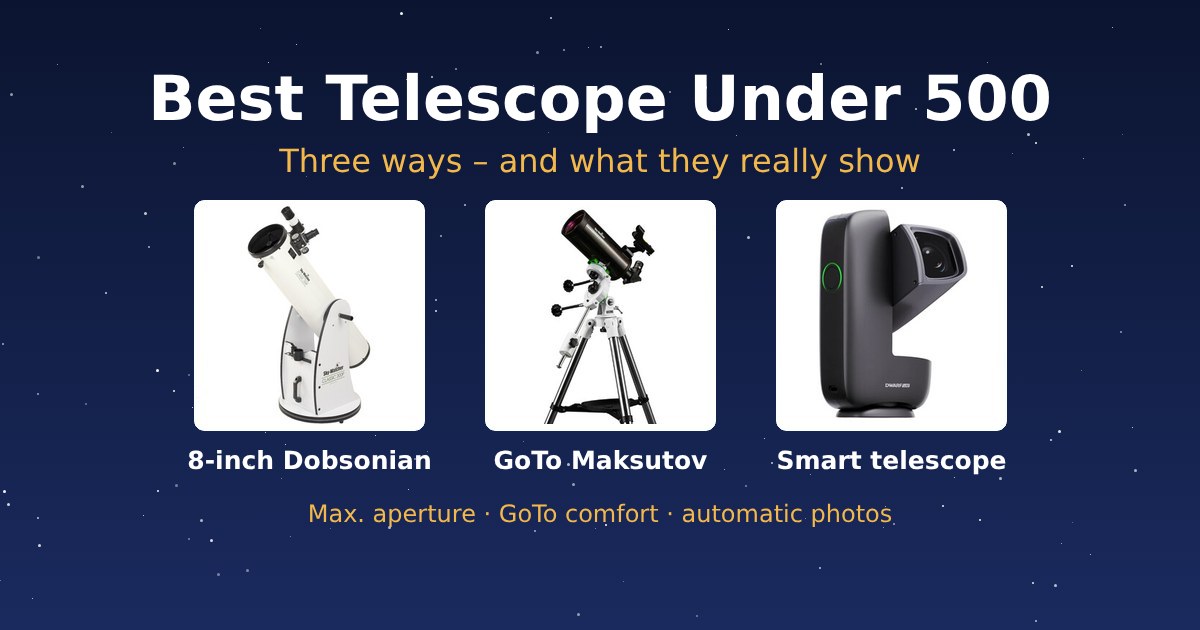
If you want to see as much as possible, get the 8-inch Dobsonian and set aside $60–120€60–120 for a second eyepiece. If you don’t want to hunt for targets, get a GoTo or app-guided telescope and accept half the aperture. If you want photos, get a smart telescope – and give up looking through an eyepiece.
The best picks at a glance
Around 500 is the level where you no longer have to cut corners for the first time: this is where toys end and instruments begin that you’ll use for years. What you won’t get for this money is an all-rounder.
So the question isn’t “which one is best?” but “what do you want to do under the night sky?” The table sorts available telescopes by exactly that question.
| Use | Model | Aperture | Why | Price |
|---|---|---|---|---|
| See everything | Apertura AD8 8" Dobsonian TelescopeSkywatcher Dobson Telescope N 200/1200 Skyliner Classic | 200 mm | ⭐ Our pickThe most aperture you can get for this money – and the mount is already included In stock · ready for shipping in 24 h | $649.95€ 479 |
| See everything, alternative | Apertura AD8 Dobsonian 8" Telescope with AccessoriesOmegon Advanced X N 203/1200 Dobsonian | 203 mm | Same class, different tube – take whichever is in stock Available to order | $649.95€ 499 |
| Little space | Apertura AD6 6" Dobsonian TelescopeSkywatcher Dobson Telescope N 150/1200 Skyliner Classic DOB | 150 mm | The 6-inch is the largest Dobsonian most people can still carry on their own | $499.95€ 359 |
| Take it along | Sky-Watcher Heritage 150 Tabletop DobsonianSkywatcher Dobson Telescope N 150/750 Heritage FlexTube DOB | 150 mm | Collapses to half its length and fits on a garden table | $309.00€ 345 |
| Photos only | DwarfLab DWARF mini Smart TelescopeDWARFLAB DWARF mini Smart Telescope | 35 mm | Fully automatic via app, but no eyepiece – you only see the screen | $419.00€ 429 |
| Use | Model | Aperture | Why | Price |
|---|---|---|---|---|
| Moon & planets | Skywatcher SkyMax-102 Starquest | 102 mm | Long focal length in a short tube, GoTo-capable – weak on nebulae | € 399 |
| Photos later | Omegon Advanced 150/750 EQ-320 | 150 mm | Newtonian on an equatorial mount: the only option here that can track | € 499 |
What 500 buys over 300
The step from 300 to 500 is the biggest jump in quality in the whole beginner range – and there’s one single reason for it: aperture. An 8-inch telescope collects a good four times as much light as a 100 mm instrument.
That’s not a matter of taste, it’s geometry: the area grows with the square of the diameter. 200 mm versus 100 mm means four times the area.
In practice: with 100 mm, the Ring Nebula in Lyra is a faint little smudge. With 200 mm, it’s a recognizable ring.
On the Moon and planets the difference is smaller, because atmospheric turbulence sets the limit there – but even there, more aperture resolves more detail as soon as the night is steady.
Why the 8-inch Dobsonian wins
A Dobsonian is a Newtonian reflector on a wooden box that you push by hand along two axes. The whole trick is that the mount costs almost nothing and is still stable.
That’s exactly where the all-in-one kits of the 300 class fail: the tripod wobbles, every refocus makes the image shake, and the fun is over after three evenings.
An equatorial mount that holds an 8-inch Newtonian truly steady costs more than this entire budget on its own. The Dobsonian sidesteps the problem instead of solving it.
Tip: Before you buy, check where the telescope will stand between two nights. An 8-inch is about 1.2 m (4 ft) long and weighs a good 25 kg (55 lb) in two parts – you can carry it, but not happily up the stairs twice.
That’s why the table above also lists the 6-inch. It collects about 44 % less light, but you can carry it in one piece.
A telescope that stays in the basement shows you nothing at all. If you’re unsure, take the smaller aperture that goes outside every clear night.
Our pick under 500: Skywatcher Dobson Telescope N 200/1200 Skyliner Classic
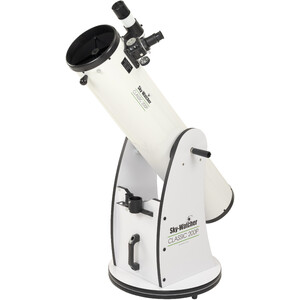
200 mm of aperture — the most sky for your money. Set it on the ground, point by hand: nebulae, clusters and galaxies for years to come.
Price: € 479
Find targets yourself or not?
That’s the second real decision in this price class – and in our own advice requests it’s the most common extra wish: 9 of the 24 free-text answers in the last 100 requests (28 September to 7 October 2026) mention GoTo unprompted.
Under 500 there are three ways to get it, and all three cost aperture:
- Push-to via app: You push by hand, your phone tells you where. Inexpensive, no power needed, but you stay involved.
- GoTo with a motor: The telescope slews on its own. It has to be aligned first, though – that’s something to learn, not a freebie.
- Smart telescope: Finds and photographs on its own, but has no eyepiece.
The most common misconception is that GoTo means “no effort”. A motorized mount needs to be set up and aligned properly, otherwise it finds just as little as you do.
If you really just want to look, the app version is the better choice – it forgives setup errors and is ready in two minutes.
Moon & planets: the Maksutov
If your sky is bright – suburbs, balcony, streetlights – nebulae and galaxies are hard to get anyway. Then lots of aperture is the wrong investment.
A Maksutov with 102 mm and 1,300 mm focal length packs a long focal length into a short tube. For lunar craters, Saturn’s rings and Jupiter’s moons, that’s plenty.
The price for this is a quarter of the light of the 8-inch. Deep-sky is over before it starts.
For the Moon and planets: Skywatcher Maksutov Telescope MC 102/1300 Starquest DX EQ
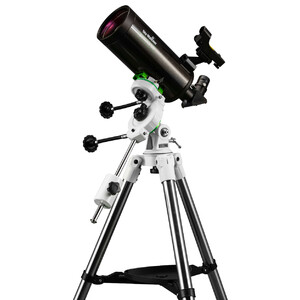
A Maksutov with 1,300 mm of focal length in a very short tube: crisp views of the Moon and planets, almost no colour fringing.
Price: € 399
Astrophotography on this budget
Classic astrophotography – telescope, tracking mount, camera – doesn’t start at 500. A usable tracking mount alone costs more than that.
There are two honest options, and both are compromises. The first is a phone held to the eyepiece: you’ll get the Moon and bright planets surprisingly well this way, but nothing more.
The second is a smart telescope. It stacks images on its own and shows you a nebula on your phone after a few minutes – but you never look through an eyepiece.
Common mistake: A Newtonian on a “photo-ready” equatorial mount in this price class does not track. Upgrading costs more than the telescope. If you definitely want to take photos, buy for that from the start – or get a smart telescope.
More on this in our comparison of the best smart telescopes.
Budget left for accessories
This is where most buying guides stop – and the reason experienced observers in forums warn about it almost reflexively: the included accessories are where almost every manufacturer saves money.
The 8-inch Dobsonian usually comes with two simple eyepieces. They work, but the first good eyepiece is the most noticeable gain after the telescope itself.
Plan for an extra $60–120€60–120 – not right away, but in the first few months. A mid-range zoom eyepiece replaces three single eyepieces and is the most convenient start. Which eyepieces fit your telescope is shown by our eyepiece finder: pick your telescope, get three matching eyepieces.
| What for | What | Roughly |
|---|---|---|
| Finding objects at all | Red-dot finder, if none is included | $25–40€25–40 |
| More magnification | Second eyepiece or a zoom eyepiece | $60–370€60–370 |
| Keeping your eyes dark-adapted | Red flashlight | $10–20€10–20 |
| Knowing where to look | Planisphere or app | $0–20€0–20 |
Our free tools take care of the last point: the live star chart shows you what’s above you tonight.
Five costly mistakes
- Buying by magnification. “525x” on the box is arithmetic, not performance. The sensible maximum is about twice the aperture in millimetres.
- Overlooking the mount. A good tube on a wobbly tripod is unusable. On a Dobsonian this problem is solved by design.
- Putting the whole budget into the telescope. Without a finder and a second eyepiece, part of its performance goes unused.
- Underestimating the size. 1.2 m and 25 kg is not something for a shelf. If you have to carry it up four floors, buy smaller and observe more often.
- Expecting photos that don’t exist. What you see in the eyepiece is grey-green and delicate – not the colorful Hubble image. That expectation is the most common reason telescopes are sold again after a year.
Just above 500: worth waiting?
Right above the line it gets interesting: a 10-inch Dobsonian collects another 56 % more light than the 8-inch, but costs noticeably more and weighs about 10 kg (22 lb) extra.
Also just above it are the app-controlled telescopes such as the Celestron StarSense Explorer DX 102AZ Refractor TelescopeCelestron StarSense Explorer DX 102 AZ for $429.00€ 529 and the Sky-Watcher Virtuoso GTi 150 Tabletop GoTo DobsonianSkywatcher Heritage 150/750 FlexTube Virtuoso GTi Dobsonian for $469.00€ 535.
Our rule of thumb: wait if you can be sure of having another 100 in two months – otherwise buy now. All the details are in our comparison of telescopes under 1,000.
Below, the line is sharper: under 300, the class of instrument changes fundamentally, so we compared telescopes under 300 separately.
FAQ about telescopes under 500
Best telescope under 500?
For most beginners, the 8-inch Dobsonian with 200 mm of aperture, currently $649.95€ 479. It brings the largest aperture of this price class, and the mount is included in the price. If you can’t carry or store it, take the 6-inch.
What does an 8-inch show?
Lunar craters down to a few kilometres across, the Cassini Division in Saturn’s rings, cloud belts on Jupiter along with its four large moons. Under a dark sky, globular clusters that resolve into individual stars join in, as well as the bright nebulae and the larger galaxies as faint patches.
Dobsonian or GoTo under 500?
Under 500, GoTo costs roughly half the aperture – you get convenience instead of light. If you enjoy finding things yourself and want to learn the sky, take the Dobsonian. If you have little time or want to show something quickly, take app navigation.
Can you take photos with it?
The Moon and bright planets, yes, with a phone held to the eyepiece. Nebulae and galaxies only with a smart telescope that stacks on its own. A classic imaging setup of telescope, tracking mount and camera is well above this budget.
Is a used telescope worth it?
Optics barely age, and used you often get one class higher for 500. The catch: you need to be able to judge the condition – mirror coating, collimation, completeness. For a first purchase without someone to help, new is the safer choice.
How many accessories do I need?
On the first evening, nothing that isn’t included. Useful in the first few months: a second eyepiece or a zoom eyepiece, a red-dot finder if needed, and a red flashlight. Budget $60–120€60–120 – more is possible, but not necessary.
Not sure what suits your sky and your space? Our free telescope advice asks you four questions and sends you a personal recommendation.